
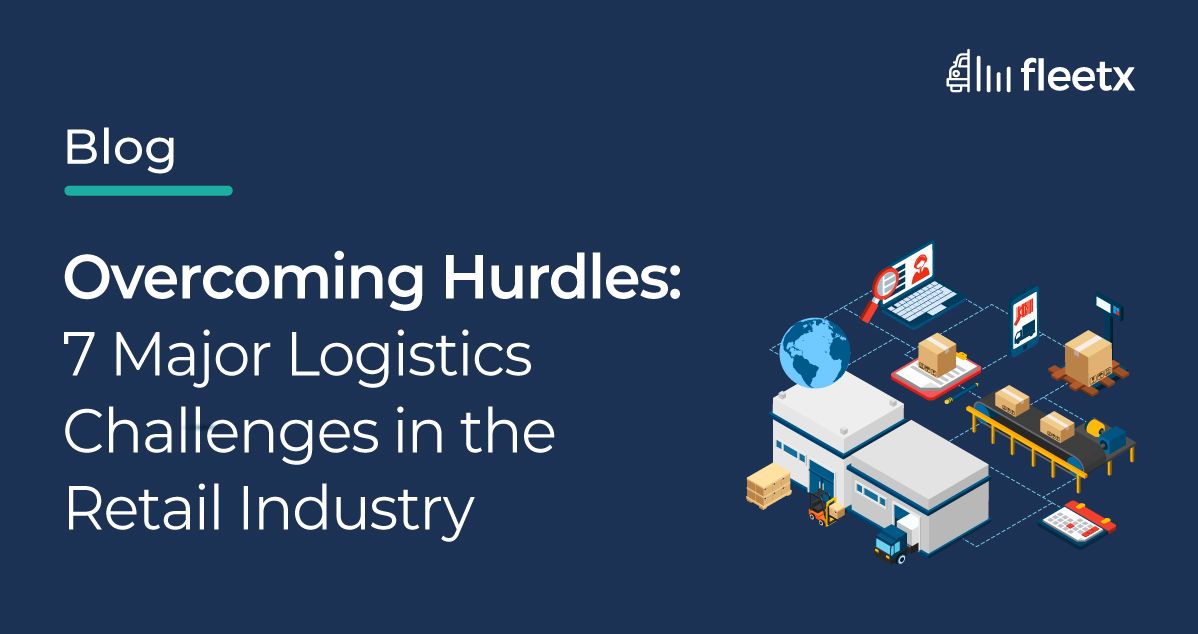
In the fast-moving landscape of the retail industry, the efficient movement of goods is essential for smooth operations. However, with the ever-growing demand for fast, accurate, and cost-effective deliveries, the logistics sector in India faces significant challenges. To address said challenges, retailers are turning in greater numbers than ever before to smart technology solutions. This has helped businesses streamline their fleet management processes, improve efficiency, and meet consumer expectations.
Understanding these challenges is the first step for businesses to strategize and overcome obstacles effectively. Join us as we identify the 7 major logistics challenges facing the retail industry and how smart solutions are changing the game.
The Challenge
The retail industry's logistics space is filled with obstacles that can prevent smooth operations. Here are seven significant hurdles that logistics in the retail sector often confront:
1. Inventory Management and Stockouts:
Maintaining optimal inventory levels while avoiding stockouts is a balancing act for retailers. Overstocking leads to increased costs, while stockouts result in dissatisfied customers. Efficient inventory management, real-time tracking, and predictive analytics are crucial to strike the right balance.
The Smart Solution: Just-In-Time inventory management focuses on stocking inventory only as needed, minimizing excess inventory and reducing the risk of stockouts. This method relies on accurate demand forecasting and streamlined supply chain processes to deliver goods precisely when they are needed, thereby eliminating the need for excessive stockpiling. Integrating real-time data and historical patterns, businesses can optimize inventory levels, reducing excess stock while ensuring availability.
2. Demand Forecasting and Seasonal Peaks:
Predicting consumer demand accurately, especially during seasonal peaks or sudden market fluctuations, is a persistent challenge. Retailers must employ advanced analytics and historical data to forecast demand, prevent over/understocking, and ensure timely delivery.
The Smart Solution: AI-driven predictive analytics and machine learning models can effectively forecast demand patterns, enabling retailers to proactively adjust inventory levels to match fluctuations, reducing the risk of stockouts or overstocking.
3. Rising Fuel Costs and Environmental Concerns:
Fluctuating fuel prices impact transportation costs, affecting the overall logistics expenses. Coupled with environmental concerns, there is a growing need for eco-friendly transportation solutions and the optimization of routes to reduce emissions.
The Smart Solution: Employing telematics and eco-friendly vehicles combined with route optimization software minimizes fuel consumption. By utilizing alternate energy sources and efficient routes, businesses can reduce their carbon footprint and operational costs.
4. Supply Chain Visibility and Transparency:
Lack of transparency and visibility across the supply chain can lead to inefficiencies, delays, and mismanagement. Implementing robust technology solutions that offer real-time tracking, end-to-end visibility, and data-driven insights is crucial for seamless operations.
The Smart Solution: RFID technology uses electromagnetic fields to automatically identify and track tags attached to objects. Integrating RFID tags into inventory items allows for real-time tracking and monitoring of the entire supply chain process. These tags can be scanned remotely, enabling businesses and other stakeholders to trace the movement of goods throughout the supply chain.
5. Efficient Warehousing and Distribution:
Optimizing warehouse operations and distribution processes is a challenge, especially with the need for speed, accuracy, and reduced errors. Utilizing technology like automation, robotics, and AI can enhance efficiency and productivity.
The Smart Solution: Smart warehousing solutions like Warehouse Management Systems are designed to optimize and manage warehouse operations. It helps streamline the movement and storage of goods within the warehouse, improving overall efficiency and accuracy. WMS coordinates various tasks, such as inventory management, order picking, packing, and shipping, utilizing advanced technologies and automation.
6. Compliance and Regulatory Challenges:
Navigating through a web of complex regulations, varying compliance standards, and trade barriers often hampers logistics operations of different scales. Staying updated with changing regulations and ensuring compliance is critical for uninterrupted operations.
The Smart Solution: Compliance management systems provide real-time updates on changing regulations and help retailers ensure adherence to diverse standards. These systems can automate documentation, customs procedures, and trade compliance checks, minimizing the risk of compliance-related delays and penalties.
7. Last-Mile Delivery:
The last-mile delivery, known as the final leg of the delivery process, poses considerable challenges. It involves reaching the end consumer's doorstep efficiently and swiftly. This stage demands optimized routes, on-time deliveries, and often faces issues with traffic congestion, unstructured addresses, and specific delivery time preferences.
The Smart Solution: Implementing route optimization software integrated with GPS tracking and AI-powered algorithms can streamline last-mile deliveries. Smart technologies enable efficient route planning, real-time tracking, and dynamic rerouting based on traffic conditions.
To Wrap Up
In the fiercely competitive retail industry, the challenges in logistics can be formidable. However, with the integration of smart technology solutions for fleet management, these hurdles can be effectively tackled. By understanding the pain points and implementing the right tools, businesses can not only overcome these challenges but also transform them into opportunities for growth and success in the ever-evolving retail landscape.
Frequently Asked Questions
What are retail logistics challenges, and why are they important for businesses? ▼
Retail logistics challenges refer to the operational issues businesses face while moving products from suppliers to warehouses, stores, and customers. These challenges include inventory shortages, inaccurate demand forecasting, transportation delays, rising fuel costs, warehouse inefficiencies, supply chain visibility gaps, regulatory compliance, and last-mile delivery issues. As customer expectations continue to grow, retailers must deliver products faster while maintaining profitability, making logistics one of the most critical business functions.
In India, retail businesses operating across Delhi, Delhi NCR, Gurgaon, Mumbai, Bengaluru, and Pune often experience additional complexities because of traffic congestion, seasonal demand fluctuations, infrastructure differences, and varying customer delivery expectations. E-commerce growth has further increased pressure on retailers to provide same-day or next-day deliveries while keeping logistics costs under control.
Modern businesses are increasingly adopting Transportation Management Systems (TMS), Warehouse Management Systems (WMS), AI-driven forecasting, GPS fleet tracking, route optimization, and predictive analytics to overcome these problems. These technologies help improve delivery accuracy, reduce operational costs, minimize stockouts, and increase customer satisfaction.
Understanding retail logistics challenges is essential because efficient logistics directly impacts customer experience, inventory costs, profitability, and long-term business growth. Companies that proactively address these challenges are better equipped to compete in today's fast-paced retail environment while building resilient supply chains capable of handling future disruptions.
What are the biggest logistics challenges faced by the retail industry in India? ▼
The biggest logistics challenges faced by retailers in India extend beyond transportation and include every stage of the supply chain. Businesses commonly struggle with inventory management, inaccurate demand forecasting, rising fuel expenses, poor supply chain visibility, inefficient warehouse operations, regulatory compliance, and last-mile delivery delays. These issues can significantly increase operational costs while reducing customer satisfaction.
Retailers serving metropolitan markets such as Delhi, Gurgaon, Mumbai, Bengaluru, and Pune often deal with urban congestion, delivery restrictions, varying customer preferences, and fluctuating seasonal demand. During festive periods like Diwali or year-end sales, businesses experience sudden spikes in orders that require flexible inventory planning and scalable logistics operations.
Technology has become the preferred solution for overcoming these challenges. GPS-enabled fleet tracking, AI-powered demand forecasting, warehouse automation, RFID inventory management, route optimization software, and integrated Transportation Management Systems help retailers improve visibility across their logistics network while reducing delays and unnecessary expenses.
Businesses that continuously monitor logistics performance using real-time dashboards and analytics can identify bottlenecks early, optimize vehicle utilization, improve delivery planning, and maintain higher service levels. A proactive logistics strategy not only improves operational efficiency but also strengthens customer loyalty and creates a competitive advantage in India's rapidly evolving retail sector.
Which is the best logistics software for the retail industry in India? ▼
The best logistics software for retail businesses depends on company size, delivery network, warehouse complexity, and operational goals. Retailers generally look for solutions that provide transportation management, fleet tracking, warehouse visibility, inventory management, route optimization, proof of delivery, analytics, and ERP integration within a single platform.
Large retailers operating across India, including Delhi NCR, Gurgaon, Mumbai, Bengaluru, and Pune, typically benefit from enterprise-grade Transportation Management Systems that combine AI-powered route optimization, GPS tracking, demand forecasting, automated dispatch planning, and real-time shipment visibility. These capabilities help reduce delivery delays, improve customer communication, and optimize fleet utilization.
When comparing the top logistics software solutions, businesses should evaluate scalability, ease of implementation, API integrations, mobile accessibility, customer support, reporting capabilities, and total cost of ownership rather than focusing solely on software price. The right platform should also support compliance requirements, multi-location warehouse operations, and growing e-commerce fulfillment needs.
Instead of choosing software based purely on popularity, retailers should identify their operational bottlenecks first. A solution that improves inventory accuracy, delivery planning, warehouse productivity, and supply chain visibility will generate better long-term returns than software offering only isolated logistics functions.
How much does logistics software cost for retail businesses in India? ▼
The cost of logistics software in India varies depending on business size, fleet volume, warehouse complexity, and the number of users. Small retailers generally spend between ₹20,000 and ₹1 lakh annually for cloud-based logistics solutions with basic transportation management, inventory visibility, GPS tracking, and reporting capabilities. Medium-sized businesses usually invest between ₹2 lakh and ₹10 lakh annually for platforms offering warehouse management, route optimization, automated dispatch, analytics, and ERP integration. Large enterprise retailers operating across multiple cities like Delhi, Gurgaon, Mumbai, Bengaluru, and Pune may require customized implementations that range from ₹15 lakh to several crores depending on deployment scale.
Implementation costs should also be considered alongside subscription fees. These may include data migration, API integrations, employee training, workflow customization, onboarding support, and system configuration. Businesses often overlook these expenses during vendor evaluation, making total cost of ownership a better metric than software licensing alone.
Cloud-based Software-as-a-Service (SaaS) platforms have become increasingly popular because they reduce upfront infrastructure investments while providing automatic updates and faster deployment. Many providers also offer modular pricing, allowing retailers to add advanced features such as AI-powered forecasting, predictive analytics, fleet telematics, or warehouse automation as their operations expand.
Rather than selecting the lowest-priced solution, retailers should evaluate return on investment. Software that reduces delivery delays, minimizes stockouts, improves fleet utilization, lowers fuel expenses, and enhances customer satisfaction often generates savings that significantly outweigh implementation costs over time.
How do retailers in Delhi NCR and Gurgaon improve logistics efficiency using technology? ▼
Retail businesses across Delhi NCR and Gurgaon operate in one of India's busiest commercial regions, where increasing order volumes, heavy traffic congestion, urban delivery restrictions, and customer expectations make logistics particularly challenging. Traditional manual planning methods often struggle to manage deliveries efficiently in such dynamic environments.
To overcome these challenges, many retailers are implementing Transportation Management Systems (TMS), Warehouse Management Systems (WMS), GPS fleet tracking, AI-powered demand forecasting, and route optimization software. These technologies provide real-time shipment visibility, automated vehicle dispatching, intelligent route planning, and accurate inventory tracking across multiple warehouses and retail locations.
For businesses delivering across Delhi, Noida, Faridabad, Ghaziabad, and Gurgaon, dynamic route optimization helps drivers avoid congestion while reducing fuel consumption and improving on-time deliveries. Integrated warehouse systems also minimize picking errors, speed up order fulfillment, and maintain better inventory accuracy during high-demand periods such as festive sales and promotional campaigns.
Retailers additionally benefit from automated customer notifications, proof-of-delivery solutions, compliance monitoring, and performance dashboards that allow managers to monitor fleet productivity and warehouse operations from a centralized platform. These capabilities improve operational transparency while enabling quicker decision-making.
As retail competition continues to increase throughout Delhi NCR and Gurgaon, businesses investing in digital logistics technologies are better positioned to deliver superior customer experiences, optimize operating costs, and scale their operations efficiently without sacrificing service quality.
What logistics strategies work best for retailers operating in Mumbai, Bengaluru, and Pune? ▼
Retail businesses operating in Mumbai, Bengaluru, and Pune encounter unique logistics challenges due to high customer density, rapid urban expansion, unpredictable traffic conditions, and increasing expectations for faster deliveries. Businesses serving these markets require logistics strategies that prioritize flexibility, visibility, and operational efficiency rather than relying solely on larger fleets.
Many successful retailers adopt hub-and-spoke distribution models supported by strategically located fulfillment centers. Combining these facilities with AI-powered route optimization, warehouse automation, GPS fleet monitoring, and predictive demand forecasting enables businesses to shorten delivery times while improving vehicle utilization and reducing transportation costs.
Retailers in Mumbai frequently optimize delivery schedules to avoid peak traffic hours, while businesses in Bengaluru often leverage intelligent routing to manage technology park deliveries and suburban expansion. Pune-based retailers commonly focus on balancing industrial and consumer deliveries by integrating warehouse operations with transportation planning.
Cloud-based logistics platforms further improve coordination by providing real-time shipment tracking, automated dispatch planning, inventory synchronization, proof of delivery, and detailed analytics. Managers gain complete visibility across warehouses, vehicles, and customer orders, allowing them to respond quickly to disruptions and maintain service consistency.
Combining technology with efficient operational planning enables retailers across these major Indian cities to reduce delivery delays, control logistics costs, improve customer satisfaction, and build supply chains capable of supporting long-term business growth in highly competitive retail markets.
How can retailers reduce last-mile delivery challenges and improve customer satisfaction? ▼
Last-mile delivery is one of the most expensive and operationally challenging stages of the retail supply chain. It represents the final movement of goods from a distribution center or local warehouse to the customer's doorstep. Although it accounts for only a small portion of the total transportation distance, it often contributes the highest logistics cost because of fuel consumption, traffic congestion, failed delivery attempts, route inefficiencies, and customer scheduling preferences.
Retailers across India, particularly in densely populated cities such as Delhi, Gurgaon, Mumbai, Bengaluru, and Pune, face additional complexities including narrow roads, gated communities, delivery time restrictions, and changing customer expectations for same-day or next-day deliveries. Businesses that rely on manual dispatch planning often experience delayed deliveries, increased operating expenses, and dissatisfied customers.
Modern logistics technology significantly improves last-mile performance. AI-powered route optimization calculates the fastest delivery paths based on live traffic conditions, delivery priorities, and vehicle capacity. GPS-enabled fleet tracking provides real-time shipment visibility, while electronic proof of delivery, automated customer notifications, and driver mobile applications improve communication throughout the delivery process.
Retailers can further improve customer satisfaction by offering delivery time slots, proactive delay notifications, flexible rescheduling options, and centralized customer support. Combining these practices with transportation management software enables businesses to reduce delivery costs, improve first-attempt delivery success rates, increase driver productivity, and consistently deliver better customer experiences in highly competitive retail markets.
How does supply chain visibility help retailers overcome logistics challenges? ▼
Supply chain visibility refers to the ability to monitor inventory, shipments, warehouse operations, transportation activities, and delivery performance through a single integrated platform. Instead of relying on disconnected spreadsheets or manual updates, retailers gain real-time access to operational data across every stage of the supply chain.
For retailers operating multiple warehouses and stores across Delhi NCR, Mumbai, Bengaluru, Pune, Gurgaon, and other Indian cities, visibility becomes essential for maintaining inventory accuracy and ensuring timely deliveries. Without centralized monitoring, businesses often encounter stock discrepancies, shipment delays, poor communication between departments, and limited control over transportation operations.
Advanced logistics platforms combine GPS tracking, RFID technology, IoT sensors, warehouse management systems, transportation management systems, and cloud analytics to provide end-to-end operational transparency. Managers can instantly identify delayed shipments, monitor vehicle locations, optimize warehouse workflows, detect inventory shortages, and respond to disruptions before they affect customers.
Better visibility also strengthens supplier collaboration and customer communication by providing accurate delivery updates and performance insights. Businesses can make faster decisions using real-time dashboards instead of waiting for manual reports, resulting in improved operational efficiency and reduced logistics costs.
Ultimately, supply chain visibility enables retailers to build resilient logistics operations capable of adapting to changing market demand, seasonal fluctuations, and unexpected disruptions while consistently delivering superior customer service.
What should retailers consider before implementing logistics management software? ▼
Before implementing logistics management software, retailers should first identify the operational challenges they want to solve rather than selecting technology based solely on features or pricing. Common objectives include reducing delivery delays, improving inventory accuracy, optimizing transportation costs, enhancing warehouse productivity, increasing shipment visibility, or improving customer satisfaction.
Businesses should evaluate whether the platform integrates with existing ERP systems, warehouse management software, accounting applications, e-commerce platforms, CRM solutions, and supplier networks. Seamless integration minimizes manual work while ensuring accurate information flows across every department.
Scalability is another important consideration, particularly for retailers planning expansion across cities such as Delhi, Gurgaon, Mumbai, Bengaluru, Pune, and other fast-growing markets. The software should support increasing order volumes, multiple warehouses, larger fleets, and additional users without requiring complete system replacement in the future.
Implementation planning should also include employee training, vendor support, data migration, cybersecurity, reporting capabilities, mobile accessibility, and compliance with relevant regulatory requirements. Businesses should request demonstrations, pilot deployments, and clearly defined implementation timelines before making a final decision.
The best logistics management software is one that aligns with long-term business goals while delivering measurable improvements in operational efficiency, inventory control, transportation planning, customer experience, and overall supply chain performance. Choosing the right solution based on business requirements rather than marketing claims typically results in stronger return on investment and sustainable growth.