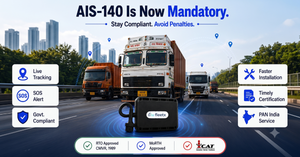


India's AIS 140 mandate did not change shape in 2026. It changed force. The rules written between 2016 and 2022 are now backed by a Supreme Court direction, enforced through the Vahan ecosystem, and hardened by binding state transport authority orders, while the ministry has published the draft of the next compliance layer. Let's take a look at the latest updates on the AIS 140 upgrade in India.
What is the latest update on AIS 140 in India?
The headline development of 2026 is judicial, not legislative. In May 2026, the Supreme Court, hearing the long-running road safety case, noted that fewer than one percent of public service vehicles on Indian roads comply with the VLTD and emergency button mandate under Rule 125H. It directed states to ensure vehicles are fitted with both, and gave states the liberty to withhold fitness certificates unless the devices are installed and reflected on the Vahan portal and the Centre's tracking application. In one order, the court converted a rule that had drifted for a decade into a condition attached to the one document no commercial vehicle can operate without.
Alongside this, states have operationalised their own vehicle location tracking programmes with notified timelines, empanelled vendors and penalty mechanisms, and MoRTH's draft GSR 184(E) proposes advanced driver assistance systems for commercial vehicles as the next mandatory layer.
|
Did
you know? Under
the 2018 framework, every VLT device manufacturer must upload each device's
details onto the Vahan database through secured, authenticated access, and
register the device against the vehicle on the backend system in real time.
That is why an RTO can see a vehicle's tracking compliance on screen before
clearing a transaction. |
Which notifications mandate AIS 140?
The mandate operates under the Motor Vehicles Act, 1988 and the Central Motor Vehicle Rules, 1989, specifically rules 125H, 129 and 90. Four central instruments define who must comply:
|
Instrument |
Date |
Coverage |
|
GSR 1095(E) |
28 Nov 2016 |
Inserted Rule 125H: public service vehicles must be fitted
with a VLT device and one or more emergency buttons as per AIS 140 |
|
MV (VLT Device and Emergency Button) Order, 2018, notified
25 Oct 2018 |
Effective 1 Jan 2019 |
All public transport vehicles registered on or after 1
January 2019, excluding auto rickshaws and e-rickshaws. Compliance dates for
vehicles registered up to 31 December 2018 are notified by states and UTs |
|
GSR 1081(E) |
2 Nov 2018 |
National permit vehicles to be equipped with AIS 140 VLTD |
|
GSR 617(E) |
3 Aug 2022 |
N2 and N3 vehicles carrying dangerous or hazardous goods:
new models from 1 September 2022, existing models from 1 January 2023 |
The 2022 extension has an instructive origin. Per the Press Information Bureau release of 23 August 2022, MoRTH acted after finding that vehicles outside the national permit system carrying gases such as argon, nitrogen and oxygen were operating without tracking devices. GSR 617(E) closed the gap by vehicle category rather than permit type, which means applicability can no longer be judged from the permit alone.
The framework also clarifies the standard's scope: AIS 140 covers both the vehicle location tracking device and the backend tracking system, and it applies as amended from time to time until corresponding BIS standards are notified under the Bureau of Indian Standards Act.
How are compliance deadlines decided?
Under the 2018 Order, vehicles registered up to 31 December 2018 were exempted at the central level, with each state and union territory empowered to notify its own compliance date for bringing those vehicles in. This is why AIS 140 timelines differ across the country: the operative deadline for any fleet is the one published by its state transport authority, and multi-state operators need to track each state's order separately.
|
Worth
noting: The
2018 Order deliberately built AIS 140 as a Centre-plus-state framework. The
Centre defines the standard and the vehicle classes. Your state defines when
older vehicles must comply and how the rule is enforced on the ground. |
How is AIS 140 enforced in 2026?
Enforcement is digital and transaction-linked, and the Supreme Court's May 2026 direction has attached it firmly to the fitness certificate. States now have explicit judicial backing to refuse a fitness certificate, and by extension, continued operation, to any public service vehicle whose VLTD and panic button are not installed and visible on Vahan. Device manufacturers upload every unit's details to the Vahan database, so compliance status is checkable at the RTO counter. The Parivahan Sewa portal lists the VLTS ecosystem for national vehicle tracking among its official services, with manufacturer and device registration handled through the VLTD Maker portal on Vahan and monitoring through each state's own VLTS portal.
End-to-End AIS-140 Compliance.
Everything handled. Nothing outsourced to you.
From certified hardware and installation to VAHAN integration and compliance certificates, Fleetx manages the complete deployment so your team doesn't have to.
Two honest caveats belong in any accurate account. First, the court's own finding is that actual fitment remains under one percent for public service vehicles, so the gap between rule and road is still wide. That gap is precisely what transaction-linked enforcement is designed to close, because a vehicle can skip an advisory but cannot skip a fitness renewal. Second, day-to-day strictness still varies by state, which is why the state orders below matter as much as the central rules.
The panic button is an equal half of the mandate. The regulation exists primarily as a passenger safety measure, especially for women and children, so the emergency alert path from the button to the state monitoring centre is part of what compliance means, not an accessory to the location feed.
|
Indian
perspective: AIS
140 may be the only vehicle regulation in the world funded through a women's
safety programme. Under the Nirbhaya framework, the Centre funds 60 percent
of state monitoring centre costs for general states, 90 percent for states
with difficult terrain, and 100 percent for union territories. |
What are states doing right now?
Odisha runs a stringent digital model. The State Transport Authority mandates VLT devices with panic buttons for commercial vehicles, and its dedicated compliance portal at vltd.odishatransport.gov.in covers public service vehicles, national permit vehicles and hazardous goods carriers in line with the MoRTH notifications, with fitment verified against Vahan transactions.
Karnataka used a fixed installation window. The Transport Department gave public service and national permit goods vehicles one year, from 1 December 2023 to 30 November 2024, to install devices from empanelled companies at a notified price of Rs 7,599 excluding GST, with permits renewed at the designated RTO after installation. Publishing the price removed the cost ambiguity operators face elsewhere.
Chandigarh enforces at fitness. The State Transport Authority issues challans to maxi cabs, motor cabs and buses operating without the devices, verifies fitment during fitness inspection, and exempts two-wheelers, e-rickshaws and three-wheelers, under a UT notification citing rules 125H, 90(5) and 129(1) of the CMVR.
Three models: portal-verified compliance, a fixed window with notified pricing, and challan-backed inspection. Most other states operate somewhere on this spectrum, which is why compliance planning has to be done state by state.
What comes after AIS 140?
MoRTH issued draft notification GSR 184(E) on 20 March 2025, proposing amendments to the Central Motor Vehicle Rules that would mandate advanced driver assistance systems for M2, M3, N2 and N3 category vehicles, that is, buses and trucks. The proposed suite includes advanced emergency braking (AIS-162), driver drowsiness and attention warning (AIS-184), blind spot information (AIS-186), moving off information (AIS-187) and lane departure warning (AIS-188), alongside stability systems. The proposed applicability is 1 April 2026 for new models and 1 October 2026 for existing models. The draft was open for public comment for 30 days from gazette publication; final notification status should be confirmed on morth.nic.in before making procurement decisions on its basis.
|
What
this means for you: AIS
140 built the data link between every commercial vehicle and the government.
GSR 184(E) proposes to put intelligence at the vehicle's end of that link.
The compliance conversation is moving from where the vehicle is to how it is
being driven. |
How do you verify compliance from official sources?
• Certification: confirm the device holds valid type approval from ARAI or another MoRTH-approved test agency. AIS 140 was developed by the Automotive Research Association of India under MoRTH's mandate, and ARAI publishes the live list of approved VLT models on araiindia.com.
• Portal registration: confirm the device identity and chassis number appear on your state VLTS portal (each state runs its own instance on parivahan.gov.in) and that the manufacturer has registered the device through the VLTD Maker portal on Vahan. An unregistered device fails at fitness even if certified.
• State order: read your state transport authority's VLTD order for the applicable timeline, exempted categories and empanelled vendors. This is the document that enforcement officers act on, and after the May 2026 Supreme Court direction, it is the document on which fitness renewal depends on.
• Panic button test: confirm the emergency alert reaches the state monitoring centre. A location feed without a working alert path does not meet the purpose the rule was written for.