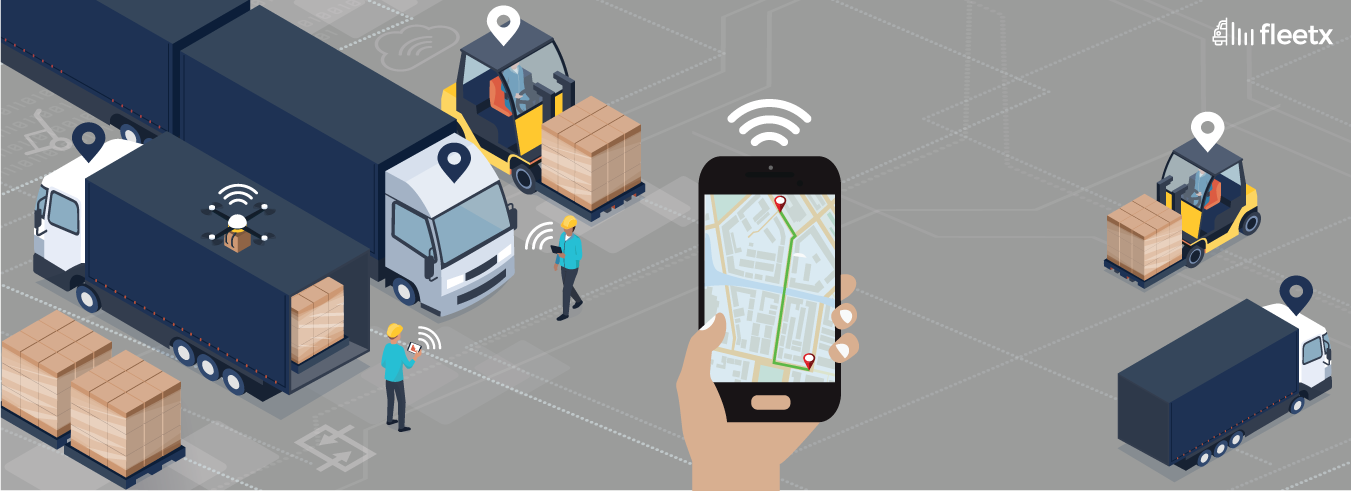
Asset Tracking is a complete solution for maintaining, monitoring and managing your vehicles. A complete Asset tracking software consists of a Vehicle GPS tracking device, server, and monitoring software. An Asset Tracking GPS device is installed in vehicles and integrated with the software, which would show you the real-time data of the vehicle.
With a host of unique features, fleetx stands out amongst its competitors in several ways when it comes to Asset Tracking System.
Real-Time Asset Tracking
Fleetx Real-time Asset tracking will help you manage your fleet and optimize the way you used to work until now. Our online web-based fleet tracking and management software provide you an easy to use monitoring dashboard and accurate statistics are directly driven from the Asset Tracking devices installed on your fleet. You can keep an eye on your entire fleet and learn their exact location and status. The accuracy of Asset Tracking is 3 seconds, which means you can get your fleet’s data every 3 seconds.
If any of your Vehicle gets trapped in some emergency, we provide a Nearby Vehicles feature with Asset Tracking Software In India which will locate and design all your nearby vehicles which can provide some assistance to the vehicle in an emergency. This can be used to schedule trips and improve your vehicle loads.
Control harsh driving, which improves asset life
Fleetx allows you to monitor your vehicle activity in real-time when they are trip. With our Asset Management System, you can easily get each vehicle's driving data based on Idle Duration, Over-speed Duration, Hard Acceleration, and Hard Brake Count. This data is very useful for controlling harsh driving by your driver. Based on above parameter we also rate the vehicle driving known as Driving Score. Higher the score, the better the driver/vehicle performance is which directly improves your vehicle life.
Instant Notification keeps you updated about your asset
With the Geofence feature of fleetx in Enterprise Transport Management Software, you can now keep a God's-eye view on your fleet movement and get instantly notified whenever any of your vehicles enter or leave any pre-defined geofences. This could be instrumental in preventing the theft or any unwanted movement of your Vehicle.
With the Speed Violation Alert feature of fleetx, you will be notified via email/sms at every instance whenever the driver violates the maximum speed limit for a certain number of minutes.
We also provide additional alerts to get you connected with your fleet at all times. Some of our most used alerts are Misuse, Sharp Turn, ignition On/Off, Idle engine, Quick lane change, and Parked.
This is just a small preview of the features that we offer. Moreover, regular additions are always coming up. Interested in getting started with fleetx- Asset Tracking Software? Request? Request a free demo here.
Asset Tracking Technologies: Understanding the Components Behind Modern Visibility
Modern asset tracking software is far more sophisticated than traditional GPS-based vehicle monitoring systems. Today’s asset tracking ecosystem combines multiple technologies that work together to provide accurate location data, operational insights, predictive alerts, and complete asset visibility across supply chains.
Organizations managing fleets, construction equipment, containers, trailers, tankers, rental assets, and high-value cargo increasingly rely on a combination of GPS, IoT sensors, cloud computing, mobile connectivity, and analytics platforms to achieve real-time asset intelligence.
GPS Technology: The Foundation of Asset Tracking
Global Positioning System (GPS) technology remains the backbone of most asset tracking solutions. GPS-enabled devices receive signals from satellites orbiting the Earth and calculate the precise location of a vehicle or movable asset.
In logistics operations, GPS tracking helps organizations:
- Monitor vehicle locations in real time
- Track route deviations
- Improve dispatch planning
- Reduce unauthorized asset usage
- Improve customer communication with accurate ETAs
- Support theft recovery efforts
GPS tracking is particularly useful for long-haul transportation, last-mile delivery operations, mining fleets, construction equipment, and intercity logistics networks where visibility is critical.
IoT Sensors and Connected Assets
The emergence of the Internet of Things (IoT) has significantly expanded the capabilities of asset tracking software.
IoT-enabled sensors can continuously monitor:
- Temperature
- Humidity
- Fuel levels
- Vibration
- Engine health
- Tire pressure
- Door status
- Cargo conditions
For example, a refrigerated vehicle transporting pharmaceuticals or food products can use temperature sensors to ensure compliance throughout the journey. If temperatures exceed predefined thresholds, managers can receive immediate alerts and take corrective action before product quality is affected.
This level of visibility transforms asset tracking from simple location monitoring into comprehensive operational intelligence.
Cellular Connectivity and Data Transmission
Modern tracking devices typically rely on cellular networks to transmit location and sensor data to centralized software platforms.
The widespread availability of 4G and emerging 5G networks in India has improved:
- Data transmission speed
- Device reliability
- Tracking frequency
- Real-time visibility
- Remote diagnostics
Continuous connectivity allows fleet operators to monitor assets even when they are distributed across multiple states, warehouses, customer locations, or project sites.
Geofencing and Virtual Boundaries
Geofencing technology enables businesses to create virtual boundaries around locations such as warehouses, plants, customer facilities, distribution centers, and restricted zones.
Whenever an asset enters or exits a designated area, the system automatically generates notifications.
Common use cases include:
- Monitoring warehouse arrivals
- Detecting unauthorized vehicle movements
- Tracking loading and unloading operations
- Measuring turnaround time
- Monitoring compliance with approved routes
Geofencing also supports automated workflows by reducing manual tracking efforts and improving operational accountability.
Cloud-Based Asset Tracking Platforms
Cloud computing has transformed how businesses deploy and manage asset tracking software.
Unlike traditional on-premise systems, cloud-based solutions offer:
- Remote accessibility
- Faster deployment
- Automatic software updates
- Improved scalability
- Centralized data storage
- Lower infrastructure costs
Fleet managers can access dashboards from desktops, tablets, or smartphones and monitor assets regardless of location.
Cloud architecture also enables organizations to manage thousands of assets through a single centralized platform.
Artificial Intelligence and Predictive Analytics
Asset tracking software is increasingly integrating Artificial Intelligence (AI) and predictive analytics to move beyond reactive monitoring.
AI-powered systems can analyze historical and real-time data to identify patterns that humans may overlook.
Predictive capabilities may include:
- Maintenance forecasting
- Driver behavior analysis
- Fuel consumption optimization
- Route performance evaluation
- Asset utilization forecasting
- Risk identification
Rather than simply reporting problems after they occur, AI-driven asset tracking helps organizations proactively prevent disruptions.
Comparison of Components of Asset Tracking Technologies
| Technology | Primary Function | Key Benefits | Common Applications |
|---|---|---|---|
| GPS Tracking | Real-time location monitoring | Visibility and route tracking | Fleets, trucks, trailers |
| IoT Sensors | Operational condition monitoring | Prevent losses and improve safety | Cold chain, fuel tankers |
| Cellular Connectivity | Data transmission | Continuous updates | Nationwide logistics |
| Geofencing | Location-based alerts | Improved security and compliance | Warehouses and yards |
| Cloud Platforms | Centralized management | Scalability and accessibility | Enterprise fleet operations |
| AI Analytics | Predictive decision-making | Optimization and forecasting | Large logistics networks |
As digital transformation accelerates across transportation and logistics, organizations are increasingly combining these technologies to build intelligent asset tracking ecosystems capable of improving visibility, reducing costs, and enhancing operational performance.
Asset Tracking Software vs Traditional Fleet Monitoring Methods
As logistics operations continue to scale across India, businesses are increasingly moving away from manual fleet monitoring methods and adopting asset tracking software. Traditional monitoring approaches often rely on driver phone calls, spreadsheets, paper-based trip records, and periodic status updates. While these methods may work for smaller fleets, they become inefficient and error-prone as fleet sizes grow.
Asset tracking software provides a centralized platform that combines GPS tracking, telematics, geofencing, driver behavior monitoring, trip analytics, and automated alerts. Instead of waiting for updates from drivers or field staff, fleet managers gain real-time visibility into the location, status, and utilization of every vehicle and mobile asset.
One of the biggest challenges with conventional fleet monitoring is the lack of accurate and timely information. Delayed updates can affect customer service, route planning, delivery schedules, and emergency response. Asset tracking systems eliminate these blind spots by continuously collecting and transmitting operational data from connected vehicles.
Another limitation of manual monitoring is the inability to generate actionable insights. Modern asset tracking platforms convert raw location and vehicle data into meaningful reports on utilization, idle time, route efficiency, fuel consumption patterns, and driver performance. These insights help businesses make informed operational decisions instead of relying on assumptions.
For industries such as transportation, construction, mining, field services, FMCG distribution, cold chain logistics, and e-commerce logistics, asset tracking software has become an essential operational technology rather than an optional tool.
Asset Tracking Software vs Traditional Monitoring
| Parameter | Asset Tracking Software | Traditional Monitoring Methods |
|---|---|---|
| Asset Visibility | Real-time location updates | Periodic manual updates |
| Route Monitoring | Continuous tracking | Limited visibility |
| Geofencing | Automated alerts | Manual supervision |
| Driver Behaviour Analysis | Available | Not available |
| Emergency Response | Faster due to live location data | Delayed response |
| Reporting & Analytics | Automated dashboards | Manual spreadsheet analysis |
| Asset Utilization Tracking | Accurate and measurable | Difficult to calculate |
| Theft Prevention | High due to instant alerts | Limited capability |
| Scalability | Suitable for large fleets | Difficult to manage at scale |
| Operational Efficiency | Significantly improved | Dependent on manual processes |
Why Businesses Are Prioritizing Digital Asset Tracking
Organizations today operate in highly competitive supply chains where delays, inefficiencies, and asset losses directly impact profitability. Real-time asset tracking enables businesses to identify operational bottlenecks, improve dispatch planning, enhance customer communication, and reduce unnecessary vehicle downtime.
The increasing adoption of IoT-enabled devices, cloud platforms, mobile connectivity, and AI-powered analytics has further strengthened the value proposition of asset tracking software. Instead of simply knowing where an asset is located, businesses can now understand how efficiently it is being utilized, whether it requires maintenance, and how it contributes to overall operational performance.
For enterprises managing hundreds or thousands of vehicles across multiple locations, asset tracking software acts as the foundation for data-driven logistics management and long-term fleet optimization.
Business Benefits of Asset Tracking Software Across Different Industries
The value of asset tracking software extends far beyond vehicle location monitoring. Modern organizations use asset tracking systems to improve operational efficiency, reduce losses, increase productivity, strengthen compliance, and enhance customer service. As digital transformation accelerates across supply chains, businesses are recognizing asset visibility as a strategic advantage.
Different industries face unique operational challenges, but they all share a common requirement: knowing where critical assets are, how they are being used, and whether they are performing efficiently. Asset tracking software addresses these requirements through continuous monitoring, automated reporting, and actionable insights.
Transportation and Logistics
Transportation companies rely heavily on asset availability and route efficiency. Delayed deliveries, route deviations, excessive idle time, and unauthorized vehicle usage can significantly impact operational costs.
Asset tracking software helps logistics providers:
- Monitor vehicle movement in real time.
- Improve dispatch planning.
- Reduce empty miles.
- Track delivery progress.
- Optimize route utilization.
- Improve customer communication through accurate ETAs.
- Minimize unauthorized vehicle usage.
For large logistics networks, real-time visibility enables proactive decision-making, helping businesses respond quickly to disruptions such as traffic congestion, route changes, weather conditions, or vehicle breakdowns.
Construction and Infrastructure Projects
Construction companies often manage expensive machinery and equipment spread across multiple project sites. Equipment theft, underutilization, and maintenance challenges can result in substantial financial losses.
Asset tracking software allows construction businesses to:
- Monitor heavy equipment locations.
- Improve equipment allocation.
- Track utilization rates.
- Reduce idle equipment costs.
- Prevent unauthorized asset movement.
- Improve maintenance scheduling.
With centralized visibility, project managers can ensure that equipment is deployed efficiently across multiple sites while minimizing asset losses.
Mining and Industrial Operations
Mining operations typically involve assets operating in remote and challenging environments. Visibility into asset movement and utilization is essential for productivity and safety.
Asset tracking solutions support mining operations by:
- Tracking heavy machinery.
- Monitoring operational hours.
- Enhancing workforce safety.
- Supporting preventive maintenance.
- Improving resource allocation.
These capabilities help organizations maximize asset uptime while reducing operational disruptions.
Cold Chain and Temperature-Sensitive Logistics
Industries handling pharmaceuticals, food products, dairy products, and perishable goods require continuous monitoring of transportation assets.
Asset tracking systems support cold chain operations through:
- Real-time shipment visibility.
- Route monitoring.
- Geofence-based alerts.
- Delivery verification.
- Fleet utilization tracking.
Combined with sensor-based technologies, tracking solutions help ensure product quality throughout transportation and distribution processes.
FMCG and Distribution Networks
Fast-moving consumer goods companies depend on consistent and timely product deliveries. Delays in transportation can lead to stock shortages and customer dissatisfaction.
Asset tracking software enables FMCG organizations to:
- Improve distribution efficiency.
- Optimize fleet deployment.
- Monitor delivery schedules.
- Improve route planning.
- Enhance service reliability.
By gaining greater visibility into fleet operations, companies can reduce transportation inefficiencies and strengthen supply chain performance.
Utility and Field Service Organizations
Field service providers frequently manage mobile workforces and service vehicles operating across large geographic regions.
Asset tracking software helps organizations:
- Improve workforce coordination.
- Optimize technician dispatch.
- Monitor service vehicle locations.
- Reduce travel time.
- Improve service response times.
This leads to higher productivity and improved customer satisfaction.
Measuring ROI from Asset Tracking Software: Key Metrics Every Business Should Monitor
Investing in asset tracking software is not simply a technology decision; it is a business decision that directly affects operational efficiency, asset utilization, customer satisfaction, and profitability.
While many organizations initially adopt asset tracking to improve visibility, the long-term value comes from measurable business outcomes. Understanding the key performance indicators (KPIs) associated with asset tracking helps organizations evaluate return on investment (ROI) and continuously optimize operations.
Asset Utilization Rate
Asset utilization measures how effectively vehicles, equipment, or movable assets are being used.
Low utilization often indicates:
- Excess fleet capacity
- Poor scheduling
- Idle equipment
- Resource allocation inefficiencies
Asset tracking software provides visibility into actual operating hours, movement patterns, and utilization trends.
By identifying underutilized assets, organizations can:
- Improve deployment planning
- Reduce unnecessary purchases
- Lower ownership costs
- Increase productivity per asset
Reduction in Asset Downtime
Downtime remains one of the most significant contributors to operational inefficiency.
Unexpected breakdowns can lead to:
- Delayed deliveries
- Missed service commitments
- Higher maintenance expenses
- Reduced asset availability
Asset tracking systems equipped with telematics and predictive maintenance capabilities can identify early warning signs before failures occur.
Monitoring downtime trends allows businesses to measure how tracking technology contributes to improved reliability and operational continuity.
Fuel Efficiency Improvements
Fuel expenses often represent one of the largest operational costs in transportation and logistics.
Asset tracking platforms help reduce fuel consumption by identifying:
- Excessive idling
- Route deviations
- Harsh acceleration
- Speeding incidents
- Unauthorized vehicle usage
Managers can use these insights to improve driving behavior and optimize routes, leading to measurable fuel savings over time.
Improved Turnaround Time
Turnaround time refers to the duration required for a vehicle or asset to complete a defined operational cycle.
Examples include:
- Warehouse loading and unloading
- Customer delivery completion
- Site visit completion
- Vehicle dispatch cycles
Tracking software provides timestamp-based visibility into each stage of operations.
This information enables organizations to identify bottlenecks, improve scheduling, and increase operational throughput.
Theft Prevention and Asset Recovery
Asset theft remains a major challenge across transportation, construction, mining, and infrastructure industries.
Real-time tracking, geofencing, and instant alerts help organizations:
- Detect suspicious activity
- Recover stolen assets faster
- Reduce security risks
- Minimize financial losses
Even a single prevented theft incident can significantly improve the overall ROI of an asset tracking deployment.
Driver Performance and Safety Metrics
Driver behavior has a direct impact on safety, maintenance costs, fuel consumption, and asset longevity.
Key safety indicators include:
- Overspeeding events
- Harsh braking
- Harsh acceleration
- Excessive idling
- Unauthorized trips
Tracking these metrics allows organizations to establish safer driving practices while reducing operational risks.
Customer Service Performance
Modern customers increasingly expect transparency and accurate delivery information.
Asset tracking systems support customer service improvements through:
- Accurate ETAs
- Real-time shipment visibility
- Faster issue resolution
- Proactive communication
Improved customer experiences can contribute to stronger retention rates and long-term business growth.
Key Asset Tracking ROI Metrics Comparison
| KPI | Business Impact | Expected Improvement Area |
|---|---|---|
| Asset Utilization | Higher productivity | Resource optimization |
| Vehicle Downtime | Lower maintenance disruptions | Operational continuity |
| Fuel Consumption | Reduced operating costs | Cost savings |
| Turnaround Time | Faster operations | Service efficiency |
| Theft Incidents | Improved asset security | Risk reduction |
| Driver Safety Score | Fewer accidents | Safety enhancement |
| On-Time Deliveries | Better customer satisfaction | Service reliability |
Building a Data-Driven Asset Management Strategy
Organizations that achieve the highest returns from asset tracking software are those that use data consistently to drive operational decisions.
Rather than viewing tracking systems solely as monitoring tools, leading businesses treat them as strategic platforms for:
- Performance measurement
- Process optimization
- Resource planning
- Risk management
- Continuous improvement
As logistics operations become increasingly complex, the ability to convert asset data into actionable business intelligence will become a critical competitive advantage.
Asset tracking software provides the foundation for this transformation by connecting physical assets with real-time operational insights that support smarter, faster, and more profitable decision-making.
Future of Asset Tracking Software in India
The future of asset tracking software in India is being shaped by rapid advancements in digital technologies, increasing logistics complexity, and growing demand for real-time operational visibility. As businesses across transportation, manufacturing, construction, mining, e-commerce, and supply chain sectors continue their digital transformation journeys, asset tracking solutions are expected to evolve beyond location monitoring into intelligent decision-support systems. Emerging technologies such as Artificial Intelligence (AI), Machine Learning (ML), IoT sensors, predictive analytics, and 5G connectivity will enable organizations to forecast maintenance requirements, optimize asset utilization, automate compliance monitoring, and detect operational risks before they impact business performance. Additionally, with the continued growth of India's logistics sector, government-led infrastructure initiatives, and increasing focus on supply chain efficiency, asset tracking software will play a critical role in helping businesses improve productivity, reduce operational costs, enhance asset security, and support data-driven decision-making. In the coming years, organizations that adopt advanced asset tracking technologies will be better positioned to achieve greater operational agility, scalability, and competitive advantage in an increasingly connected logistics ecosystem.
CONCLUSION
Asset tracking software has evolved from a simple vehicle location tool into a comprehensive operational intelligence platform that helps businesses improve visibility, security, efficiency, and decision-making. By combining GPS tracking, IoT-enabled monitoring, real-time alerts, geofencing, and data-driven analytics, organizations can gain complete control over their assets while reducing operational costs and minimizing risks. As supply chains become more complex and customer expectations continue to rise, investing in a robust asset tracking solution is no longer just a technological upgrade; it is a strategic business necessity. Companies that leverage modern asset tracking software can improve asset utilization, enhance fleet productivity, strengthen security, and build more resilient logistics operations, positioning themselves for long-term growth in an increasingly connected and competitive marketplace.
Asset Tracking Software FAQs
What is asset tracking software and how does it work?
Asset tracking software is a technology platform that helps businesses monitor the location, movement, utilization, and condition of vehicles, equipment, containers, and other valuable assets. Modern solutions combine GPS tracking, telematics, IoT sensors, cloud computing, and analytics to provide real-time visibility. Companies across India use asset tracking to improve fleet efficiency, reduce theft, optimize routes, and improve customer service. The software receives data from installed tracking devices and displays it through dashboards, alerts, reports, and mobile applications.
What are the benefits of asset tracking software for businesses in India?
Asset tracking software helps organizations reduce losses, improve operational visibility, increase utilization, and enhance security. Businesses in Delhi, Mumbai, Bengaluru, Pune, and Gurgaon use tracking platforms to monitor fleets, improve dispatching, reduce fuel wastage, and improve delivery performance. Additional benefits include geofencing, maintenance planning, driver behavior monitoring, and faster decision-making based on real-time data.
What is the typical cost of asset tracking software in India?
The cost of asset tracking software in India varies based on fleet size, hardware requirements, features, and deployment model. Basic GPS tracking solutions may start from a few hundred rupees per asset per month, while enterprise-grade platforms with telematics, AI analytics, maintenance management, and IoT integrations can cost significantly more. Businesses should evaluate total ownership cost, including devices, installation, subscriptions, support, and scalability.
Which industries benefit the most from asset tracking software?
Asset tracking software is widely used in transportation, logistics, construction, mining, manufacturing, retail distribution, e-commerce, pharmaceuticals, and cold-chain operations. Any organization managing movable assets can benefit from improved visibility and control. Companies operating across multiple Indian cities often use tracking systems to streamline operations and reduce asset downtime.
How does GPS asset tracking improve fleet management?
GPS asset tracking enables real-time monitoring of vehicles and equipment. Fleet managers can view live locations, identify route deviations, track idle time, and improve dispatch efficiency. This helps reduce operational costs while improving customer service. GPS visibility also supports theft recovery and compliance monitoring.
What is geofencing in asset tracking software?
Geofencing allows businesses to create virtual boundaries around locations such as warehouses, plants, customer sites, and logistics hubs. The system automatically sends alerts whenever an asset enters or exits a predefined zone. This improves security, turnaround monitoring, and operational visibility.
How can asset tracking software reduce theft and unauthorized usage?
Real-time tracking, geofence alerts, movement history, and instant notifications help organizations quickly detect suspicious activity. Businesses can identify unauthorized movement, recover stolen assets faster, and maintain better control over vehicles and equipment operating across different regions.
What should businesses look for in the best asset tracking software?
Key considerations include GPS accuracy, reporting capabilities, scalability, mobile access, analytics, geofencing, maintenance tracking, integrations, ease of use, customer support, and cloud accessibility. Organizations should choose solutions aligned with their operational requirements and future growth plans.
How does asset tracking software support logistics operations in Delhi NCR, Mumbai, and Bengaluru?
Large metropolitan regions experience congestion, complex delivery networks, and high asset utilization. Asset tracking software provides visibility into vehicle movements, delivery timelines, and operational bottlenecks. Businesses can improve route planning, monitor delays, and enhance customer communication across urban logistics networks.
What is the future of asset tracking software in India?
The future of asset tracking software in India will be driven by AI, IoT, predictive analytics, and advanced connectivity technologies. Businesses will increasingly use intelligent platforms that provide forecasting, automation, predictive maintenance, and real-time operational insights. As logistics and supply chains become more digitized, asset tracking will become a critical technology for efficiency, visibility, and competitiveness.