
This year’s union budget is critical as it complements India’s path in its pursuit of economic recovery after two years of the coronavirus pandemic. Although experts and stakeholders across different sectors had a mixed bag reaction to the budget, there is no denying that there were a lot of positives for the Logistics & Transport Industry.
What are the key highlights for the Logistics & Transport industry?
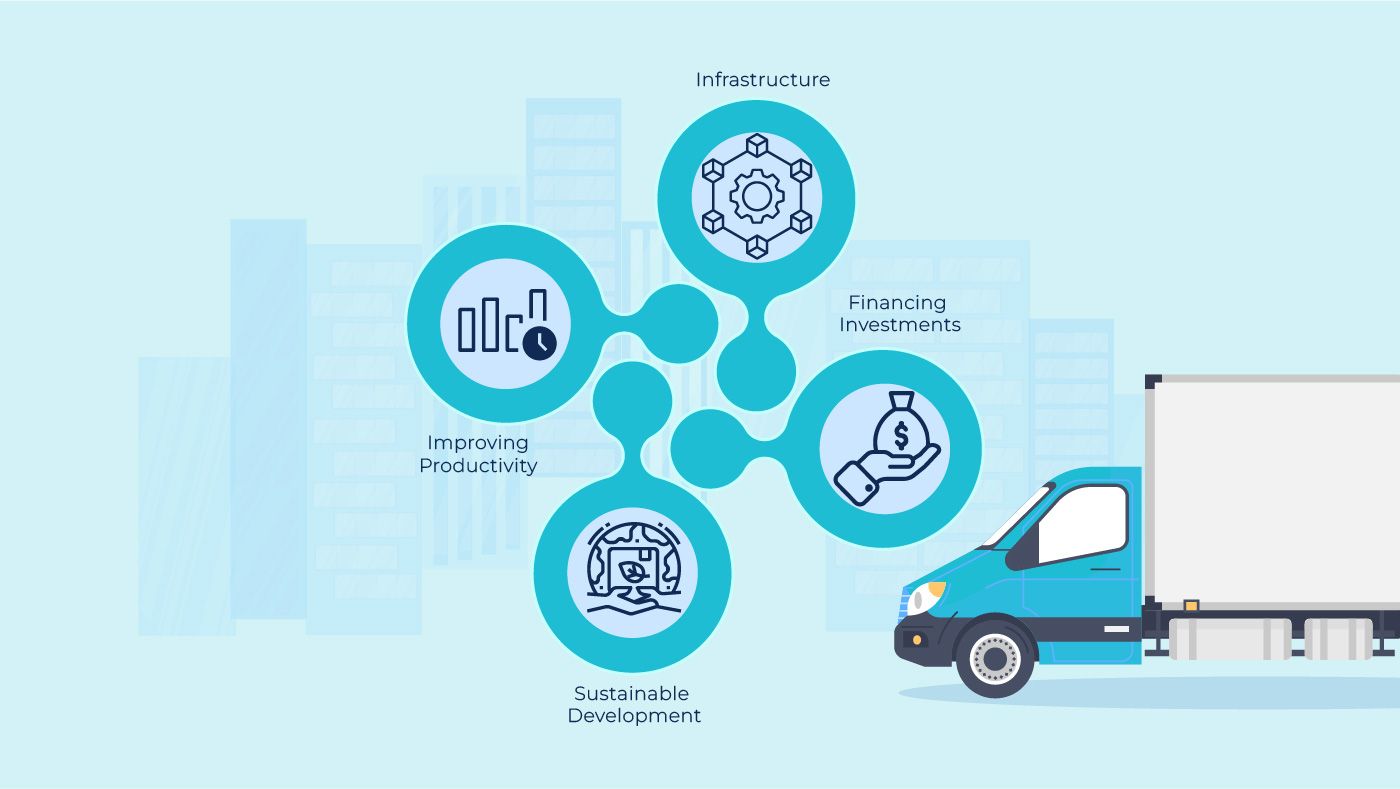
Without a doubt, the union budget's underlying focus has been distributed across four key areas that include improving productivity, infrastructure, financing investments, and sustainable development. In addition to that, the budget also emphasized quite a bit on climate change action; perhaps the first-time climate change has received a substantial acknowledgment in the union budget.
Coming back to the Logistics & Transport industry, focusing on infrastructure development in the Union Budget greatly benefits the industry, considering its reliance on public infrastructures such as roads, expressways, highways, logistics parks, and other public goods. Moreover, improving such critical infrastructure results in increased inflow of investments, thus improving the overall market. To further understand what the union budget had in store for the industry, let’s look at some of the key announcements and relevant measures for the logistics & transport industry.
1. PM GatiShakti for improving multimodal connectivity and logistics efficiency
Launched in 2020, ‘PM GatiShakti Master Plan’ builds on the National Infrastructure Pipeline for 2019-2025, which was announced in 2019 with an aim to invest Rs 100 lakh crore on infrastructure in the country over the given period.
Objective of the GatiShakti Master Plan
The core objective of the scheme is to reduce the logistics cost in India by ensuring that the planning and implementation of projects across 16 different infrastructure-related ministries are carried out in an integrated and coordinated manner. In addition to reducing the logistics cost, it aims to increase the cargo handling time further and reduce inefficiencies in the sector.
Identifying the problem in the logistics industry & infrastructure development
The logistics and supply chain processes are very much fragmented in India. As a result, the Indian logistics sector accounts for an estimated 14.4% of the GDP, growing at a CAGR of 10.5%. It is much higher when compared to 6-8% spending of the more developed regions like the United States, China, or Europe. The spending gap is expected to widen, resulting in much higher spending and cost of doing business, which would negatively impact transporters and logistics operators, particularly small and medium-sized ones. Moreover, due to a lack of coordination between ministries at the centre and state level in planning and implementation of infrastructure projects, the cost of the projects ultimately ends up being exponentially higher than what is supposed to be.
How will the GatiShakti Master plan benefit the industry?
By integrating the planning and implementation of projects of all 16 infrastructure-related ministries under one roof, the scheme will allow them to coordinate better, tracking plans and ongoing projects in real-time through a digital platform. Moreover, it will bridge the gap between planning on macro-scale and respective micro-level implementation, reducing the cost of doing business and improving the competitiveness of Indian transporters and logistics providers.
Developments on GatiShakti Master Plan in Union Budget 2022-23
The first outlay of the GatiShakti scheme was announced in the Union Budget, receiving Rs 20,000 crores for 2022-23. The sectors in focus for 2022-23 are Roads, Railways, Airports, Ports, Mass Transport, Waterways, and Logistics Infrastructure.
- Formulation of the GatiShakti master plan for expressways will be formulated in the financial year 2022-23.
- The National Highways network is expected to be expanded by another 25,000 kilometres utilizing the allocated funds in 2022-23.
- Announcement on the all-mode operators being brought under the Unified Logistics Interface Platform (ULIP) for efficient movement of goods and reducing the cost of logistics in the country. ULIP will offer a single-window platform to provide information to all stakeholders assisting multimodal logistics operations benefiting all stakeholders.
- Announcement regarding awarding contracts for the development of multimodal logistics parks across four key locations through the Public-Private-Partnership (PPP) model in 2022-23.
- Announcement regarding the development of 100 GatiShakti Cargo terminals for multimodal logistics over three years.
2. Battery Swapping Policy to improve EV adoption
Our earlier piece titled Why is India’s Logistics & Transport industry bull on EV adoption explains in great detail the current EV ecosystem in India and prevailing challenges when it comes to mass-scale adoption of EVs in the commercial sector. One of the critical problems that continues to trouble the industry is the lack of charging infrastructure to support the adoption of EVs. When it comes to urban areas, they lack the space for setting up charging infrastructure at a mass scale. To counter this issue, a Battery Swapping Policy has been proposed in the Union Budget as well as Interoperability Standards for batteries are being formulated to enable the policy. In addition to that, it was also announced that the private sector would be encouraged to develop sustainable business models offering Battery or Energy As a Service to bolster EV adoption in India further. The policy is set to counter the challenge of charging infrastructure in constrained urban centres and bring innovative solutions to tackle energy problems for the EV industry. Lastly, it also offers an innovative solution to long charging times that currently discourages EV adoption at scale.
3. Push for clean energy, climate action, and low carbon economy
Several initiatives and reforms have been announced to aid India’s climate action policy and bring climate change into the more significant focus of development. Measures such as an increase in allocation of PLI scheme for manufacturing of solar modules (Rs 19,500 crores), co-firing biomass pellets in thermal plants, battery swapping policy (explained above), development of Energy Service Company (ESCO), issuing sovereign Green Bonds, are some of the key announcements related to climate action in the union budget 2022-23. Moreover, India has made strides in its pursuit of clean energy through policy and investment measures that are likely to be announced later. One such policy includes the much-awaited Green Hydrogen Policy, which is set to revolutionize the efforts to transition to a low-carbon economy. These efforts align with India’s commitments at COP26, Glasgow, towards its net-zero ambition by 2070.
Conclusion
The Union Budget 2022-23 has given strong signals that India is committed to a growth-led economy with a strong emphasis on infrastructure and growth. Although we are yet to see how much of these commitments will materialize into action, the willingness shown by the government, particularly with respect to reducing its emission and bolstering growth in key sectors, is a good signal and will positively reflect across industries benefiting stakeholders and improving investment inflow.
Frequently Asked Questions
What is the Union Budget's impact on the transport and logistics industry in India?
The Union Budget plays a major role in shaping the future of India's transport and logistics sector because it determines government spending on highways, railways, ports, multimodal logistics parks, digital infrastructure, sustainability initiatives, and industrial development. Every budget announcement influences logistics costs, freight movement, infrastructure quality, and investment opportunities for transport businesses. The 2022-23 Union Budget particularly focused on PM GatiShakti, Unified Logistics Interface Platform (ULIP), multimodal connectivity, cargo terminals, and increased highway development, all of which directly benefit logistics companies.
For logistics businesses operating across India, including Delhi NCR, Gurgaon, Mumbai, Bengaluru, Pune, Chennai, Hyderabad, and Ahmedabad, these infrastructure investments can reduce transportation delays, improve vehicle utilization, shorten transit times, and lower fuel consumption. Better roads, integrated logistics corridors, and digital planning also create opportunities for fleet owners to optimize routes and expand operations into new markets.
The budget additionally emphasized climate-friendly transportation by encouraging EV adoption, battery swapping infrastructure, and cleaner energy initiatives. These policies are particularly relevant for fleet operators planning long-term investments in electric commercial vehicles and sustainable logistics operations.
Overall, the Union Budget is more than a financial announcement—it establishes policy direction for infrastructure growth, logistics modernization, supply chain resilience, and private-sector investment. Businesses that understand these policy changes can make better decisions regarding fleet expansion, technology adoption, warehouse planning, and long-term transportation strategies.
What is PM GatiShakti and why is it important for the logistics industry?
PM GatiShakti is India's National Master Plan for Multi-Modal Connectivity designed to integrate infrastructure planning across multiple government ministries. Instead of developing roads, railways, ports, airports, and logistics parks independently, the initiative coordinates these projects through a common digital platform. The objective is to reduce logistics costs, improve supply chain efficiency, eliminate infrastructure bottlenecks, and accelerate economic growth.
For transport companies, manufacturers, distributors, and third-party logistics providers across India, PM GatiShakti creates significant opportunities. Better connectivity means shorter delivery times, improved route planning, reduced idle time, lower vehicle operating costs, and faster movement of freight across states. Logistics companies in Delhi NCR, Gurgaon, Mumbai, Bengaluru, and Pune are expected to benefit from improved multimodal transport corridors and integrated freight infrastructure.
The initiative also supports development of logistics parks, cargo terminals, industrial corridors, and digital freight systems that simplify transportation planning. As these projects mature, businesses can expect improved warehouse connectivity, reduced congestion, and greater visibility throughout the supply chain.
Combined with digital technologies such as transportation management systems (TMS), GPS fleet tracking, route optimization software, and real-time analytics, PM GatiShakti creates a stronger logistics ecosystem capable of supporting India's growing manufacturing, ecommerce, and export sectors while making Indian logistics globally competitive.
How can transport and logistics companies prepare for infrastructure and policy changes announced in the Union Budget?
Government investments alone do not automatically improve logistics performance. Transport companies must align their operations with evolving infrastructure, technology, and regulatory changes to fully benefit from new policies. As highways expand, logistics parks develop, and multimodal transport networks improve, businesses should modernize their fleet operations and supply chain processes accordingly.
Fleet owners should evaluate their existing routes, delivery schedules, fuel efficiency, maintenance practices, and vehicle utilization to identify opportunities created by better infrastructure. Companies operating in Delhi, Gurgaon, Mumbai, Bengaluru, Pune, and other major logistics hubs can leverage improved road connectivity to redesign distribution networks and reduce delivery costs.
Investing in digital technologies such as fleet management software, GPS vehicle tracking, transportation management systems, electronic proof of delivery, predictive maintenance, and fuel monitoring enables businesses to capitalize on improved infrastructure more effectively. Data-driven planning helps organizations reduce empty trips, improve turnaround time, enhance customer visibility, and maximize fleet productivity.
Businesses should also monitor upcoming government initiatives related to green logistics, EV adoption, multimodal freight movement, and logistics digitization. Organizations that combine infrastructure improvements with operational technology are better positioned to achieve sustainable growth, lower transportation costs, improve customer satisfaction, and remain competitive in India's rapidly evolving logistics industry.
What are the benefits of investing in transport management software after the Union Budget infrastructure announcements?
Government investments in highways, logistics parks, cargo terminals, and multimodal connectivity create tremendous opportunities for logistics businesses, but companies only realize their full value when supported by modern transportation technology. Transport Management Software (TMS) helps businesses manage shipments, optimize routes, automate dispatch, monitor deliveries, and improve operational visibility. As infrastructure improves under initiatives like PM GatiShakti and ULIP, digital logistics platforms become even more valuable because they enable companies to utilize new transport corridors efficiently.
For businesses operating across Delhi NCR, Gurgaon, Mumbai, Bengaluru, Pune, Chennai, and Hyderabad, a TMS can reduce fuel consumption, improve on-time deliveries, automate trip planning, simplify invoicing, and provide real-time tracking for customers. Companies also gain valuable analytics that help identify inefficient routes, underutilized vehicles, and operational bottlenecks.
Many organizations also integrate transportation management software with GPS tracking, warehouse management systems, ERP software, e-way bills, FASTag data, and predictive maintenance solutions to create a connected logistics ecosystem. This integration becomes increasingly important as India's logistics infrastructure continues to modernize.
Ultimately, businesses that combine infrastructure improvements with digital fleet management are better positioned to reduce logistics costs, improve customer satisfaction, increase profitability, and remain competitive in India's rapidly evolving transportation sector.
How much does it cost to implement logistics or transportation management software in India?
The cost of implementing logistics or transportation management software in India depends on business size, fleet strength, required features, deployment model, and integration requirements. Small fleet operators typically require basic GPS tracking, trip management, and reporting capabilities, while enterprise logistics providers often need advanced automation, AI-powered analytics, route optimization, fuel management, maintenance scheduling, and ERP integration.
For many small businesses, cloud-based subscription models generally start from a few hundred to a few thousand rupees per vehicle each month depending on functionality. Medium-sized transport companies operating in Delhi, Gurgaon, Mumbai, Bengaluru, Pune, and other logistics hubs usually invest more comprehensive budgets to support larger fleets and multiple operational locations. Enterprise deployments involving hundreds or thousands of vehicles may include implementation services, integrations, user training, dashboards, and customized workflows, increasing the overall investment.
Businesses should evaluate total return on investment instead of focusing only on software pricing. Better route planning, lower fuel expenses, reduced vehicle downtime, improved utilization, faster billing, and fewer manual processes often generate savings that outweigh implementation costs over time.
When selecting a solution, companies should compare scalability, customer support, implementation timelines, reporting capabilities, API availability, security, compliance features, and future expansion requirements rather than choosing solely on the lowest price.
Which are the best transport and logistics software solutions for businesses in India?
The best transport and logistics software depends on the organization's operational complexity, fleet size, industry, and long-term growth plans rather than a single universal product. Businesses typically evaluate transportation management systems, fleet management software, GPS vehicle tracking platforms, warehouse management systems, route optimization tools, proof-of-delivery applications, and supply chain visibility platforms based on their operational requirements.
Companies operating across Delhi NCR, Gurgaon, Mumbai, Bengaluru, Pune, Ahmedabad, and other major logistics centers often prioritize software that provides real-time fleet tracking, automated dispatch planning, fuel monitoring, predictive maintenance, trip analytics, electronic documentation, driver performance monitoring, and integration with ERP or accounting software. Cloud deployment, mobile accessibility, multilingual support, and responsive customer service are also important selection criteria.
Before choosing any platform, businesses should request live demonstrations, evaluate reporting capabilities, review integration options, verify implementation support, and calculate expected return on investment. Organizations should also consider future scalability, especially if fleet expansion or geographical growth is planned.
The ideal logistics software should improve operational efficiency, reduce transportation costs, increase delivery reliability, enhance customer communication, and support compliance with changing industry regulations while remaining flexible enough to adapt to future technological and infrastructure developments.
How are Delhi, Gurgaon, Mumbai, Bengaluru and Pune benefiting from logistics infrastructure development?
India's largest logistics markets are expected to benefit significantly from continued infrastructure investments, industrial corridor development, multimodal connectivity, and digital logistics initiatives. Delhi NCR and Gurgaon remain major distribution and warehousing hubs because of their strategic access to northern India, expressways, manufacturing clusters, and national freight corridors. Improved connectivity helps businesses reduce delivery timelines while supporting faster movement of goods across neighboring states.
Mumbai continues to play a critical role because of its ports, financial ecosystem, import-export activities, and extensive transportation network. Infrastructure investments strengthen cargo movement between ports, warehouses, manufacturing facilities, and inland logistics centers. Bengaluru benefits from technology-driven supply chains, ecommerce growth, and manufacturing expansion, while Pune continues to emerge as an important automotive, industrial, and warehousing destination supported by improved highway infrastructure.
Businesses operating across these regions increasingly adopt transportation management systems, GPS fleet tracking, warehouse automation, and route optimization technologies to maximize the advantages created by infrastructure improvements. Combining digital logistics with better roads, cargo terminals, and logistics parks helps reduce delays, optimize freight movement, and improve customer service.
As government initiatives continue to modernize India's logistics ecosystem, these metropolitan regions are expected to remain among the country's strongest logistics and supply chain growth centers.
What is the Gati Shakti Master Plan?
The PM GatiShakti National Master Plan is an integrated infrastructure development initiative launched by the Government of India to improve multimodal connectivity and reduce logistics costs across the country. Instead of planning roads, railways, airports, ports, inland waterways, and logistics parks independently, the platform enables coordinated planning across multiple ministries through a single digital framework. This reduces project delays, avoids duplication of infrastructure, and creates a more efficient freight transportation ecosystem.
For logistics companies operating in Delhi, Gurgaon, Mumbai, Bengaluru, Pune, Chennai, and other industrial regions, the initiative offers long-term operational benefits. Better highways, cargo terminals, logistics parks, and multimodal transport corridors help reduce travel time, improve fleet utilization, minimize fuel consumption, and enhance delivery reliability. Businesses can also integrate transportation management systems, GPS fleet tracking, warehouse management software, and route optimization tools with this expanding infrastructure to maximize efficiency.
The initiative is also expected to strengthen India's manufacturing competitiveness by lowering logistics expenses, which have historically remained higher than many developed economies. As infrastructure continues to improve, transport operators, fleet owners, manufacturers, distributors, and third-party logistics providers can expect better supply chain visibility and more predictable freight movement.
Overall, PM GatiShakti represents one of India's most significant infrastructure modernization initiatives and serves as a foundation for building a faster, more connected, and technology-enabled logistics ecosystem.
What is PM GatiShakti?
PM GatiShakti is the Government of India's National Master Plan for Multi-Modal Connectivity that brings together infrastructure planning across sixteen ministries using a common digital platform. Its primary objective is to improve coordination while developing highways, railways, ports, airports, industrial corridors, logistics parks, and freight infrastructure. By integrating planning and execution, the initiative aims to reduce logistics costs, eliminate infrastructure bottlenecks, and improve the movement of goods across India.
For businesses operating in logistics-intensive regions such as Delhi NCR, Gurgaon, Mumbai, Bengaluru, Pune, Hyderabad, and Ahmedabad, PM GatiShakti supports faster freight movement, improved warehouse connectivity, better multimodal transportation, and reduced transit delays. These improvements can significantly increase operational efficiency while lowering transportation expenses for manufacturers, distributors, retailers, and logistics service providers.
The initiative also complements digital logistics technologies including GPS vehicle tracking, transportation management systems, AI-powered route optimization, warehouse automation, electronic documentation, and predictive analytics. Businesses adopting these technologies alongside expanding infrastructure are better positioned to improve customer satisfaction and increase profitability.
As India continues investing in infrastructure, PM GatiShakti is expected to play a central role in transforming the country's logistics landscape by creating an integrated, technology-driven, and globally competitive transportation network that supports sustainable economic growth.