
Hydrogen has become an increasingly researched alternative fuel in the automotive and logistics industries. It makes a great fit for commercial usage over petroleum and electric technology due to its completely eco-friendly and zero-emission nature. Keeping this in mind, many transportation and logistics businesses have started initiatives that can help reduce their carbon footprint as well as get financial and long-term gains in the process.
In today’s age where logistical complications and clean fuel availability is rampant, hydrogen has become the main element that can advance sustainability in logistics. The trucking industry has identified hydrogen as a new opportunity towards a greener tomorrow and is on its way towards implementing solutions to take advantage of its many benefits.
The Promise of a Green Tomorrow
Hydrogen has quickly become a strategic cornerstone for sustainability, and its growing demand has already surpassed the available supply. While this may seem like a logistical problem, the use of hydrogen is also in fact a way to transition to cleaner alternatives globally.
The energy sector has faced quite a few roadblocks over the years, where fossil fuels have contributed significantly to environmental pollution and motor fuels like petrol and diesel are only getting more expensive. On the other hand, while electric vehicles can mitigate tailpipe emissions, there are still concerns over how this electricity is produced. For instance, most of the electricity produced in India comes from burning coal, which again adds to the carbon-emission problem. Another issue with using electric technology for transportation and logistics vehicles is that it can hinder timely deliveries that such an industry relies on. Apart from frequent charging times, electric trucks also need more batteries to travel long distances, thus increasing the weight on the truck and reducing the available payload or cargo.
Owing to such problems, hydrogen fuel cells have become more suited to commercial vehicles. There is also pressure on the energy sector to keep environmental degradation in check and make a rapid shift towards cleaner and greener alternatives - with the answer being hydrogen.
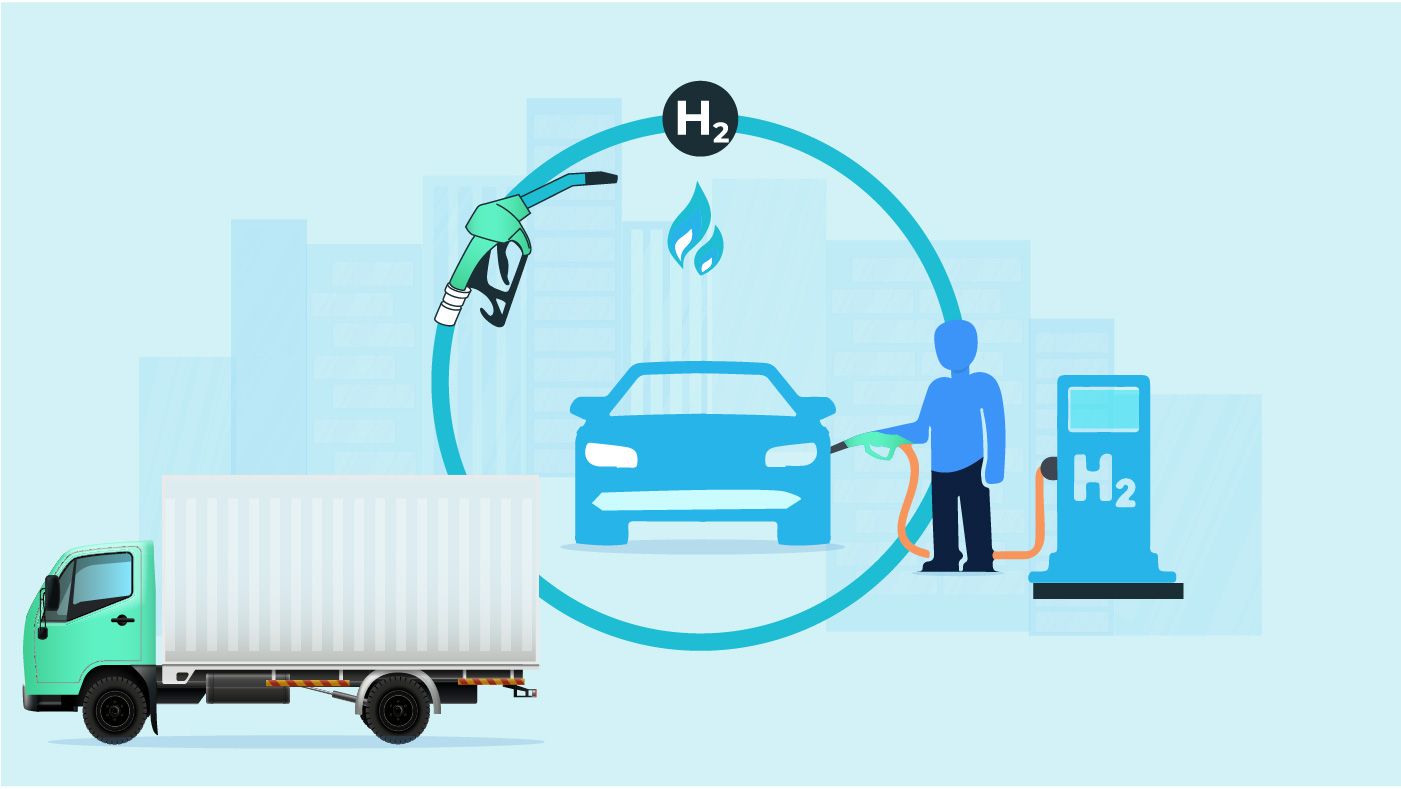
Hydrogen is the future of transportation and logistics as it offers a long-term and cost-efficient alternative. Vehicles using hydrogen can be refuelled within minutes and are not damaging to the environment since they emit just water vapour and not carbon. Weight distribution for large transportation trucks is easier since the components can be placed around the vehicle without reducing the payload. Such vehicles also have a high-energy density for long-range use, as opposed to the other fuelling options.
Challenges Down the Road
Many countries such as the United States, Japan, Germany, South Korea, and more are already using hydrogen-fuelled commercial vehicles, but this technology is still at a nascent stage in India. The Indian government is now fast moving towards the development of hydrogen fuel cell technology and promoting it as a big step towards greener and cleaner fuel solutions.
However, despite the fact that hydrogen is a promising alternative fuel solution, there are many challenges to overcome before adopting it nationwide.
Two main hindrances India faces in the supply and distribution of hydrogen are new infrastructure requirements and high production costs. The lack of infrastructure like very few hydrogen dispensing fuel stations makes it difficult to adopt this technology. The up-front cost of making such infrastructure all over the country as well as investing in hydrogen fuel cell powertrains is extremely high, scaring investors away. Additionally, hydrogen dispensing stations and vehicles using it would need to use very stringent safety measures as it is more flammable due to its higher energy content over petrol or diesel.
How to Evaluate the Long-Term Value of Hydrogen Fuel for Logistics Investments
Hydrogen fuel adoption is often discussed in terms of sustainability, but for fleet operators, transport companies, and supply chain leaders, the decision is equally about operational feasibility and long-term business value. While battery electric vehicles (BEVs) and conventional diesel fleets each have their place, hydrogen-powered commercial vehicles offer a distinct value proposition for businesses that require long driving ranges, faster refuelling, and high vehicle utilization.
Instead of viewing hydrogen as a replacement for every logistics operation, organizations should evaluate where it creates the greatest operational and financial impact. This approach helps businesses make informed investments while preparing for India's transition toward cleaner transportation.
Factors to Consider Before Investing in Hydrogen-Powered Logistics
Before adopting hydrogen fuel technology, logistics businesses should evaluate multiple operational parameters rather than focusing only on vehicle acquisition costs.
Key evaluation factors include:
- Daily route distance: Hydrogen fuel cell trucks are particularly suitable for long-haul transportation where frequent charging interruptions are impractical.
- Fleet utilization: High vehicle utilization improves the return on investment by maximizing asset productivity.
- Refuelling infrastructure: Companies should assess hydrogen availability across key freight corridors connecting Delhi NCR, Mumbai, Pune, Bengaluru, Chennai, and other industrial regions.
- Cargo type: Industries transporting temperature-sensitive goods, FMCG products, industrial materials, automotive components, chemicals, and pharmaceuticals may benefit from reduced downtime.
- Government incentives: Central and state-level clean mobility initiatives can significantly influence the total cost of ownership.
- Technology readiness: Fleet managers should evaluate vehicle reliability, maintenance support, hydrogen supply partners, and OEM service networks before deployment.
Rather than implementing hydrogen vehicles across an entire fleet immediately, many organizations begin with pilot deployments on high-volume transport routes. This phased strategy minimizes operational risk while generating real-world performance data before expanding fleet adoption.
Hydrogen Fuel vs Diesel vs Battery Electric Vehicles for Commercial Logistics
| Factor | Hydrogen Fuel Cell Vehicles | Battery Electric Vehicles | Diesel Vehicles |
|---|---|---|---|
| Refuelling time | Very fast (similar to diesel) | Longer charging time | Fast |
| Driving range | Excellent for long-haul transport | Better suited for short and medium distances | Excellent |
| Tailpipe emissions | Water vapour only | Zero tailpipe emissions | High CO₂ emissions |
| Payload efficiency | High due to lighter energy storage | May decrease because of battery weight | High |
| Best use cases | Long-distance freight, heavy commercial vehicles | Urban distribution, last-mile delivery | Conventional transport |
| Infrastructure maturity in India | Developing | Growing rapidly | Fully established |
| Long-term sustainability | Very High | High | Low |
This comparison highlights that hydrogen fuel is not intended to replace every transport solution. Instead, it complements battery-electric fleets by addressing operational scenarios where long driving ranges, quick refuelling, and minimal vehicle downtime are business priorities.
Why This Matters for India's Logistics Industry
India's freight transportation demand continues to grow with the expansion of manufacturing, e-commerce, retail distribution, and multimodal logistics. Large freight corridors connecting Delhi NCR, Gurgaon, Mumbai, Pune, Bengaluru, Chennai, Hyderabad, and Ahmedabad require transportation solutions that balance sustainability with operational efficiency.
Hydrogen fuel has the potential to support this transition by enabling cleaner freight movement without significantly compromising vehicle utilization. As hydrogen production capacity, refuelling infrastructure, and government support continue to improve, logistics companies that evaluate hydrogen strategically today will be better positioned to adapt to future regulatory requirements and customer expectations.
Rather than viewing hydrogen fuel solely as an environmental initiative, businesses should consider it part of a broader fleet modernization strategy that combines operational efficiency, emissions reduction, energy diversification, and long-term competitiveness within India's evolving logistics ecosystem.
The Future of Hydrogen in India
Keeping the above challenges in mind, the Indian government announced the National Hydrogen Energy Mission (NHEM), which was presented at the virtual RE-INVEST conference in November 2020. The government has shown keen interest in hydrogen since 2006 when they first announced the Hydrogen and Fuel Cell roadmap. Last year, India’s finance minister Nirmala Sitharaman, also made a special mention about alternative fuel options in the 2021 Union Budget, stating that green energy is the way forward for the country's energy requirements, setting aside Rs 800 crore for the same.
In 2021, Oil Minister Dharmendra Pradhan spoke about the hydrogen economy and said that the Indian government is extremely committed to advancing the infrastructure for the hydrogen supply chain. India’s commitment towards a greener future is accompanied by taking the right measures for deploying renewable energy. The country’s renewable power portfolio has grown considerably in the last six years, from 32 GW to around 100 GW, while the country is targeting a renewable energy generation capacity of 450 GW by the year 2030.
Apart from government endeavours, Reliance Industries Ltd (RIL) also announced its plan to shift towards a net-zero carbon company by 2035. They are investing over Rs 75,000 crore in research and clean energy projects, as well as building a fuel cell Giga factory and electrolyser to help boost India’s pre-existing hydrogen economy in a big way.
Hydrogen’s potential in helping India reduce carbon emissions is extremely high. TERI states that the demand for hydrogen is almost 6 MT (million tonnes) per year and it needs to increase to 28 MT by 2050 and eventually 40 MT by 2060 to achieve a net-zero carbon target.
There is no doubt that hydrogen is the future of logistics and will pose as a huge solution for many businesses in the transportation, construction, and fleet management industry. Hydrogen is the optimal key for the logistics market and as its usage grows, so will the infrastructure. With the current technology, it is now possible to create the infrastructure and start eliminating logistics issues, finally giving a push to the much-required hydrogen economy. By making such a huge investment towards an eco-friendly future, India is well on its way towards creating an uninterrupted supply chain and transitioning the transportation industry.
Frequently Asked Questions
What is hydrogen fuel and why is it considered the future of sustainable logistics?
Hydrogen fuel is an energy source produced using hydrogen gas, which can power vehicles through hydrogen fuel cells or hydrogen internal combustion engines. In fuel-cell vehicles, hydrogen reacts with oxygen to generate electricity while emitting only water vapour, making it one of the cleanest transportation fuels available. Unlike diesel trucks that produce significant carbon emissions, hydrogen-powered commercial vehicles offer a promising pathway toward greener freight transportation without compromising operational efficiency.
Hydrogen is particularly suitable for the logistics industry because heavy commercial vehicles often travel hundreds of kilometres every day, making long charging times impractical. Hydrogen trucks can generally be refuelled much faster than battery-electric trucks while maintaining long driving ranges and high payload capacity. This makes them ideal for long-haul freight, industrial transportation, mining operations, ports, and interstate logistics.
India is actively investing in hydrogen through the National Green Hydrogen Mission, with increasing interest across Delhi NCR, Mumbai, Pune, Bengaluru and other industrial corridors. As hydrogen production becomes more affordable and refuelling infrastructure expands, logistics companies are expected to gradually integrate hydrogen-powered fleets alongside electric and conventional vehicles.
Rather than replacing every transport technology, hydrogen is expected to complement battery-electric vehicles by serving applications where long-distance transportation, continuous fleet utilization and reduced downtime are critical business requirements. This combination can significantly reduce carbon emissions while maintaining operational productivity across India's growing logistics ecosystem.
Why is hydrogen not widely used as a transportation fuel today?
Although hydrogen offers significant environmental advantages, its adoption is still limited because developing an entirely new fuel ecosystem requires substantial investment. Producing green hydrogen through renewable-powered electrolysis remains considerably more expensive than conventional fossil fuels, although costs are expected to decline as production scales.
Infrastructure is another major challenge. Unlike petrol, diesel or even electric charging stations, hydrogen refuelling stations are still limited worldwide. Building production plants, storage facilities, transportation pipelines and dispensing stations requires coordinated investment from governments, fuel suppliers and vehicle manufacturers. Safety standards must also be extremely stringent because hydrogen is highly flammable and requires specialized storage systems.
In India, hydrogen infrastructure is currently concentrated around pilot projects and research initiatives. Cities such as Delhi, Gurgaon, Mumbai and Bengaluru are likely to become early adopters because they already serve as major logistics and industrial hubs with growing clean-energy investments. Government policies including the National Green Hydrogen Mission are expected to accelerate commercial deployment over the coming decade.
Despite these challenges, hydrogen continues attracting investment because it addresses several limitations associated with battery-electric heavy trucks, including charging time, payload reduction and long-distance operations. As technology improves and production costs decrease, hydrogen is expected to become increasingly viable for commercial freight transportation rather than remaining a niche alternative fuel.
How does hydrogen fuel compare with diesel and electric trucks for commercial logistics in India?
Each commercial vehicle technology offers unique advantages depending on operational requirements. Diesel trucks currently dominate Indian logistics because fuel stations are widely available and vehicle acquisition costs remain comparatively lower. However, diesel contributes significantly to greenhouse gas emissions, fluctuating fuel costs and stricter environmental regulations.
Battery-electric trucks are increasingly popular for urban deliveries, last-mile logistics and regional transportation where vehicles return to charging stations regularly. They provide zero tailpipe emissions but may face limitations related to charging duration, battery weight and long-haul operations.
Hydrogen fuel cell trucks bridge many of these gaps. They combine fast refuelling with long driving ranges while maintaining higher payload efficiency because hydrogen storage systems weigh considerably less than large battery packs. This makes hydrogen especially attractive for interstate freight, cold-chain logistics, mining transportation, container movement and industrial supply chains operating across Delhi NCR, Mumbai, Pune, Bengaluru and other major freight corridors.
For Indian businesses, the best long-term strategy may not involve choosing one technology exclusively. Many logistics companies are expected to operate mixed fleets where electric vehicles handle city distribution, hydrogen powers long-distance freight and conventional vehicles gradually phase out as infrastructure expands. This balanced approach allows businesses to improve sustainability while maintaining operational flexibility and controlling total ownership costs.
What is the cost of implementing hydrogen fuel infrastructure for logistics companies in India?
The cost of adopting hydrogen-powered logistics depends on the scale of operations, fleet size, and whether a company is building its own refuelling infrastructure or using third-party hydrogen stations. For most logistics businesses, the initial investment is significantly higher than diesel fleets because hydrogen vehicles, storage systems, and dispensing stations are still in the early stages of commercialization.
A commercial hydrogen refuelling station in India can currently require investments ranging from approximately ₹8 crore to over ₹30 crore depending on daily dispensing capacity, storage technology, land availability, and safety systems. Fleet operators considering private hydrogen infrastructure for dedicated freight corridors must also account for maintenance, compression equipment, monitoring systems, and trained personnel. Fortunately, businesses are not always required to build their own stations. As public hydrogen infrastructure expands under the National Green Hydrogen Mission, many companies will likely rely on shared commercial stations.
Organizations operating across Delhi NCR, Gurgaon, Mumbai, Pune, Bengaluru, and major industrial corridors are expected to benefit first because these regions are likely to receive early hydrogen infrastructure investments. Companies should also evaluate the total cost of ownership rather than only vehicle purchase prices. Lower emissions, reduced dependence on imported fossil fuels, improved energy efficiency, and possible government incentives can improve long-term financial returns.
Instead of replacing an entire fleet immediately, many enterprises begin with pilot deployments on selected long-haul routes to understand operational performance before scaling hydrogen adoption across larger logistics networks.
Which industries in India can benefit the most from hydrogen-powered logistics?
Hydrogen-powered transportation is most valuable for industries that rely heavily on continuous freight movement, high vehicle utilization, and long-distance operations. Businesses transporting goods across multiple states often require vehicles that minimize downtime while maintaining high payload capacity, making hydrogen fuel particularly attractive.
Industries expected to benefit include FMCG distribution, e-commerce logistics, pharmaceuticals, cold chain logistics, construction, mining, cement, steel manufacturing, automotive supply chains, chemicals, petroleum distribution, and container transportation. These sectors frequently operate heavy commercial vehicles where battery charging limitations could reduce operational efficiency.
Industrial hubs including Delhi NCR, Gurgaon, Mumbai, Pune, Bengaluru, Chennai, Hyderabad, Ahmedabad, and Gujarat's manufacturing corridors are among the strongest candidates for early hydrogen adoption because they already support extensive freight movement and supply chain infrastructure. Companies serving ports, warehouses, export facilities, and manufacturing clusters may achieve greater operational advantages as hydrogen refuelling becomes more accessible.
Hydrogen also aligns well with organizations pursuing Environmental, Social and Governance (ESG) goals or net-zero carbon commitments. Many global manufacturers increasingly prefer logistics partners capable of reducing transportation emissions. As sustainability reporting becomes more important, hydrogen-powered logistics may provide both environmental benefits and competitive business advantages while supporting India's transition toward cleaner freight transportation.
What are the best hydrogen fuel technologies and solutions available for commercial logistics?
When businesses search for the best hydrogen fuel solutions, they are usually evaluating complete ecosystems rather than individual vehicles. Successful hydrogen logistics depends on fuel production, storage, transportation, refuelling infrastructure, vehicle technology, fleet management software, and predictive maintenance working together.
Leading global manufacturers continue developing hydrogen fuel cell trucks, heavy commercial vehicles, buses, and industrial equipment designed specifically for freight transportation. At the same time, logistics technology providers are integrating fleet telematics, route optimization, predictive maintenance, fuel monitoring, and AI-powered analytics to maximize operational efficiency regardless of the vehicle's energy source.
For Indian businesses, the best approach is selecting solutions that combine hydrogen-ready vehicles with intelligent fleet management platforms capable of monitoring utilization, maintenance schedules, route efficiency, emissions performance, and driver productivity. These digital tools become increasingly valuable as fleets adopt multiple propulsion technologies including diesel, battery-electric, and hydrogen-powered vehicles.
Businesses operating in Delhi NCR, Gurgaon, Mumbai, Bengaluru, Pune, and other logistics hubs should prioritize scalable solutions that can adapt as hydrogen infrastructure expands. Rather than focusing only on today's availability, companies should evaluate technology partners capable of supporting future clean-energy transitions while maintaining productivity, regulatory compliance, and long-term operational profitability.
How can logistics companies in Delhi NCR and Gurgaon prepare for hydrogen fuel adoption?
Delhi NCR and Gurgaon are among India's largest logistics and warehousing hubs, making them ideal locations for early hydrogen fuel adoption. Thousands of commercial vehicles operate daily between industrial parks, warehouses, manufacturing units, ports, airports, and distribution centres. As environmental regulations become stricter and businesses work toward reducing carbon emissions, hydrogen-powered transportation is expected to become an important part of sustainable logistics strategies.
Companies should begin by assessing which freight routes are most suitable for hydrogen vehicles. Long-haul operations, dedicated industrial corridors, and fleets with high daily utilization often deliver the strongest business case. Businesses should also evaluate future hydrogen refuelling availability, vehicle maintenance requirements, safety standards, and government incentive programs before making investment decisions.
Digital fleet management systems will play an equally important role during this transition. Fleet operators should invest in telematics, predictive maintenance, route optimization, fuel analytics, and vehicle health monitoring to maximize fleet utilization regardless of fuel type. These technologies reduce operational risk while improving overall efficiency.
Rather than replacing entire diesel fleets immediately, many organizations are expected to introduce hydrogen vehicles gradually through pilot projects. This phased implementation allows companies to evaluate operational performance, calculate total ownership costs, and train drivers and maintenance teams before expanding hydrogen adoption across larger commercial fleets.
Will hydrogen fuel play a major role in Mumbai, Pune and Bengaluru's future logistics ecosystem?
Yes. Mumbai, Pune and Bengaluru are expected to become some of India's most important hydrogen logistics markets because of their strong manufacturing base, technology ecosystem, automotive industry, ports, and rapidly growing freight movement. These cities generate significant demand for commercial transportation while also supporting government initiatives focused on clean mobility and industrial decarbonization.
Mumbai's port-driven logistics sector handles large volumes of domestic and international freight where hydrogen-powered heavy vehicles could significantly reduce emissions. Pune's automotive and manufacturing industries provide opportunities for hydrogen-powered industrial transportation, while Bengaluru's technology ecosystem supports innovation in clean mobility, artificial intelligence, fleet analytics, and connected transportation systems.
As hydrogen production becomes more affordable and infrastructure expands, logistics companies serving these regions may benefit from lower long-term emissions, improved ESG performance, and compliance with future environmental regulations. Businesses working with multinational manufacturers may also gain competitive advantages by demonstrating sustainable transportation practices.
Although widespread hydrogen adoption will take time, experts expect these cities to become important demonstration markets where government agencies, vehicle manufacturers, energy companies, and logistics providers collaborate on commercial deployment. Companies preparing today through digital fleet management, sustainability planning, and operational optimization will likely be better positioned for India's evolving hydrogen economy.
What should businesses consider before investing in hydrogen-powered logistics solutions?
Investing in hydrogen-powered logistics requires more than simply purchasing new commercial vehicles. Businesses should evaluate operational requirements, financial viability, infrastructure readiness, and long-term sustainability objectives before making significant investments. Hydrogen offers tremendous potential, but it delivers the greatest value when aligned with appropriate transportation use cases.
Important considerations include average trip distance, daily vehicle utilization, payload requirements, freight type, maintenance support, driver training, refuelling availability, and expected government incentives. Companies should also calculate total cost of ownership by considering fuel costs, maintenance savings, vehicle lifespan, operational productivity, and potential carbon reduction benefits instead of focusing solely on upfront purchase prices.
Organizations operating across India should prioritize routes connecting major freight corridors such as Delhi NCR, Gurgaon, Mumbai, Pune, Bengaluru, Chennai, Ahmedabad, and Hyderabad where hydrogen infrastructure is most likely to expand first. Investing in scalable fleet management software that supports hydrogen, electric, and conventional vehicles can also simplify future fleet modernization.
Ultimately, the best investment strategy is a phased transition supported by data-driven decision making. Businesses that combine hydrogen adoption with intelligent fleet analytics, predictive maintenance, route optimization, and sustainability planning are likely to achieve stronger operational performance while preparing for India's long-term shift toward cleaner commercial transportation.