
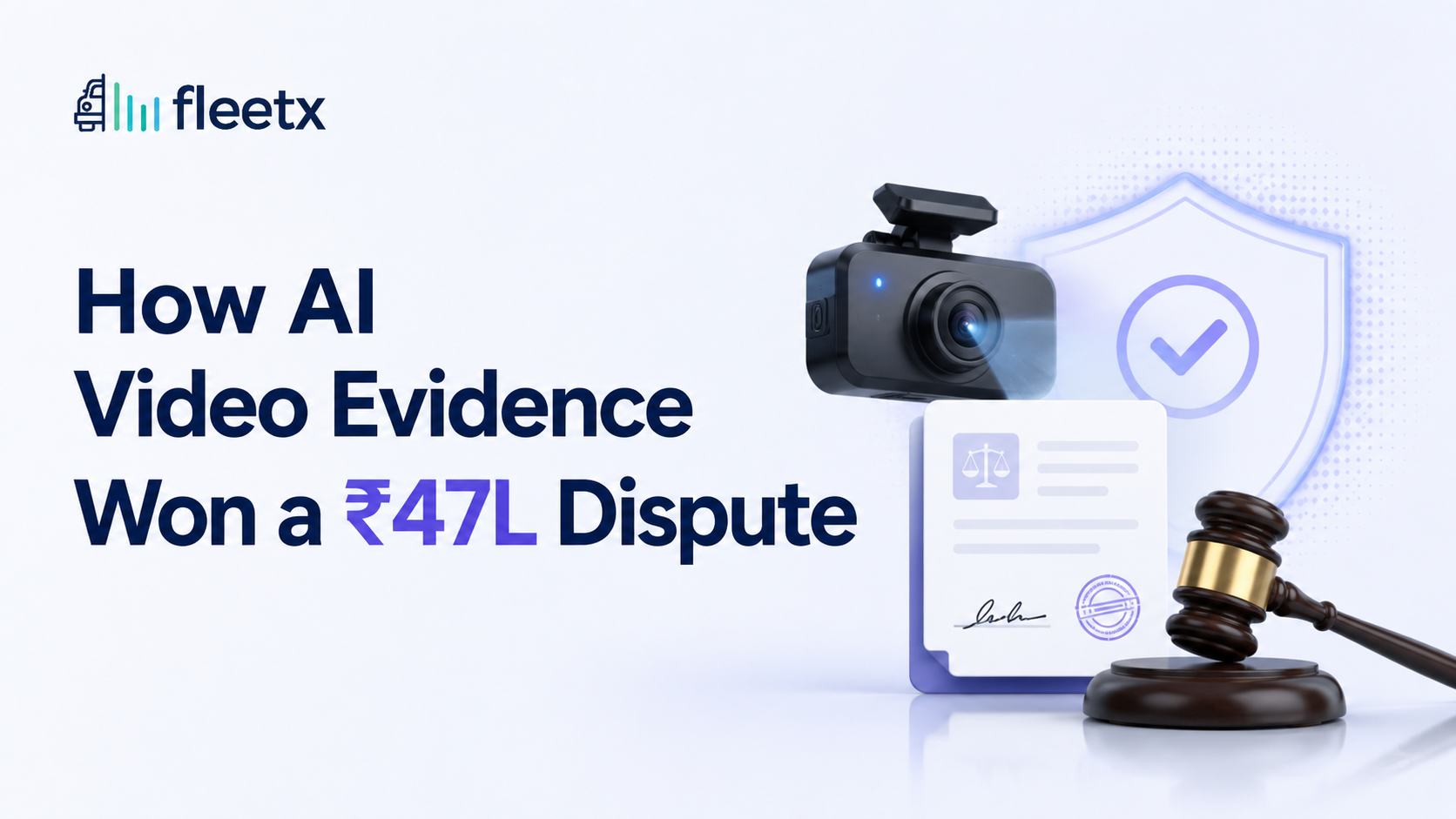
A tanker rolls into a weighbridge two hours late. The delivery manifest shows a shortfall. The client alleges route diversion and fuel siphoning. The insurer wants proof before settling a claim worth ₹47 lakh, and the transporter has only a GPS breadcrumb trail and a driver's word against a client's suspicion.
This plays out weekly across India's petroleum, FMCG, manufacturing, and logistics corridors, and it is exactly what a driver behaviour monitoring system paired with AI video telematics is built to resolve. In this case, a Fleetx-enabled fleet pulled event-tagged footage, GPS-correlated timestamps, and driver-facing camera evidence within minutes, and the ₹47 lakh dispute closed without litigation. Here is how, and what it means for any fleet still relying on paperwork and memory.
Why Are Enterprise Fleets Losing the Liability Battle?
Most liability problems are not caused by bad drivers alone. They are caused by an absence of evidence. Enterprise fleets across India report the same recurring pain points: rising road accidents on national highways, no usable video evidence when a dispute reaches a claims desk, cargo theft during long-haul transit, manual review of hours of footage that delays investigations, driver fatigue and distraction going undetected, rising insurance premiums tied to poorly evidenced claims, and no real-time visibility into what happens between dispatch and delivery.
India recorded over 4.8 lakh road accidents and more than 1.7 lakh fatalities in India in 2024, with over-speeding responsible for roughly 70 percent of road deaths. The WHO's Global Status Report on Road Safety has long flagged commercial vehicle operations as a disproportionate contributor to this toll. For a CFO or Risk and Compliance Manager, these numbers translate directly into premium hikes, legal exposure, and reputational risk with clients who expect audit-ready proof of safe operations.
What Is a Driver Behaviour Monitoring System?
A driver behaviour monitoring system is an AI-powered in-cabin camera and sensor setup that continuously observes how a driver operates a vehicle and flags unsafe actions the moment they happen, rather than waiting for a manager to review footage after an incident. It watches for mobile phone use, drowsiness, distraction, harsh braking, and seatbelt violations, and triggers an in-cab voice alert before the behaviour turns into a collision.
Fleetx's system runs on a 5-channel camera setup that reads the road conditions and the driver simultaneously, correlating what the camera sees with GPS, speed, and route data. A single flagged event carries full context: which driver, which vehicle, which location, and at what severity. This context made it possible to reconstruct the ₹47 lakh dispute in minutes rather than weeks.
What Is Video Telematics and How Is It Different From a Dashcam?
A standard dashcam records video. It does not think or alert anyone. It loops footage to an SD card until someone manually pulls it, and by then the footage that mattered has often been overwritten.
Video telematics combines AI cameras, GPS integration, cloud storage, and behaviour analytics into one connected system. A dashcam shows what happened. Video telematics explains what happened, why, who was involved, and what to do about it.
|
Capability |
Basic Dashcam |
AI Video Telematics (Fleetx) |
|
Footage capture |
Continuous loop recording |
AI event-tagged clips plus
continuous feed |
|
Alerting |
None or basic motion alert |
In-cab voice alert in under 2
seconds |
|
Storage |
7-day overwrite on SD card |
90-day secure cloud audit
trail |
|
Investigation time |
Hours of manual review |
Minutes, via searchable event
timeline |
|
Driver context |
None |
Face-match, driver score,
route history |
|
Cargo visibility |
Rarely available |
Container and interior camera
monitoring |
|
Fleet integration |
Standalone app |
Open APIs into ERP, insurance,
HR, compliance |
Search interest in "what is video telematics" and "benefits of a dashcam" has climbed as buyers realize the two solve different problems. A dashcam protects a single trip. Video telematics protects the entire operation.
How Did AI Video Evidence Resolve the ₹47 Lakh Dispute?
The dispute began with conflicting accounts and no fast way to verify either side, and every day of delay compounded the financial exposure. Here is how it unfolded on Fleetx's platform:
- The fleet manager searched the incident timeline by vehicle ID and time window instead of scrubbing raw footage.
- AI-generated event tags surfaced the exact moment of the alleged deviation, cross-referenced against GPS coordinates.
- The dual-facing camera confirmed the driver's actions and the vehicle's actual path, while the cargo lens confirmed the load was untouched.
- The full clip, with timestamp, geolocation, and driver face-match, was exported through the video evidence portal as one audit-ready package.
- Insurer and client reviewed the same evidence kit, and the claim closed without escalation to litigation.
What would ordinarily take days of footage review was compressed into a single afternoon. Liability is the pain, and event-tagged footage is the resolution.
How Does an AI Dashcam Detect Cargo Theft in Real Time?
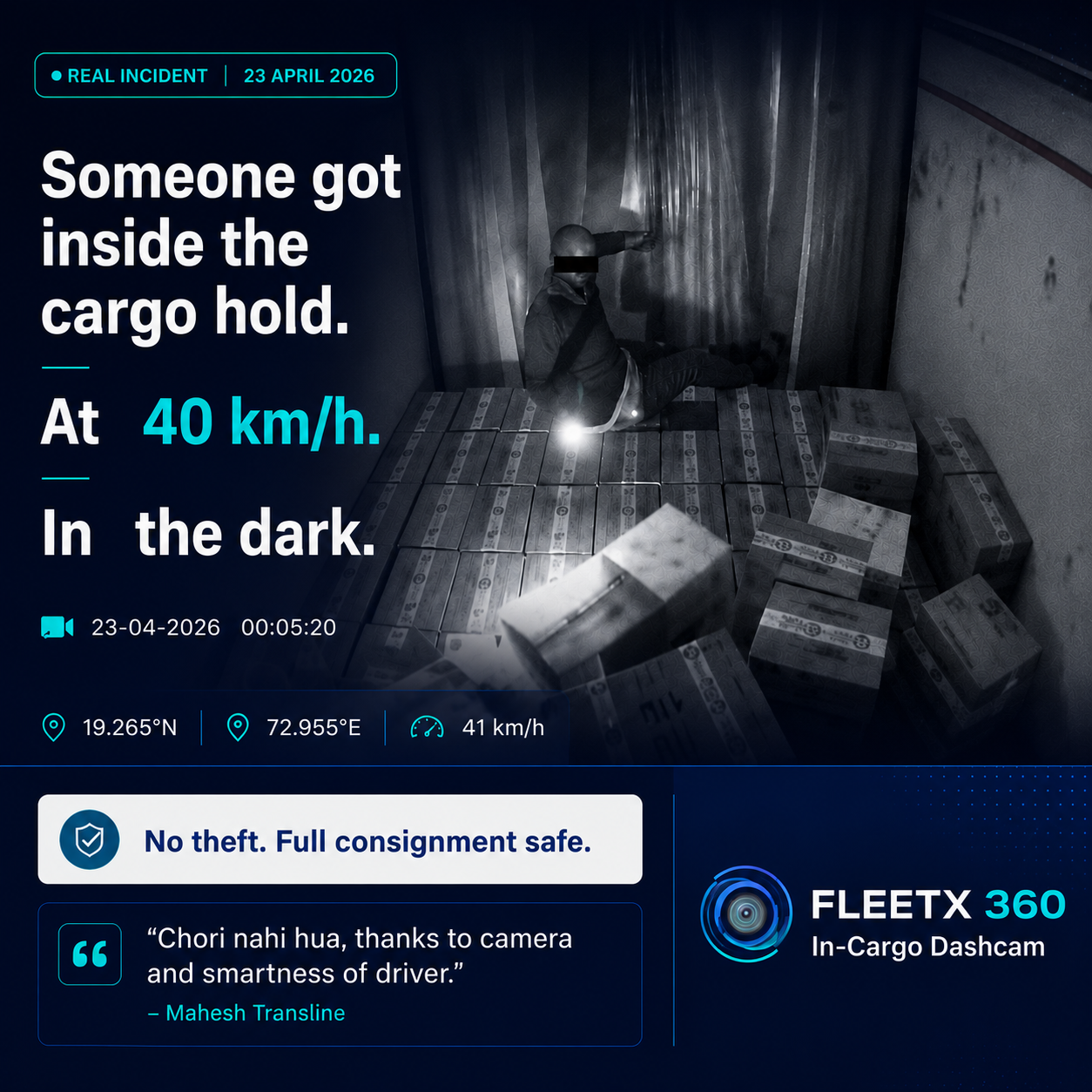
Cargo theft rarely happens dramatically. It happens during an unscheduled stop or an unlocked container door; no one notices until the delivery comes up short. In one Fleetx deployment, a container-facing camera flagged unauthorized movement near a cargo door while a truck was still moving. The AI classified the event as high severity, alerted the control room, and the driver intervened before any material loss occurred, using a dedicated container-facing camera, AI classification of door-open and tampering events, and a searchable evidence portal tying every cargo event back to driver, vehicle, and route.
What Should Enterprise Fleets Look for in a Dash Cam With GPS Tracking?
Not every dashcam marketed to fleets holds up during an investigation or compliance audit. Buyers evaluating a dash cam with GPS tracking should check for:
• Multi-camera support, up to a 5-channel setup covering road, cabin, cargo, and blind spots.
• Genuine live streaming, not delayed clip upload, so managers view an incident as it unfolds.
• Loop recording combined with AI event tagging so critical clips are preserved, not overwritten.
• Parking mode that keeps recording when the engine is off, useful for depot security.
• ADAS features such as forward collision warning and lane-departure alerts.
• Cloud storage with a defined retention window rather than local SD cards that can fail.
• GPS integration that timestamps and geo-tags every clip, plus driver scorecards over time.
The placement principle stays consistent regardless of fleet size: a road-facing lens mounted centrally behind the windshield, a driver-facing lens angled to capture the face and hands without obstructing vision, and, for cargo vehicles, a container-facing lens covering the load area.
How Much Can AI Video Telematics Reduce Accidents and Claims?
These numbers reflect what enterprise fleets running Fleetx's platform have measured in live operations, not marketing estimates.
|
Metric |
Improvement |
|
Reduction in accidents |
Up to 90 percent |
|
Reduction in repeat safety
violations |
40 percent |
|
Incident response speed |
3x faster |
|
Manual video review time |
60 percent less |
|
Secure video audit trail |
90 days, searchable |
|
Camera coverage |
Up to 5-channel monitoring |
McKinsey and Deloitte have both flagged AI-enabled telematics as one of the highest-ROI safety investments for commercial fleets, since the cost of one serious accident in claims, downtime, and reputation damage dwarfs the cost of the hardware. In the US, the Federal Motor Carrier Safety Administration (FMCSA) has pushed similar video-based safety adoption, while NHTSA crash data continues to underscore the outsized role of distraction and fatigue in commercial vehicle incidents.
Where Do AI Dashcams Deliver the Fastest Payback Across Industries?
Fleetx's enterprise deployments span petroleum, manufacturing, FMCG, logistics, and mining, and the priority use case shifts by sector. Petroleum and fuel transport fleets prioritize the evidence kit and 90-day audit trail, since fuel theft and shortfall disputes are the largest source of claims. Manufacturing fleets lean on ADAS and driver scorecards to control accident rates on repetitive routes. FMCG and last-mile operators use cargo monitoring and live streaming to protect high-theft-risk shipments, while mining and heavy-equipment fleets depend on multi-camera coverage and night vision for off-highway conditions.
How Does Fleetx's Video Evidence Portal Speed Up Investigations?
The difference between a fleet that resolves a dispute in an afternoon and one that spends weeks on it usually comes down to search, not storage. Fleetx's video telematics platform is built around faster incident response through real-time alerts, stronger accountability through face-match linking every event to a driver and vehicle, driver scoring based on actual on-road behaviour, real-time dashboards as a single source of truth, and open APIs connecting video data to ERP, insurance, HR, and compliance systems.
AI voice escalation across Hindi, Tamil, Marathi, Kannada, and Telugu matters here too. A safety alert that a driver cannot understand is noise, not a safeguard, which is part of why repeat violations drop by 40 percent after deployment rather than staying flat.
What Should Fleet and Risk Managers Do Next?
The ₹47 lakh dispute referenced at the start did not resolve quickly by luck. It resolved quickly because the fleet had already invested in a driver behaviour monitoring system and video telematics infrastructure before the dispute happened. Evidence captured only after an incident is not evidence at all.
For fleet managers, transport managers, safety and HSE heads, operations managers, CFOs, and risk and compliance teams, the practical next step is the same: audit the gap between what your fleet can prove and what it currently claims. If a client, insurer, or regulator asked for footage of a specific vehicle at a specific time tomorrow, would your team produce it in minutes or spend days searching?
Fleetx works with enterprise fleets across petroleum, manufacturing, FMCG, logistics, and mining to close that gap, combining AI dashcams, driver monitoring, ADAS, live streaming, and a 90-day searchable audit trail into one platform. Schedule a demo to see how the same evidence kit that resolved a ₹47 lakh dispute can be deployed across your fleet.
Frequently Asked Questions (FAQs)
AI video telematics combines vehicle cameras, GPS, cloud connectivity and AI-based behaviour analytics to understand what is happening on the road and inside the cabin. Unlike a basic dashcam that primarily records video, an AI video telematics system can identify events such as drowsiness, mobile phone use, distraction, harsh braking and other risky behaviours, then correlate those events with the vehicle, driver, location and time. For Indian fleets operating across Delhi, Gurgaon, Mumbai and national highways, this creates a searchable evidence trail rather than leaving managers to manually review hours of footage.
AI dashcams can help establish what happened before, during and after a suspected incident. For example, event-tagged footage can be correlated with GPS coordinates, timestamps and driver information to investigate an unscheduled stop, route deviation or suspected cargo interference. In the ₹47 lakh dispute discussed in this blog, the fleet used event-tagged footage, GPS-correlated timestamps, driver-facing evidence and cargo-camera footage to establish the sequence of events and provide an audit-ready evidence package to the insurer and client.
A standard dashcam primarily records video, while AI video telematics adds intelligence, connectivity and searchable context. A basic dashcam may require someone to manually locate and review footage after an incident. AI video telematics can automatically flag relevant events, correlate footage with GPS and vehicle data, generate driver behaviour insights and make incident investigation significantly faster. For enterprise fleets in India, the difference is essentially between having a video recording and having an operational evidence system.
A driver behaviour monitoring system can detect unsafe behaviours such as drowsiness, distraction, mobile phone use, harsh braking and seatbelt violations, depending on the camera and AI configuration. Fleetx's system described in this blog uses a multi-channel camera setup and correlates detected events with GPS, speed and route information. This allows fleet managers to identify not only the behaviour but also the driver, vehicle, location and severity associated with the event.
Indicative Indian market pricing for AI-powered video telematics hardware is around ₹20,000–₹45,000+ per vehicle, depending on the number of cameras, AI capabilities, connectivity and installation requirements. Software and cloud subscriptions can add roughly ₹500–₹2,500 or more per vehicle per month depending on storage, streaming and analytics. Enterprise deployments in Delhi-NCR, Gurgaon, Mumbai and other major logistics hubs are often quoted based on fleet size and required integrations, so a 50-truck deployment and a 500-truck deployment can have very different per-vehicle economics. These are market estimates, not Fleetx pricing.
The best AI dashcam depends on the fleet's operational risk rather than camera resolution alone. For long-haul trucks, tankers and petroleum fleets, look for multi-camera coverage, driver monitoring, event-based recording, GPS correlation, cloud evidence storage and a searchable audit trail. For buses and employee transportation fleets in Gurgaon, Delhi and Mumbai, DMS, ADAS, live streaming and driver coaching can be particularly important. Enterprise buyers should also evaluate installation support, API integrations, data retention, scalability and the quality of incident investigation workflows before selecting a platform.
It can strengthen the evidence available for accident, cargo and liability investigations. Instead of relying only on driver statements, paperwork or GPS breadcrumbs, fleet operators can provide timestamped video linked to the vehicle, driver and location. This can help insurers and clients understand the circumstances surrounding an incident and potentially reduce investigation delays. However, any impact on insurance premiums or claim outcomes depends on the insurer, policy terms, incident and quality of evidence; AI video telematics should not be treated as an automatic insurance discount.
Yes. Fleets operating from Delhi-NCR and Gurgaon frequently deal with dense traffic, highway movement, frequent stops and mixed operating conditions, while Mumbai fleets may combine city distribution with long-distance routes. AI video telematics can help these fleets monitor driver behaviour, investigate incidents, verify route events and protect cargo. For FMCG, petroleum, manufacturing, logistics and mining fleets, the value is particularly strong when a single incident can create significant claims, downtime or customer disputes.
Retention should be based on the fleet's risk profile, investigation timelines, customer requirements and applicable internal policies. A 90-day searchable audit trail is particularly useful for enterprise operations because disputes or insurance investigations may emerge well after the original trip. The Fleetx solution described in this blog uses a 90-day searchable audit trail, allowing teams to retrieve historical evidence rather than discovering that critical footage has already been overwritten.
Fleet managers should evaluate camera coverage, DMS and ADAS capabilities, event-based recording, GPS correlation, live streaming, cloud storage, evidence search, driver identification, data retention and integration capabilities. For large Indian fleets, scalability and installation support matter just as much as hardware specifications. It is also worth checking whether the platform can connect video data with ERP, insurance, HR and compliance workflows. The best solution is not necessarily the cheapest dashcam; it is the one that can produce usable evidence and actionable safety intelligence when an incident actually occurs.