
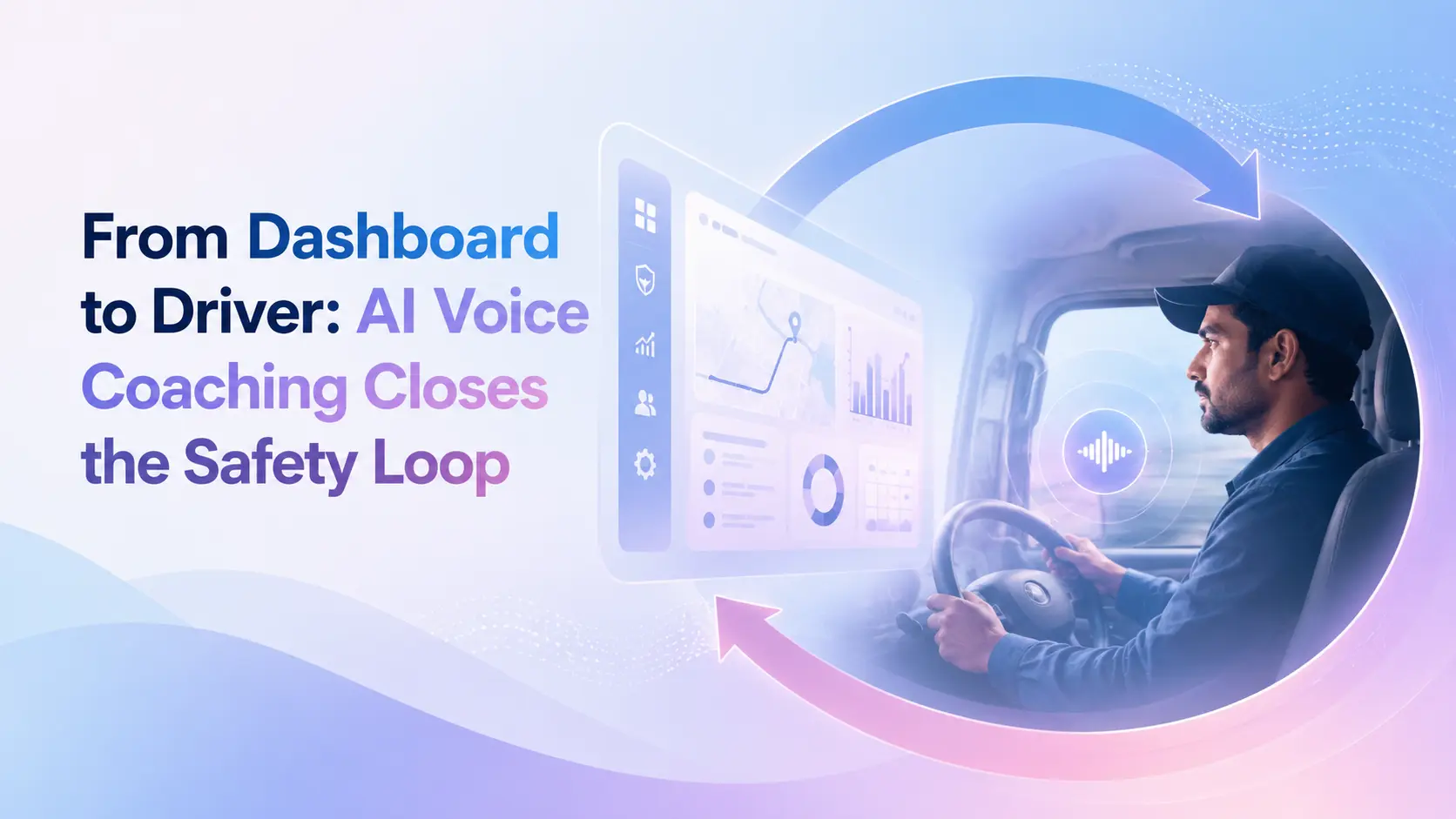
How a multi-client 3PL turns silent dashboards into real-time, in-cab coaching, and takes the human bottleneck out of driver behaviour monitoring.
Situation: A long-haul truck is cruising on a national highway outside Nagpur. A driver hauling a client's temperature-sensitive load has been awake for eleven hours. His eyes close for a second too long. In the old model, that moment lives quietly inside a camera, waiting for a fleet manager to spot it on a dashboard hours later, long after the danger has passed.
Problem Statement: For a multi-client third-party logistics (3PL) operator, that gap is the entire problem. You answer to dozens of clients, hundreds of drivers, and safety commitments that never sleep. Watching every video feed by hand is impossible. This is the point where driver behaviour monitoring stops being a viewing exercise and becomes a closed loop: detect the risk, speak to the driver, correct the behaviour, and log it, all in seconds and with no human sitting in the middle.
Why does the traditional safety loop keep breaking?
Most fleets already own cameras. Very few actually close the loop. The reason is simple. The old model puts a person between the incident and the response, and people do not scale to round-the-clock coverage.
Human behaviour is the dominant cause of crashes on Indian roads. According to the Ministry of Road Transport and Highways, over-speeding alone is linked to close to 68 percent of road accident deaths, and driver fault sits behind the large majority of crashes. The World Health Organization ranks road traffic injuries among the leading killers of working-age adults worldwide. Independent research from the IIT Delhi road safety group points to the same conclusion: the behaviour that causes these outcomes happens live, on the road, not in a review queue.
Here is where the loop usually snaps:
• Detection without response. Footage is captured, but nobody is watching in real time.
• Delayed coaching. A manager reviews the clip days later, when the driver barely remembers the trip.
• Alert fatigue. Control room staff drown in low-value pings and miss the one that mattered.
• No proof of correction. There is no record that the driver ever changed anything.
What does closing the loop mean for a multi-client 3PL?
Closing the loop means the correction happens inside the cab, in the moment, without waiting for a person to step in. The camera stops being a silent witness and becomes an active coach.
For a 3PL running mixed fleets across many clients, this shift matters even more than it does for a single owner operator, because:
• Volume - No team can manually monitor thousands of driver hours every day.
• Service levels - Each client expects safety and on-time performance backed by evidence, not opinion.
• Neutrality - Automated alerts hold every driver to the same standard, on every contract.
The table below shows why the automated loop wins where the manual one strains.
|
What matters |
Human in the loop |
Automated AI voice coaching |
|
Response time |
Minutes to days |
Under 2 seconds, in the cab |
|
Coverage |
Limited by staff shifts |
24x7 across the whole fleet |
|
Consistency |
Varies by reviewer |
Same standard for every driver |
|
Scaling |
Add people to add reach |
Scales with software, not headcount |
|
Proof of correction |
Manual notes, if any |
Auto logged, timestamped, face matched |
How does AI voice coaching work without a human in the loop?
A modern video telematics solution moves the intelligence to the edge, inside a dash cam with GPS tracking that watches both the road and the driver at once. The sequence is short, and it never leaves the vehicle:
- Detect - Onboard AI watches for critical events such as fatigue, mobile phone use, no seatbelt, harsh driving, and forward collision risk.
- Rank - Not every event is equal. Each one is scored by severity, so a drowsy driver at highway speed outranks a minor idling flag.
- Speak - The camera issues an in-cab voice alert, often in under two seconds, telling the driver exactly what to fix. No dashboard, no phone call, no delay.
- Correct - The driver responds while the risk is still live, which is the only moment that actually prevents a crash.
- Log - The event, the correction, and the driver's identity are recorded through face matching and stored for audit.
That is the real gap between raw dash cam footage and driver behaviour monitoring that changes outcomes. One tells you what went wrong. The other stops it from going wrong.
|
INSIDE THE LOOP WITH FLEETX Fleetx video telematics runs this
exact loop on Indian roads. Its AI detects 11 plus critical driving events,
ranks each by severity, and escalates through AI voice alerts in seven
languages including Hindi, English, Tamil, Marathi, Kannada, and Telugu, with
in-cab alerts firing in under two seconds. Every event is tied to a driver
through face matching and archived for 90 days in line with AIS-140. Explore
it at fleetx.ai/video-telematics. |
What results can a 3PL actually measure?
The goal of closing the loop is not more video. It is fewer incidents and cleaner proof. Fleets that run automated, in-cab coaching report gains that repeat across sites and seasons.
|
Metric |
Impact with in-cab AI voice coaching |
|
Repeat violations |
Up to 40 percent reduction |
|
Incident response speed |
3x faster |
|
Manual video review effort |
60 percent less |
|
Accident rate |
Up to 90 percent reduction |
These numbers are not abstract. FlixBus India rolled out AI enabled dash cams across 100 percent of its fleet, detecting fatigue, phone usage, and camera obstruction in real time to raise passenger safety and accountability across intercity routes. For a 3PL, the same engine converts every client contract into a measurable safety record instead of a monthly guess.
How does automated coaching scale across clients and languages?
A single site pilot is easy. A multi-client 3PL needs the loop to hold across geographies, languages, and reporting lines. A capable fleet dashcam software handles this in a few specific ways:
• Multilingual voice: Coaching in the driver's own language lifts compliance far more than an ignored English beep.
• Driver scoring: Every event feeds a behaviour score, so coaching targets the riskiest drivers first.
• Per-client dashboards: Each customer gets a single source of truth for their own fleet.
• Enterprise integration: Open APIs connect the safety data to ERP, insurance, and compliance systems.
• Court admissible archive: Events retained for 90 days and aligned with AIS-140 give you defensible evidence for disputes and claims.
For an India-based 3PL, one more thing separates a global camera from a local one: the road it learned on. A purpose-built video telematics platform that is trained on Indian traffic behaves very differently from a system tuned for orderly US or EU lanes.
|
THE FLEETX EDGE Nothing moves without intelligence watching. Fleetx AI is trained
on more than 31 billion India-road data points every month, so it reads the
chaos of local highways that camera systems trained on US and EU roads
routinely miss. The same engine deploys across a live, multi-client fleet in
about 72 hours and preserves a 90-day, court-admissible archive aligned with
AIS-140, turning every trip into defensible evidence rather than a lost clip. 31B+
India-road data points / month | 72-hour fleet deployment | 90-day court-admissible archive |
What should you check before deploying fleet dashcam software?
Before you commit, pressure test any video telematics solution against a short checklist:
• How fast is the in-cab voice alert, and in how many languages?
• Are events ranked by severity, or is every ping treated the same?
• Is the data stored in India and aligned with local compliance, such as AIS-140?
• Can it link each event to a specific driver through face matching?
• How quickly can it deploy across a live, multi-client fleet?
Closing the loop, one vehicle at a time
Back on that highway outside Nagpur, the closed-loop version of the story ends differently. The camera catches the drooping eyes, ranks the moment as critical, and a calm voice fills the cab in the driver's own language before the vehicle drifts an inch. The driver straightens up. The event gets logged. The client's load and the driver's life are protected, and not one person had to be watching a screen.
That is the real shift from dashboard to driver: safety that acts at the speed of the road, not the speed of a review queue.
Ready to close your safety loop?