
It is 9 in the morning, and the transport office is already loud. One phone is buzzing with a customer inquiring about the location of their truck. A dispatcher is scrolling through three WhatsApp groups to confirm a POD photo actually arrived. The billing person is copying trip numbers from a spreadsheet that someone edited last night. Somewhere in all of this sits the real question nobody can answer quickly: did that trip make money or lose it? If this sounds like your morning, you are not behind on technology. You are simply running a growing business on tools that were never built to run it.
That's where transporter ERP comes into the picture, assisting growing Indian transporters in eliminating platforms such as Excel and WhatsApp, and running their fleet operations seamlessly within a centralized framework.
What does a normal day look like when your business runs on Excel and WhatsApp?
For most small and mid-size transporters in India, the operating system is a mix of Excel sheets, WhatsApp groups, a diary at the loading point, and a lot of phone calls. It works surprisingly well until volume grows. Then the cracks show up in familiar ways:
• Trip details live in one person's sheet, so nobody else can answer a customer without calling them first.
• POD photos sit in WhatsApp, get buried under new messages, and go missing exactly when you need them for billing.
• Invoices go out late because trip data, fuel, and driver advances are scattered across files.
• You know the monthly bank balance, but not the profit or loss on a single route or vehicle.
None of this is a discipline problem. It is a visibility problem. And it gets more expensive as you grow, which matters in a sector where India's logistics cost is now estimated at 7.97% of GDP, according to the first systematic NCAER and DPIIT assessment.
So what is a transporter ERP, really?
A transporter ERP is a single software platform that connects every part of a transport business, from booking a consignment to collecting the payment and tracking the profit on it. Think of it as one place where operations, documentation, and accounts finally speak the same language. In the wider software world, this idea is called a logistics ERP or an enterprise resource planning system. When it is purpose-built for the way Indian fleets and transporters actually move money and freight, it becomes far more useful than a generic tool bent into shape.
The short version: instead of five disconnected tools that need a human to stitch them together, a transporter ERP keeps one continuous record that everyone works from.
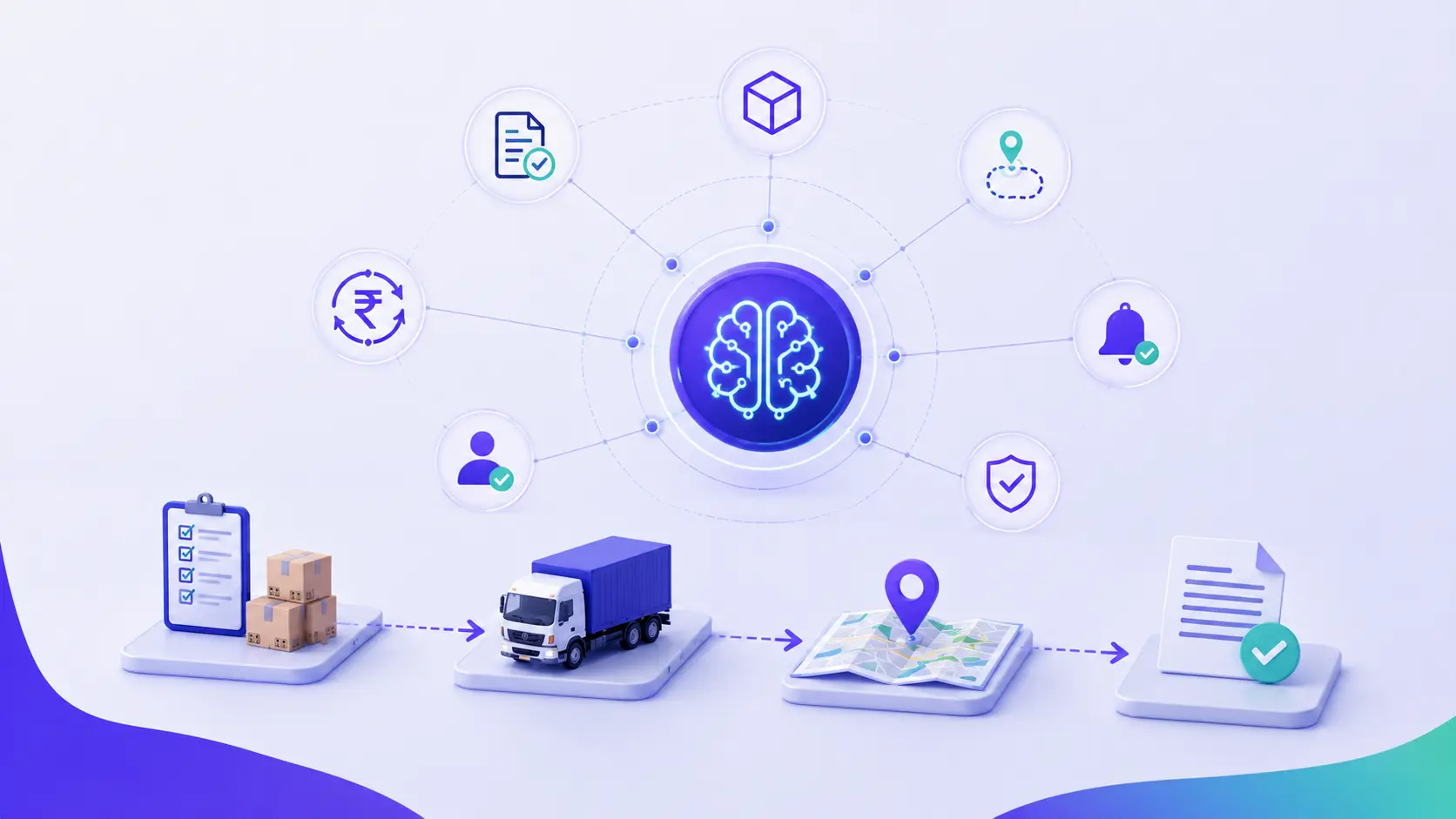
How does a transport ERP handle the full journey, from consignment to P&L?
The value of a transport ERP shows up when you follow a single load through the system. Every stage that used to need a call or a message becomes a step that updates the same record automatically.
|
Stage |
On Excel and WhatsApp |
Inside a transporter ERP |
|
Consignment |
Booked in a diary or sheet, re-typed later |
Created once, carries through the whole trip |
|
Dispatch |
Confirmed over calls, hard to track |
Vehicle and driver assigned with live status |
|
POD |
Photo shared on WhatsApp, often lost |
Digital ePOD attached to the exact trip |
|
Billing |
Manual invoice from scattered data |
Invoice generated from trip data, TDS handled |
|
P&L |
Guesswork at month end |
Profit and loss visible per trip and asset |
This end-to-end flow is exactly how Fleetx frames its Transport ERP, which describes itself as one platform that tracks every rupee spent, giving real P&L visibility across every trip, every route, and every asset. Documentation like the digital POD stops being a lost message and becomes proof that is ready for billing the moment the truck arrives.
Excel and WhatsApp versus a transport ERP: what actually changes?
The difference is not that spreadsheets are bad. It is that they cannot keep one shared truth as your trips multiply. Here is the practical contrast.
|
What you care about |
Excel and WhatsApp |
Transporter ERP |
|
Single source of truth |
Many versions, one owner |
One live record for all |
|
Customer updates |
Reactive phone calls |
ETA and status on demand |
|
Documentation |
Photos lost in chats |
ePOD tied to each trip |
|
Money flow |
Manual, delayed reconciliation |
Auto reconciliation and payouts |
|
Profitability |
Known only at month end |
Visible per trip in real time |
How much does transport ERP software in India cost?
There is no single sticker price, and any vendor who quotes one before understanding your operation is guessing. The transport software price you end up paying depends on a handful of clear factors, and it helps to know them before you take a demo.
|
Pricing factor |
What it usually depends on |
|
Fleet or trip volume |
Number of vehicles, trips, or consignments handled each
month |
|
Modules chosen |
Operations only, or the full stack up to accounting and
compliance |
|
Users and branches |
How many people and locations need access |
|
Integrations |
Links to your accounting tool, telematics, and payment
systems |
|
Support and onboarding |
Data migration, training, and the level of ongoing help |
Most credible platforms in India price on a subscription, scaling with volume and the modules you switch on. The right way to compare is not the lowest monthly figure but the cost of the delay, lost PODs, and unbilled trips you are absorbing today.
|
CASE IN POINT From scattered sheets to one connected view A growing regional transporter running 120+
trucks moved off a mix of Excel trackers and WhatsApp groups onto a single
transport ERP. Consignments, dispatch, and ePOD now sit on one record, so
billing that used to lag by days closes far faster and every trip carries its
own profit and loss. The office spends less time chasing documents and more
time deciding which routes and customers are actually worth keeping. |
How do you know your business is ready for a logistics ERP?
You do not need to be a large enterprise to benefit. A few honest signals tell you the spreadsheet era is over:
• You cannot answer a customer's trip status without calling one specific person.
• Invoicing regularly slips because the trip and document data are scattered.
• You suspect some routes lose money but cannot prove which ones.
• Your team spends more time updating files than moving freight.
India's policy direction is also pushing digitisation forward. Platforms like the Unified Logistics Interface Platform under PM GatiShakti are building shared digital rails for the sector, which makes running a connected system less of a luxury and more of a baseline.
Getting off Excel and WhatsApp is not about adding another app. It is about giving your business one honest record it can trust, from the moment a consignment is booked to the rupee of profit it leaves behind.
Frequently Asked Questions
What is the best transporter ERP for a small or mid-size fleet in India?
There is no single best transporter ERP for everyone, because the right fit depends on your trip volume, the modules you need, and whether you want operations only or the full stack up to accounting and compliance. The best choice for a small or mid-size Indian transporter is usually a purpose-built, India-first platform that handles consignment, dispatch, ePOD, billing, and per-trip profit and loss on one record, rather than a generic global ERP bent into shape.
Fleetx Transport ERP is built for exactly this use case, covering Operations, Collections, Settlement, Maintenance, Accounting, and Compliance in one suite with 150+ pre-built integrations. The smartest way to find your best fit is to shortlist two or three platforms and map each one against your own worst morning of chasing PODs and trip status.
How much does transport ERP software cost in India?
There is no fixed sticker price, and any vendor who quotes one before understanding your operation is guessing. As a rough guide, most credible platforms in India price on a subscription that scales with fleet size and the modules you switch on. Entry-level plans for smaller fleets often work out to roughly Rs 100 to Rs 500 per vehicle per month, while a fuller stack with accounting, settlement, and compliance for a mid-size transporter can run anywhere from about Rs 25,000 to Rs 1,00,000 or more per month.
These are indicative ranges only. Your final transport software price depends on trip volume, users and branches, integrations with your accounting tool and telematics, and the level of onboarding and support. The right way to compare is not the lowest monthly figure but the cost of the delay, lost PODs, and unbilled trips you are absorbing today.
Is a transporter ERP useful for transporters in Delhi, Gurgaon, and Mumbai?
Yes, and it is often most valuable in dense freight corridors. Transporters operating across Delhi NCR, Gurgaon, and the Mumbai belt handle high trip volumes, multiple branches, and demanding enterprise customers who expect live ETA and clean documentation. A transporter ERP gives one shared record across all locations, so a dispatcher in Gurgaon and a billing team in Mumbai work from the same live data instead of separate Excel sheets and WhatsApp groups.
For fleets running the busy Delhi to Mumbai and Gurgaon to Pune type routes, per-trip profit and loss visibility quickly shows which lanes and customers are actually worth keeping, which is hard to prove when everything sits in scattered files.
Can a transporter ERP fully replace Excel and WhatsApp?
For core operations, yes. A transporter ERP replaces the scattered mix of Excel trackers, WhatsApp POD photos, and loading-point diaries with one continuous record that everyone works from. Consignment is created once and carries through the whole trip, dispatch shows live status, the digital ePOD stays tied to the exact trip, and invoices generate straight from trip data.
The point is not that spreadsheets are bad. It is that they cannot hold one shared truth as your trips multiply. Teams often still use WhatsApp for casual chat, but the trip record, documents, and money flow move into the ERP where they stay reliable.
Does transport ERP software handle GST, e-way bill, and TDS for Indian transporters?
A good India-first transporter ERP is built around exactly these compliance needs. Invoices generate from trip data with TDS handled inside the same system, and the accounting and compliance modules are designed for how Indian fleets actually move money and freight. Look for platforms with payment and reconciliation layers built in, so payouts, approvals, and settlement happen in one place rather than in a separate accounting tool.
India's policy direction is also pushing this forward. Shared digital rails like the Unified Logistics Interface Platform under PM GatiShakti make running a connected, compliant system less of a luxury and more of a baseline.
What are the top features to look for in a transport ERP?
The top features that separate a strong transporter ERP from a basic tracker are a single source of truth across all trips and branches, live vehicle and trip status for on-demand ETA, a digital ePOD tied to each trip, invoicing generated from trip data with TDS handled, and auto reconciliation with payouts. Above all, look for real per-trip and per-asset profit and loss visibility, since that is what turns raw activity into decisions about which routes and customers to keep.
Ready-made integrations matter too. The best platforms connect to your existing accounting software, telematics, payment gateways, and systems like SAP, Oracle, and ULIP, so the ERP fits your stack instead of forcing you to rebuild it.
How do I know my transport business is ready to move to an ERP?
You do not need to be a large enterprise to benefit. A few honest signals tell you the spreadsheet era is over: you cannot answer a customer's trip status without calling one specific person, invoicing regularly slips because trip and document data is scattered, you suspect some routes lose money but cannot prove which ones, and your team spends more time updating files than moving freight.
If two or more of these sound like your daily reality, a transporter ERP is worth a serious look. The best next step is a short demo where you map your current process against what the ERP would have done differently.