
Quick Summary
Key Takeaways
Running an FMCG fleet and short on time? Here is the whole brief in six points. ⏳
-
🚛
Truck camera systems have moved from optional hardware to core FMCG distribution infrastructure. Modern systems combine dual-facing AI dashcams, cargo cameras, driver monitoring, and a cloud control tower into a single safety and accountability layer.
-
⚠️
The FMCG risk profile is unique: high trip frequency, multi-transporter networks, market vehicles, tight OTIF windows, and consumer brand exposure mean a single on-road incident carries cost, service, and reputation consequences simultaneously.
-
🤖
A basic dashcam for truck use records events. An AI dashcam for commercial vehicles prevents them, detecting mobile phone usage, fatigue, tailgating, no seatbelt, and cargo tampering, and correcting the driver in the cab within seconds.
-
📉
Documented outcomes from AI video telematics deployments include up to a 90 percent reduction in accidents, a 40 percent drop in repeat violations, 3x faster incident response, and 60 percent less manual video review.
-
📡
A global FMCG major running roughly 1,900 vehicles across 190 transporters used a Fleetx Safety Control Tower to resolve 95 percent of safety alerts within 30 minutes and maintain a 90 percent issue resolution rate, with driver scorecards covering more than 2,500 drivers.
-
⚡
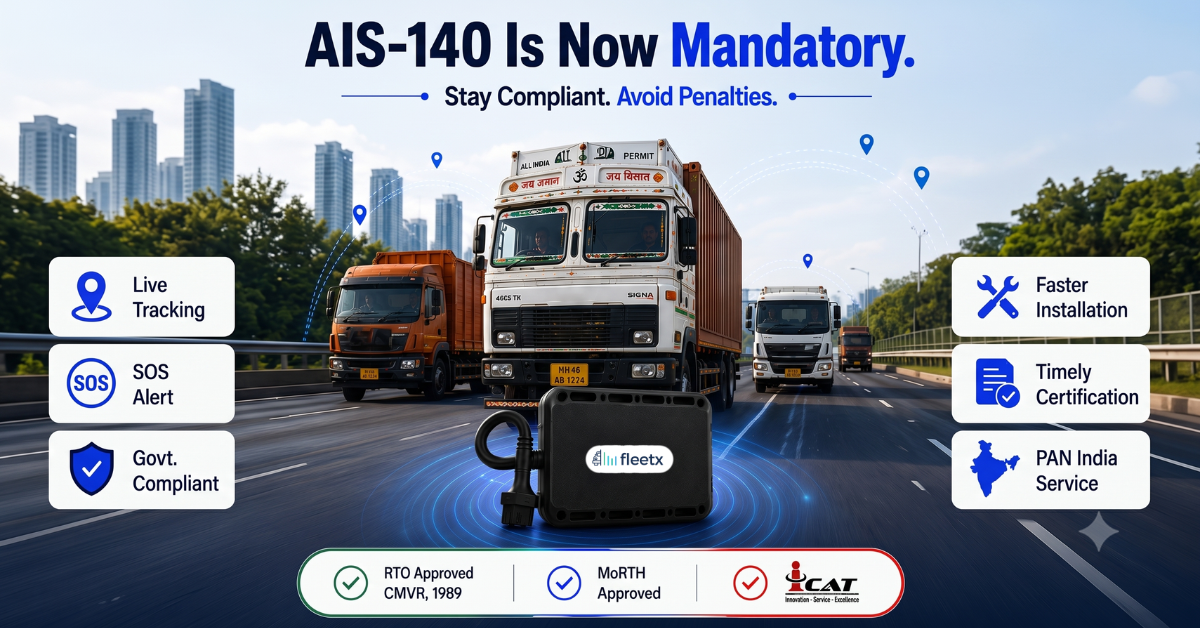
The fleetx dashcam stack is built for Indian FMCG conditions: 15 alert types, in-cabin AI voice intervention in under 2 seconds across 7 languages, India road AI trained on 31 billion+ data points a month, 72-hour deployment, and a court-admissible 90-day AIS 140 compliant video archive.
Consider this a working brief for FMCG supply chain, logistics, and EHS leaders. The subject is truck camera systems: what they are, what they change, what they cost, and what happened when one of the world's largest consumer goods companies put them at the center of its Indian distribution network.
Start with the operating reality. An FMCG distribution fleet is not a trucking fleet that happens to carry soap and biscuits. It is a high-frequency delivery machine. Vehicles cycle continuously between factories, depots, distributors, and retail points, often several trips a day, across every road condition India offers. Most of those vehicles are not owned. They belong to dozens or hundreds of transport partners, each with its own drivers, its own standards, and its own tolerance for risk. The brand on the carton, however, belongs to you.
That structure creates a specific exposure. When a market vehicle carrying your inventory is involved in a serious accident, the transporter's name appears on the RC. Your name appears in the news. When a driver on his fourth trip of the day falls asleep at the wheel, the fatigue accumulated moving your freight. And when a dispute arises over damaged or missing cargo, the absence of visual evidence costs your company the claim, the stock, and often the distributor relationship.
Truck camera systems exist to close exactly this gap. This brief lays out the category from an FMCG operator's seat: the technology, the India-specific regulatory context, the deployment architecture proven at enterprise scale, and the measured results, including a documented case where 95 percent of safety incidents across a 1,900-vehicle network were resolved within 30 minutes.
What Are Truck Camera Systems and Why Do FMCG Fleets Need Them Now?
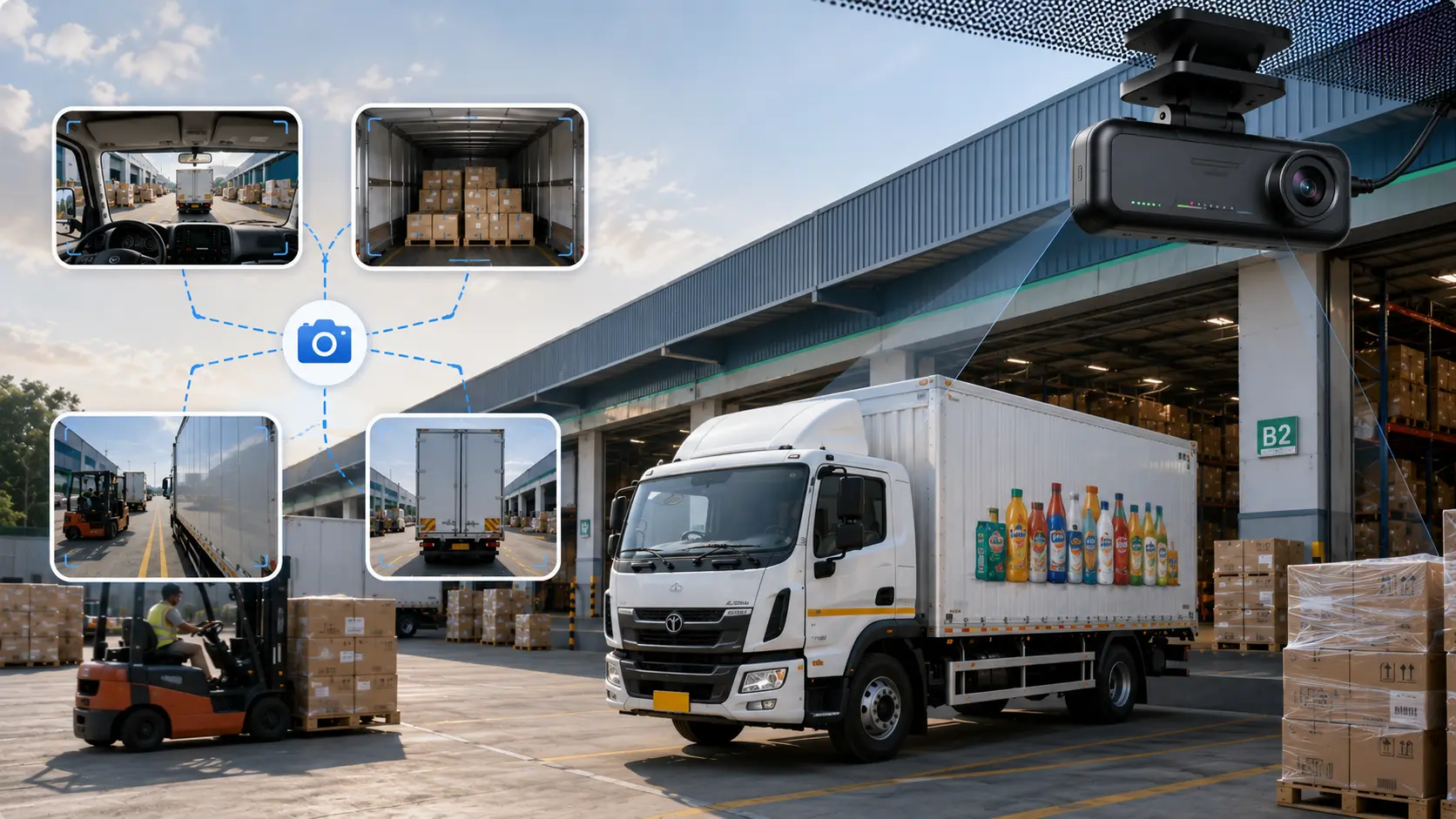
A truck camera system is an integrated network of AI-enabled cameras, sensors, and cloud software that watches three things simultaneously: the road, the driver, and the cargo. The modern system has four working parts, and the intelligence lives in how they connect rather than in any single lens.
• Road-facing camera - Captures the forward view, detects tailgating, forward collision risk, lane behavior, and provides the evidence record for every on-road event.
• Driver-facing camera - The AI layer that changed the category. It detects mobile phone usage, fatigue and drowsiness, smoking, seatbelt violations, distraction, and even face mismatch when an unauthorized person drives the vehicle.
• Cargo and container-facing cameras - For FMCG this is not an accessory. Cameras covering the load body monitor loading and unloading, detect door openings at unauthorized locations, and create accountability from dock to delivery.
• Cloud platform and control tower - Footage and AI events stream to a central dashboard where alerts are ranked by severity, issues are assigned and tracked to closure, and every event is linked to a driver, a vehicle, and a trip.
Why now, specifically, for FMCG? Three curves crossed at once. First, AI on-device processing became cheap and reliable enough to detect risky behavior in real time rather than record it for later. Second, India's regulatory and judicial environment hardened around commercial road safety, raising the cost of weak governance. Third, FMCG service expectations compressed: same-day and next-day replenishment leave no slack in the schedule for accidents, disputes, or vehicles held at police stations. A camera system is how a distribution network absorbs all three pressures without slowing down.
Read this as the core thesis of the brief: in FMCG distribution, a truck camera system is not a safety accessory bolted onto logistics. It is the governance layer that makes high-speed, multi-transporter logistics governable at all.
Is a Basic Dashcam for Truck Use the Same as a Truck Camera System?
No, and the difference is where most procurement mistakes happen. A consumer-grade camera for truck cabins records video to an SD card. It answers one question, after the fact: what happened? An AI truck camera system answers the question that actually protects the business: what is about to happen, and who is intervening right now? The distinction breaks down like this:
|
Dimension |
Basic camera for truck (recorder) |
AI truck camera system (interventionist) |
|
Primary function |
Passive recording to SD card,
reviewed after an incident |
Real-time detection, in-cab
intervention, and cloud escalation before the incident |
|
Driver behavior |
Invisible until footage is
manually reviewed |
AI detects phone usage, fatigue,
no seatbelt, distraction, and issues a voice alert in the cab within seconds |
|
Cargo visibility |
None |
Container and load-body cameras
with door-open and tampering alerts at non-designated points |
|
Evidence quality |
7 to 14 day loop overwrite,
footage often lost by the time a claim is filed |
Cloud archive of 90 days with
timestamps and metadata, court-admissible and AIS 140 aligned |
|
Fleet integration |
Standalone app per vehicle |
Unified control tower linked to
trips, drivers, transporters, and ERP systems such as SAP |
|
Accountability |
Vehicle-level at best |
Event linked to a named driver
via face match, scored, ranked, and tracked to closure |
|
Scalability |
Manageable to perhaps 20 vehicles |
Proven at 1,900+ vehicle
multi-transporter networks with severity-ranked alert queues |
The pricing gap between the two is smaller than most leaders assume, and the outcome gap is enormous. A recorder gives you a memory. A system gives you a reflex.
How Does a Truck Camera System Work From Lens to Control Tower?
A short technical detour, because understanding the pipeline sharpens every procurement question that follows. Between the lens on the windshield and the analyst in the control tower, five things happen in sequence, most of them within seconds:
|
Stage |
What happens |
The FMCG procurement question to ask |
|
1. Capture |
Dual-facing and cargo cameras
record continuously; on-device AI chips analyze frames in real time rather
than uploading everything |
What is captured at night, in
rain, and in the load body with doors closed? |
|
2. Edge detection |
The AI recognizes events (phone
in hand, closing eyes, short following distance, door opening) directly on
the device |
Which detections run on-device
versus in the cloud, and what happens in a network dead zone? |
|
3. In-cab intervention |
A voice alert fires in the cab in
the driver's language, correcting the behavior in the moment |
How fast is the alert, and in
which languages? Under 2 seconds is the current benchmark |
|
4. Cloud escalation |
The event clip, ranked by
severity, streams to the control tower with driver, vehicle, trip, and
location metadata attached |
How are alerts ranked and
deduplicated so a 1,900-vehicle network does not drown its analysts? |
|
5. Workflow and archive |
An issue is auto-created,
assigned, and tracked to closure; footage lands in a tamper-evident archive |
How long is retention, is the
archive court-admissible, and where is the data stored? |
Two Indian-market specifics belong in this picture. Data residency: for a consumer brand handling incident footage of identifiable people, storage within India simplifies both compliance and legal discovery, and platforms like Fleetx store video data in India by default. Connectivity: FMCG lanes cross network dead zones daily, so devices must buffer events locally and sync when coverage returns, with nothing silently lost in between. A vendor who cannot answer the dead-zone question crisply has not run at Indian highway scale.
Why Has Fleet Safety Become a Board-Level Issue for FMCG Companies?
The numbers force the issue. India records among the highest road fatality counts in the world, with the Ministry of Road Transport and Highways publishing annual Road Accidents in India reports that consistently document over 1.5 lakh deaths a year, a substantial share involving commercial vehicles. Globally, the World Health Organization estimates road crashes kill about 1.19 million people annually and cost most countries around 3 percent of GDP. For a company whose trucks make thousands of retail deliveries a day, this is not an abstract statistic. It is exposure, multiplied by trip frequency.
Four forces have pushed that exposure into the boardroom:
• Legal escalation - The Motor Vehicles (Amendment) Act sharply increased penalties for violations, and Indian courts have grown progressively less tolerant of fleet operators who cannot demonstrate systematic safety governance. Video evidence has become decisive in accident litigation, and its absence is increasingly read against the fleet.
• Distraction as the new drunk driving - Research compiled by the US National Highway Traffic Safety Administration shows distracted driving kills thousands annually, and regulators worldwide treat mobile phone usage behind the wheel as a primary enforcement target. In-cab AI detection is currently the only scalable countermeasure for a large fleet.
• ESG and CSRD-style reporting - Global FMCG parents now report safety metrics for their logistics chains, not just their factories. Auditable, timestamped safety data across third-party transporters is exactly what camera systems generate and legacy paper processes cannot.
• Insurance economics - Insurers globally price fleet risk on demonstrated behavior, and programs modeled on frameworks like the US FMCSA safety fitness regime reward carriers with clean, evidenced records. Video telematics converts safety from an assertion into a dataset that lowers claims frequency and strengthens every disputed claim you do file.
For FMCG specifically, add a fifth force with no line item: the brand. India's FMCG sector, profiled by the India Brand Equity Foundation, lives on consumer trust built over decades. A branded truck in a fatal accident, or a viral video of a load being pilfered, spends that trust in hours. Camera systems are how the supply chain stops writing risk cheques the brand has to cash.
What Does an AI Dashcam for Commercial Vehicles Actually Detect?
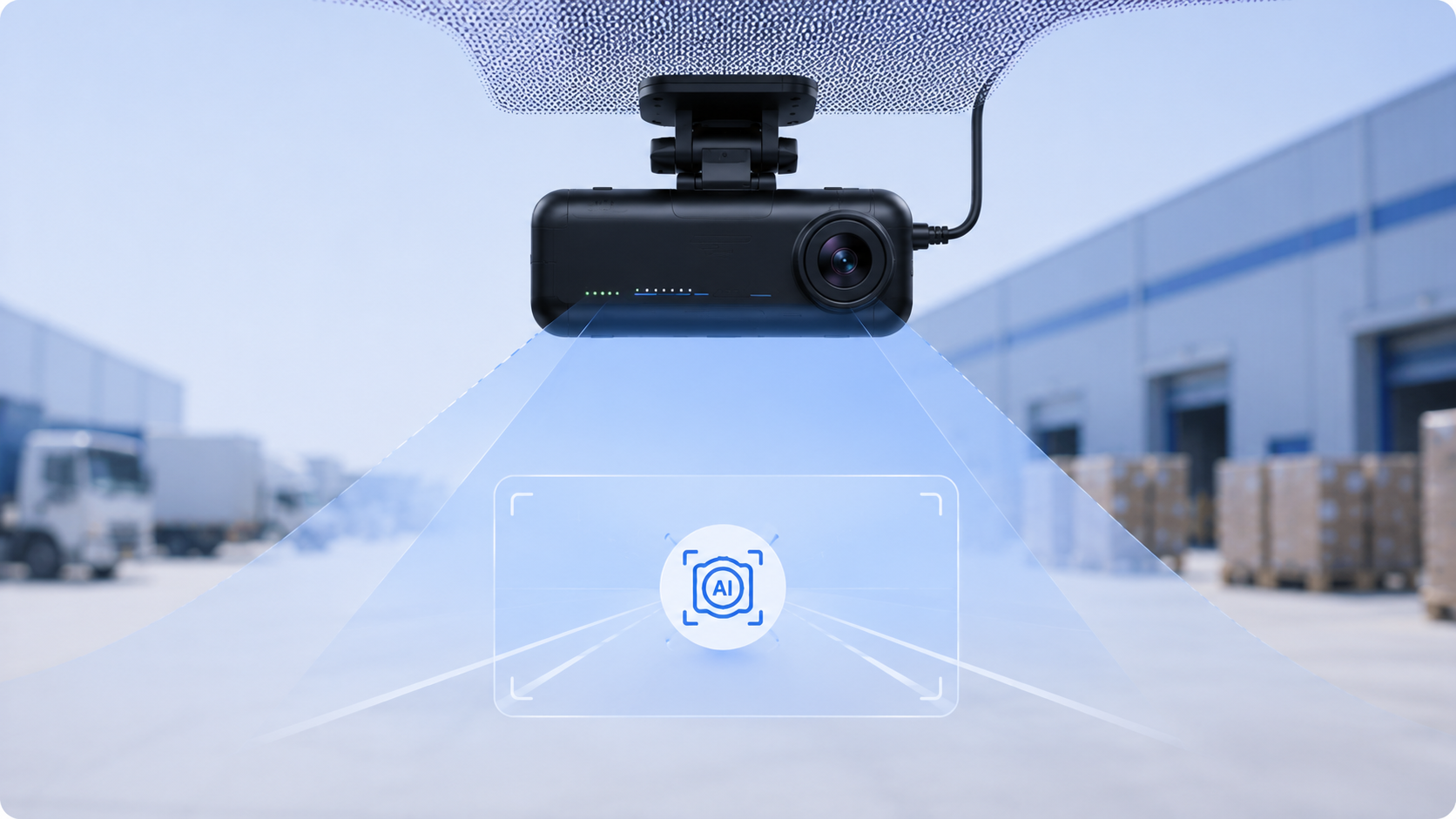
Detection breadth is where vendors differ most, so anchor the evaluation in specifics. A modern AI dashcam for commercial vehicles, of which the Fleetx platform is a reference implementation with over 11 real-time detection categories and 15 alert types, watches for the following, and intervenes rather than merely records:
|
Detection |
How the AI responds |
Why it matters in FMCG distribution |
|
Mobile phone usage |
Detects calling, texting, or
holding a device; triggers an in-cab voice alert and logs evidence for
coaching |
High-frequency urban delivery
runs multiply distraction windows; phone usage is the leading controllable
risk |
|
Fatigue and drowsiness |
Tracks eye closure, yawning, and
head position; escalates with voice alerts and control tower notification |
Multi-trip days and night
dispatches to meet distributor cutoffs make fatigue a structural FMCG hazard |
|
No seatbelt |
Instant detection and reminder,
violation logged to the driver scorecard |
A basic compliance marker that
auditors and courts check first |
|
Forward collision warning |
Monitors following distance and
closing speed, warns the driver seconds before impact risk |
Prevents the rear-end collisions
endemic to congested last-mile corridors |
|
Harsh driving |
Flags hard braking, hard
acceleration, and sharp cornering beyond set g-force thresholds |
Directly correlates with damaged
FMCG cargo, from crushed cartons to leaking liquids |
|
Face mismatch |
Compares the person driving
against the authorized driver profile |
Stops unauthorized driver swaps,
a chronic issue in multi-transporter market vehicle operations |
|
Cargo and load monitoring |
Container-facing cameras detect
door openings and load disturbance, flagged against location |
The anti-pilferage layer: theft
and in-transit damage become visible, attributable events |
|
Smoking and distraction |
Detects smoking and sustained
inattention in the cab |
Protects cargo integrity and
enforces uniform conduct standards across transport partners |
Two platform-level capabilities matter as much as the detections themselves. First, intervention speed: the fleetx dashcam issues its in-cabin AI voice alert in under 2 seconds, in 7 languages including Hindi, Tamil, Marathi, Kannada, and Telugu, which is the difference between correcting a driver mid-mistake and documenting him after one. Second, alert triage: every event is automatically ranked Critical, Urgent, or High, so a control tower watching 2,000 vehicles works a prioritized queue instead of drowning in noise.
Which FMCG-Specific Problems Do Truck Camera Systems Solve?
Generic safety arguments undersell the category for consumer goods operators. Map the technology against the problems an FMCG logistics head actually owns and the case sharpens considerably:
• The multi-transporter governance gap - With 50 to 200 transport partners, safety standards fragment across vendors. A camera system with a central control tower imposes one measurable standard on every vehicle moving your freight, regardless of whose name is on the RC, and produces transporter-level scorecards that turn contract renewals into data-driven decisions.
• OTIF protection - Every accident, breakdown investigation, or police detention is a missed delivery window somewhere downstream. Preventing incidents protects On Time In Full performance more cheaply than expediting freight after them.
• Cargo pilferage and damage disputes - FMCG loads are dense, sellable, and anonymous, which makes them theft-prone. Load-body cameras plus door sensors plus location context turn shrinkage from a monthly write-off into an attributable event with footage. Harsh-driving detection simultaneously cuts the carton damage that fuels distributor claims.
• Freshness and cold chain integrity - For foods and beverages, delay is spoilage. Camera-verified accountability for stoppages, combined with route and temperature telemetry on the same platform, protects both shelf life and audit trails for food safety compliance.
• Driver churn and anonymous workforces - FMCG networks run on thousands of drivers that the brand never meets. Face-match verification, scorecards, and structured coaching create a managed driver population out of an anonymous one, and top-quartile scorecards give transporters a retention and incentive tool.
• Claims defense at FMCG scale - High trip counts mean high claim counts. A 90-day court-admissible archive converts he-said-she-said accident disputes and fraudulent third-party claims into evidence reviews. Fleets typically find that a single overturned false claim pays for a year of cameras on the vehicles involved.
• Audit readiness - Whether the audit comes from a global parent, an insurer, or a regulator, timestamped video plus metadata plus a documented alert-to-closure workflow is the difference between asserting safety culture and proving it.
Which Camera Configuration Fits Which FMCG Vehicle Type?
FMCG networks are not homogeneous, and neither should the camera specification be. Over-specifying every vehicle wastes budget; under-specifying the wrong ones leaves your highest-risk exposure dark. The configuration logic that recurs across enterprise deployments:
|
Fleet segment |
Recommended configuration |
Rationale |
|
Primary trucking (factory to
depot, 16 to 46 ft) |
Dual-facing AI dashcam plus
container-facing camera plus SOS |
Long highway hours make fatigue
and collision the top risks; full loads make cargo accountability essential |
|
Secondary distribution (depot to
distributor LCVs) |
Dual-facing AI dashcam plus
load-area camera |
Urban distraction and harsh
driving dominate; frequent multi-drop handling raises pilferage and damage
exposure |
|
Last-mile and van sales vehicles |
Road plus driver-facing dashcam
for truck cabins, compact form factor |
Highest trip frequency and public
interaction; collision evidence and driver behavior are the priorities |
|
Reefer and cold chain vehicles |
Dual-facing dashcam plus cargo
camera plus temperature telemetry on the same platform |
Every stoppage is a spoilage and
audit event; visual plus thermal context resolves disputes in minutes |
|
Attached market vehicles |
Dual-facing AI dashcam with
face-match enforced |
The least controlled segment of
the network; driver identity verification and uniform standards matter most
here |
A sequencing note: most FMCG deployments start with primary trucking, where per-vehicle freight value and accident severity are highest, then extend to secondary and market vehicles as the control tower workflow matures. The mistake to avoid is the opposite order, instrumenting the easy-owned vehicles first and leaving the multi-transporter fleet, where the governance gap actually lives, for a phase two that never arrives.
What Does an FMCG-Grade Deployment Blueprint Look Like?
Hardware on windshields is the visible layer. The architecture that makes truck camera systems work at FMCG scale is the Safety Control Tower sitting behind them: a central monitoring capability with defined thresholds, automated issue creation, and measured response times. The blueprint below reflects a live enterprise deployment, and the threshold values are worth studying because they encode hard-won operational judgment about what merits an alert:
|
Control tower component |
Configuration in a live FMCG deployment |
Operating principle |
|
Speeding threshold |
Alert when a vehicle exceeds 80
km/h continuously for more than 3 minutes |
Filters momentary overtakes from
sustained risk, keeping the alert queue meaningful |
|
Fatigue threshold |
Alert when continuous driving
exceeds 240 minutes without a mandatory rest break |
Encodes duty-hour discipline
directly into monitoring rather than leaving it to transporter policy |
|
Harsh driving threshold |
Hard acceleration and harsh
braking events beyond 0.3g |
A calibrated line between normal
traffic response and cargo-damaging, accident-adjacent driving |
|
Emergency response |
SOS panic button alerts routed
instantly to the control tower |
Driver distress becomes a tracked
incident within seconds, not a phone call that may never come |
|
Risk-point stoppages |
Alert when a vehicle is
stationary in a designated high-risk location for more than 10 minutes |
The anti-theft and anti-diversion
tripwire, mapped to known pilferage and crime corridors |
|
Issue management module |
Every alert auto-creates a
categorized issue (Emergency, Fatigue, Speeding, Power-Off) with ownership
and response-time tracking |
Converts alerts from
notifications into accountable workflows measured to closure |
|
Driver analytics |
Weighted scorecards across
speeding, fatigue, harsh acceleration, and harsh braking; violators ranked by
transporter and depot |
Makes 2,500+ anonymous drivers
individually measurable and coachable |
|
ERP integration |
Control tower integrated with SAP
BTP so every monitored vehicle maps to a live logistics job |
Safety data and shipment data
converge; roughly 95% of safety issues link to vehicles on active jobs |
Note what this architecture assumes: cameras and telematics generate the raw events, but governance happens in the workflow layer. If a vendor demo shows you video clips and dashboards but cannot show you issue ownership, categorization, and time-to-resolution metrics, you are being shown a recorder with a nicer interface.
How a Global FMCG Company Built a Proactive Fleet Safety Control Tower
Discover how Fleetx helped monitor nearly 1,900 vehicles, resolve 95% of safety incidents within 30 minutes, improve driver accountability, and create centralized visibility across a multi-transporter logistics network.
How Did a Global FMCG Giant Run 1,900 Vehicles Through One Safety Control Tower?
The profile: a global FMCG major whose Indian distribution network spanned approximately 190 transporters, 1,900 vehicles, and more than 2,500 drivers, moving product continuously between depots, distributors, and retail networks.
The starting condition will be familiar to anyone running a large consumer goods network. Safety monitoring tools varied from transporter to transporter. Data sat scattered across systems, with shipment tracking running independently of safety monitoring. There was no unified view of fleet safety, no way to correlate delivery outcomes with driver behavior, and no structured mechanism to track alerts, assign ownership, or measure response times. Incidents were handled after they happened. Driver performance data existed nowhere in an actionable form.
Fleetx deployed a centralized Safety and Logistics Control Tower purpose-built for FMCG-scale operations, with the threshold architecture described in the previous section, a dedicated issue management module, driver scorecards, and SAP BTP integration tying every vehicle to its live logistics job. The measured results:
|
Outcome metric |
Result |
What it means operationally |
|
Safety incident resolution speed |
95% of safety alerts resolved
within 30 minutes |
On-road risk is interrupted
mid-trip, not reviewed in a weekly meeting |
|
Overall issue resolution rate |
90% of all issues tracked to
closure |
Alerts became accountable
workflows rather than ignored notifications |
|
Emergency alerts handled |
About 2,000+ emergency alerts
detected and actioned |
Driver distress and critical
events surface instantly across the whole network |
|
Speeding events surfaced |
About 1,400+ speeding violations
detected monthly |
Sustained risk behavior became
visible, attributable, and coachable at scale |
|
Monitoring coverage |
Roughly 1,900 vehicles across 190
transporters under one tower |
One safety standard imposed
across a fully outsourced, multi-vendor fleet |
|
Safety-to-operations linkage |
About 95% of safety issues linked
to vehicles on active logistics jobs |
Monitoring effort concentrates
exactly where cargo and service exposure is highest |
Strategically, the client converted fleet safety from a fragmented operational headache into a governance capability: centralized visibility across a multi-transporter ecosystem, real-time risk detection, structured incident resolution, and data-driven driver performance management, all embedded directly into daily logistics operations. That is the pattern this entire category is converging toward, and it is worth benchmarking any vendor proposal against it.
What ROI Should FMCG Fleets Expect From Truck Camera Systems?
Camera economics are unusually easy to defend because the losses they prevent are already on your P&L, just scattered across insurance, claims, damaged stock, and expedited freight lines where nobody totals them. The documented outcome ranges from AI video telematics deployments:
|
Impact area |
Documented outcome |
Primary mechanism |
|
Accident frequency |
Up to 90% reduction in accidents |
Real-time in-cab intervention on
phone usage, fatigue, and following distance, plus deterrence from known
monitoring |
|
Repeat violations |
40% reduction in repeat
violations |
Scorecards and targeted coaching
convert one-time alerts into changed behavior |
|
Incident response |
3x faster response |
Severity-ranked alerts and
auto-created issues replace phone trees and morning-after discovery |
|
Review workload |
60% less manual video review |
AI surfaces the events that
matter; teams stop scrubbing hours of routine footage |
|
Claims and insurance |
Fewer claims filed, higher win
rate on disputes |
Court-admissible 90-day archive
with timestamps and metadata settles fault questions quickly |
|
Cargo shrinkage and damage |
Measurable reduction in pilferage
and carton damage |
Load-body cameras, door alerts,
risk-point stoppage monitoring, and harsh-driving control |
Build the business case bottom-up on four numbers you already have: annual accident and incident costs including vehicle downtime, annual cargo shrinkage and damage write-offs, insurance premium plus deductibles paid on disputed claims, and the administrative hours spent investigating incidents. Apply conservative fractions of the outcomes above. In FMCG fleet reviews, the model typically clears payback within the first year on claims and shrinkage alone, before counting accident prevention, which is both the largest and the least monetizable line because it includes the incidents that never happened.
A discipline note for the CFO conversation: never anchor the case on the catastrophic tail event, the multi-crore litigation or the brand crisis. Anchor it on the boring recurring lines, damaged cartons, disputed claims, and repeat violators. The tail risk reduction then arrives as free insurance on top of a case that already closes.
What Should an FMCG RFP for Truck Camera Systems Demand?
Condensing this brief into procurement language, these are the clauses that separate a governance-grade truck camera system from a fleet of recorders. Put each one in the RFP as a written requirement, and score vendors on evidence rather than assurances:
• Detection scope in writing - Minimum: mobile phone usage, fatigue and drowsiness, no seatbelt, forward collision warning, harsh driving with configurable g-force thresholds, face mismatch, and cargo door or load-area monitoring. Demand a live demonstration of each on Indian road footage, not marketing video.
• Intervention latency - In-cab voice alert in under 2 seconds from detection, in the languages your driver population actually speaks. Ask for the measured latency distribution, not the best case.
• Control tower workflow - Auto-created issues with category, ownership, response-time tracking, and closure metrics. Ask to see a live customer's resolution-time dashboard with numbers on it.
• Evidence standards - Minimum 90-day cloud retention, tamper-evident storage, timestamps and metadata suitable for legal proceedings, AIS 140 alignment, and data residency in India.
• Scale references - At least one live deployment above 1,000 vehicles in a multi-transporter Indian network, with a reference call. The FMCG control tower described in this brief is the kind of proof point to benchmark against.
• Deployment commitment - Installation rate per week, depot coverage plan, and a named field engineering capacity. A 72-hour per-batch deployment standard exists in the market; hold vendors to it.
• Platform convergence - Native integration of video with GPS, fuel, temperature, and trip data on one platform, plus documented APIs to your ERP or SAP landscape, so safety events map to live logistics jobs.
• Commercial transparency - Bundled per-vehicle pricing covering hardware, connectivity, software, and support, with exit terms and data portability defined upfront.
One scoring rule keeps the evaluation honest: any capability a vendor cannot demonstrate live, on your routes or a current customer's, scores zero. Truck camera systems are a category where the demo-to-production gap has burned many buyers, and live evidence is the only reliable filter.
How Does the Fleetx Dashcam Stack Compare With Other Options?
Procurement teams typically evaluate four archetypes: a purpose-built AI platform such as Fleetx, basic standalone dashcams, GPS tracking with a camera bolted on, and global enterprise telematics suites. The comparison below consolidates the differences that surface in Indian FMCG evaluations, drawn from the Fleetx video telematics platform specification:
|
Capability |
Fleetx |
Basic dashcam |
GPS + camera |
Global enterprise suite |
|
AI video telematics |
15 alert types, data stored in
India |
Motion and impact detection only |
None |
Strong AI, but models miss Indian
road conditions |
|
Real-time driver alert |
In-cabin AI voice alert in under
2 seconds, 7 languages |
Push notification, often ignored |
No driver-facing response |
Typically 15+ minute lag via
review teams |
|
India road AI training |
31 billion+ data points per month
from Indian roads |
No learning loop |
No AI |
Trained largely on US and EU
driving data |
|
Fleet platform integration |
Unified with FMS, TMS, fuel, and
control tower on one platform |
Standalone app per device |
No operations connection |
Possible, but API projects
required |
|
Deployment speed |
Around 72 hours, backed by 600+
engineers on the ground |
Self-install over weeks |
Weeks |
8 to 16 week proof of concept
cycles |
|
Evidence archive |
90-day court-admissible archive,
AIS 140 aligned |
7-day loop overwrite |
None |
Often sold as a paid add-on |
|
Pricing model |
Bundled subscription, no surprise
line items |
Hardware purchase, INR 8K to 25K
per unit |
Hardware cost plus basic tracking
fee |
USD pricing, enterprise contracts |
Three details in that matrix deserve an FMCG reader's attention. The 2-second in-cab intervention is the line between prevention and documentation. The India-trained AI matters because a model that has never seen a mixed-traffic Indian arterial road generates false positives that erode driver trust within weeks. And the 72-hour deployment window matters because FMCG networks cannot pause distribution for a technology rollout; cameras have to go in between trips, depot by depot, without touching service levels.
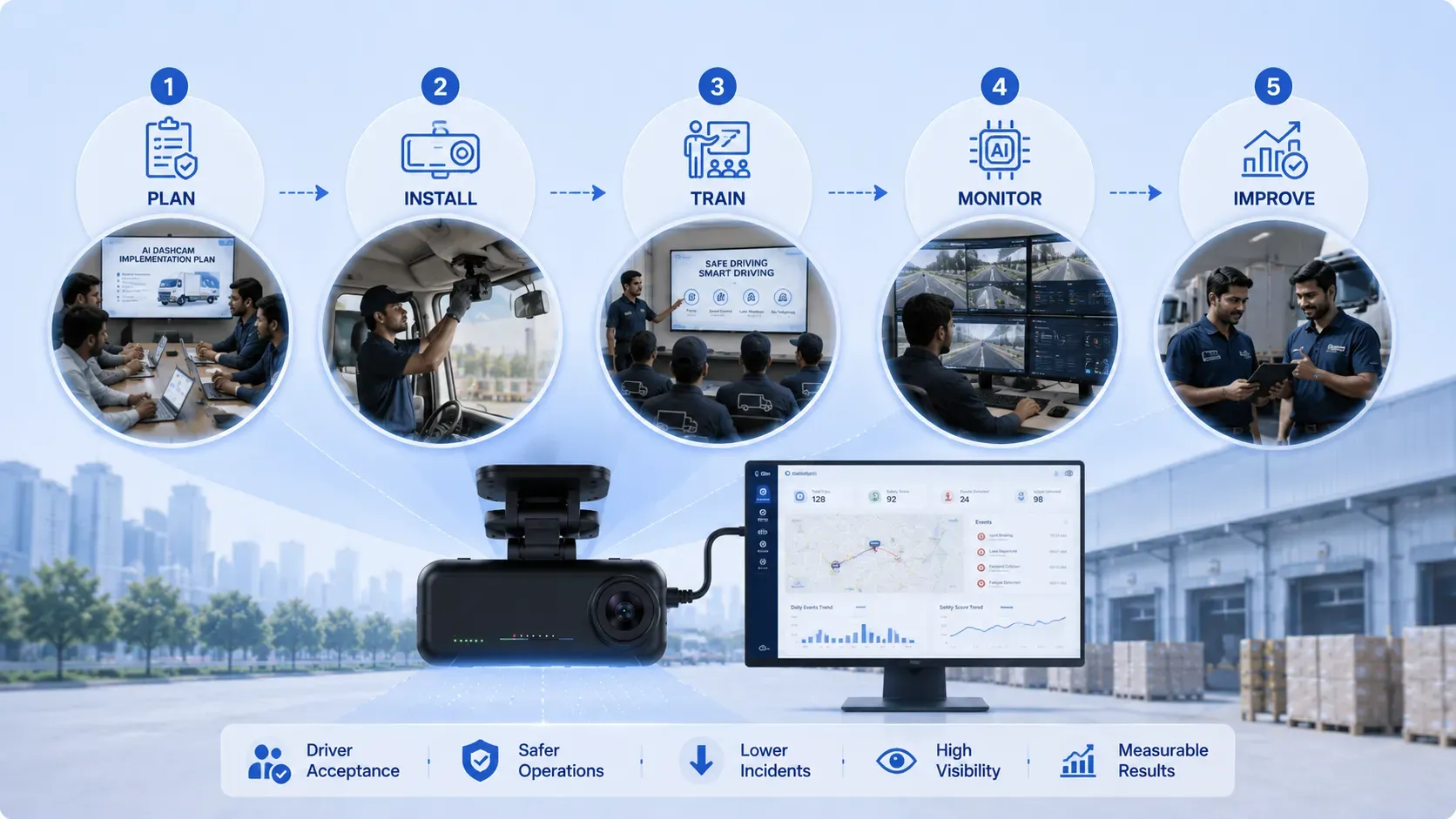
How Do You Roll Out Cameras Across 100+ Transporters Without Objections?
The technology is the easy half of this brief. Cameras watch people, and people who feel watched without consent push back: devices get unplugged, lenses get covered, transporters quietly resist. Every large FMCG deployment that succeeded followed a version of the same seven-step sequence, and every failed one skipped at least two of these steps:
- Write the safety standard before buying hardware
Define thresholds, alert categories, response ownership, and escalation paths as a documented policy. The FMCG deployment profiled above worked because 80 km/h for 3 minutes, 240-minute fatigue limits, and 0.3g harsh-driving thresholds were codified rules, not vendor defaults.
- Bring transporters in as partners, not subjects
Present transporter-level scorecards as a fair, uniform standard that protects good operators from being undercut by careless ones. Tie scores to contract reviews transparently, and give every transporter access to their own data.
- Frame cameras to drivers as protection first
The honest pitch: the archive defends drivers against false accident claims and wrongful blame, the SOS button summons help, and fatigue alerts exist because the schedule, not the driver, is often the problem. This framing is factually true and decides adoption.
- Pair every penalty with an incentive
Publish scorecards with rewards for top performers, per trip or per month. Deployments that only punish the bottom of the table breed sabotage; deployments that pay the top of the table breed competition.
- Pilot on 10 to 15 percent of vehicles across your hardest lanes
Prove the alert thresholds, the false-positive rate, and the control tower workflow on real routes before network-wide rollout. Publish the pilot's incident and resolution numbers internally.
- Stand up the control tower with named ownership
Alerts without owners are noise. Assign categories, response-time targets, and closure tracking from day one; the 95 percent within 30 minutes benchmark is a workflow achievement, not a hardware one.
- Review at 90 days against the written standard
Violations per lakh kilometres, repeat-violator counts, resolution times, and claims outcomes. Expand thresholds, retire noisy alerts, and take the results to transporter business reviews.
Privacy discipline is part of the rollout, not an afterthought: define who can view footage, for what purpose, with what retention, and communicate it in writing to drivers and transporters. A camera program with clear privacy rules earns trust; one without them earns a union dispute.
Where Are Truck Camera Systems Heading Next for FMCG?
Four developments are close enough to influence a 2026 procurement decision, and a system bought today should have a credible path to all four:
• From alerts to autonomous triage - AI control towers increasingly close routine events themselves, voice-coaching the driver, logging the outcome, and escalating only genuine exceptions to humans. At a 2,000-vehicle scale, this is the only trajectory that keeps monitoring headcount flat while coverage grows.
• Cargo intelligence beyond the door sensor - Camera AI is moving from detecting that a container opened to understanding what happened inside it: load shift, carton counts at loading versus unloading, and tampering signatures. For FMCG shrinkage control, this is the next major unlock.
• Safety data as commercial currency - Transporter scorecards are starting to flow into freight procurement, insurance pricing, and even distributor SLAs. FMCG shippers that accumulate two years of clean, evidenced safety data will negotiate from a structurally stronger position than those starting cold.
• Convergence onto one platform - Cameras, GPS, fuel sensors, temperature probes, and TMS data are collapsing into single-platform architectures. Buying video as an isolated point solution in 2026 means paying for an integration project in 2027; the evaluation should assume the camera system and the fleet platform are one decision.
What Should FMCG Leaders Do About Truck Camera Systems Now?
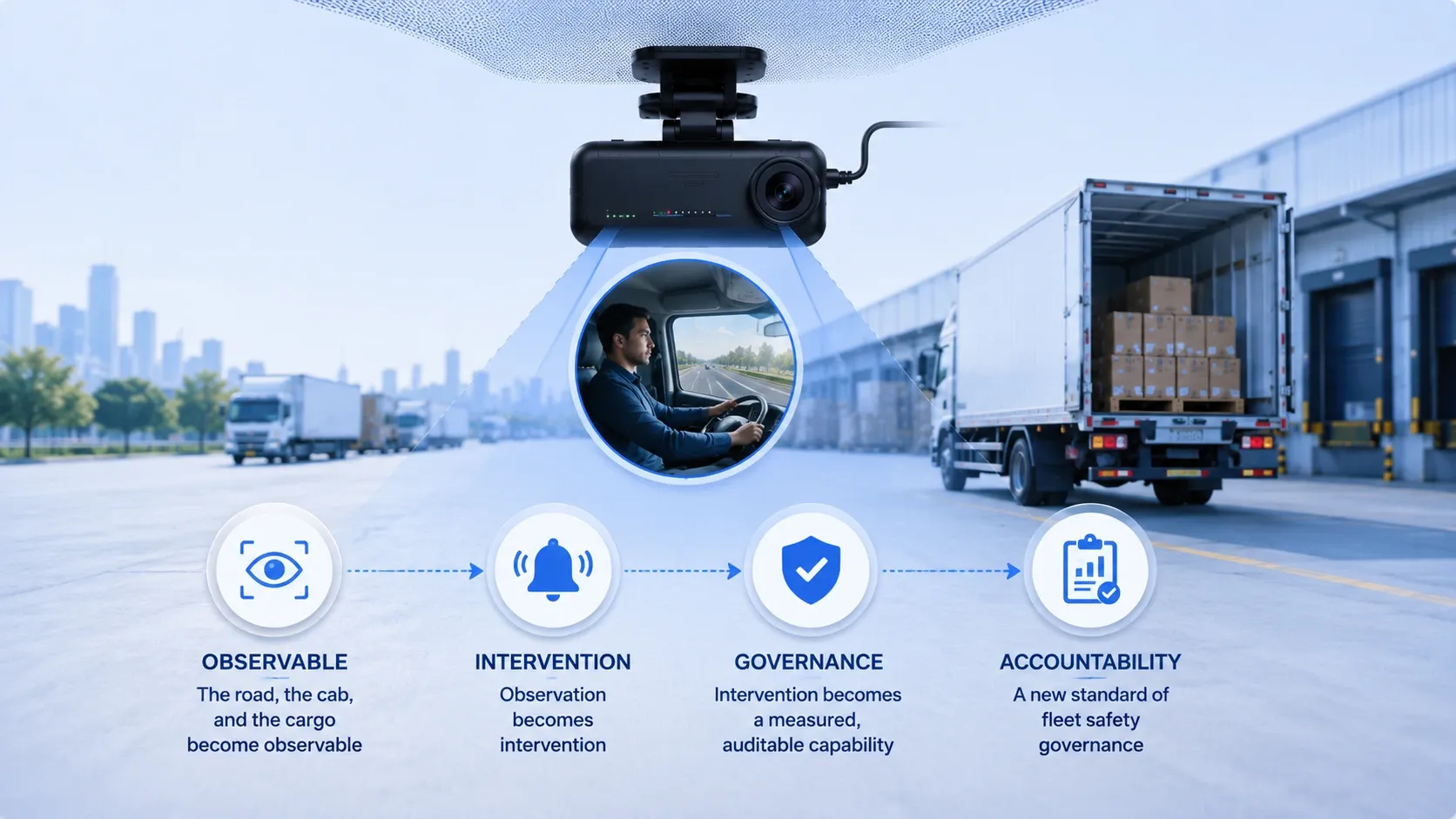
Return to the exposure this brief opened with. Your brand moves through India on vehicles you do not own, driven by people you have never met, through conditions you cannot control. For decades the honest description of FMCG fleet safety governance was hope, formalized into transporter contracts nobody could verify. Truck camera systems end that era. The road, the cab, and the cargo become observable; observation becomes intervention; intervention becomes a measured, auditable governance capability.
The action sequence is short. Write your safety standard. Pilot an AI camera system on your hardest corridors with a real control tower behind it. Measure resolution times, repeat violations, and claims outcomes against your baseline. Then scale transporter by transporter with scorecards, incentives, and written privacy rules. The reference deployment in this brief covered 1,900 vehicles and 190 transporters, resolved 95 percent of safety incidents within 30 minutes, and turned more than 2,500 anonymous drivers into a managed, coachable workforce. That is not a pilot result. That is the operating standard your network will eventually be compared against.
If you want to see the standard running live, the Fleetx video and cargo safety platform, with its dual-facing AI dashcam, container cameras, sub-2-second in-cab intervention, and 90-day court-admissible archive, is documented, and a demo can be scheduled on your own routes with your own transporters.
Nothing moves without intelligence watching. In FMCG distribution, that is no longer a product tagline. It is the emerging definition of a well-run network.