
The chain of supply chain functions, globally, starts with Inbound logistics. It is the foundational pillar in the production cycle and optimization efforts are ongoing. Varied obstacles arise in the process of receiving, moving, and storing raw materials and components that are essential for the production of goods or rendering services, covering sectors such as:
- Manufacturing
- Retail
- Construction
- Healthcare
Let’s explore the scope of inbound logistics, the associated challenges, and ways to manage those. Technology has played a crucial role in transforming other sectors and here we’ll discuss its transformative potential in inbound functions.
What is Inbound Logistics - The Core Components
There are multiple stages involved in the inbound logistics system, some of which are:
Material Sourcing
Identifying and selecting the material supplier with competitive rates and suitable delivery terms is one of the most significant parts of the process. The quality of the materials determines the quality of the finished goods.
Purchase Transactions
The raw material purchase involves suppliers’ purchase agreement negotiations that include pricing, delivery timelines, and agreeing on the terms of payment.
Materials Transportation
This stage is all about coordinating the movement of goods from one point to another, commonly from the suppliers to the manufacturer’s warehouses or production facilities. The process requires working with shipment carriers, brokers, and other logistics stakeholders to ensure timebound and cost-effective deliveries.
Storage Facilities
Different categories of materials require several forms of organization and storage means for their most optimum utility in production. Temperature, hygiene measures, available storage capacity, packing material, etc. are essential considerations at this stage.
Quality Assurance
Before being used in production, the materials have to be inspected upon receipt to verify their compliance with the industry standards in the next stages.
Through effective management of these activities, businesses can save on costs incurred, enhance visibility into the supply chain functions, and improve their market competitiveness.
Broad Differences Between Inbound and Outbound Logistics
Inbound and outbound are two entirely different divisions in logistics operations. The functional differences are:
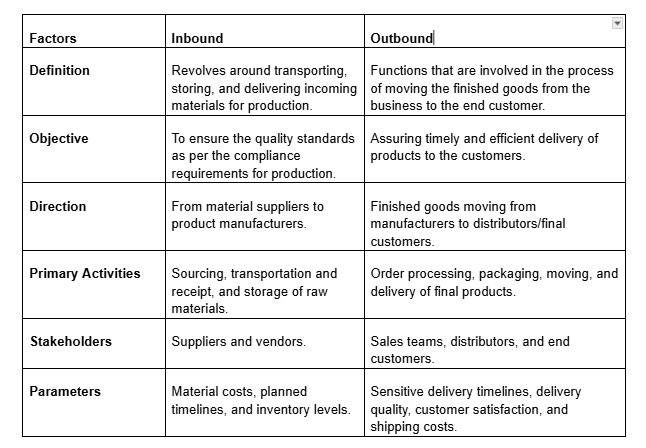
Both processes are independent of one another yet, are essential to ensure the efficiency and competitiveness of the overall supply chain.
Role of Inbound Logistics in Production
Let’s consider a cement manufacturer’s operations. They would require several raw materials, the basics being:
- Limestone
- Clay or shale
- Pozzolans
- Iron ore
- Gypsum
- Fly ash
Ordering lesser volumes of materials would hamper production, and higher order volumes would create stagnant inventory levels leading to higher costs. So, optimizing inbound logistics management results in the timely availability of the required materials in adequate quantities, optimizing costs and business profits.
Challenges in Inbound Logistics
Logistics comprises a wide variety of challenges and those associated with the inbound process are:
Transportation Hurdles
Multiple situations can lead to dysfunctional shipment schedules – unavailability of vehicles, natural calamities, vehicle breakdowns, and unplanned route diversions, are some.
Insufficient Visibility
Lack of supervision into inbound functions increases risks of accidents or thefts, idling, and route-related violations, leading to untimely delivery and inadequate quantities, ultimately causing financial business losses.
Improper Unloading Practices
Long queues outside and within the plant gates are common sights, leading to delays and goods damage, and ultimately the outbound operations.
Communication Shortcomings
The involvement of multiple stakeholders and the unavailability of a centralized communication platform breaks the efficient flow of information related to delivery progress, bottlenecks, costs, and more.
Increasing Costs
The inbound costs rise significantly due to various factors that include unplanned route diversions, and vehicle idling, among other factors that make inbound processes an expensive affair.
Businesses require updated and cost-effective visibility solutions to monitor the detailed aspects of the entire process and solve inefficiencies.
How to Improve Inbound Logistics with the Power of AI?
At Fleetx, our 7+ years of industry experience have enabled us to get a clear picture of the logistics landscape. Our constant problem-solving outlook has equipped us to innovate more efficient, transparent, and responsive solutions using artificial intelligence (AI) and has fueled us to develop inbound logistics best practices.
Planning & Visibility
The integrated and unified Transportation Management platform (TMS) manages end-to-end freight movement, addressing the issues of higher freight cost, inefficient planning, lack of visibility into the freight movement, and unavailability of an automated, centralized platform.
Contracts Management
Digital contract management is the nerve center for tracking and monitoring all transactional SLAs and is ideal for conducting freight audits. Such centralization of all contracts manages the complete lifecycle while recording and tracking the history of all changes implemented.
Spot Auction
An automated, negotiation-free process that saves valuable time by conducting auctions, receiving bids, and sending indents via WhatsApp for quick and easy communication.
Dispatch Planning
A route optimization tool to optimize transportation and reduce costs based on factors such as distance, on-road traffic, and others. Load planner optimizes the vehicle space utilization and multi-point unloading of the goods.
Vehicle Indenting
Transporters can send vehicle requisitions digitally and collaboratively, with ready visibility into each transporter’s share of the business and reporting ETA at origin.
Digital Proof of Delivery
The consignee can easily capture the real-time condition of the goods and also trace the FTL and PTL shipments and manage detentions through auto-capturing of truck entry and exit times. These automated features are crucial in ensuring a seamless freight settlement.
Inbound Logistics Optimization - How is Fleetx Control Tower Making a Difference?
One of the core aspects of the Fleetx software is the virtual tracking capability. The capabilities include:
● The virtual control tower monitors each trip against the contract SLAs
● Single interface to view all FTL & PTL shipments in transit
● View and manage all deviations and escalations easily at origin, in transit, and destination
● Auto application of SLA parameters on freight invoices
Optimize Inbound Logistics with Futuristic Solutions: Partner with Fleetx
A growing business’ reliance on technology is not a mere trend but a vital necessity. A technology-driven approach enhances accuracy and speed, thereby maximizing customer satisfaction. In the modern competitive marketplace, keeping the customers satisfied and engaged is the key to long-term success.
Fleetx’s AI-driven solutions have been significantly successful in redefining the inbound logistics landscape in India. Our clients have achieved a more advanced, efficient, and sustainable logistics framework, resulting in overall business success.
AI-Powered Inbound Logistics KPIs: Measuring Performance Beyond On-Time Deliveries
Most organizations measure inbound logistics performance using only a handful of indicators such as on-time deliveries or freight costs. While these metrics provide a basic understanding of operational efficiency, they rarely reveal the root causes of recurring supply chain disruptions. Modern inbound logistics requires a more comprehensive performance measurement framework that combines operational, financial, supplier, and customer-centric metrics. Artificial Intelligence (AI) enables businesses to continuously monitor these Key Performance Indicators (KPIs) in real time, identify anomalies before they become costly problems, and recommend corrective actions automatically.
For manufacturers, distributors, retailers, and infrastructure companies operating across India, including Delhi NCR, Gurgaon, Mumbai, Bengaluru, Pune, Chennai, Ahmedabad, and Hyderabad, measuring inbound logistics performance has become increasingly important due to rising transportation costs, supplier diversification, and growing customer expectations. AI-powered Transportation Management Systems (TMS) provide centralized dashboards that convert raw logistics data into actionable business intelligence, enabling organizations to make faster and more informed operational decisions.
Why Traditional Logistics KPIs Are No Longer Enough
Traditional reporting often focuses on historical performance. Logistics managers review delivery reports after shipments have already been completed, leaving little opportunity to prevent delays or optimize transportation while goods are still in transit. AI fundamentally changes this approach by continuously analyzing live shipment data collected from GPS devices, IoT sensors, transport management platforms, warehouse systems, and supplier networks.
Instead of asking, "Why was the shipment delayed?" AI helps answer, "Which shipment is likely to be delayed in the next few hours, and what should be done now?" This predictive capability allows businesses to reduce disruptions before they affect production schedules or customer commitments.
Furthermore, organizations with multiple manufacturing plants and hundreds of suppliers often struggle to identify patterns hidden within thousands of logistics transactions. Machine learning algorithms automatically recognize trends, seasonal demand fluctuations, recurring supplier issues, inefficient transportation routes, and warehouse congestion, enabling continuous operational improvement without relying solely on manual analysis.
Essential KPIs for AI-Powered Inbound Logistics
A comprehensive inbound logistics strategy should monitor multiple categories of performance metrics rather than relying on isolated indicators.
Supplier On-Time Delivery Performance
One of the most critical metrics is supplier delivery reliability. AI continuously evaluates supplier performance by comparing promised delivery schedules against actual arrival times. Businesses can identify consistently underperforming vendors, negotiate stronger service-level agreements, or diversify supplier networks before production is affected.
Shipment Visibility Rate
Visibility measures the percentage of inbound shipments that can be monitored in real time. Companies with complete shipment visibility are able to respond more effectively to route diversions, vehicle breakdowns, traffic congestion, weather disruptions, or unforeseen operational risks.
Estimated Time of Arrival (ETA) Accuracy
Predictive ETA accuracy directly impacts warehouse scheduling and production planning. AI considers live traffic conditions, historical travel patterns, vehicle speed, weather forecasts, driver behaviour, and route deviations to provide highly accurate delivery predictions. Improved ETA accuracy reduces unloading congestion and enables warehouses to allocate labour more efficiently.
Inventory Availability
Maintaining optimal inventory levels is one of the primary objectives of inbound logistics. AI-powered forecasting ensures raw materials arrive exactly when required, minimizing both stock shortages and excessive inventory carrying costs. Better inventory availability directly supports uninterrupted production and stronger customer service.
Warehouse Turnaround Time
Warehouse efficiency depends heavily on how quickly inbound vehicles are processed. Measuring vehicle gate entry, unloading duration, document verification, and exit times enables businesses to identify bottlenecks that increase detention charges and reduce warehouse productivity. AI automatically detects unusual delays and recommends scheduling improvements.
Transportation Cost Per Shipment
Rather than evaluating only total freight expenditure, organizations should monitor transportation costs per shipment, per kilometre, per supplier, and per product category. AI identifies opportunities for route optimization, vehicle consolidation, improved load utilization, and freight contract optimization to reduce transportation expenses.
Supplier Compliance Score
AI evaluates supplier adherence to purchase order quantities, documentation requirements, packaging standards, delivery windows, and quality compliance. This score helps procurement teams strengthen vendor relationships while minimizing operational disruptions caused by inconsistent supplier performance.
How AI Converts Logistics Data into Actionable Decisions
Collecting logistics data alone does not improve operational performance. The real advantage lies in transforming data into recommendations that logistics managers can immediately implement.
For example, if multiple supplier shipments destined for a manufacturing facility in Pune are delayed because of highway congestion, AI can automatically suggest alternative transport routes, revise unloading schedules, notify warehouse managers, update procurement teams, and generate revised production forecasts—all without requiring manual intervention.
Similarly, if a supplier based in Delhi repeatedly exceeds agreed delivery timelines, AI identifies the trend, calculates its financial impact, and recommends corrective measures such as alternate sourcing strategies or revised procurement schedules. These predictive capabilities reduce decision-making time while improving supply chain resilience.
Another significant advantage is automated exception management. Instead of monitoring every shipment individually, logistics teams receive alerts only when shipments deviate from expected performance parameters. This enables managers to focus on solving high-priority operational issues rather than reviewing routine logistics updates.
Business Benefits of KPI-Driven Inbound Logistics
Organizations that establish a structured KPI framework supported by AI consistently experience measurable operational improvements. Better shipment visibility reduces uncertainty across procurement and warehouse operations. Predictive analytics minimizes production interruptions by ensuring materials arrive according to manufacturing schedules. Route optimization lowers transportation expenses while improving vehicle utilization.
Businesses also benefit from improved supplier accountability because objective performance metrics create greater transparency during contract negotiations. Procurement decisions become increasingly data-driven rather than based solely on historical relationships or manual assessments.
From a financial perspective, improved inbound logistics performance contributes to lower inventory carrying costs, reduced emergency procurement, fewer detention charges, optimized warehouse labour allocation, and stronger return on logistics investments. These improvements become increasingly significant for organizations managing high shipment volumes across India's major industrial and manufacturing hubs.
Building a Culture of Continuous Improvement
The most successful logistics organizations treat KPI measurement as an ongoing process rather than a periodic reporting exercise. AI-powered dashboards provide continuous feedback that allows businesses to benchmark performance against historical trends, identify emerging risks, and refine operational strategies over time.
As supply chains become more interconnected and customer expectations continue rising, organizations that measure only traditional logistics metrics risk missing opportunities for operational optimization. By adopting an AI-driven KPI framework, businesses gain deeper visibility into every stage of inbound logistics while building a smarter, more agile, and future-ready supply chain capable of supporting sustainable long-term growth.
This data-driven approach not only improves day-to-day logistics execution but also strengthens strategic decision-making, helping organizations respond confidently to market fluctuations, supplier disruptions, changing transportation conditions, and increasing operational complexity.
Industry-Wise Inbound Logistics Best Practices: How AI Creates Competitive Supply Chains Across Different Sectors
Although the fundamental objective of inbound logistics remains the same—ensuring that raw materials and goods arrive at the right place, in the right quantity, and at the right time—the operational requirements differ significantly across industries. A pharmaceutical manufacturer prioritizes product integrity and regulatory compliance, while an automotive manufacturer focuses on just-in-time inventory. Similarly, retail businesses aim to maintain product availability during seasonal demand spikes, whereas construction companies require synchronized deliveries across multiple project sites.
This variation makes a one-size-fits-all inbound logistics strategy ineffective. Modern organizations are increasingly adopting AI-powered Transportation Management Systems (TMS), predictive analytics, and intelligent supply chain platforms that can be configured according to industry-specific logistics requirements. These technologies enable businesses to improve procurement planning, supplier collaboration, inventory visibility, transportation efficiency, and warehouse operations while reducing operational costs.
Across India's major industrial regions—including Delhi NCR, Gurgaon, Mumbai, Pune, Bengaluru, Chennai, Ahmedabad, and Hyderabad—digital transformation has become a strategic priority as businesses seek greater resilience against transportation disruptions, fluctuating demand, and increasingly complex supplier networks.
How AI Adapts to Different Industry Requirements
Artificial Intelligence improves inbound logistics by learning from historical shipment patterns, supplier performance, inventory consumption, transportation delays, and warehouse operations. Instead of applying identical workflows across every business, AI continuously adapts recommendations according to each industry's operational priorities.
For example, an automotive manufacturer requires component synchronization because missing even a single part can halt an entire production line. An FMCG company, however, focuses on maintaining high inventory turnover while minimizing warehouse congestion. Pharmaceutical organizations require complete traceability and temperature-controlled transportation, whereas construction companies prioritize project-based material scheduling across multiple delivery locations.
By combining machine learning with real-time logistics visibility, businesses can improve operational efficiency while supporting industry-specific compliance requirements and customer expectations.
Industry Comparison: Inbound Logistics Requirements and AI Benefits
| Industry | Primary Inbound Logistics Challenge | AI-Powered Solution | Key Business Benefits |
|---|---|---|---|
| Manufacturing | Supplier delays affecting production | Predictive ETAs, supplier performance analytics, automated procurement alerts | Reduced production downtime, improved inventory planning |
| Automotive | Just-in-Time inventory coordination | AI scheduling, component tracking, route optimization | Higher production efficiency, lower inventory carrying costs |
| FMCG | High shipment volumes and seasonal demand | Demand forecasting, warehouse scheduling, transportation optimization | Faster replenishment, improved inventory turnover |
| Pharmaceutical | Regulatory compliance and temperature-sensitive shipments | IoT monitoring, AI exception alerts, digital documentation | Product integrity, compliance, reduced spoilage |
| Retail & E-commerce | Rapid inventory replenishment across multiple locations | AI inventory forecasting, shipment visibility, warehouse automation | Improved product availability and customer satisfaction |
| Construction | Coordinating deliveries across multiple project sites | Dynamic routing, delivery scheduling, supplier collaboration | Reduced material shortages and project delays |
| Food & Beverage | Perishable inventory management | Predictive inventory planning, cold chain monitoring, automated ETA updates | Reduced wastage and improved freshness |
| Chemicals & Industrial Materials | Hazardous material transportation compliance | AI route planning, digital compliance monitoring, transporter tracking | Improved safety, reduced operational risks |
Best Practices for Building a High-Performance Inbound Logistics Network
Regardless of industry, organizations that consistently outperform competitors follow several common best practices that improve visibility, reduce costs, and strengthen supplier collaboration.
The first priority is establishing complete digital visibility across supplier operations. Every shipment should be trackable from dispatch to warehouse receipt through centralized dashboards that provide live location updates, predictive ETAs, and automated notifications. This visibility enables procurement teams, warehouse managers, and production planners to coordinate activities using a single source of truth.
The second priority is supplier performance management. Instead of evaluating suppliers only during contract renewals, businesses should continuously monitor delivery reliability, documentation accuracy, order fulfilment rates, transit performance, and quality compliance. AI-generated supplier scorecards simplify procurement decisions while encouraging long-term operational improvements.
Warehouse readiness is equally important. AI-powered dock scheduling ensures vehicles arrive according to available unloading capacity, reducing congestion, detention charges, and unnecessary waiting times. Dynamic labour planning further improves productivity by matching workforce availability with expected shipment volumes.
Organizations should also integrate inbound logistics with ERP systems, warehouse management software, procurement platforms, and finance applications. Integrated systems eliminate duplicate data entry, reduce manual errors, accelerate purchase order reconciliation, and improve decision-making across departments.
Another emerging best practice is predictive risk management. Instead of responding after disruptions occur, AI identifies potential risks such as traffic congestion, adverse weather conditions, supplier delays, vehicle breakdowns, and route deviations before they affect production schedules. Logistics managers can proactively reroute shipments, adjust warehouse schedules, or notify procurement teams, significantly reducing operational disruption.
Why Industry-Specific Logistics Strategies Improve Business Performance
Businesses often invest heavily in logistics technology but fail to realize its full value because they deploy generic workflows rather than configuring solutions according to industry-specific operational requirements. AI-powered inbound logistics platforms provide significantly greater value when customized around procurement cycles, supplier ecosystems, production schedules, regulatory requirements, and transportation patterns unique to each sector.
This tailored approach enables organizations to reduce transportation costs, improve supplier collaboration, strengthen inventory planning, increase warehouse efficiency, and minimize operational risks simultaneously. It also supports long-term scalability as businesses expand into new manufacturing locations, supplier networks, and regional markets.
For organizations operating across India's rapidly evolving industrial landscape, industry-specific AI-powered inbound logistics has become a strategic competitive advantage rather than simply another operational improvement initiative. Companies that embrace this approach are better positioned to build resilient, efficient, and future-ready supply chains capable of adapting to changing market conditions while consistently delivering superior operational performance.
Frequently Asked Questions
What is inbound logistics, and why is it important for modern supply chains? ▼
Inbound logistics refers to the planning, transportation, receiving, storage, and management of raw materials, components, and supplier shipments before production begins. It forms the foundation of every manufacturing, retail, FMCG, pharmaceutical, automotive, construction, and e-commerce supply chain. When inbound logistics operates efficiently, manufacturers receive the right materials in the right quantity at the right time, reducing production delays, inventory carrying costs, and operational risks.
Across India, businesses in Delhi NCR, Gurgaon, Mumbai, Bengaluru, Pune, Chennai, and Hyderabad are increasingly adopting AI-powered inbound logistics solutions because supplier networks have become more complex. Companies now manage multiple vendors, transporters, warehouses, and production facilities simultaneously. Manual coordination through spreadsheets, phone calls, and emails often creates visibility gaps that increase logistics costs.
Modern inbound logistics software combines Transportation Management Systems (TMS), AI analytics, GPS vehicle tracking, automated ETA prediction, freight auditing, route optimization, digital proof of delivery, and supplier collaboration into one platform. These technologies help businesses reduce detention time, improve warehouse scheduling, optimize truck utilization, and ensure uninterrupted production.
For organizations aiming to build resilient supply chains, investing in intelligent inbound logistics management is no longer optional. It helps improve procurement efficiency, reduce freight costs, strengthen supplier relationships, and deliver better business outcomes while supporting scalable growth across India's rapidly evolving logistics ecosystem.
What are the biggest inbound logistics challenges in India, and how can AI help overcome them? ▼
Indian supply chains face several operational challenges that directly affect inbound logistics performance. Delayed supplier deliveries, traffic congestion, unpredictable weather, vehicle shortages, warehouse bottlenecks, manual documentation, communication gaps, and lack of shipment visibility often increase logistics costs and delay production schedules.
Large industrial hubs such as Delhi NCR, Gurgaon, Mumbai, Pune, and Bengaluru experience additional complexity because thousands of supplier shipments move simultaneously every day. Manufacturing plants frequently struggle with truck congestion, gate delays, unloading inefficiencies, inventory mismatches, and inconsistent transporter performance.
Artificial Intelligence addresses these challenges through predictive analytics and automation. AI-powered logistics platforms continuously monitor shipment progress, estimate arrival times, recommend optimized routes, detect delivery exceptions, and automatically notify stakeholders before disruptions escalate. Machine learning algorithms also analyze historical freight data to identify recurring delays and suggest process improvements.
Businesses using AI-driven Transportation Management Systems can also automate freight allocation, optimize warehouse dock scheduling, reduce vehicle idle time, improve supplier coordination, and increase inventory accuracy. Digital dashboards provide real-time visibility across every shipment instead of relying on manual updates.
As India's manufacturing and infrastructure sectors continue expanding under initiatives like Make in India, AI-enabled inbound logistics is becoming a strategic investment that improves operational efficiency, lowers transportation costs, minimizes production interruptions, and supports sustainable long-term supply chain growth.
Which is the best inbound logistics software in India for manufacturers and enterprises? ▼
The best inbound logistics software depends on business size, shipment volumes, supplier complexity, and operational objectives. Organizations should look for platforms that combine Transportation Management, supplier collaboration, freight auditing, AI-powered route optimization, real-time vehicle tracking, warehouse visibility, contract management, digital proof of delivery, and analytics within one integrated solution.
For manufacturers operating across Delhi, Gurgaon, Mumbai, Bengaluru, Pune, Ahmedabad, and other industrial corridors, enterprise-grade platforms like Fleetx provide comprehensive inbound logistics capabilities that improve visibility from supplier dispatch to warehouse receipt. Such platforms help businesses reduce delays, optimize transportation costs, automate documentation, and improve coordination across procurement, logistics, and warehouse teams.
Before selecting software, businesses should evaluate features such as predictive ETAs, AI recommendations, automated alerts, transporter management, GPS integration, ERP compatibility, analytics dashboards, scalability, and customer support. A cloud-based solution also offers faster implementation and easier expansion as operations grow.
Rather than choosing software solely based on price, companies should calculate long-term return on investment through lower freight expenses, fewer production stoppages, improved supplier performance, higher inventory accuracy, and better customer service. The best inbound logistics software delivers measurable operational improvements while supporting digital transformation initiatives across India's increasingly competitive logistics and supply chain landscape.
How much does inbound logistics software cost in India? ▼
The cost of inbound logistics software in India varies depending on the size of the business, the number of vehicles and suppliers, monthly shipment volumes, required integrations, and the level of automation. Small businesses typically require basic transportation visibility and shipment tracking, whereas medium and large enterprises often need AI-powered route optimization, freight audit, contract management, warehouse coordination, ERP integration, analytics, and supplier collaboration.
As a general estimate, cloud-based inbound logistics solutions for SMEs can start from approximately ₹25,000–₹75,000 per month, while mid-sized organizations usually invest between ₹1 lakh and ₹5 lakh per month depending on users, shipment volumes, and features. Large enterprises operating across multiple manufacturing plants in Delhi NCR, Gurgaon, Mumbai, Bengaluru, Pune, Chennai, or Hyderabad often opt for customized enterprise pricing based on logistics complexity and implementation scope.
Implementation charges may vary depending on ERP integrations, data migration, training, and onboarding. Businesses should also evaluate the long-term savings achieved through lower freight costs, reduced detention charges, better truck utilization, fewer production delays, improved supplier performance, and higher inventory accuracy. In many cases, organizations recover their investment within a relatively short period through operational efficiencies.
Instead of choosing the lowest-priced solution, businesses should focus on total value delivered. A scalable AI-powered inbound logistics platform provides significantly better ROI by improving visibility, automating workflows, reducing manual effort, and enabling data-driven decision-making across the supply chain.
What features should businesses look for in a top AI-powered inbound logistics platform? ▼
Choosing a top inbound logistics platform involves much more than selecting shipment tracking software. Modern organizations require a centralized solution capable of managing procurement logistics, transportation planning, warehouse coordination, supplier communication, freight auditing, and operational analytics from a single interface.
The most important feature is end-to-end shipment visibility. Businesses should be able to monitor supplier dispatches, truck movements, estimated arrival times, unloading progress, delivery confirmations, and freight settlements in real time. AI-powered predictive ETAs and automated alerts help logistics teams respond proactively to delays before they impact production schedules.
Other valuable capabilities include route optimization, digital proof of delivery, vehicle indenting, contract lifecycle management, supplier scorecards, dock scheduling, automated freight calculations, invoice validation, GPS integration, geofencing, ERP compatibility, and customizable dashboards. Analytics should provide insights into transporter performance, detention time, freight spend, turnaround time, and vendor reliability.
For enterprises operating across India—including manufacturing hubs such as Delhi, Gurgaon, Mumbai, Pune, Bengaluru, Ahmedabad, and Chennai—cloud deployment, mobile accessibility, multilingual support, strong cybersecurity, and responsive customer service are equally important. The best AI-powered logistics platforms continuously learn from operational data, helping businesses improve planning accuracy, reduce costs, and build more resilient supply chains over time.
How can manufacturers in Delhi, Gurgaon, Mumbai, Bengaluru, and Pune improve inbound logistics efficiency? ▼
Manufacturing companies located in India's major industrial corridors face unique inbound logistics challenges because supplier networks are geographically distributed and transportation conditions constantly change. Facilities across Delhi NCR, Gurgaon, Mumbai, Bengaluru, Pune, and surrounding regions frequently manage hundreds of inbound shipments every day from multiple suppliers using different transport partners.
The first step toward improving efficiency is gaining complete visibility into supplier shipments. Businesses should implement AI-powered Transportation Management Systems that provide live tracking, predictive ETAs, automated notifications, and centralized dashboards. This allows warehouse managers to prepare receiving docks before trucks arrive, reducing unloading delays and congestion.
Organizations should also establish standardized supplier communication processes, automate purchase order tracking, digitize freight documentation, and integrate inbound logistics with ERP and warehouse management systems. Route optimization further reduces fuel consumption while helping transporters meet delivery schedules more consistently.
Analytics play an equally important role by identifying recurring bottlenecks such as supplier delays, excessive detention, poor transporter performance, or inefficient warehouse scheduling. Businesses can use these insights to negotiate stronger service-level agreements and continuously improve logistics performance.
Manufacturers that embrace AI-driven inbound logistics typically achieve lower transportation costs, faster inventory availability, improved production continuity, stronger supplier relationships, and higher customer satisfaction while creating a scalable supply chain capable of supporting long-term business growth throughout India.
Can small and medium businesses benefit from AI-powered inbound logistics management? ▼
Yes. AI-powered inbound logistics solutions are no longer limited to large enterprises. Small and medium businesses (SMBs) across India—including manufacturers, distributors, retailers, pharmaceutical companies, food processing units, and engineering businesses—are increasingly adopting digital logistics platforms to improve operational efficiency while controlling transportation costs.
Many SMBs in Delhi, Delhi NCR, Gurgaon, Mumbai, Pune, Bengaluru, Ahmedabad, and Chennai still depend on spreadsheets, phone calls, and manual coordination with suppliers and transporters. While these methods may work initially, they become increasingly difficult to manage as supplier networks expand. Delayed shipments, inconsistent communication, inventory shortages, and poor shipment visibility often lead to higher operating costs and dissatisfied customers.
An AI-powered inbound logistics platform automates shipment tracking, predicts delivery delays, optimizes transportation planning, digitizes documentation, and provides centralized dashboards for procurement, warehouse, and logistics teams. Businesses gain real-time visibility without investing heavily in additional manpower.
Cloud deployment also makes implementation easier for growing organizations because there is minimal IT infrastructure required. Companies can start with essential features and gradually expand to freight audit, warehouse scheduling, supplier scorecards, analytics, and ERP integrations as operations grow.
For SMBs looking to improve supply chain performance while preparing for long-term expansion, AI-enabled inbound logistics offers measurable improvements in efficiency, productivity, inventory availability, and customer service without the complexity traditionally associated with enterprise software.
What is the future of AI in inbound logistics and supply chain management in India? ▼
The future of inbound logistics is becoming increasingly intelligent, predictive, and automated. As India's manufacturing, infrastructure, automotive, retail, pharmaceutical, and e-commerce sectors continue expanding, businesses are investing heavily in AI-driven supply chain technologies to improve resilience and operational efficiency.
Emerging technologies such as predictive analytics, machine learning, IoT sensors, computer vision, digital twins, autonomous planning, and generative AI are transforming how organizations manage inbound logistics. Instead of reacting to shipment delays after they occur, businesses can proactively predict disruptions, recommend alternative transport routes, forecast supplier risks, optimize warehouse capacity, and automate procurement decisions.
Industrial regions such as Delhi NCR, Gurgaon, Mumbai, Pune, Bengaluru, Hyderabad, and Chennai are expected to witness rapid adoption of intelligent Transportation Management Systems integrated with ERP platforms, warehouse management software, and supplier collaboration tools. Real-time visibility across the entire supply chain will become a competitive necessity rather than a differentiator.
Organizations will increasingly rely on AI assistants to generate logistics insights, automate freight audits, monitor transporter performance, recommend procurement improvements, and support faster operational decision-making. Sustainability will also become a key priority, with AI helping reduce empty miles, fuel consumption, emissions, and logistics waste.
Businesses that begin digital transformation today will be better positioned to build agile, data-driven, and future-ready supply chains capable of adapting to changing customer expectations and increasingly complex logistics networks.