
Continuing our discussion from our previous article, which focused on the most crucial module of a Transportation Management System (TMS) - the automated dispatch planner - we will now explore the other modules that comprise a TMS and examine their potential benefits for the pharmaceutical industry.
Key modules of a TMS?
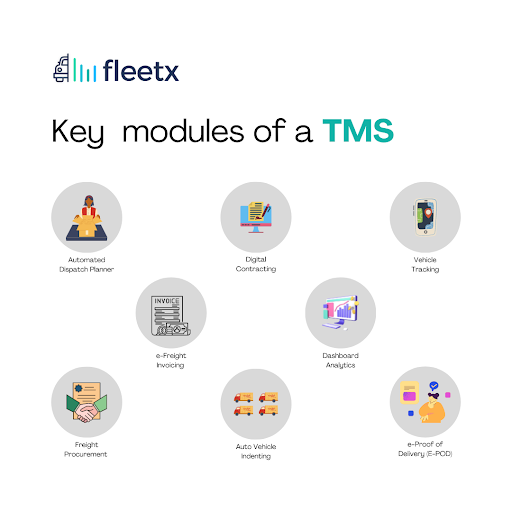
- Automated Dispatch Planning
- Freight Procurement
- Auto Vehicle Indenting
- Digital Contracting
- Tracking of the vehicle/shipment
- E-POD and E-LR
- E-Freight Invoicing
- Dashboard Analytics
Benefits of the Freight Procurement in a TMS
Among other challenges a pharma company may face other obstacles related to supply and logistics management, expense control, and stringent rules. By adopting a data-centric approach to contract administration, businesses can get assistance in managing all phases of the contract procedure throughout the shipping cycle. This approach would facilitate the handling of complex contracts in the pharma industry with strict compliance and detailed monitoring of line items, along with the management of delivery schedules, to enhance transportation operations seamlessly. Furthermore, pharma companies can effortlessly construct and supervise agreements with numerous suppliers, including complex procurement and indent logic.
Benefits of Auto Vehicle Indenting or Auto Requisition
A lot has already been discussed about the automated dispatch planning module of a TMS. The next important module is related to sending indents to transporters on behalf of your pharma company. To put it simply, an indent is a request sent to partner transporters stating the requirements for trucks to transport goods to their respective delivery locations at a given time and date. It also includes other details such as the number and type of trucks needed and the order of delivery. Before TMS, all of this information was provided manually to the transporter, based on manual assessment from the manufacturer. However, with a TMS equipped with an automatic dispatch planner, this information is provided to transporters in the most efficient manner to maximise the utilisation of resources.
The indenting process itself is quite repetitive and manual, as someone has to physically connect and follow up with the transporter to discuss the terms of the contract, among other things. Furthermore, someone from the logistics team also needs to follow up with the driver, retrieve information on the trucks, and verify compliance with several other requirements. Manually managing all these tasks related to indenting leaves ample room for errors and can be expensive for larger operations.
However, the Auto Vehicle Indenting module of a TMS can automate all these processes, leaving no room for error. Additionally, notifications regarding indent updates are automatically shared electronically via email, SMS, WhatsApp, as well as pop notifications on the TMS mobile and web app. Transporters also respond to the indent electronically.
The most significant benefit of using a TMS is that the manufacturer or shipper can receive all the information related to the quantity, type of trucks, and the expected time of arrival of the trucks. In case of any failure on the transporter's end after accepting the contract, the shipper can take corrective action well in advance and arrange for a substitute vehicle when using a TMS. Corrective action is also possible manually, but it results in a loss of crucial time for shippers, leading to a loss of revenue and higher operating costs.
Benefits of the Contracting Module in a TMS
Companies typically work with multiple transporters (an average of three) on every delivery route they operate. Therefore, it is essential to ensure that the share of business is distributed fairly among partner transporters, and contracts are equitably disbursed. This is achieved through the contracting module, where all charges, such as base rates, incidental charges, and additional charges in the form of penalties and extra charges, are maintained in the digital contract module. This ensures that all contract principles are followed according to the agreement.
Benefits of Tracking shipment in real-time with the vehicle tracking module
Businesses and transporters who manage their logistics and transport operations manually have no supply chain visibility once the cargo is loaded on the trucks and departs from the shipper's warehouse or manufacturing plant. This lack of supply chain visibility has been one of the most pressing issues plaguing Indian businesses and their respective transport operations. However, with a TMS, you have complete visibility of your shipment and the trucks carrying your goods through some form of tracking.
The vehicle tracking module offered by TMS provides pharma companies and their customers with real-time location updates of their shipment using either a GPS tracking system or a SIM-based tracking system. The real-time tracking module of the TMS provides all information in the form of Estimated Time of Arrival (ETA) and alerts all relevant stakeholders, especially the consignee in case of delays or unforeseen accidents or incidents. Accurate ETAs can help the consignees/channel partner prepare for unloading and dispatch appropriately and without delays.
This feature is especially beneficial for pharma goods due to their sensitive nature. The real-time vehicle tracking module of the TMS is a boon for the pharma industry as it helps to ensure that the products are delivered on time and in the right condition. This can help pharma companies maintain their product's quality, integrity and safety, which is of utmost importance in the industry.
Benefits of the E-Proof of Delivery (E-POD) or E- Lorry Receipt (LR) module
The next module pertains to the Lorry Receipt (LR) or Bilty, which is generated during the time of dispatch. Four copies of the LR are created, out of which one copy is retained by the shipper, i.e. the pharma company. Of the remaining three copies, one is kept by the consignee while the remaining two are given to the driver and are eventually handed over to the transporter. One of the two copies provided to the shipper or the pharma company contains all the information related to the date, time, and condition of the delivery, signed by the consignee. The transporter will receive payment only when it provides the freight invoice and Proof of Delivery (POD) to the shipper.
A TMS with its electronic Proof of Delivery (e-POD) module simplifies the entire process for all the stakeholders, specially the transporter that had to deal with misplaced or missing LRs. E-POD ensures that there is no loss of LR in transit. Electronically generating LR makes it more convenient to abide by all compliances and SLA adherence. A TMS also makes dispute resolutions much easier and simplifies the penalty application process. Faster trip closure by uploading the E-POD along with damages improves the overall efficiency of the process as well.
Benefits of the Freight Invoicing module in a TMS
The base freight rate for a vehicle is set in the contract, but the shipper must pay for overhead charges like detention fees for container use outside a port or terminal. The transporter may also be penalised for delayed deliveries, vehicle placement issues, cargo theft, and other problems, which will be deducted from their payment by the shipper.
Some common issues for the shipper include paying the additional detention charges, while disputes from the transporters can include penalties for delayed deliveries, non-placement or delayed placement of trucks, damaged goods, and cargo theft, among others.
Disputes over extra charges and penalties are common between shippers and transporters, but the e-Freight module of a Transportation Management System (TMS) can help resolve them with electronic-Proof of Delivery (e-POD) enabled negotiations. After negotiation and approval, the software generates electronic freight invoices.
Using a TMS-enabled e-Freight Invoicing module can reduce the delivery-to-invoicing cycle for the transporter by up to 50%, improving cash flow and bringing transparency to the invoicing process. This can also help the transporter get better rates for its services in the long run, benefiting both parties. The module can also prevent duplicate invoicing and provide a multi-level approval mechanism for greater transparency. In the medium-to-long term, the transporter can also get better rates for its services, in turn benefiting the shipper with more competitive rates for freight transportation.
Benefits of the All-in-one Dashboard for TMS
The dashboard provides a single-screen summary of your entire business operations and can be used for analytics and report generation. You can review a transporter's performance across its KPIs, such as timely deliveries and placements. It also simplifies the contract process, allowing shippers to make more informed decisions. A TMS provides transparency across performance metrics, including timely approval of e-PODs, invoicing, and payments, thus offering transparent information for transporters. A TMS even gamifies information by providing performance-based ratings to both shippers and transporters. Gamification is a more efficient form of analytics that provides maximum information in the least time for better decision-making.
The dashboard also enables businesses and transporters to track actual spending against their assigned transport budget, making it easy to identify and address overspending with full transparency.
Final Thoughts
While TMS integrations are still relatively new in India's logistics industry, estimates suggest that shippers can save between 4-7% on freight costs through TMS integration in their transport operations. For specific modules, such as e-Freight Invoicing, the efficiency gains can be even higher, up to 40-50%, with greater potential efficiency as more pharma companies fully adopt TMS in their transport operations.
Frequently Asked Questions
What is a Transportation Management System (TMS) for pharmaceutical logistics?
A Transportation Management System (TMS) is a digital platform that helps pharmaceutical manufacturers, distributors, third-party logistics providers (3PLs), and healthcare supply chains plan, execute, monitor, and optimize transportation operations. Unlike a basic logistics management system, a pharmaceutical TMS is designed to support strict regulatory compliance, temperature-sensitive deliveries, shipment visibility, electronic documentation, freight procurement, contract management, vehicle tracking, proof of delivery (ePOD), freight invoicing, and analytics from a single dashboard.
Pharmaceutical transportation involves far greater complexity than conventional freight because medicines, vaccines, diagnostic kits, biologics, and medical devices often require cold-chain compliance, timely delivery, and complete traceability. A modern TMS automates manual workflows, minimizes human errors, improves ETA accuracy, and enables proactive decision-making through real-time alerts.
Across India, pharmaceutical companies operating from Delhi NCR, Gurgaon, Mumbai, Bengaluru, Hyderabad, Ahmedabad, and Pune increasingly use Transportation Management Software to improve delivery performance while reducing transportation costs. Digital workflows also simplify compliance with documentation requirements and help companies respond quickly during product recalls or delivery disruptions.
For organizations evaluating digital transformation, implementing a TMS is no longer only about reducing freight costs. It is about improving supply chain resilience, ensuring product quality, strengthening customer satisfaction, and building an intelligent logistics ecosystem that scales with business growth. These capabilities make Transportation Management Systems one of the most valuable investments for modern pharmaceutical logistics.
Why is transportation management so important for pharmaceutical deliveries?
Transportation plays a direct role in maintaining medicine quality, patient safety, and regulatory compliance. Pharmaceutical products often have strict storage conditions, limited shelf life, and precise delivery timelines. Any delay, temperature excursion, incorrect documentation, or lack of shipment visibility can result in financial losses and product wastage.
A Transportation Management System reduces these risks by integrating dispatch planning, freight procurement, GPS tracking, automated vehicle indenting, contract management, electronic Proof of Delivery (ePOD), freight invoicing, and dashboard analytics into one platform. Instead of relying on manual phone calls and spreadsheets, logistics teams receive live shipment updates, automated notifications, estimated arrival times, and centralized reporting.
Large pharmaceutical hubs in Mumbai, Delhi NCR, Gurgaon, Bengaluru, Pune, Hyderabad, and Ahmedabad often handle thousands of shipments every month across hospitals, pharmacies, wholesalers, and distributors. Manual coordination becomes increasingly difficult as shipment volumes grow. A TMS enables logistics teams to allocate vehicles efficiently, monitor transporter performance, reduce empty miles, improve fleet utilization, and resolve delivery exceptions before they impact customers.
Beyond operational efficiency, transportation management strengthens compliance with industry regulations by maintaining digital records of contracts, shipment history, proof of delivery, and invoicing. This level of transparency improves collaboration between manufacturers, transporters, warehouses, and distributors while helping companies maintain service-level agreements (SLAs). For pharmaceutical businesses focused on growth, transportation management is not simply an operational tool—it is a strategic capability that improves reliability, reduces costs, and protects product integrity throughout the supply chain.
What are the key modules of a Transportation Management System (TMS) for pharmaceutical logistics?
A modern Transportation Management System (TMS) consists of multiple integrated modules that work together to streamline pharmaceutical transportation from dispatch planning to final delivery. Rather than functioning as standalone tools, these modules share real-time information, enabling logistics teams to make faster, data-driven decisions while maintaining compliance with strict pharmaceutical regulations.
The most important module is Automated Dispatch Planning, which allocates vehicles based on shipment priority, delivery windows, vehicle availability, and route efficiency. Freight Procurement helps businesses compare transporters, negotiate rates, and manage vendor contracts digitally. Auto Vehicle Indenting automates truck requests, reducing manual communication and improving fleet availability.
Another essential capability is Digital Contract Management, which stores freight agreements, pricing structures, penalties, and transporter commitments in one centralized system. Real-time GPS Vehicle Tracking provides live shipment visibility and accurate ETAs, allowing pharmaceutical companies to monitor sensitive cargo throughout transit. Electronic Proof of Delivery (ePOD) replaces paper documentation with secure digital records, accelerating dispute resolution and payment processing.
Modern TMS platforms also include Electronic Freight Invoicing, helping automate invoice verification and reducing billing errors. Finally, Dashboard Analytics consolidates operational KPIs such as transporter performance, delivery timelines, freight costs, SLA compliance, and fleet utilization into interactive reports.
These modules are increasingly being adopted by pharmaceutical manufacturers and distributors across India, particularly in Delhi NCR, Gurgaon, Mumbai, Bengaluru, Pune, Hyderabad, and Ahmedabad. Together, they improve operational efficiency, reduce transportation costs, enhance shipment visibility, strengthen regulatory compliance, and support scalable pharmaceutical supply chains capable of meeting growing market demands.
What is the best Transportation Management System (TMS) for pharmaceutical companies in India?
The best Transportation Management System (TMS) for pharmaceutical companies depends on several operational factors, including shipment volume, cold chain requirements, regulatory compliance, transporter network, ERP integrations, and the level of automation required. Pharmaceutical logistics is significantly more complex than conventional freight because medicines, vaccines, APIs, biologics, and medical devices require strict temperature control, complete shipment visibility, accurate documentation, and timely deliveries.
An ideal pharmaceutical TMS should offer end-to-end capabilities such as automated dispatch planning, freight procurement, digital contract management, auto vehicle indenting, GPS-based shipment tracking, electronic Proof of Delivery (ePOD), electronic freight invoicing, transporter performance management, dashboard analytics, and automated alerts. Cloud-based deployment, mobile accessibility, API integrations, and AI-powered reporting further improve operational efficiency while supporting future business growth.
Across India, pharmaceutical manufacturers operating in Delhi NCR, Gurgaon, Mumbai, Pune, Bengaluru, Hyderabad, Ahmedabad, and Chennai increasingly evaluate TMS platforms based on implementation speed, scalability, customer support, and measurable return on investment rather than simply selecting the lowest-cost software. Businesses should also assess whether the platform supports multi-warehouse operations, multiple transport partners, compliance reporting, and live ETA calculations.
The best TMS is ultimately one that aligns with your logistics processes while reducing freight costs, improving shipment visibility, minimizing manual intervention, and ensuring regulatory compliance. Before finalizing any solution, request a live product demonstration, evaluate integration capabilities, verify implementation timelines, and calculate long-term operational savings instead of focusing solely on licensing costs. This approach helps pharmaceutical companies choose software that continues delivering value as operations expand.
How much does Transportation Management System (TMS) software cost in India?
The cost of implementing a Transportation Management System (TMS) in India varies depending on deployment model, company size, shipment volume, number of users, integrations, customization requirements, and support services. Most modern TMS providers offer cloud-based subscription pricing, while large enterprises may choose customized enterprise deployments.
For small and mid-sized pharmaceutical companies, cloud-based TMS pricing typically starts from approximately ₹25,000 to ₹1 lakh per month, depending on features and shipment volume. Medium-sized organizations requiring ERP integration, advanced analytics, automated freight procurement, and GPS tracking generally invest between ₹3 lakh and ₹15 lakh for implementation along with recurring subscription charges. Large pharmaceutical enterprises operating nationwide may invest substantially more due to custom workflows, API integrations, multiple warehouses, dedicated onboarding, and enterprise-level support.
Companies in Delhi NCR, Gurgaon, Mumbai, Bengaluru, Pune, and Hyderabad should evaluate the total cost of ownership rather than comparing subscription fees alone. Hidden expenses such as manual dispatching, delayed invoicing, excess detention charges, poor vehicle utilization, paperwork, and shipment delays often exceed the software investment itself. A well-implemented TMS can significantly reduce these operational inefficiencies while improving transporter collaboration and customer service.
Before selecting software, businesses should request a transparent pricing breakdown covering implementation, onboarding, user training, integrations, support, future upgrades, and scalability. The right Transportation Management System should deliver measurable ROI through freight savings, improved operational efficiency, better compliance, and faster shipment execution rather than simply offering the lowest initial price.
How do pharmaceutical companies in Delhi, Gurgaon, and Mumbai benefit from a Transportation Management System?
Delhi NCR, Gurgaon, and Mumbai are among India's largest pharmaceutical manufacturing, distribution, and healthcare logistics hubs. Every day, thousands of medicine shipments move between manufacturing plants, warehouses, hospitals, distributors, pharmacies, and export terminals. Managing these high shipment volumes manually often results in delayed dispatches, limited shipment visibility, documentation errors, and higher transportation costs.
A Transportation Management System (TMS) helps pharmaceutical businesses digitize these operations by automating dispatch planning, transporter allocation, freight procurement, digital contracts, GPS-based vehicle tracking, electronic Proof of Delivery (ePOD), freight invoicing, and performance reporting. Logistics teams receive live shipment updates, accurate ETAs, automated alerts, and centralized dashboards, enabling faster operational decisions and improved customer communication.
For example, pharmaceutical companies operating in Delhi NCR and Gurgaon often distribute medicines across North India through extensive transporter networks. Mumbai-based businesses frequently manage both domestic distribution and export logistics through ports, airports, and regional warehouses. A centralized TMS enables these organizations to coordinate multiple transport partners while maintaining consistent compliance, visibility, and service quality across every shipment.
As pharmaceutical businesses continue expanding into Bengaluru, Pune, Hyderabad, Ahmedabad, and other growing logistics corridors, a scalable Transportation Management System becomes increasingly valuable. It supports business growth by improving fleet utilization, reducing freight costs, minimizing paperwork, accelerating invoicing, strengthening transporter accountability, and maintaining product integrity throughout the supply chain. This combination of operational efficiency and compliance makes TMS adoption a strategic investment for pharmaceutical logistics across India's rapidly evolving healthcare ecosystem.
What features should you look for in a pharmaceutical Transportation Management System?
Selecting the right Transportation Management System (TMS) goes beyond comparing software vendors—it requires evaluating whether the platform can support the complex requirements of pharmaceutical logistics. Medicines, vaccines, APIs, biologics, and temperature-sensitive products require complete shipment visibility, regulatory compliance, timely deliveries, and accurate documentation. A TMS should therefore automate transportation processes while maintaining high standards of reliability and traceability.
Essential features include automated dispatch planning, freight procurement, vehicle indenting, digital contract management, GPS-enabled shipment tracking, electronic Proof of Delivery (ePOD), freight invoicing, transporter performance monitoring, ETA prediction, dashboard analytics, and automated notifications. The platform should also integrate seamlessly with ERP, Warehouse Management Systems (WMS), and accounting software to eliminate duplicate data entry and improve operational efficiency.
Businesses operating across Delhi NCR, Gurgaon, Mumbai, Bengaluru, Pune, Hyderabad, and Ahmedabad should also evaluate scalability. As logistics networks expand, the software should support multiple warehouses, transport partners, users, and regional operations without affecting performance. Mobile accessibility for drivers and transporters, API integrations, cloud deployment, and AI-powered reporting further improve operational decision-making.
Rather than focusing solely on software cost, pharmaceutical companies should prioritize long-term value. A feature-rich TMS can reduce freight expenses, improve transporter accountability, minimize documentation errors, strengthen compliance, and increase customer satisfaction. Choosing a scalable platform with strong implementation support ensures that the software continues delivering measurable business benefits as logistics operations grow.
Can a Transportation Management System help reduce pharmaceutical logistics costs?
Yes. One of the biggest advantages of implementing a Transportation Management System (TMS) is its ability to reduce transportation costs without compromising service quality or regulatory compliance. While software implementation requires an initial investment, most organizations recover these costs through improved operational efficiency, better vehicle utilization, reduced manual work, and optimized freight planning.
A TMS minimizes unnecessary expenses by automating dispatch planning, selecting the most suitable transporters, optimizing vehicle allocation, reducing empty return trips, improving route planning, and automating freight procurement. Features such as electronic Proof of Delivery (ePOD), automated freight invoicing, digital contracts, and real-time shipment tracking also reduce administrative overhead while accelerating payment cycles.
For pharmaceutical companies operating in Delhi NCR, Gurgaon, Mumbai, Bengaluru, Pune, and other major logistics hubs, transportation costs often represent a significant portion of overall supply chain expenditure. Delayed deliveries, detention charges, manual paperwork, duplicate invoicing, inefficient transporter allocation, and limited shipment visibility further increase operational costs. A modern TMS helps identify these inefficiencies through analytics dashboards and performance reports, allowing businesses to make data-driven improvements.
Industry estimates indicate that companies adopting digital transportation management can achieve meaningful reductions in freight costs while significantly improving delivery performance. Although actual savings vary by shipment volume and operational complexity, organizations generally experience better fleet utilization, faster invoicing, improved compliance, reduced manual effort, and stronger transporter collaboration, making TMS one of the highest-return investments within pharmaceutical logistics.
Is Transportation Management System software suitable for small and mid-sized pharmaceutical businesses in India?
Absolutely. Modern cloud-based Transportation Management Systems (TMS) are no longer limited to large enterprises. Small and medium-sized pharmaceutical manufacturers, distributors, wholesalers, and third-party logistics providers can now access enterprise-grade transportation capabilities without investing heavily in on-premise infrastructure.
Businesses operating in Delhi, Gurgaon, Mumbai, Bengaluru, Pune, Hyderabad, Ahmedabad, and other growing pharmaceutical markets often manage increasing shipment volumes with relatively small logistics teams. Manual planning through spreadsheets, emails, and phone calls becomes difficult as operations expand. A cloud-based TMS automates dispatch planning, shipment tracking, transporter communication, electronic documentation, freight invoicing, and performance reporting while remaining easy to deploy and scale.
Many software providers offer modular pricing, allowing companies to begin with essential transportation features and gradually add advanced capabilities such as AI-powered analytics, automated freight procurement, digital contracts, API integrations, and multi-warehouse management as business requirements evolve. This approach reduces implementation risk while allowing organizations to realize operational improvements almost immediately.
For growing pharmaceutical businesses, adopting a TMS early provides a competitive advantage by improving delivery accuracy, increasing shipment visibility, reducing transportation costs, and strengthening customer confidence. Instead of replacing existing workflows overnight, a modern Transportation Management System supports gradual digital transformation while creating a scalable logistics foundation capable of supporting future expansion across India and international markets.