
Picking up the baton from where we left off in our previous article on how TMS can improve transportation for pharma companies, we will now delve deeper into how pharma companies manage their day-to-day operations related to transportation. Pharma companies that rely on in-house manufacturing typically do not differ significantly from one another when it comes to their transport operations. However, upon closer assessment, they incorporate a mix-and-match of different TORs (Terms of Agreement) for drug manufacturing and distribution. This can include own manufacturing units, third-party manufacturers, as well as loan liaising companies. Another key difference between drugs produced from own-manufacturing and third-party manufactured drugs is observed during distribution. Drugs produced from own-manufacturing can go directly to the CFA, followed by Super stockist and so on, or go to a central warehousing from where they are processed further. Meanwhile, drugs produced by third-party manufacturers have to go to the central warehousing, from where they are processed further down the distribution channel.
After educating ourselves on the nuances of pharma manufacturing, it is natural to wonder how pharma manufacturing companies manage their procurement, accounting, and everything in between. Well, pharmaceutical manufacturers use one version or another of an Enterprise Resource Planning or ERP software that helps businesses control, connect, and integrate all departments and internal processes. This software automates all key functions, such as planning, procurement, inventory, manufacturing, and business intelligence. Over the past 20 years, ERP has been omnipresent across all manufacturing operations, including pharmaceutical manufacturing. However, adoption of automation tools, such as enterprise transport management solutions, has been relatively dismal. Technology integration in enterprise logistics and transport operations can help businesses improve operating efficiency and reduce cost. For pharma companies, more supply chain visibility and real-time monitoring solutions, such as cold chain fleet management solutions, can make transporting temperature-sensitive drugs and vaccines safer and more convenient. Leading by example, several companies now tend to set up digital budgets to digitize their transport and logistics operations end-to-end.
Key challenges faced by businesses during logistics or transport planning
Perhaps the biggest challenge faced by pharma businesses in their logistics and transport operations is planning. Logistics or transport planning has three rudimentary questions, so to speak:
- How many trucks are required?
- What kind of trucks are required?
- How can the loads be consolidated together?
The primary reason for these questions is to ensure that the cargo is shipped quickly and at the lowest cost.
How is a TMS integrated with logistics or transportation planning?
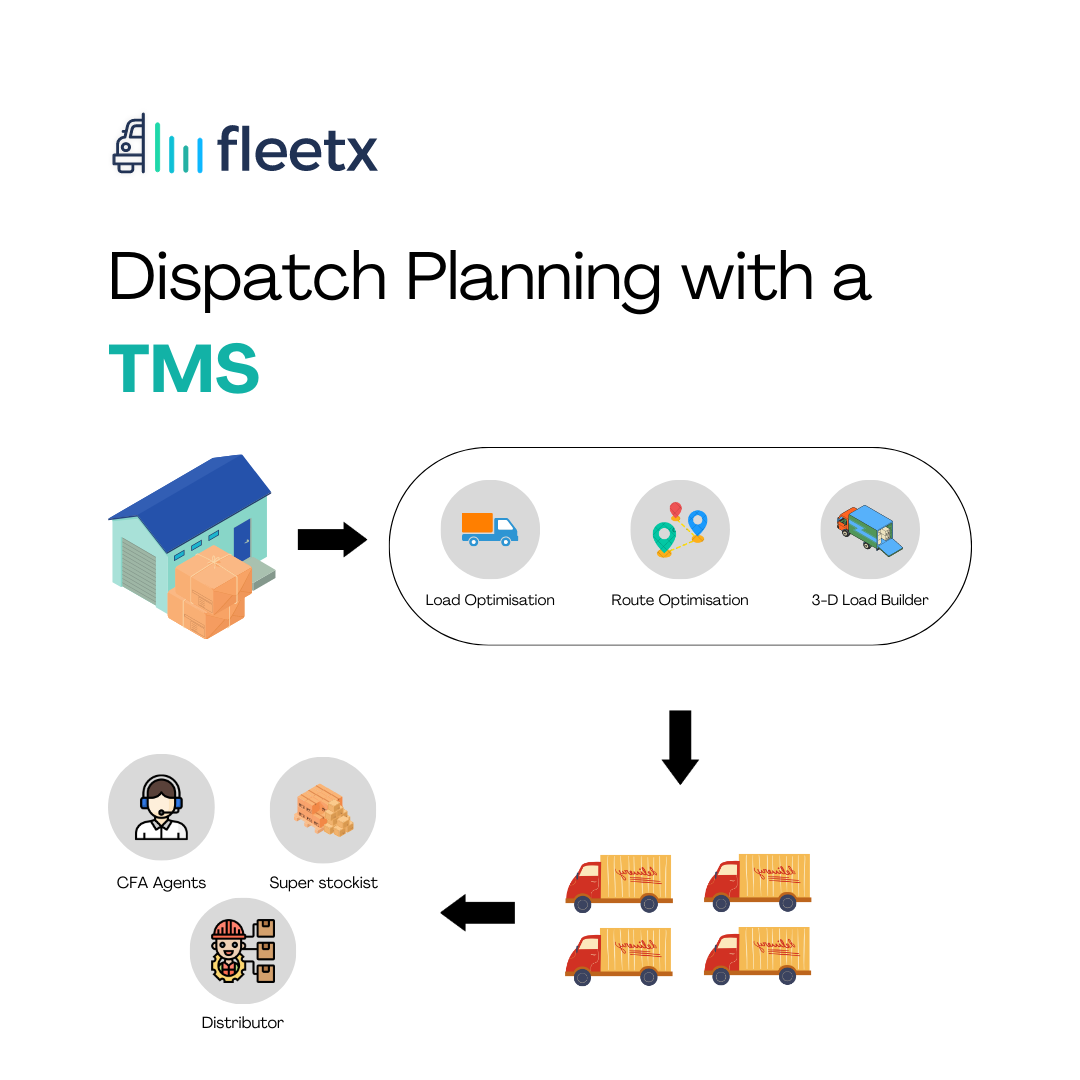
The role of the Transport Management System or TMS in logistics or transportation planning in the pharma industry can be understood through the process of dispatch planning, which can be broken down into three parts:
Load Planning/Optimization
An optimizer is an essential tool that can deliver significantly better results compared to manual planning. For instance, if a company's transportation operations require 100 trucks per month based on cargo load, an optimizer can help reduce the number to 85-90 trucks per month, resulting in cost savings
Route Planning/Optimization
The route planning step essentially involves the consolidation of the cargo load. For example, suppose a manufacturing unit is based in Kolkata and needs to deliver three shipments to Prayagraj, Delhi, and Amritsar, respectively. In that case, instead of engaging three trucks for three separate routes from the base location of Kolkata, a route planning module will predict that all these locations fall on the same highway (NH-19). Thus, it would consolidate the load and use one truck instead of three. In essence, the route planning module helps companies reduce costs by ensuring the maximum utilization of resources.
Pharma companies tend to have a much wider distribution network, from their own manufacturing to third-party manufacturing to other stakeholders down the distribution channel. The application of route planning is most suited for last-mile deliveries. However, most pharma manufacturers do not manage last-mile delivery on their own. Instead, they rely on FMCG companies, as their channel partners are often the same.
3-D Load Builder
The third module is the 3-D load builder, which essentially instructs on how to load goods into trucks to ensure maximum resource utilization. For instance, during multi-point deliveries by goods-carrying trucks, if the cargo required to be delivered at the first point is loaded at the end of the truck, the truck will have to unload all other cargo intended for other locations before unloading the cargo meant for the first location. Transport operations managed in this way result in a waste of time, labor, and risk damaging other goods loaded on the same truck.
In the case of sensitive pharmaceutical goods, the risk becomes even higher.
In such cases, a 3-D load builder helps companies load the cargo in a way that ensures maximum efficiency with zero errors. A 3-D load builder assists pharma companies by ensuring that all stacking and packaging norms and compliances are followed while loading the goods.
The best part?
3-D load builders provide a pictorial representation that is easy to understand and implement across warehouses and manufacturing facilities.
Learning by example: Why dispatch planning in TMS matters
Dispatch planning is arguably the most critical component of a Transport Management System (TMS). To underscore this point, let's review the three different TMS modules together. By doing so, we can gain a deeper appreciation for how adopting a TMS can benefit your pharmaceutical company's logistics and transportation operations.Let's consider a pharmaceutical company that operates its own manufacturing unit in Kolkata while also collaborating with third-party manufacturers from Tamil Nadu and Telangana.
This company primarily serves super stockists and distributors in North India. By using a TMS to plan and execute the transportation of goods from manufacturing to delivery, they can maximize efficiency and reduce costs significantly. The TMS optimizes truck requirements based on orders and plans routes to ensure maximum efficiency in delivering goods to customers through multi-point deliveries.
Additionally, the route planning software ensures drugs are delivered to customers from the closest manufacturing plant using the shortest and most efficient route. Finally, the 3-D load builder ensures goods are loaded in delivery trucks safely, leading to maximum resource optimization.
In a nutshell
Upon reading this, an obvious response could be that everything we talked about can also be done manually. As a matter of fact, it can. However, the scale at which most pharma companies operate involves thousands of orders to transport several tons of goods across hundreds of locations. Medium-sized pharma companies utilize hundreds of trucks in a given month, while large-scale companies could require thousands of trucks as well. Therefore, the question you should ask yourself before getting a TMS is whether your company would like to conduct transport operations at such a scale manually, which would increase the chance of errors exponentially. In a nutshell, a TMS would primarily automate the transport/dispatch planning and execution, maximizing the efficiency of the entire operation while bringing down the cost of transportation.
Frequently Asked Questions
What is a Transport Management System (TMS) for pharmaceutical logistics?
A Transport Management System (TMS) is software designed to plan, execute, monitor, and optimize transportation activities throughout the supply chain. In pharmaceutical logistics, a TMS becomes especially important because medicines, vaccines, medical devices, and temperature-sensitive products require strict handling standards, regulatory compliance, and on-time deliveries. Unlike traditional logistics planning, a pharma-focused TMS combines dispatch planning, route optimization, vehicle allocation, load optimization, proof of delivery, transporter management, and real-time shipment visibility into a single platform.
For pharmaceutical manufacturers across India, whether operating in Delhi NCR, Mumbai, Bengaluru, Hyderabad, Pune, or Gurgaon, a TMS helps reduce transportation costs while ensuring product integrity. It minimizes delays by automatically selecting suitable vehicles, identifying the most efficient delivery routes, and tracking shipments from manufacturing plants to warehouses, distributors, stockists, hospitals, or pharmacies.
Modern transportation management software also integrates with ERP systems, Warehouse Management Systems (WMS), GPS tracking, cold chain monitoring, and electronic proof of delivery solutions. These integrations enable logistics teams to make informed decisions using real-time operational data instead of spreadsheets or manual processes.
For businesses scaling across multiple cities or managing thousands of monthly deliveries, implementing a TMS significantly improves fleet utilization, customer satisfaction, regulatory compliance, and supply chain visibility while lowering freight costs and reducing operational risks.
Why is transport planning critical for pharmaceutical supply chains in India?
Transport planning is one of the most important components of pharmaceutical logistics because medicines must reach distributors, hospitals, pharmacies, and healthcare providers safely, on time, and within regulated environmental conditions. Delays, incorrect vehicle selection, poor route planning, or inefficient dispatch scheduling can increase transportation costs while also affecting medicine quality and customer service.
In India, pharmaceutical companies often distribute products from manufacturing hubs located in states like Telangana, Gujarat, Maharashtra, and Himachal Pradesh to demand centers including Delhi, Mumbai, Bengaluru, Chennai, Pune, and Kolkata. Managing such a nationwide network manually becomes increasingly difficult as shipment volumes grow.
A Transport Management System improves planning by automatically determining vehicle requirements, consolidating loads, optimizing routes, assigning transporters, scheduling dispatches, and providing live shipment visibility. Businesses can reduce empty runs, improve truck utilization, and avoid unnecessary transportation expenses.
For pharmaceutical companies serving Delhi NCR hospitals or distributors across Mumbai and Gurgaon, optimized transport planning also supports faster deliveries and improved customer satisfaction. Companies using intelligent transport planning are better positioned to handle seasonal demand fluctuations, urgent medical shipments, and expanding distribution networks without proportionally increasing logistics costs.
Which is the best Transport Management System for pharmaceutical companies in India?
The best Transport Management System depends on your shipment volume, business size, regulatory requirements, and distribution network. Pharmaceutical companies should prioritize solutions that provide dispatch planning, transporter management, route optimization, real-time GPS tracking, temperature monitoring integration, electronic proof of delivery, analytics dashboards, and ERP connectivity.
For enterprises operating across India, cloud-based transportation management software generally provides greater flexibility than legacy systems. Businesses with manufacturing plants and warehouses spread across Delhi NCR, Mumbai, Pune, Bengaluru, Hyderabad, or Gurgaon benefit from centralized visibility into shipments, fleet utilization, and transporter performance.
When evaluating top TMS software, businesses should compare features such as:
- Automated dispatch and load planning
- Multi-location shipment management
- Cold chain monitoring capabilities
- Real-time vehicle tracking
- Freight cost optimization
- Analytics and reporting dashboards
- ERP, WMS, and accounting software integrations
- Scalable cloud infrastructure
- Mobile applications for drivers and transporters
- Implementation support and customer service
Rather than choosing software based solely on price, pharmaceutical companies should evaluate long-term operational savings, compliance capabilities, implementation quality, and scalability. A robust enterprise TMS often delivers measurable improvements in delivery performance, transporter productivity, inventory visibility, and logistics costs over time.
How much does Transport Management System software cost in India?
The cost of implementing a Transport Management System (TMS) in India depends on several factors, including the size of the business, shipment volumes, number of users, required integrations, and deployment model. Small and medium-sized businesses often prefer cloud-based subscription models, while large pharmaceutical enterprises may require enterprise-grade implementations with customized workflows, ERP integration, analytics, and dedicated support.
As a general benchmark, cloud-based TMS solutions may start from approximately ₹25,000–₹1 lakh per month for growing businesses, whereas enterprise deployments for large pharmaceutical manufacturers can range from ₹10 lakh to ₹1 crore+ depending on implementation scope, customization, number of locations, and system integrations. Costs may also include onboarding, training, API integrations, GPS hardware (if required), and implementation consulting.
Companies operating across Delhi NCR, Mumbai, Pune, Bengaluru, Hyderabad, or Gurgaon should evaluate the overall return on investment instead of focusing solely on licensing costs. A well-implemented TMS often reduces transportation expenses by improving truck utilization, lowering empty miles, minimizing manual planning, optimizing routes, reducing detention costs, and improving shipment visibility.
Before selecting a solution, request a detailed demonstration, implementation roadmap, support plan, and total cost of ownership analysis. This helps businesses compare vendors fairly while understanding long-term operational savings rather than only the initial purchase price.
How long does it take to implement a Transport Management System for pharmaceutical logistics?
The implementation timeline for a pharmaceutical Transport Management System varies depending on business complexity, existing IT infrastructure, integration requirements, and operational scale. Small organizations with straightforward transportation processes may complete implementation within 4 to 8 weeks, while medium-sized businesses generally require 2 to 4 months. Large pharmaceutical enterprises with multiple manufacturing plants, warehouses, ERP systems, transporter networks, and cold chain operations may require 4 to 9 months for a phased rollout.
Implementation typically involves process mapping, master data preparation, transporter onboarding, ERP integration, route configuration, dispatch workflow setup, user training, testing, and pilot deployments before organization-wide rollout. Businesses operating across Delhi, Gurgaon, Mumbai, Bengaluru, Pune, and other regional distribution hubs often choose phased implementations to minimize disruption.
Choosing an experienced implementation partner significantly improves project success. The right vendor helps standardize logistics processes, migrate historical data, configure dashboards, integrate with GPS and warehouse systems, and train logistics teams to use the software effectively.
Organizations should also establish measurable success indicators before implementation, including freight cost reduction, delivery performance, truck utilization, transporter turnaround time, and shipment visibility. These KPIs help evaluate the effectiveness of the TMS after deployment and support continuous operational improvement.
How can pharmaceutical companies in Delhi NCR and Gurgaon improve transport efficiency using a TMS?
Delhi NCR and Gurgaon have become major logistics and distribution hubs for pharmaceutical companies serving North India. Businesses operating in these regions often face challenges such as urban congestion, multiple delivery points, strict delivery schedules, fluctuating transportation costs, and increasing customer expectations. A Transport Management System helps overcome these challenges through intelligent planning and automation.
A TMS enables logistics teams to automate dispatch planning, consolidate shipments, optimize delivery routes, allocate the most suitable vehicles, monitor deliveries in real time, and manage transporter performance from a centralized platform. For companies distributing medicines to hospitals, distributors, retailers, and healthcare institutions throughout Delhi NCR, route optimization reduces delays while improving vehicle utilization.
Companies based in Gurgaon can also integrate TMS software with ERP systems, warehouse operations, GPS tracking, and electronic proof of delivery to improve visibility across the entire transportation process. Managers receive real-time alerts about shipment delays, route deviations, and delivery completion, enabling faster operational decisions.
By replacing manual planning with intelligent transport automation, pharmaceutical companies reduce freight expenses, improve customer satisfaction, strengthen regulatory compliance, and create a scalable logistics operation capable of supporting future business growth throughout North India.
What are the top features to look for in Transport Management Software for pharmaceutical companies?
Selecting the right Transport Management Software (TMS) is about more than digitizing dispatch operations. Pharmaceutical companies require a solution that supports regulatory compliance, temperature-sensitive transportation, real-time shipment visibility, and efficient logistics planning across manufacturing plants, warehouses, distributors, and healthcare facilities.
The best TMS platforms should include automated dispatch planning, vehicle allocation, transporter management, route optimization, GPS-based live tracking, electronic proof of delivery (ePOD), freight cost analytics, load optimization, delivery scheduling, and customizable reporting dashboards. Integration with ERP, Warehouse Management Systems (WMS), inventory management platforms, and accounting software is equally important for seamless information flow.
Businesses operating nationwide from locations such as Delhi, Mumbai, Bengaluru, Pune, Hyderabad, and Gurgaon should also prioritize cloud-based deployment, mobile applications for drivers, API connectivity, automated alerts, and centralized control over multiple warehouses and transport partners.
Advanced analytics powered by AI can further improve transport efficiency by predicting delays, recommending optimized routes, identifying underperforming transporters, and improving fleet utilization. Companies should also evaluate vendor implementation experience, technical support, cybersecurity, scalability, and product roadmap before making a long-term investment. Choosing a feature-rich platform helps pharmaceutical businesses improve delivery performance, reduce logistics costs, strengthen compliance, and build a more resilient supply chain.
How does a Transport Management System improve pharmaceutical deliveries in Mumbai, Bengaluru, and Pune?
Mumbai, Bengaluru, and Pune are among India's largest pharmaceutical manufacturing, research, and distribution hubs. Companies operating across these cities often manage high shipment volumes, multiple warehouses, diverse transporter networks, and strict customer delivery timelines. A Transport Management System enables businesses to manage these complex logistics operations efficiently while maintaining product quality and regulatory compliance.
Using intelligent route optimization, a TMS selects efficient delivery routes based on shipment priorities, traffic conditions, and delivery schedules. Automated dispatch planning ensures vehicles are allocated appropriately, while load optimization reduces unnecessary trips and improves truck utilization. Real-time GPS tracking allows logistics teams to monitor shipments throughout transit and respond quickly to delays or disruptions.
For temperature-sensitive medicines, vaccines, and specialty pharmaceuticals, integration with cold chain monitoring solutions provides greater visibility into shipment conditions. Businesses can also automate proof of delivery, monitor transporter performance, and generate compliance reports for audits.
Whether serving hospitals in Mumbai, distributors in Pune, or healthcare providers across Bengaluru, companies benefit from lower freight costs, improved delivery accuracy, higher customer satisfaction, and greater operational visibility. As pharmaceutical distribution networks continue expanding across India, digital transportation management becomes an essential capability rather than a competitive advantage.
Can a Transport Management System reduce pharmaceutical logistics costs while improving delivery performance?
Yes. One of the biggest reasons pharmaceutical companies invest in a Transport Management System is to reduce logistics costs without compromising delivery quality or regulatory compliance. Transportation represents a significant portion of overall supply chain expenses, making optimization a high-impact opportunity for operational improvement.
A modern TMS lowers costs by automating dispatch planning, optimizing delivery routes, consolidating shipments, maximizing vehicle utilization, reducing empty return trips, and selecting the most suitable transporters based on predefined performance metrics. Businesses also gain complete visibility into freight spending, delivery timelines, detention costs, and transporter efficiency through centralized analytics dashboards.
Beyond direct cost savings, improved transportation planning minimizes manual errors, accelerates order fulfillment, reduces shipment delays, and enhances customer satisfaction. Pharmaceutical companies can proactively respond to disruptions using live GPS tracking, automated alerts, and real-time shipment monitoring, helping maintain product integrity throughout the supply chain.
Organizations operating across Delhi NCR, Gurgaon, Mumbai, Pune, Bengaluru, Hyderabad, and other major logistics corridors often achieve measurable improvements in fleet utilization, freight efficiency, on-time deliveries, and operational productivity after implementing an enterprise-grade TMS. When combined with ERP, warehouse management, and cold chain monitoring systems, transportation management software becomes a strategic investment that supports long-term business growth while improving service quality across the pharmaceutical supply chain.