
In our last article, The Ultimate Guide to 3PL logistics we broadened our understanding of Third-Party Logistics or 3PL and how it compares to other systems of supply-chain management. We understood, how 3PL providers benefit businesses to reduce the burden of delivering the goods to end customers so they can focus on their core production and product R&D.
Businesses focusing on improving their product and outsourcing the entire process from warehousing to packaging to fulfilment can deliver goods faster to the customers while simultaneously increasing the quality and offerings of their product. In the process, they considerably reduce their operating cost, thus, providing an overall win-win deal for the companies.
Key Takeaways
- A 3PL provider manages outsourced logistics functions such as transportation, warehousing, fulfilment, inventory management and reverse logistics.
- The best 3PL provider should be selected based on operational fit, technology capabilities, network coverage, scalability and service reliability—not price alone.
- Businesses should compare providers using measurable criteria such as on-time delivery, order accuracy, inventory accuracy, damage rates and cost per shipment.
- Technology-enabled 3PL providers can offer real-time shipment tracking, automated alerts, digital documentation and integration with ERP, WMS and TMS platforms.
- Companies operating across India should verify actual regional capabilities in important logistics markets such as Delhi NCR, Gurgaon, Mumbai, Bengaluru and Pune.
- A clearly defined service-level agreement (SLA) should establish responsibilities, performance targets, reporting requirements and escalation procedures.
- Before entering a long-term contract, businesses should compare total logistics costs and, where practical, test shortlisted providers through a pilot programme.
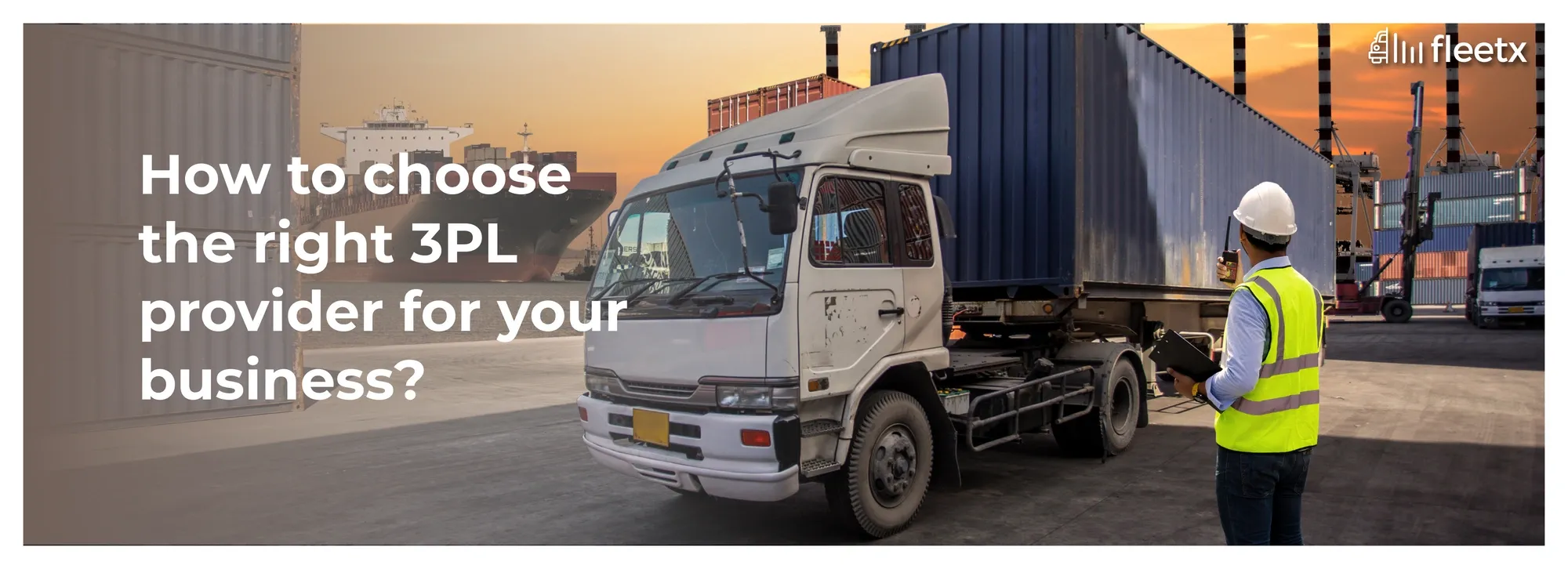
Choosing the right 3PL provider
In this short article, we look at a few key pointers and factors that can help companies choose the right 3PL provider for their business based on their Budget, Requirement and Compatibility.
The 3PL provider should have an excellent safety and reliability record.

A high Safety rating translates to higher trustworthiness towards customers and businesses
Due to changing regulatory scenarios, across regions, your 3PL provider must be a reliable one when it comes to the delivery of goods and services which results in higher public rating as well as safety ratings.
The 3PL provider must have responsive and reliable customer service.

Customer Disputes are common occurrences in e-commerce and it should be promptly handled for better service
For many businesses especially e-commerce, customer service is the No. 1 priority due to the nature of their business. One bad customer review can do a lot of damage. Hence, it is important to choose a provider with efficient customer service and conflict resolution 24x7.
The 3PL provider must be up-to-date with technology and offer a wide set of services

As a rule of thumb, if they are not incorporating fleet management and other technology in their business, they will likely lose out to the competition. Hence, it’s important to choose a provider that is up-to-date with technology and offers maximum services based on changing business needs.
The 3PL provider should offer customizable services and have room for scalability

As a growing business, you are bound to change your requirements and your 3PL provider should be able to offer you a custom set of services based on your requirement. They should have room for scalability as a result of expanding operations either in the same region or overseas.
The 3PL provider must bring a wide network and expertise to the table

Your 3PL logistics provider should have a large network of warehouses, fleet, fulfilment centers among other supply-chain essentials to offer the fastest logistics solutions.
How to Compare 3PL Providers Before Making a Final Decision
Shortlisting a third-party logistics provider is only the first step. Once a business has identified suitable logistics partners, it needs a structured evaluation process to determine which provider offers the strongest combination of operational capability, technology, cost efficiency and long-term business fit.
Rather than comparing providers only on freight rates, businesses should create a weighted scorecard based on the factors that have the greatest impact on their supply chain. This makes the selection process more objective and reduces the risk of choosing a provider that appears affordable initially but creates additional costs through delays, limited visibility or poor service.
3PL Provider Comparison Checklist
| Evaluation Criteria | Basic 3PL Provider | Technology-Enabled 3PL Provider | What Businesses Should Evaluate |
|---|---|---|---|
| Shipment visibility | Periodic manual updates | Real-time tracking and automated alerts | Accuracy and frequency of shipment updates |
| Order management | Manual coordination | Digitised workflows and integrations | Ability to handle increasing order volumes |
| Performance reporting | Basic reports | Analytics and KPI dashboards | Access to actionable logistics data |
| System integration | Limited | ERP, WMS, TMS and API integrations | Compatibility with existing business systems |
| Exception management | Reactive | Automated alerts and proactive intervention | Response to delays and operational disruptions |
| Scalability | Capacity may be limited | Flexible, data-driven resource planning | Ability to support seasonal and long-term growth |
| Documentation | Paper-based or fragmented | Digitised documentation | Ease of accessing invoices, PODs and shipment records |
| Decision-making | Experience-driven | Data-supported | Ability to identify trends and improve operations |
Create a Weighted 3PL Evaluation Scorecard
Businesses can assign a percentage weight to each selection criterion according to their priorities. For example, an e-commerce company may assign greater importance to fulfilment speed and reverse logistics, while a manufacturer may prioritise freight capacity, safety and multi-location distribution.
A practical evaluation framework can include:
- Service capability: Does the provider support all required logistics activities?
- Technology compatibility: Can its systems integrate with the company's existing technology stack?
- Geographical reach: Does the network cover current and planned markets?
- Operational performance: Can the provider demonstrate measurable delivery and fulfilment performance?
- Cost transparency: Are all major charges clearly defined?
- Scalability: Can capacity increase without compromising service quality?
- Risk management: What processes exist for delays, damaged goods and supply chain disruptions?
Businesses can score each shortlisted provider against these criteria and conduct a pilot project before making a long-term commitment. This approach provides more reliable evidence than selecting a logistics partner solely on sales presentations or quoted prices.
For companies expanding across India, the evaluation should also consider whether the provider can maintain consistent service standards across major logistics markets such as Delhi NCR, Gurgaon, Mumbai, Bengaluru and Pune. A provider's national footprint is valuable only when its local execution capabilities are equally dependable.
Which 3PL Performance Metrics Should Businesses Track?
Selecting the right 3PL provider is not a one-time decision. Businesses should continuously measure the performance of their logistics partner using clearly defined key performance indicators or KPIs. These metrics create accountability and help both parties identify opportunities to improve cost, delivery speed and customer experience.
Essential 3PL KPIs to Include in Service Reviews
On-Time Delivery Rate
This measures the percentage of shipments delivered within the agreed delivery window. A consistent decline may indicate problems with transportation planning, carrier performance or network capacity.
Order Accuracy
Order accuracy measures whether customers receive the correct products and quantities. This is particularly important when a 3PL manages warehousing, picking, packing and fulfilment.
Inventory Accuracy
Businesses outsourcing warehousing should compare recorded inventory with actual stock. High inventory accuracy supports better demand planning and reduces the risk of stockouts or excess inventory.
Order Cycle Time
This tracks the time between receiving an order and completing its delivery. Monitoring the different stages of the cycle can reveal where delays occur.
Damage and Claims Rate
A high rate of damaged or lost shipments can increase replacement costs and negatively affect customer satisfaction. Businesses should establish clear processes for reporting and resolving claims.
Cost per Shipment or Order
Tracking logistics expenditure at the shipment or order level makes it easier to understand whether outsourcing is producing measurable cost efficiencies.
Use Service-Level Agreements to Create Accountability
The most important KPIs should be incorporated into the service-level agreement between the business and its 3PL provider. The agreement can establish expected performance thresholds, reporting frequency and escalation procedures.
A useful 3PL performance dashboard may track:
- On-time pickup and delivery percentages
- Average order processing time
- Inventory and fulfilment accuracy
- Shipment damage and loss rates
- Cost per shipment, order or kilogram
- Number and resolution time of customer complaints
- Return and reverse logistics processing time
- Vehicle or capacity utilisation, where applicable
Performance should be reviewed regularly rather than only when a major problem occurs. Monthly or quarterly business reviews can help identify recurring issues and determine whether corrective actions are producing measurable improvements.
For businesses using multiple warehouses, transport partners or regional distribution networks, location-level performance analysis is particularly useful. Comparing performance across Delhi NCR, Mumbai, Bengaluru, Pune and other operating regions can reveal whether service quality is consistent throughout the network.
How Technology Is Changing the Relationship Between Businesses and 3PL Providers
Technology has changed what businesses should expect from a modern third-party logistics partnership. While traditional outsourcing primarily focused on accessing warehouses, vehicles and operational manpower, technology-enabled 3PL services can provide businesses with greater visibility and control over outsourced logistics operations.
Real-Time Visibility Reduces Information Gaps
One of the traditional challenges of logistics outsourcing is losing direct visibility once a shipment leaves the company's facility. Real-time vehicle and shipment tracking can reduce this information gap by allowing businesses to monitor movement and identify potential delays earlier.
Modern logistics platforms can provide:
- Live shipment and vehicle location
- Estimated arrival times
- Automated delay and route-deviation alerts
- Digital proof of delivery
- Centralised shipment documentation
- Performance reports and analytics
This information can also improve communication with customers because teams can respond to delivery queries using current shipment data rather than manually contacting multiple transporters.
Integration Creates a Connected Logistics Workflow
A 3PL provider should ideally be able to exchange data with the systems already used by the business. Depending on the operation, this may include enterprise resource planning systems, warehouse management systems, transportation management systems and order management platforms.
Effective integration can reduce repetitive data entry and support a more connected workflow from order creation to final delivery.
Businesses evaluating a technology-enabled 3PL should ask:
- Can shipment information be exchanged automatically?
- Are APIs or standard integrations available?
- Can users access real-time dashboards?
- Are reports configurable according to business requirements?
- How is customer and operational data protected?
- Can the technology support higher transaction volumes as the business grows?
Data Should Support Continuous Supply Chain Improvement
The value of logistics technology goes beyond tracking individual shipments. Historical data can help businesses identify recurring delays, inefficient routes, costly transport lanes and changes in logistics demand.
For example, businesses can use logistics data to evaluate whether inventory should be positioned closer to major customer markets, whether particular routes regularly experience delays or whether certain distribution centres consistently perform better than others.
This turns the relationship with a 3PL provider from simple logistics outsourcing into a more strategic partnership. The right provider should not only execute daily operations but also use reliable operational data to help the business improve its supply chain over time.
As companies expand across India and serve increasingly complex networks, this combination of physical logistics capabilities and digital visibility becomes more important. Businesses choosing a long-term 3PL partner should therefore evaluate not only what the provider can deliver today, but whether its technology, data capabilities and network can support future growth.
How to Choose a 3PL Provider in 7 Steps
Choosing a third-party logistics partner requires more than comparing quotations. A structured selection process can help businesses identify a provider capable of meeting current operational requirements while supporting future supply chain growth.
Step 1: Define Your Logistics Requirements
Begin by documenting exactly what needs to be outsourced. This may include transportation, warehousing, inventory management, order fulfilment, last-mile delivery or reverse logistics.
Businesses should identify:
- Average monthly shipment and order volumes
- Key origin and destination locations
- Required warehouse capacity
- Product handling requirements
- Expected delivery timelines
- Seasonal fluctuations in demand
- Current logistics challenges
Clear requirements make it easier to compare 3PL providers on equivalent criteria.
Step 2: Shortlist Providers With Relevant Industry Experience
A provider experienced in handling similar products and supply chain models may understand operational challenges more effectively. For example, the logistics requirements of an automotive manufacturer can differ significantly from those of an e-commerce or FMCG business.
Businesses should therefore assess relevant sector experience, existing infrastructure and the provider's ability to manage comparable shipment volumes.
Step 3: Verify Network and Geographic Coverage
Do not rely only on claims of nationwide coverage. Verify where the provider has warehouses, fulfilment centres, transportation capacity and reliable partner networks.
For businesses operating across India, this may involve assessing capabilities in major markets such as Delhi NCR, Gurgaon, Mumbai, Bengaluru and Pune as well as connectivity with Tier 2 and Tier 3 cities.
Step 4: Evaluate Technology and Data Visibility
Ask shortlisted providers to demonstrate their logistics technology rather than relying only on feature lists.
Check whether the system provides:
- Real-time shipment tracking
- Automated exception alerts
- Estimated delivery times
- Digital proof of delivery
- Centralised dashboards
- Customisable performance reports
- Integration with existing ERP, TMS, WMS or order management systems
The objective is to determine whether the technology provides actionable visibility rather than simply collecting logistics data.
Step 5: Compare Total Logistics Cost
The lowest quotation does not necessarily represent the lowest total logistics cost. Businesses should evaluate the complete pricing structure, including transportation, storage, handling, fulfilment, technology, detention and additional service charges.
A provider offering a slightly higher base rate may deliver better overall value if stronger operational performance reduces delays, inventory losses, damages and manual coordination.
Step 6: Review SLAs, Risk Management and Scalability
Before signing an agreement, define measurable service expectations for delivery performance, order accuracy, inventory management and issue resolution.
Businesses should also determine how the provider handles:
- Shipment delays and disruptions
- Lost or damaged goods
- Sudden increases in order volumes
- Peak-season capacity requirements
- Technology failures
- Customer escalations
A suitable 3PL partner should demonstrate both operational resilience and the ability to scale as business requirements change.
Step 7: Conduct a Pilot and Measure Performance
Where possible, test the shortlisted provider with a limited number of shipments, routes or fulfilment operations before committing to a large-scale contract.
During the pilot, measure factors such as:
- On-time pickup and delivery
- Order and inventory accuracy
- Shipment visibility
- Communication quality
- Issue-resolution time
- Billing accuracy
- Actual cost against quoted cost
The final decision should combine pilot performance, total cost, technology capability and long-term scalability. This evidence-based approach can reduce the risks associated with changing logistics partners.
A Practical 3PL Decision Framework
Before making the final selection, businesses can classify each shortlisted provider against four critical dimensions: operational fit, technology readiness, financial value and growth potential.
Operational Fit
The provider should demonstrate that it can consistently manage the company's specific logistics requirements. Businesses should verify service capabilities using operational evidence, references and measurable performance data wherever available.
Technology Readiness
A modern 3PL relationship should provide sufficient data visibility for the business to understand what is happening across its outsourced logistics operations. Integration capabilities are particularly important when logistics data needs to connect with inventory, order and enterprise systems.
Financial Value
Businesses should evaluate the total cost of the proposed relationship rather than individual freight or warehousing rates. The assessment should consider both direct costs and the potential financial impact of service failures.
Long-Term Growth Potential
The right provider should be capable of supporting future changes in shipment volume, geographic reach and operational complexity. Businesses planning expansion should determine whether the provider can add capacity and serve new markets without requiring another major logistics transition.
A strong 3PL partnership ultimately combines reliable physical execution, transparent performance measurement, connected technology and scalable infrastructure. Using these four dimensions alongside a structured selection process can help businesses make a more informed decision and build a logistics partnership that supports long-term growth.
Frequently Asked Questions
What is a 3PL provider and how does third-party logistics work? ▼
A 3PL provider, or third-party logistics provider, is an external company that manages one or more logistics activities on behalf of another business. Depending on the service agreement, a 3PL company may handle transportation, warehousing, inventory management, order fulfilment, packaging, freight coordination, shipment tracking, reverse logistics and last-mile delivery. Businesses typically use 3PL services when managing these functions internally becomes expensive, complex or difficult to scale.
The process usually begins when a business shares its inventory, order and delivery requirements with the logistics partner. The 3PL provider then coordinates resources such as warehouses, transporters, fulfilment centres and technology platforms to move products through the supply chain. Modern 3PL companies increasingly use transportation management systems, GPS tracking, automated order allocation and real-time shipment visibility to improve efficiency.
For businesses operating across India, a 3PL partner can help coordinate shipments between major commercial centres such as Delhi NCR, Gurgaon, Mumbai, Bengaluru and Pune without requiring the company to build its own logistics infrastructure in every region. The exact service model may range from basic transportation outsourcing to complete end-to-end supply chain management.
The best 3PL provider is therefore not simply the company with the largest fleet or lowest freight rate. Businesses should evaluate reliability, geographic coverage, technology capabilities, customer support, industry expertise, scalability and cost transparency before selecting a logistics partner.
What should businesses look for when choosing the right 3PL provider? ▼
Businesses choosing a 3PL provider should evaluate the company's operational capabilities against their current logistics requirements and future growth plans. The right provider should be able to deliver reliable service consistently while adapting to changes in shipment volumes, geographical expansion and customer expectations.
Important factors to evaluate include:
- Service coverage: Check whether the provider offers transportation, warehousing, fulfilment, inventory management and reverse logistics services relevant to your business.
- Technology: Look for real-time tracking, digital documentation, analytics, automated alerts and integration with ERP, warehouse or transportation management systems.
- Reliability: Review delivery performance, shipment safety processes and service-level commitments.
- Network strength: Evaluate the provider's transport, warehouse and partner network across your key markets.
- Scalability: Confirm that the 3PL can manage seasonal peaks and business expansion without major service disruptions.
- Customer support: Ensure escalation procedures and dedicated account support are available.
Businesses operating across India should also examine regional capabilities carefully. A provider that performs well in one city may not necessarily have equally strong infrastructure in Delhi, Gurgaon, Mumbai, Bengaluru or Pune.
Before signing a long-term agreement, companies should request references, understand the pricing model and conduct a pilot where practical. Comparing multiple 3PL providers using measurable criteria rather than selecting solely on price can help identify the best long-term logistics partner.
How much does a 3PL provider cost in India? ▼
The cost of hiring a 3PL provider in India varies significantly because most providers calculate pricing according to the specific logistics services, shipment volumes, routes, storage requirements and technology integrations required by the customer. There is therefore no single standard price for third-party logistics services.
As a broad market estimate, smaller businesses may spend approximately ₹20,000 to ₹1 lakh or more per month when outsourcing limited logistics activities such as regional transportation, basic warehousing or order fulfilment. Businesses with larger shipment volumes, multiple warehouses or nationwide distribution networks may spend several lakhs or considerably more each month. These figures are indicative rather than fixed quotations.
Common 3PL pricing components include:
- Transportation charges based on distance, vehicle type, weight or freight volume.
- Warehousing charges calculated per pallet, square foot or cubic foot.
- Order picking and packing fees.
- Inventory handling and storage charges.
- Technology or platform integration fees.
- Reverse logistics and returns processing costs.
- Additional charges for urgent or specialised deliveries.
Prices can also vary between logistics markets such as Delhi NCR, Gurgaon, Mumbai, Bengaluru and Pune because of differences in warehouse rentals, labour costs and transportation demand.
Businesses should request an itemised quotation and calculate total logistics cost rather than comparing only the headline freight rate. The best-value 3PL provider is typically the one that combines competitive pricing with reliable delivery, visibility, scalability and fewer operational disruptions.
How can businesses choose the best 3PL provider in India? ▼
Choosing the best 3PL provider in India requires businesses to assess whether a logistics company can support their specific products, distribution model and geographical requirements. India's logistics environment includes major metros, industrial corridors, regional markets and remote delivery locations, so network coverage and operational consistency are particularly important.
Start by defining measurable requirements such as monthly shipment volume, delivery locations, warehouse capacity, average order size, expected turnaround time and technology integration needs. Businesses should then compare potential providers based on experience in their industry rather than selecting the largest company automatically.
A strong 3PL partner for an India-wide operation should ideally provide:
- A dependable transportation and warehouse network.
- Coverage across important commercial regions and emerging markets.
- Real-time shipment visibility and digital reporting.
- Clearly defined service-level agreements.
- Scalable capacity for seasonal and long-term growth.
- Transparent billing and documentation processes.
- Responsive customer and escalation support.
Companies serving customers in Delhi, Gurgaon, Mumbai, Bengaluru and Pune should verify the provider's actual capabilities in each market rather than relying only on nationwide coverage claims. Requesting customer references and reviewing service performance data can provide additional confidence.
The top 3PL provider for one business may not be the best choice for another. A manufacturer may prioritise freight and warehouse capabilities, while an e-commerce company may value fast fulfilment and returns management. The right decision should therefore be based on operational fit, reliability, technology and total cost.
How do I choose the best 3PL provider in Delhi and Delhi NCR? ▼
Businesses searching for the best 3PL provider in Delhi or Delhi NCR should focus on regional connectivity, warehouse accessibility, transportation capacity and the provider's ability to manage movement across a highly active distribution market. Delhi NCR serves as an important logistics gateway for businesses distributing goods throughout North India, making network strength a critical selection factor.
Evaluate whether the 3PL provider can efficiently connect locations across Delhi, Gurgaon, Noida, Ghaziabad, Faridabad and surrounding industrial areas. Businesses that distribute products beyond NCR should also examine connections to major North Indian markets and national freight corridors.
Key questions to ask include:
- Where are the provider's warehouses and fulfilment facilities located?
- Does the company provide real-time vehicle and shipment tracking?
- Can it manage peak-season increases in shipment volumes?
- What are its average delivery performance and escalation procedures?
- Does it support FTL, PTL, last-mile or specialised transport requirements?
Costs vary according to service requirements. Smaller regional logistics arrangements may begin from tens of thousands of rupees per month, while integrated warehousing, transportation and fulfilment contracts can cost several lakhs depending on scale. Businesses should obtain customised quotations rather than relying on generic rate estimates.
The best 3PL provider in Delhi NCR should ultimately combine strategic locations, reliable transportation, technology visibility and scalable capacity. A provider with strong regional knowledge may also help businesses reduce unnecessary transit time and improve delivery predictability.
What should businesses consider when selecting a top 3PL provider in Gurgaon? ▼
Businesses looking for a top 3PL provider in Gurgaon should examine how well the provider can support both local distribution and connections with the wider Delhi NCR logistics ecosystem. Gurgaon is home to businesses across e-commerce, automotive, retail, technology and manufacturing, so different companies may require very different logistics capabilities.
A useful starting point is to identify whether the 3PL has operational facilities or strong partner networks near the business's primary shipment locations. Proximity to warehouses and major transport routes can improve pickup planning and reduce unnecessary movement, although location alone should not determine the selection.
Businesses should compare providers based on:
- Experience handling similar products and shipment volumes.
- Availability of dedicated and shared transportation options.
- Technology for GPS tracking and shipment visibility.
- Ability to integrate with order, inventory or ERP systems.
- Scalability during sales campaigns and seasonal demand peaks.
- Customer support and issue-resolution processes.
Pricing for 3PL services in Gurgaon can vary substantially according to warehouse space, transport frequency, distance and fulfilment complexity. Basic outsourced logistics arrangements may cost from approximately ₹30,000 to ₹1 lakh or more per month, whereas larger integrated contracts can run into several lakhs. Actual quotations depend on business requirements.
Instead of choosing a provider only because it offers the lowest initial price, businesses should compare total logistics cost, delivery performance and operational reliability. A slightly higher service fee may provide better value when it reduces delays, damages and manual coordination.
How can companies find the best 3PL provider in Mumbai? ▼
Companies searching for the best 3PL provider in Mumbai should evaluate the provider's capabilities across transportation, warehousing and distribution while considering the complexity of serving a large metropolitan and regional market. Mumbai is an important commercial and logistics hub, making reliable movement between warehouses, industrial areas, ports and customer locations particularly important for many businesses.
The right provider should have a strong operational network across relevant parts of Mumbai and the surrounding region. Businesses involved in national distribution should also evaluate connectivity with markets such as Pune, Delhi NCR and Bengaluru.
When comparing providers, examine:
- Warehouse locations and available storage capacity.
- Experience with your product category.
- Transportation options for different shipment sizes.
- Tracking technology and proof-of-delivery systems.
- Delivery performance and claims management.
- Ability to handle returns and reverse logistics.
Mumbai 3PL costs depend heavily on the service model. Warehouse and fulfilment costs can vary according to location, space requirements and order volumes, while transport pricing is influenced by distance, vehicle type and shipment size. Small businesses may spend approximately ₹30,000 to ₹1.5 lakh or more per month for selected outsourced services, while enterprise arrangements can be substantially higher.
The best approach is to compare proposals using total landed logistics cost, service quality and scalability. Businesses should also conduct due diligence before committing to a long-term contract, particularly when a provider will manage critical inventory or customer deliveries.
What should businesses look for in 3PL providers in Bengaluru and Pune? ▼
Businesses evaluating 3PL providers in Bengaluru and Pune should consider the characteristics of their own distribution networks before comparing logistics partners. Both cities support large technology, manufacturing, automotive, retail and e-commerce ecosystems, creating demand for different combinations of transportation, warehousing and fulfilment services.
A business distributing consumer products may prioritise fast order processing and last-mile capabilities, while a manufacturer may require reliable movement between suppliers, factories and distribution centres. Companies should therefore examine the provider's industry expertise alongside its geographic coverage.
Important evaluation criteria include:
- Warehouse capacity in strategically relevant locations.
- Connectivity with major regional and national markets.
- Real-time tracking and digital shipment documentation.
- Experience managing high-volume or specialised cargo.
- Flexible capacity during demand fluctuations.
- Integration with existing business technology systems.
Costs for 3PL services in Bengaluru and Pune depend on transport lanes, storage space, order volumes and additional services. Businesses using basic regional distribution may spend tens of thousands of rupees monthly, while organisations outsourcing end-to-end warehousing, transportation and fulfilment can spend several lakhs or more. Providers should supply detailed pricing based on actual operational requirements.
Companies serving multiple cities should also assess whether one national 3PL provider or a combination of specialised regional partners offers better value. A centralised provider may simplify management, while strong local providers can sometimes offer deeper regional expertise. The best option depends on service consistency, technology integration and total logistics cost.
What questions should a business ask a 3PL provider before signing a contract? ▼
Before signing a contract with a 3PL provider, businesses should ask detailed questions about service capabilities, pricing, technology, accountability and performance measurement. A logistics partnership can directly affect customer satisfaction and operating costs, so contractual clarity is essential.
Important questions include:
- Which logistics services are included in the quoted price?
- Which additional services may attract separate charges?
- What service-level agreements apply to pickup and delivery performance?
- How are delayed, damaged or lost shipments handled?
- What real-time tracking and reporting tools are available?
- Can the technology integrate with existing ERP, TMS or order management systems?
- How quickly can capacity be increased during peak periods?
- What termination conditions and minimum commitments apply?
Businesses should also request clarity on fuel surcharges, storage fees, handling costs, detention charges and other variables that can influence the final logistics bill. Comparing total contract costs is more useful than comparing only base freight rates.
For companies operating across India, the provider should explain how service quality is maintained across locations such as Delhi NCR, Gurgaon, Mumbai, Bengaluru and Pune. Businesses can also ask for performance references from customers with similar requirements.
A well-structured 3PL agreement should define responsibilities, performance indicators, reporting requirements and escalation processes. Clear expectations at the beginning of the relationship help reduce disputes and make it easier to measure whether the logistics provider is delivering the expected business value.
When should a growing business switch to a 3PL provider instead of managing logistics in-house? ▼
A growing business should consider switching to a 3PL provider when managing logistics internally begins consuming excessive time, capital or operational resources. Outsourcing is particularly relevant when shipment volumes increase faster than a company's ability to expand its warehouse, transport and fulfilment infrastructure.
Common signs that a business may benefit from a 3PL partnership include frequent delivery delays, rising logistics costs, insufficient warehouse capacity, difficulty entering new markets and increasing time spent coordinating multiple transporters. Businesses experiencing seasonal demand spikes may also use a 3PL to access flexible capacity without permanently investing in additional infrastructure.
For example, a company expanding from one regional market into Delhi, Gurgaon, Mumbai, Bengaluru or Pune may need new warehouse connections and transportation networks. Building these capabilities independently can require significant investment, while a suitable 3PL provider may already have an established network.
However, outsourcing is not automatically the best option for every organisation. Businesses should compare the total cost of their current in-house operation with proposed 3PL costs and evaluate potential improvements in delivery performance, visibility and scalability.
The strongest business case for using a 3PL typically exists when the provider offers expertise or infrastructure that would be difficult or expensive to replicate internally. A well-selected 3PL partner can allow the business to concentrate more resources on product development, sales and customer experience while specialists manage complex logistics activities.