
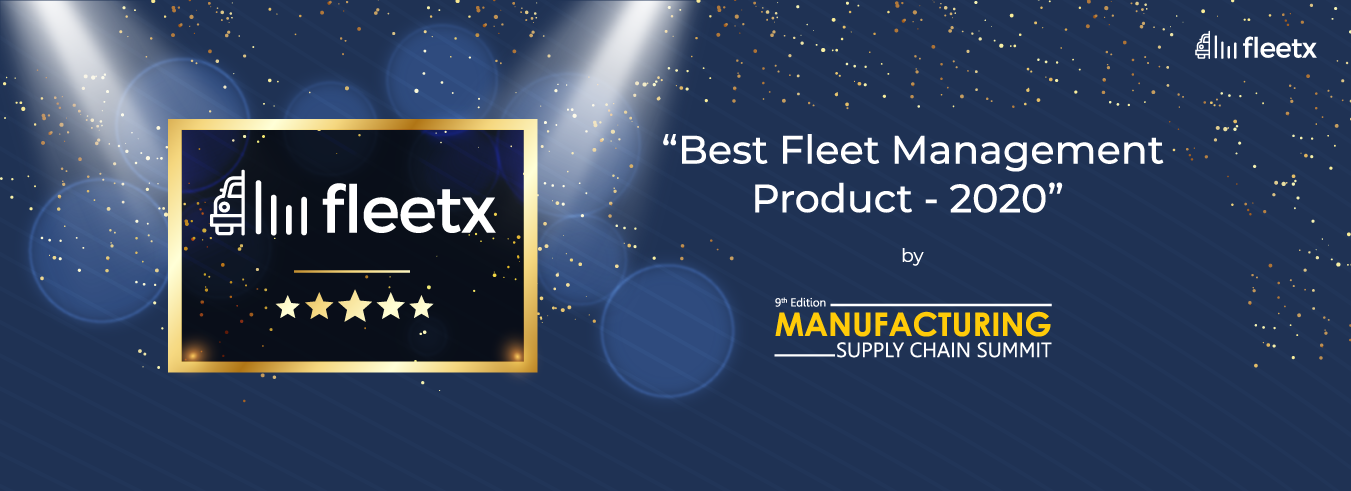
It's official now! We have the best fleet management product - recognized, appreciated and celebrated by Industry leaders, fleet owners and other stakeholders alike.
As some of you may know, Fleetx bagged the 'Best Fleet Management Product 2020' award, at the 9th edition of the Manufacturing Supply Chain Summit, held in Mumbai, India, this Wednesday.
This success is testimony to the cutting-edge technology, innovation and leadership abilities of the people here, in establishing Fleetx as one of the fastest growing SaaS companies with a growth rate of more than 20% MoM.
Fleetx's customer-centric approach to product development makes it easy and affordable for a wide range of industries to harness the power of IoT in their everyday fleet operations. From tour & travel companies who want to know if the tourists are reaching their beloved destination on time, to cargo carriers who want to tap into any undiscovered potential of their existing fleet, to food distributors who want to know the food temperature to guarantee food hygiene and safety, fleetx supports them all in no less than a spectacular fashion.
We'd like to thank all our customers for their ongoing business with us. And, we look forward to continuing to provide not only the very best innovative technology but the very best customer service, too.
About Us: Fleetx identified the grassroots problem in this highly fragmented logistics sector and developed an integrated solution from scratch, supported by latest tech stack and IoT innovation, which caters to 2000+ Clients, 50,000+ vehicles with their varied fleet management needs.
Frequently Asked Questions
What is a fleet management product award and why is it important for logistics companies? ▼
A fleet management product award is an industry recognition presented to technology providers that demonstrate innovation, operational excellence, customer value, and measurable business impact within transportation and logistics. Such awards are generally evaluated by experienced professionals, logistics experts, fleet owners, and technology leaders based on product capabilities, usability, scalability, and contribution to improving fleet operations.
For businesses searching for reliable fleet technology, an award acts as an additional trust signal. While companies should always evaluate software based on their own operational requirements, recognition from respected industry platforms often indicates that the product has been tested across real-world use cases. This is especially relevant for transporters, manufacturers, FMCG companies, mining businesses, and third-party logistics providers that depend on efficient fleet operations.
In India, organizations operating across Delhi, Delhi NCR, Gurgaon, Mumbai, Bengaluru, Pune, Chennai, and other industrial hubs increasingly look for proven fleet management platforms that help improve visibility, reduce operational costs, optimize routes, monitor vehicle health, and enhance customer satisfaction. Industry recognition also reflects continuous product innovation and customer-centric development.
An award-winning fleet management solution can support business growth by improving operational efficiency, reducing fuel wastage, increasing vehicle utilization, and providing actionable insights through GPS tracking, telematics, IoT, and AI-powered analytics. However, companies should still compare product features, implementation support, integrations, pricing, scalability, and after-sales service before making a purchasing decision.
Why do industry awards matter when selecting the best fleet management software in India? ▼
Industry awards help businesses identify software providers that consistently deliver innovation and measurable value. Although an award alone should never be the only purchasing factor, it often reflects positive customer outcomes, product maturity, technological advancement, and recognition from respected logistics and supply chain communities.
Businesses looking for the best fleet management software in India frequently compare multiple factors including GPS tracking accuracy, transportation management capabilities, fuel monitoring, predictive maintenance, driver behaviour analysis, route optimization, analytics, customer support, cloud deployment, and integration with ERP or warehouse management systems. Awards provide an additional level of confidence that the platform has successfully addressed challenges faced by modern fleet operators.
This becomes particularly valuable for companies operating large fleets in logistics-intensive cities such as Delhi NCR, Gurgaon, Mumbai, Bengaluru, Pune, Hyderabad, and Ahmedabad where operational complexity is significantly higher. Fleet owners need technology capable of managing thousands of trips while maintaining visibility and reducing operational risks.
Businesses should also evaluate customer reviews, implementation experience, return on investment, scalability, security standards, and product roadmap alongside award recognition. A solution that combines proven technology, responsive support, continuous innovation, and industry recognition is generally better positioned to deliver long-term operational benefits across manufacturing, e-commerce, construction, retail distribution, cold chain logistics, and transportation industries.
How does award-winning fleet management software improve operational efficiency for businesses? ▼
Modern fleet management software helps organizations improve operational efficiency by providing real-time visibility into vehicles, drivers, shipments, maintenance schedules, and fuel consumption. Award-winning platforms typically combine GPS tracking, telematics, IoT sensors, AI-driven analytics, and automated reporting to simplify day-to-day logistics operations.
Businesses can monitor vehicle movement, reduce idle time, improve route planning, identify fuel theft, schedule preventive maintenance, and optimize fleet utilization through a centralized dashboard. Automated alerts also help managers respond quickly to delays, unauthorized vehicle usage, maintenance issues, and driver safety concerns before they become expensive operational problems.
For logistics companies operating across India—including Delhi, Gurgaon, Mumbai, Bengaluru, Pune, and other major transport corridors—these capabilities contribute to better delivery performance, improved customer satisfaction, lower operating costs, and enhanced compliance with transportation regulations.
Organizations across manufacturing, FMCG, cement, mining, pharmaceuticals, retail distribution, and third-party logistics sectors increasingly depend on intelligent fleet solutions to support digital transformation initiatives. Beyond reducing costs, advanced fleet management platforms enable data-driven decision-making through dashboards, KPIs, predictive analytics, and performance reports. As transportation networks continue becoming more complex, businesses benefit from solutions that improve operational visibility while supporting scalability, business continuity, and sustainable fleet growth across regional as well as nationwide logistics operations.
What is the typical cost of implementing fleet management software in India? ▼
The cost of implementing fleet management software in India varies depending on fleet size, business requirements, hardware, software modules, integrations, and deployment complexity. Small businesses with limited vehicles generally have lower implementation costs, while large enterprises operating hundreds or thousands of vehicles require customized deployments with advanced analytics, ERP integration, IoT devices, AI-based reporting, and dedicated onboarding support.
For many organizations, software pricing is offered through monthly or annual subscription plans, while GPS hardware, telematics devices, dashcams, temperature sensors, and installation charges may be billed separately. Basic deployments for small fleets can begin at a few hundred rupees per vehicle per month, whereas enterprise implementations for manufacturers, logistics companies, mining firms, FMCG distributors, and transport operators may involve significantly larger investments depending on customization and support requirements.
Businesses across Delhi, Delhi NCR, Gurgaon, Mumbai, Bengaluru, Pune, Chennai, and Hyderabad should also consider indirect implementation expenses such as driver training, system integration, change management, API connectivity, mobile applications, and ongoing maintenance. Selecting the cheapest platform is rarely the best long-term strategy if it lacks scalability or essential operational features.
When comparing fleet management software, companies should evaluate the total cost of ownership instead of only the subscription fee. Solutions that reduce fuel consumption, improve route planning, minimize downtime, increase fleet utilization, and automate reporting often deliver a stronger return on investment over time. Requesting a customized quotation based on fleet size, operational complexity, and business objectives usually provides the most accurate estimate before implementation.
How can logistics companies in Delhi NCR and Gurgaon benefit from modern fleet management software? ▼
Delhi NCR and Gurgaon are among India's busiest logistics and industrial regions, supporting manufacturing, e-commerce, retail distribution, construction, pharmaceuticals, and FMCG supply chains. Fleet operators working across these areas often deal with traffic congestion, multiple delivery locations, compliance requirements, rising fuel prices, and strict customer delivery timelines. Modern fleet management software helps businesses overcome these operational challenges through real-time visibility and intelligent automation.
With GPS tracking, AI-powered route optimization, vehicle diagnostics, driver performance monitoring, geofencing, and automated alerts, fleet managers can improve delivery efficiency while reducing unnecessary operational costs. Dispatch teams gain complete visibility into vehicle movements, estimated arrival times, delays, and trip performance, enabling quicker decision-making throughout the transportation process.
For companies serving industrial clusters in Gurgaon, Noida, Faridabad, Ghaziabad, Manesar, Bhiwadi, and other parts of Delhi NCR, centralized fleet management simplifies coordination across multiple warehouses and distribution centers. Businesses can improve customer communication through live tracking while maintaining better control over fuel usage, maintenance schedules, and compliance documentation.
Organizations operating regional or nationwide transportation networks also benefit from detailed dashboards, historical trip reports, predictive maintenance, and operational analytics that support continuous improvement. As Delhi NCR continues to expand as one of India's largest logistics ecosystems, investing in scalable fleet technology helps businesses improve productivity, customer satisfaction, and long-term operational competitiveness.
Why is Mumbai an important market for advanced fleet management and transportation technology? ▼
Mumbai plays a critical role in India's transportation and logistics ecosystem because it serves as a major commercial hub, financial center, and gateway for domestic and international trade. The city's ports, warehouses, manufacturing facilities, retail distribution networks, and industrial corridors generate significant freight movement every day. Managing these operations efficiently requires advanced fleet management technology capable of providing complete operational visibility.
Fleet operators serving Mumbai often encounter challenges including heavy traffic congestion, strict delivery schedules, high fuel expenses, and complex urban distribution routes. Modern fleet management software helps businesses address these issues through live GPS tracking, route optimization, driver behaviour monitoring, maintenance scheduling, electronic proof of delivery, and AI-powered analytics.
Companies transporting goods between Mumbai, Navi Mumbai, Thane, Pune, Gujarat, Delhi NCR, Bengaluru, and other major logistics corridors benefit from centralized dashboards that improve fleet utilization while reducing delays and operational risks. Manufacturing companies, exporters, cold chain operators, e-commerce businesses, and third-party logistics providers can also automate reporting and monitor shipments more effectively.
As customer expectations continue to evolve, organizations increasingly prioritize technologies that improve on-time deliveries, reduce operational costs, and enhance customer satisfaction. Businesses evaluating transportation technology should compare software scalability, implementation support, integrations, analytics capabilities, and long-term return on investment. Selecting a reliable fleet management platform enables companies operating within Mumbai's competitive logistics environment to build more efficient, data-driven, and resilient transportation operations.
What features should businesses compare when choosing the top fleet management software? ▼
Selecting the top fleet management software requires more than comparing pricing or brand recognition. Businesses should evaluate whether the platform solves their operational challenges while supporting long-term growth. Essential capabilities include real-time GPS tracking, AI-powered route optimization, preventive maintenance scheduling, fuel monitoring, geofencing, driver behaviour analytics, trip management, electronic proof of delivery (ePOD), video telematics, IoT integration, and comprehensive reporting dashboards.
Companies operating across India should also consider software scalability, ease of implementation, API integrations, mobile accessibility, cloud deployment, cybersecurity, uptime, customer support, and training services. Organizations with multiple branches in Delhi NCR, Gurgaon, Mumbai, Bengaluru, Pune, Chennai, Hyderabad, or Ahmedabad need centralized dashboards capable of monitoring thousands of vehicles simultaneously while providing location-specific insights.
Industry-specific functionality is equally important. Manufacturing businesses may require dispatch planning, while cold-chain logistics providers benefit from temperature monitoring. Construction companies often prioritize equipment tracking, whereas retail and e-commerce operators need accurate ETA predictions and last-mile delivery visibility.
Instead of selecting software based solely on popularity, businesses should request product demonstrations, compare implementation timelines, evaluate customer reviews, calculate total cost of ownership, and measure expected return on investment. The best fleet management software is one that aligns with operational goals, improves fleet efficiency, reduces operating costs, supports business expansion, and delivers measurable value over time.
How can AI, IoT, and telematics strengthen award-winning fleet management solutions? ▼
Artificial Intelligence (AI), Internet of Things (IoT), and telematics have transformed fleet management from a simple vehicle tracking solution into a comprehensive operational intelligence platform. These technologies collect real-time information from vehicles, drivers, routes, and equipment, enabling businesses to make faster and more informed operational decisions.
IoT sensors continuously monitor vehicle location, engine health, fuel consumption, tyre pressure, cargo conditions, and driving behaviour. AI processes this data to identify patterns, predict maintenance requirements, optimize routes, improve dispatch planning, and detect operational anomalies before they become costly issues. Telematics integrates all this information into centralized dashboards that provide complete fleet visibility.
Businesses operating across logistics hubs such as Delhi, Gurgaon, Mumbai, Bengaluru, Pune, Chennai, and Hyderabad can significantly improve delivery performance while reducing downtime and operational costs through predictive maintenance and intelligent fleet analytics. Fleet managers also benefit from automated alerts, compliance reporting, driver safety scoring, and detailed operational KPIs that improve overall productivity.
Modern award-winning fleet management platforms increasingly combine AI, IoT, cloud computing, and advanced analytics to deliver smarter transportation operations. As digital transformation accelerates across India's logistics sector, organizations adopting intelligent fleet technologies are better positioned to improve customer satisfaction, optimize resources, enhance profitability, and remain competitive in rapidly evolving transportation and supply chain environments.
How does industry recognition build customer trust in fleet management technology providers? ▼
Industry recognition plays an important role in strengthening customer confidence because it demonstrates that a technology provider has been acknowledged by experienced professionals, industry experts, customers, or respected business forums. Although awards should never replace a detailed product evaluation, they often indicate consistent innovation, customer satisfaction, operational success, and commitment to solving real-world logistics challenges.
Businesses investing in fleet management technology frequently seek evidence that a platform has delivered measurable improvements across transportation, manufacturing, mining, FMCG, construction, retail, and third-party logistics operations. Recognition for innovation or product excellence provides additional credibility when comparing multiple software vendors.
For organizations operating throughout India—including Delhi NCR, Gurgaon, Mumbai, Bengaluru, Pune, Chennai, Kolkata, and Hyderabad—choosing an experienced technology partner reduces implementation risks and increases confidence in long-term product development. Reliable customer support, regular software updates, security standards, industry expertise, and proven implementation experience are equally important factors that contribute to trust.
Companies should evaluate product capabilities alongside independent reviews, customer success stories, implementation methodology, integration options, scalability, pricing transparency, and return on investment. Combining industry recognition with strong customer outcomes creates a compelling indicator that the fleet management provider is capable of supporting business growth while helping organizations improve operational efficiency, transportation visibility, and supply chain performance over the long term.
Why are technology innovation and customer success equally important in fleet management? ▼
Technology innovation is valuable only when it delivers measurable improvements for customers. In fleet management, successful digital transformation depends on combining advanced technologies with practical operational benefits that address everyday transportation challenges. Businesses require solutions that are easy to implement, scalable, reliable, and capable of producing tangible business outcomes rather than simply offering numerous technical features.
Modern fleet management platforms integrate GPS tracking, AI analytics, IoT devices, predictive maintenance, route optimization, video telematics, and automated reporting to improve efficiency across transportation operations. However, long-term customer success depends equally on responsive support, implementation expertise, employee training, continuous product updates, and the ability to adapt software to changing business requirements.
Organizations operating across Delhi, Gurgaon, Mumbai, Bengaluru, Pune, and other logistics-intensive regions often manage diverse fleets serving multiple industries. They need technology partners capable of understanding industry-specific workflows while delivering consistent operational improvements such as reduced fuel consumption, better vehicle utilization, enhanced driver safety, lower maintenance costs, and improved customer satisfaction.
When evaluating fleet management providers, businesses should balance technological innovation with customer success metrics including implementation quality, service responsiveness, product reliability, integration capabilities, and long-term return on investment. Companies that consistently innovate while maintaining strong customer relationships are generally better positioned to support sustainable fleet growth and evolving logistics requirements in India's increasingly digital transportation ecosystem.