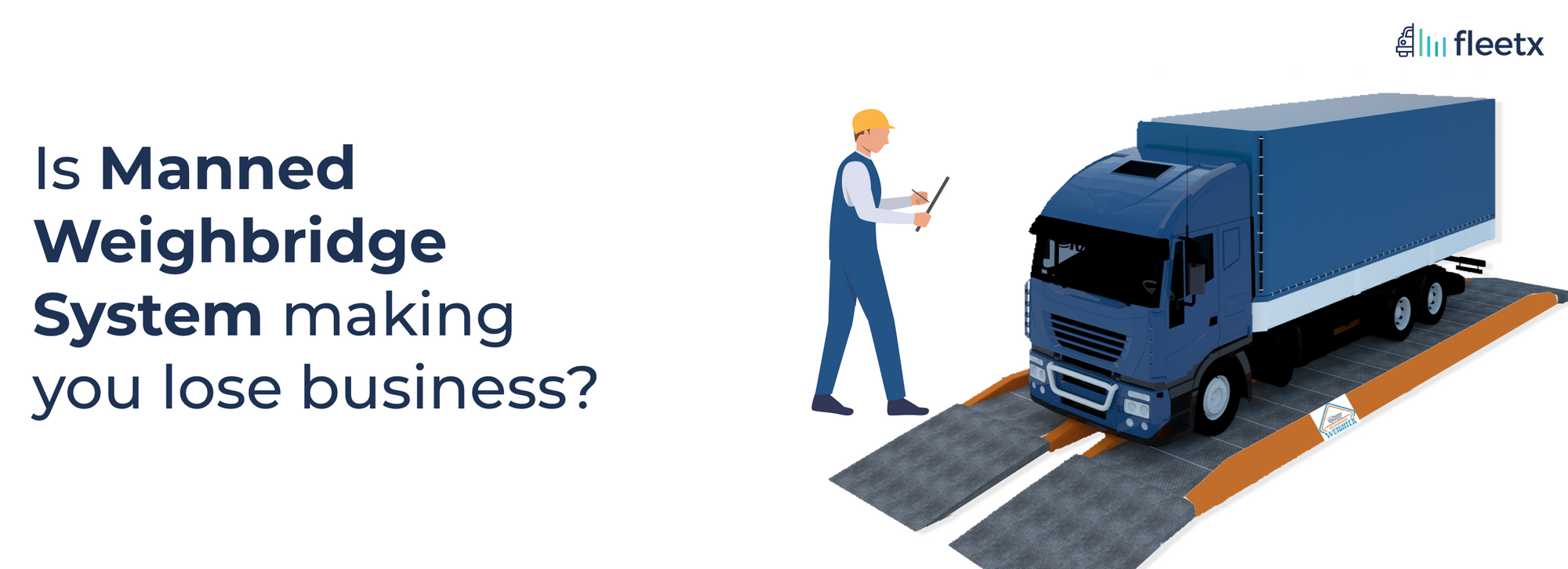

In our previous article, we discussed the manual process of weighing commercial goods using manned weighbridge systems. It pointed out the inefficiencies associated with the manned weighbridge system and their detrimental impact on the efficiency and cost of logistics operation. The piece concluded with the need for companies to automate the entire weighing process through weighbridge automation systems that we will discuss in this article.
Summarizing the problems with manned weighbridge system
Apart from being inefficient, manned weighbridge system is riddled with the following problems which reduce their output efficiency,
- Heavily dependent on booth operators
- Prone to fraud, theft, and malpractice
- Lack of transparency in the process
- Higher operational cost with lower efficiency
- Crowding and mismanagement in busier plants and facilities
How Weighbridge Automation Solutions can eliminate the problems of Manned Weighbridge Stations
Automation is revolutionizing how the logistics industry operates. Technology backed solutions like Fleet Management Systems and Vehicle Tracking Systems are already solving some of the most common issues in Supply-Chain Management, benefitting companies operationally and financially.
The introduction of the Weighbridge Automation Solution is set to regularize the commercial weighing industry through data and automation. It eliminates the need for manual intervention and booth operators, making the process tampering-free. It makes the entire weighing process more transparent, thus, making it easier for businesses as well as their clients to have more accountability.
What does Fleetx’s Weighbridge Automation Solution (WAS) offer?
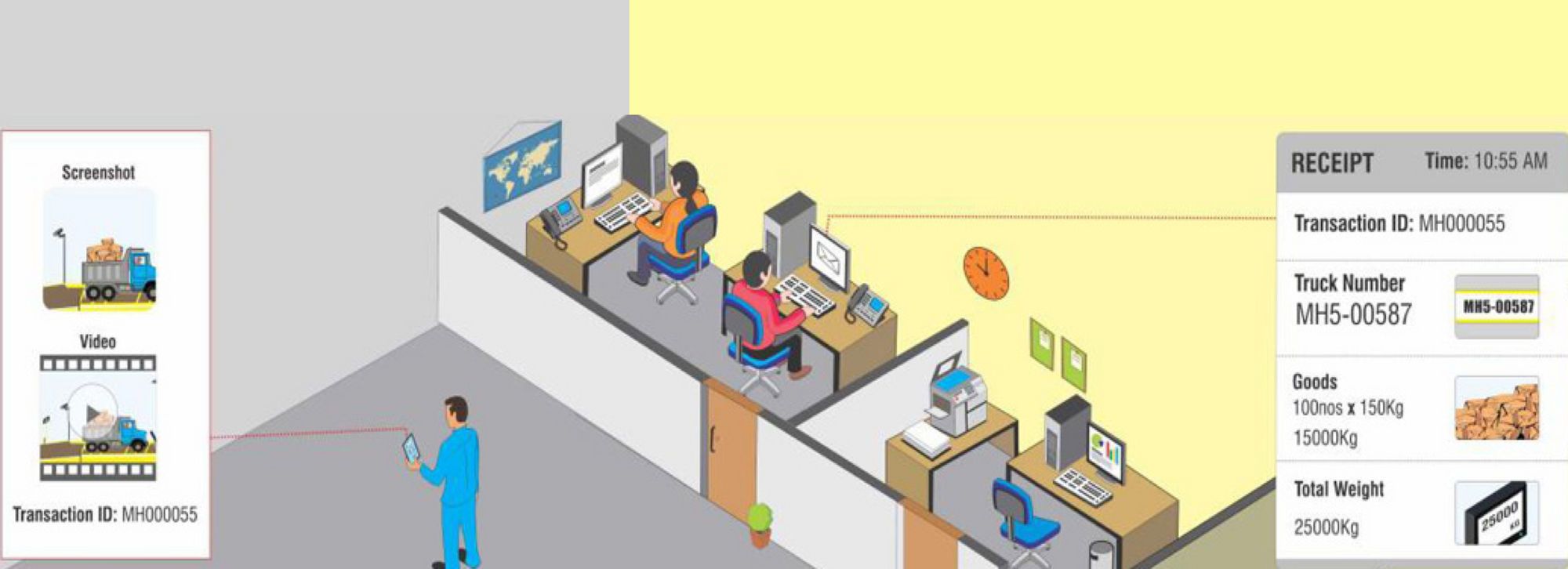
Fleetx’s Weighbridge Automation Solution (WAS) offers a complete weighing solution for commercial use that provides end-to-end transparency from the moment a vehicle enters till it exits the company's premises. It aims to eliminate the need for manual operators, thus, improving efficiency and transparency in the entire process.
- It eliminates the need to hire and train a booth or scale operator reducing operational cost significantly.
- A fully automated and easy-to-use weighing system that does not require manual intervention and can be operated by vehicle drivers.
- It reduces the likelihood of financial and operational losses that occur due to human error in the weighing process.
- Eliminates malpractices and theft by automating the process and eliminating manual intervention.
- It increases operational efficiency by employing an RFID system for vehicle identification and registration, thus, eliminating long queues or overcrowding at the facility.
- It Equips the facility with CCTV, IP Camera, Senors and other electronic devices to provide tracking for each vehicle movement that enters and exits the premises 24x7.
- It offers accurate measurement of goods using a high-quality industrial weighing scale.
- It offers extensive accountability for each vehicle by employing a receipt generation system at entry and exit points of the facility.
- It reduces the operational cost for logistics, thus, bringing down the cost of doing business for companies and allowing them to stay competitive.
How will the Weighbridge Automation Solution work?
Fleetx’s Weighbridge Automation Solution will eliminate the need for booth operators and manual intervention in the weighing process of goods.
Entry, Identification and Traffic Control
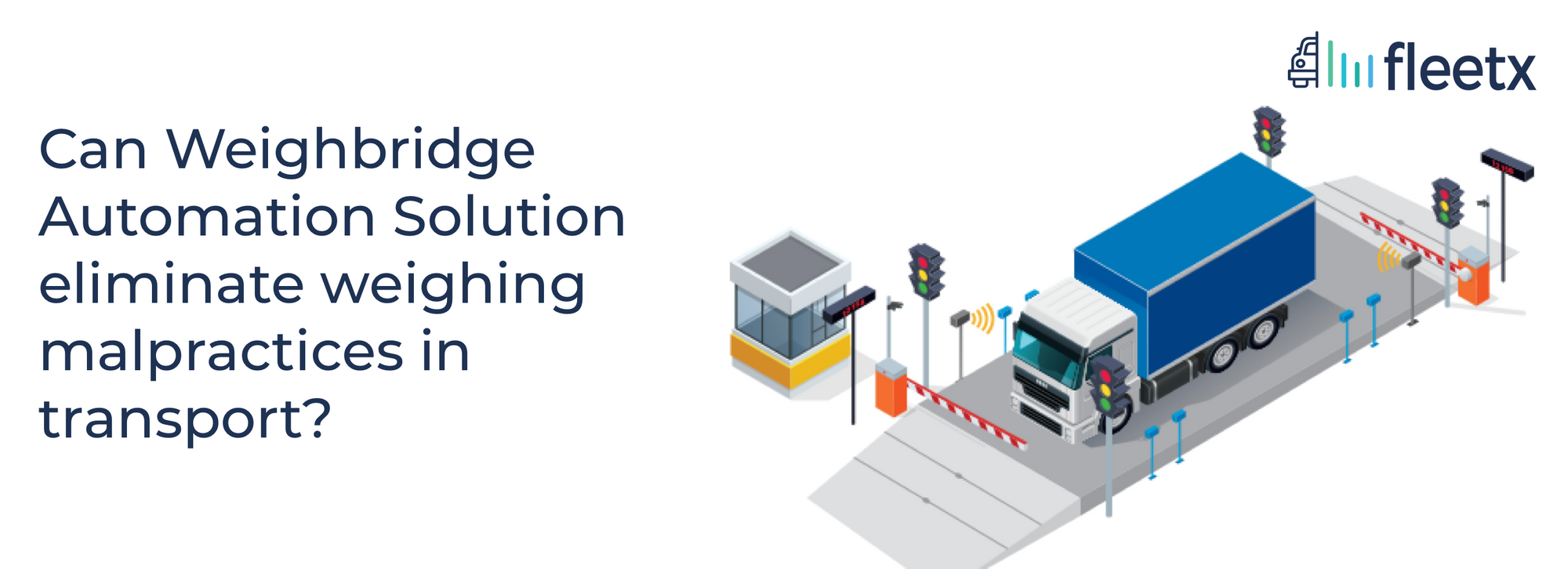
The entry point will use a combination of signal, automated barriers, IP cameras, and RFID for identification and tracking the position of the particular vehicle in the facility. It will create a systematic process for traffic control for facilities and plants which se higher traffic.
Weighbridge Alignment
Once identified and registered the vehicle proceeds to the weighbridge where it is correctly aligned using vehicle alignment sensors and signals.
Automated Weighing Process
Once vehicle alignment is correct, the digital scale captures weight of the vehicle and RFID sensor identifies the vehicle and associates the weight with the vehicle. IP cameras capture other details to match it with the one captured at entry for identification.
Exit, Communication and Repeat
Once the weighing process is completed automated barriers at exit point allows the vehicle to exit. Loudspeakers and signals placed at every step allows drivers to understand and follow steps for correct measurement without fail.
The same steps are repeated once goods are unloaded at the facility to measure the weight of the empty vehicle which is tallied with the weight of vehicle with goods to get the accurate measurement of goods that were unloaded. All the data that is captured and processed through a centralized system which makes the entire process completely transparent.
Does the Automation justify the cost?
Fleetx’s Weighbridge Automation Solution (WAS) is designed to be compatible with companies having an existing weighbridge system as well as for companies looking to set up a new weighing system. An existing Weight Station can be converted into a fully automated weight station at a significantly lower cost.
To conclude, automation in the weighing process increasing operating efficiency and reducing risks considerably, which will allow companies to perform better both operationally and financially. Additionally, there is an accountability factor involved. The Weighbridge Automated Solution offers complete accountability and transparency for the Supply-Chain managers which were are non-existent in Manned Weighbridge System.
Frequently Asked Questions on Weighbridge Automation Solutions
What is a weighbridge automation solution? ▼
A weighbridge automation solution is a digital system that automates vehicle identification, weight capture, entry-exit control, ticket generation, and data recording at a weighbridge. Instead of relying only on manual booth operators, the system uses RFID, boom barriers, IP cameras, sensors, traffic lights, digital indicators, and centralized software to manage the weighing process.
For logistics, manufacturing, mining, construction, cement, steel, FMCG, and warehouse operations in India, this helps reduce weighing fraud, manual errors, long queues, and operational delays. A good automated weighbridge solution records every vehicle movement from entry to exit, links weight data with vehicle details, and provides a tamper-resistant audit trail.
The best weighbridge automation systems are useful for high-volume sites in Delhi NCR, Gurgaon, Mumbai, Bengaluru, Pune, and industrial corridors where hundreds of trucks may enter and exit daily. They improve transparency, reduce dependency on manpower, and help businesses get real-time visibility into inbound and outbound goods movement.
How does weighbridge automation reduce fraud and malpractices in transport? ▼
Weighbridge automation reduces fraud by removing unnecessary manual intervention from the weighing process. In a manual weighbridge setup, errors or malpractices can happen through incorrect vehicle entry, manipulated slips, operator bias, unrecorded trips, wrong tare weight, or mismatch between the vehicle and the captured weight.
An automated system uses RFID-based vehicle identification, CCTV or IP camera capture, automated barriers, digital weighing integration, and timestamped records. This ensures that the same vehicle entering the premises is tracked throughout the weighing cycle. The system can also capture images of the vehicle, number plate, driver, and material movement for stronger verification.
For businesses operating in transport-heavy regions such as Delhi, Gurgaon, Mumbai, Pune, and Bengaluru, this creates a reliable digital trail. It helps supply chain managers compare gross weight, tare weight, net weight, trip records, invoices, and dispatch data. The result is better accountability, fewer disputes with vendors or transporters, and improved control over material loss, theft, and unauthorized vehicle movement.
What is the cost of a weighbridge automation solution in India? ▼
The cost of a weighbridge automation solution in India usually depends on the site size, number of weighbridges, level of automation, hardware requirements, software integrations, and whether the business already has an existing weighbridge. For a basic automation setup, pricing may start from a few lakhs, while a more advanced end-to-end automated system with RFID, boom barriers, IP cameras, sensors, control panels, cloud software, and ERP integration can cost higher.
As a broad estimate, businesses may see entry-level automation ranges around ₹3 lakh to ₹8 lakh for limited automation, while advanced multi-point automation systems may range from ₹10 lakh to ₹25 lakh or more depending on customization. Large plants, warehouses, mining sites, steel yards, and cement facilities may require higher investment because they need multiple checkpoints and deeper integrations.
For companies in Delhi NCR, Gurgaon, Mumbai, Pune, and Bengaluru, the final price can also vary based on installation complexity, site readiness, network availability, camera coverage, support requirements, and annual software subscription. The best way to evaluate cost is to compare it with savings from reduced manpower, faster turnaround time, lower fraud risk, fewer disputes, and better operational visibility.
Which industries need the best weighbridge automation system? ▼
The best weighbridge automation systems are most useful for industries where vehicle weight, material movement, and dispatch accuracy directly affect revenue, compliance, and operational efficiency. These include logistics, cement, steel, mining, construction, agriculture, warehousing, FMCG, manufacturing, ports, recycling, and bulk material transport.
In India, industries with high truck movement often face challenges such as long queues, manual slip errors, theft, overloading, underloading, and lack of visibility. A weighbridge automation solution helps solve these problems by creating a controlled, digital, and traceable weighing process.
For example, a cement plant in Rajasthan or Gujarat may use automation to track raw material and dispatch weight. A warehouse in Gurgaon or Delhi NCR may use it to reduce truck waiting time. A port-linked operation in Mumbai may use it to verify inbound and outbound cargo movement. A manufacturing unit in Pune or Bengaluru may use it to integrate weighbridge data with ERP, billing, inventory, and transport management systems.
Any business that wants better accuracy, faster vehicle processing, reduced fraud, and stronger supply chain control can benefit from automated weighing.
Is weighbridge automation suitable for logistics companies in Delhi NCR and Gurgaon? ▼
Yes, weighbridge automation is highly suitable for logistics companies, warehouses, factories, and transport hubs in Delhi NCR and Gurgaon. These regions have dense commercial vehicle movement, industrial parks, distribution centers, e-commerce warehouses, and manufacturing units where accurate vehicle weighing is important for cost control and operational transparency.
Manual weighbridge operations in high-traffic locations can create delays, long truck queues, dependency on operators, and higher risk of incorrect weight records. Automation helps by allowing RFID-based entry, automated vehicle identification, camera verification, digital weight capture, and faster exit clearance. This improves truck turnaround time and reduces congestion inside the facility.
For companies in Gurgaon, Manesar, Faridabad, Noida, Ghaziabad, and Delhi logistics corridors, an automated weighbridge system can also support better vendor billing, transporter accountability, material reconciliation, and dispatch planning. When integrated with fleet management or transport management software, it gives managers real-time visibility into vehicles, loads, routes, and site-level performance.
This makes it a strong option for businesses looking for top logistics automation solutions in Delhi NCR.
How can weighbridge automation help businesses in Mumbai, Pune, and Bengaluru? ▼
Weighbridge automation can help businesses in Mumbai, Pune, and Bengaluru by improving truck movement, reducing manual dependency, and making weighing data more reliable. These cities and surrounding industrial regions have strong logistics, manufacturing, automotive, FMCG, construction, and warehousing activity, where accurate material movement is critical.
In Mumbai and nearby logistics zones, automated weighing can support port-linked cargo, warehouse movement, construction material transport, and high-volume dispatch operations. In Pune, manufacturing and automotive businesses can use automation to connect weighbridge data with dispatch, inventory, and vendor records. In Bengaluru, warehousing, distribution, and industrial operations can use it to improve visibility and reduce manual paperwork.
The system helps businesses capture vehicle entry, gross weight, tare weight, net weight, driver details, images, and timestamps in one place. This reduces disputes and creates a stronger audit trail. For fast-growing operations, automation also helps scale without adding too many manual operators.
For companies searching for the best weighbridge automation solution in Mumbai, Pune, or Bengaluru, the ideal system should support RFID, camera capture, cloud dashboards, ERP integration, and real-time reporting.
Can an existing weighbridge be converted into an automated weighbridge? ▼
Yes, in many cases an existing weighbridge can be converted into an automated weighbridge without replacing the entire weighing infrastructure. This is one of the biggest advantages for businesses that already have a functional weighbridge but want to reduce manual errors, fraud risk, and operational delays.
The conversion usually involves adding automation hardware and software around the existing weighbridge. This may include RFID readers, vehicle tags, boom barriers, traffic lights, IP cameras, sensors, digital display boards, weighing scale integration, ticketing software, and a centralized dashboard. The system can then automate vehicle entry, identity verification, weight capture, data storage, and exit control.
For Indian businesses, upgrading an existing weighbridge is often more cost-effective than installing a completely new system. The price depends on the condition of the current weighbridge, compatibility with digital indicators, number of lanes, automation level, and integration needs.
Companies in Delhi NCR, Gurgaon, Mumbai, Pune, Bengaluru, and other industrial regions can use this approach to modernize operations gradually while improving transparency, accuracy, and reporting from day one.
What features should I look for in the best weighbridge automation solution? ▼
The best weighbridge automation solution should offer a complete combination of hardware, software, visibility, and control. A basic system may only capture weight digitally, but a stronger solution should automate the full vehicle movement cycle from entry to exit.
Important features to look for include RFID-based vehicle identification, automated boom barriers, IP camera or CCTV capture, traffic signal control, vehicle alignment sensors, digital weighing scale integration, automated slip generation, cloud dashboard, role-based access, real-time reports, ERP or TMS integration, and audit logs.
For Indian logistics and manufacturing businesses, it is also useful to have multilingual driver instructions, remote monitoring, exception alerts, transporter-wise reporting, material-wise records, and mobile access for managers. Businesses in high-traffic areas such as Delhi NCR, Gurgaon, Mumbai, Pune, and Bengaluru should also look for systems that reduce truck waiting time and support multiple weighbridge lanes.
A top weighbridge automation system should not only reduce manual work but also improve fraud control, billing accuracy, compliance, inventory reconciliation, and supply chain transparency. Choosing a scalable solution ensures the system can grow with future logistics and plant operations.
How does weighbridge automation improve ROI for transport and logistics businesses? ▼
Weighbridge automation improves ROI by reducing direct and indirect losses in transport and logistics operations. Manual weighing often creates hidden costs through operator dependency, inaccurate entries, vehicle waiting time, theft, material mismatch, billing disputes, and weak reporting. Automation helps reduce these leakages by creating a faster, more accurate, and more transparent process.
The return on investment usually comes from multiple areas. Businesses can reduce manpower requirements at the weighbridge, process more trucks in less time, lower the chance of manipulated weight records, and improve reconciliation between dispatched and received material. Automated data also helps managers identify bottlenecks, compare transporter performance, and reduce operational delays.
For companies in India with regular truck movement, even small improvements in weighing accuracy and turnaround time can create significant monthly savings. This is especially relevant for plants, warehouses, and logistics hubs in Delhi NCR, Gurgaon, Mumbai, Bengaluru, and Pune where vehicle volume and real estate pressure are high.
While the initial cost of automation may vary, the long-term value comes from fraud prevention, operational efficiency, stronger audit trails, better customer trust, and improved control over every load movement.