
GPS is one of the revolutionary innovations for the internet and technology for the last three decades. Initially, it was mainly used for tracking military troop and their movement but later it is used for homeland security, civil, commercial, and scientific needs. Due to this old history of GPS, people made a perception that GPS can only be used for tracking. But with the combination of GPS, Software and internet, there is a lot more we can do other than only tracking location. For a a GPS Tracking System vehicle is just one small part but using insights from an advance tracking device you can get a lot more than just tracking vehicles.
Here are 5 main myths that come to everyone's mind when they hear Fleet Management System:
Myth #1: Fleet Management System is just another term for GPS tracker
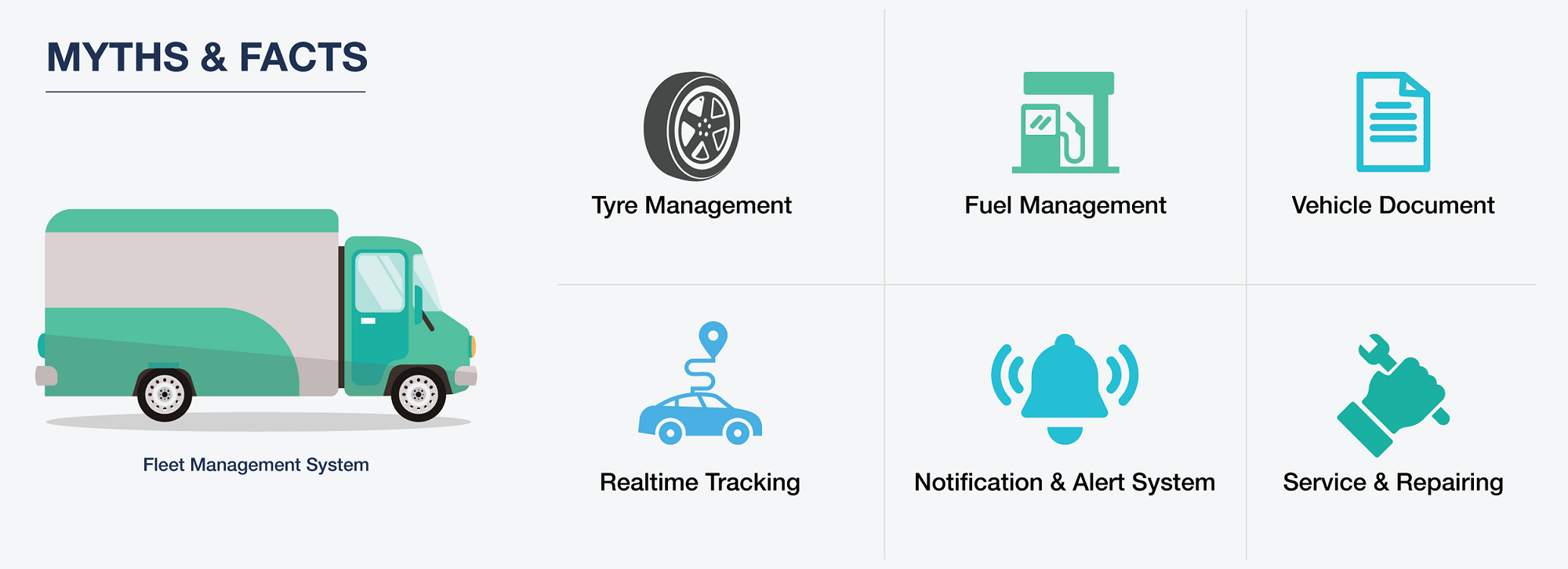
Many fleet owners have made a wrong perception that FMS (fleet management system) is only about vehicle location tracking but in reality, Transport Management is just a small part of a fleet management system. A smart FMS is capable of providing a complete solution of every problem in the fleet business that includes fuel management, tyre management, vehicle real-time tracking, route planning and scheduling, driver management, history reports, trip management, etc. A survey suggests that after installing an advance FMS, productivity increases by 58%.
Myth #2: Fleet management software is hard to understand
This is just an excuse for many people, today in the digital world, everyone has a smartphone and running applications on a daily basis. Our fleet management software is also the same as every software you are using on your smartphone. Its user interface is so simple and understandable that you can easily familiar yourself within the same day. Other than this, we provide training and manuals to all the clients.
Myth #3: Fleet Management System is too expensive
It is a one-time investment for your fleet that would give your business a good ROI. With FMS, you would save money from fuel wastage during idling of vehicle, witness the increase in fleet productivity, saves time in route planning and scheduling timely delivery, monitoring driving behavior which improves vehicle life.
Myth #4: Fleet Management System is only for large fleet business
Some fleet owners put an excuse that we have a very small fleet business and we can manage it manually. But they don't realize that if they keep on doing this manually, how would they improve their business productivity, efficiency and how would they expand their business? With manual processes and work, a company can only run but to expand it has to automate its process to improve efficiency and productivity. Its high time for small fleet company's owner to think about using a smart fleet management software to remain in this competition.
Myth #5: All Fleet Management System is the same
Not all fleet management system is same, with technological advancement, business-specific Fleet Management System is available in the Indian market that is capable of providing complete fleet management system including real-time tracking, fuel management, Tyre management, finance management, various downloadable reports, etc. We at Fleetx, provide customization in our software based on the business requirements.
It's high time that a fleet owner should accept these facts over the old myths and start using digital technology to improve their business efficiency, workflow and expand their fleet business with our smart fleet management system. Start with our free demo here.
Choosing a Future-Ready Fleet Management System: A Practical Buyer's Checklist
Understanding the myths surrounding fleet management is only the first step. The next challenge for fleet owners is selecting a solution that continues delivering value as their business grows. Many organisations compare software based only on pricing or GPS tracking capabilities, but the right Fleet Management System should improve operational efficiency, support data-driven decision-making, and adapt to changing business requirements.
Before making an investment, decision-makers should evaluate whether the platform can support both current operations and future expansion without requiring costly upgrades or multiple disconnected systems.
Questions Every Fleet Owner Should Ask Before Choosing a Fleet Management System
Instead of evaluating software solely on features advertised by vendors, businesses should ask practical questions that directly impact day-to-day operations.
- Can the platform support both small and large fleet operations without changing systems later?
- Does the software offer real-time operational dashboards instead of only vehicle location tracking?
- Is historical trip, driver, and vehicle data stored for future reporting and business analysis?
- Can the solution integrate with ERP software, Transport Management Systems (TMS), accounting software, APIs, FASTag data, IoT devices, and fuel management tools?
- How frequently are software updates and new features released?
- Does the provider offer implementation support, user training, and technical assistance after deployment?
- Is the platform accessible through mobile applications for fleet managers, drivers, and field teams?
Answering these questions helps businesses identify solutions that deliver long-term operational value rather than short-term functionality.
Fleet Management Software Evaluation Checklist
| Evaluation Criteria | Why It Matters |
|---|---|
| Scalability | Supports business growth without replacing the software. |
| Integration Capabilities | Connects with existing business systems for seamless workflows. |
| Real-Time Visibility | Provides instant access to fleet operations and exceptions. |
| Reporting & Analytics | Enables data-driven operational improvements. |
| User Experience | Reduces training time and encourages user adoption. |
| Customisation | Adapts to unique fleet operations and business processes. |
| Security & Data Protection | Protects sensitive operational and business information. |
| Customer Support | Ensures faster issue resolution and smoother implementation. |
Warning Signs That Your Fleet Needs Digital Transformation
Many businesses continue relying on manual processes without realising how much time and revenue are being lost. If any of the following situations are common, it may indicate that the existing fleet management approach is no longer sufficient.
- Managers depend heavily on spreadsheets and phone calls to coordinate daily operations.
- Vehicle performance reports take significant time to prepare manually.
- Operational decisions are based on assumptions instead of real-time data.
- Fleet expansion is becoming difficult because processes cannot scale efficiently.
- Multiple software tools are used independently, resulting in fragmented information.
- Customer enquiries require manual follow-ups to determine delivery or vehicle status.
- Important operational records are stored across different systems with limited visibility.
Recognising these operational challenges early allows businesses to transition towards a more connected, data-driven fleet management approach before inefficiencies begin affecting growth and customer satisfaction.
Why Future-Proofing Matters More Than Initial Cost
While purchase price often influences software selection, long-term business value should carry greater weight during the evaluation process. A scalable Fleet Management System helps organisations adapt to increasing fleet sizes, changing customer expectations, evolving compliance requirements, and new technologies without frequent system replacements.
Businesses that choose solutions with strong reporting capabilities, integration support, automation features, and ongoing product development are generally better positioned to improve operational efficiency over the long term. Rather than viewing fleet management software as a one-time technology purchase, organisations should consider it a strategic investment that supports sustainable business growth and continuous operational improvement.
Frequently Asked Questions
What is a Fleet Management System, and how is it different from a GPS vehicle tracking system?
A Fleet Management System (FMS) is a comprehensive software platform that helps businesses manage commercial vehicles, drivers, trips, fuel usage, maintenance, compliance, and operational performance from one centralized dashboard. Although many people assume an FMS is simply a GPS tracking solution, GPS tracking is only one component of a modern fleet management platform.
Unlike standalone GPS trackers that only display vehicle locations, a Fleet Management System combines telematics, cloud software, IoT devices, automation, and analytics to improve overall fleet efficiency. Businesses can monitor route performance, driver behaviour, maintenance schedules, idle time, trip history, fuel consumption, vehicle utilisation, and delivery performance in real time.
For logistics companies in India, especially in Delhi NCR, Mumbai, Bengaluru, Pune, and Gurgaon, an FMS provides greater visibility into daily operations while reducing manual paperwork and operational delays. Instead of making decisions based on assumptions, managers can use real-time dashboards and reports to improve planning and customer service.
A modern Fleet Management System typically includes:
- Real-time vehicle tracking
- Trip planning and scheduling
- Fuel monitoring and analytics
- Driver performance management
- Preventive maintenance reminders
- Route optimisation
- Geofencing and instant alerts
- Business intelligence dashboards
- Mobile applications for drivers and managers
Businesses looking to automate logistics operations should evaluate Fleet Management Systems rather than basic GPS devices because they deliver measurable operational improvements across the entire transportation lifecycle.
What are the biggest myths about Fleet Management Systems that businesses should stop believing?
Many businesses delay adopting fleet management technology because of outdated assumptions. However, advances in cloud computing, IoT, AI, and telematics have transformed Fleet Management Systems into intelligent business platforms that benefit fleets of every size.
Some of the most common misconceptions include believing that Fleet Management Systems are only useful for large companies, difficult to operate, or too expensive to justify. In reality, many solutions today are cloud-based, highly user-friendly, and scalable for businesses with small, medium, or enterprise fleets.
Common myths include:
- Fleet Management Systems only provide GPS tracking.
- Small fleets do not need automation.
- Implementation takes several months.
- Drivers cannot adapt to digital technology.
- Fleet software is too expensive for growing businesses.
- All Fleet Management Systems offer identical features.
These misconceptions often prevent businesses from improving operational efficiency, customer satisfaction, and profitability. Modern platforms automate routine processes such as dispatching, reporting, maintenance planning, and route optimisation while providing valuable operational insights.
Companies across industries—including logistics, FMCG distribution, construction, manufacturing, cold chain, passenger transport, and e-commerce—are increasingly adopting fleet management software to remain competitive. Understanding these facts helps organisations make informed technology investments instead of relying on outdated perceptions.
What are the key benefits of using the best Fleet Management System for logistics businesses in India?
The best Fleet Management System helps businesses improve productivity, reduce operating costs, and gain complete visibility into fleet operations. Rather than relying on manual coordination, spreadsheets, and phone calls, fleet managers can monitor every aspect of their operations through a single digital platform.
For logistics companies operating across India, including Delhi, Gurgaon, Mumbai, Bengaluru, Pune, and other major transport corridors, a modern Fleet Management System supports faster decision-making while improving delivery performance and customer satisfaction.
Some of the most valuable business benefits include:
- Improved vehicle utilisation and fleet productivity.
- Reduced fuel expenses through better route planning.
- Real-time visibility of vehicles and shipments.
- Automated preventive maintenance scheduling.
- Better driver safety through behaviour monitoring.
- Lower operational costs by reducing idle time.
- Accurate reports for business planning and compliance.
- Scalable operations as fleet size increases.
Businesses also benefit from faster communication between drivers, dispatch teams, customers, and management. Real-time alerts allow operators to respond quickly to delays, unauthorised vehicle movement, route deviations, or maintenance issues before they affect business performance.
Choosing a reliable Fleet Management System is therefore not simply a technology upgrade but a long-term operational strategy that helps organisations become more efficient, competitive, and data-driven in today's rapidly evolving logistics industry.
How much does Fleet Management Software cost in India, and what factors affect the pricing?
The cost of Fleet Management Software in India depends on several factors, including fleet size, business requirements, hardware specifications, software modules, implementation complexity, integrations, and the level of customer support provided. Instead of looking only at the initial subscription fee, businesses should evaluate the long-term return on investment through fuel savings, improved vehicle utilisation, lower maintenance costs, and higher operational efficiency.
Small fleet operators generally require essential features such as GPS tracking, trip monitoring, and mobile access, while medium and enterprise fleets often invest in advanced capabilities like AI-powered analytics, predictive maintenance, route optimisation, video telematics, fuel management, tyre management, ERP integration, Transport Management System (TMS) connectivity, and custom reporting.
Typical pricing considerations include:
- Number of vehicles being monitored.
- Type of GPS or IoT hardware installed.
- Monthly or annual software subscription.
- Implementation and onboarding services.
- Custom integrations with existing business software.
- User training and ongoing technical support.
- Additional modules such as fuel management or video telematics.
In India, businesses can expect basic cloud-based Fleet Management Software to start from approximately ₹300–₹800 per vehicle per month, while advanced enterprise solutions with automation, AI analytics, and customised workflows may range between ₹1,000–₹3,000+ per vehicle per month depending on deployment requirements. Companies operating large fleets across Delhi NCR, Mumbai, Bengaluru, Pune, and Gurgaon should request a customised quotation based on operational complexity rather than comparing software solely on price.
Which is the best Fleet Management Software for businesses in India?
The best Fleet Management Software is the one that aligns with a company's operational goals, fleet size, industry requirements, and future growth plans. There is no single solution that suits every organisation because logistics companies, passenger transport operators, construction businesses, FMCG distributors, and manufacturing firms all have different operational priorities.
When evaluating the best Fleet Management Software in India, decision-makers should look beyond GPS tracking and compare platforms based on scalability, automation, analytics, ease of use, customer support, and integration capabilities.
Important evaluation criteria include:
- Real-time fleet visibility.
- Driver behaviour monitoring.
- Fuel consumption analytics.
- Preventive maintenance scheduling.
- Route planning and optimisation.
- Trip management and digital proof of delivery.
- Mobile applications for field teams.
- Business dashboards and downloadable reports.
- Integration with ERP, TMS, APIs, FASTag, and IoT devices.
- Reliable customer onboarding and after-sales support.
Businesses operating across Delhi, Gurgaon, Mumbai, Bengaluru, Pune, and other logistics hubs often prioritise software that can manage geographically distributed fleets while providing accurate real-time insights. Rather than selecting the cheapest solution, companies should compare product demonstrations, implementation support, security features, and scalability before making a decision. A future-ready Fleet Management System should continue supporting business expansion without requiring major software replacement as fleet operations grow.
How can businesses in Delhi, Gurgaon, and Mumbai use Fleet Management Systems to improve logistics operations?
Fleet Management Systems provide significant advantages for businesses operating in densely populated metropolitan regions where traffic congestion, delivery timelines, fuel costs, and customer expectations create daily operational challenges. Cities such as Delhi, Gurgaon, and Mumbai experience heavy commercial vehicle movement, making real-time visibility and intelligent route planning increasingly valuable.
For example, transport companies in Delhi NCR often manage deliveries across multiple industrial zones and neighbouring states. Gurgaon-based businesses frequently coordinate manufacturing, warehousing, and corporate logistics, while Mumbai fleets deal with high-density urban transportation and strict delivery schedules.
A Fleet Management System helps organisations by enabling:
- Live vehicle tracking across multiple delivery locations.
- Route optimisation to reduce unnecessary travel time.
- Driver behaviour monitoring to improve safety and fuel efficiency.
- Maintenance scheduling that minimises vehicle downtime.
- Real-time alerts for delays, route deviations, and idle vehicles.
- Digital reporting for faster operational decision-making.
- Improved customer communication through accurate ETAs.
Businesses that manage regional distribution networks throughout Delhi NCR, Gurgaon, Mumbai, Pune, Bengaluru, and other major logistics corridors can use these capabilities to improve operational consistency while reducing manual intervention. As customer expectations continue to rise, adopting digital fleet management enables companies to maintain better service quality, improve resource utilisation, and support sustainable long-term business growth.
What features should businesses look for in a top Fleet Management System before making an investment?
Selecting a Fleet Management System should involve more than comparing pricing or GPS tracking capabilities. The right platform should help businesses improve operational efficiency, increase visibility, automate manual processes, and support long-term business growth. Whether managing a fleet of 20 vehicles or several thousand, investing in a scalable solution reduces future technology migration costs while improving decision-making.
Businesses should evaluate software based on both current operational requirements and future expansion plans. A solution that only addresses today's challenges may quickly become inadequate as fleet size and customer expectations grow.
Key features to evaluate include:
- Real-time GPS vehicle tracking with accurate location updates.
- Route optimisation for improved delivery efficiency.
- Driver behaviour monitoring and safety analytics.
- Fuel consumption monitoring and fuel theft detection.
- Preventive maintenance scheduling and service reminders.
- Trip management with digital trip history.
- Geofencing and instant alerts.
- Business dashboards with downloadable reports.
- Cloud-based accessibility across desktop and mobile devices.
- Integration with ERP, accounting software, APIs, FASTag, IoT devices, and Transport Management Systems.
Businesses operating across India, particularly in Delhi NCR, Mumbai, Bengaluru, Pune, and Gurgaon, should also evaluate implementation support, data security, customer service quality, software update frequency, and scalability. Choosing a future-ready Fleet Management System ensures that technology continues supporting operational growth rather than becoming a limitation after a few years.
How long does it take to implement Fleet Management Software, and what is the implementation process?
The implementation timeline for Fleet Management Software depends on fleet size, hardware installation, business complexity, software integrations, and employee training requirements. Small fleets can often begin using cloud-based solutions within a few days, while enterprise deployments involving multiple locations and thousands of vehicles may require several weeks for complete implementation.
A structured implementation process ensures minimal disruption to daily operations while allowing employees to adapt quickly to the new system.
The implementation generally includes:
- Business requirement assessment.
- Vehicle and GPS hardware installation.
- Software configuration based on operational workflows.
- Driver and fleet manager onboarding.
- Integration with ERP, TMS, accounting software, and APIs where required.
- Testing of alerts, reports, dashboards, and mobile applications.
- Training sessions for administrators and operational teams.
- Go-live support and continuous technical assistance.
Modern cloud-based Fleet Management Systems are designed with intuitive interfaces, allowing users to become familiar with the platform quickly. Many providers also offer onboarding specialists, training materials, user manuals, and dedicated customer support. Businesses in Delhi, Gurgaon, Mumbai, Bengaluru, and Pune should choose vendors that provide structured implementation assistance, ensuring faster adoption and quicker operational improvements after deployment.
Can Fleet Management Software improve fuel efficiency and reduce operating costs?
Yes. One of the most significant advantages of implementing Fleet Management Software is its ability to reduce operational expenses while improving fleet productivity. Fuel represents one of the largest recurring costs for transportation and logistics businesses, making fuel optimisation a major priority for fleet owners.
Modern Fleet Management Systems provide continuous visibility into vehicle performance and operational behaviour, allowing businesses to identify inefficiencies that often remain unnoticed in manual fleet operations.
Some of the ways the software helps reduce costs include:
- Reducing unnecessary vehicle idling.
- Identifying inefficient driving habits.
- Optimising delivery routes to minimise fuel consumption.
- Scheduling preventive maintenance before expensive breakdowns occur.
- Improving vehicle utilisation across the fleet.
- Reducing overtime caused by poor trip planning.
- Minimising manual administrative work through automation.
- Providing reports that support informed operational decisions.
Businesses managing fleets across Delhi NCR, Mumbai, Pune, Bengaluru, and Gurgaon often experience additional benefits because route optimisation helps drivers avoid congestion and improve delivery schedules. Over time, these operational improvements contribute to better profitability, increased customer satisfaction, and higher overall fleet efficiency while supporting sustainable business growth.
Why are more logistics companies in India adopting modern Fleet Management Systems?
India's logistics industry is becoming increasingly technology-driven due to growing customer expectations, expanding e-commerce operations, stricter compliance requirements, and rising transportation costs. Businesses can no longer depend entirely on manual processes, spreadsheets, or phone-based coordination if they want to remain competitive.
Modern Fleet Management Systems provide real-time operational visibility, automation, analytics, and intelligent decision-making tools that help organisations improve productivity while reducing inefficiencies. This is why companies across transportation, manufacturing, FMCG, construction, cold chain logistics, passenger transport, mining, and field services are accelerating digital transformation initiatives.
Reasons for increasing adoption include:
- Growing demand for real-time shipment visibility.
- Need for faster and more accurate deliveries.
- Higher fuel prices requiring better operational control.
- Expansion of multi-city distribution networks.
- Improved compliance and digital record keeping.
- Greater focus on driver safety and vehicle health.
- Availability of cloud-based and scalable software solutions.
- Better customer experience through accurate delivery updates.
Businesses across Delhi, Delhi NCR, Gurgaon, Mumbai, Bengaluru, Pune, Chennai, Hyderabad, Ahmedabad, and other major logistics hubs increasingly recognise Fleet Management Software as a strategic investment rather than simply a tracking tool. Organisations that adopt digital fleet operations today are better positioned to improve efficiency, scale their operations, enhance customer service, and make data-driven decisions that support long-term business success.