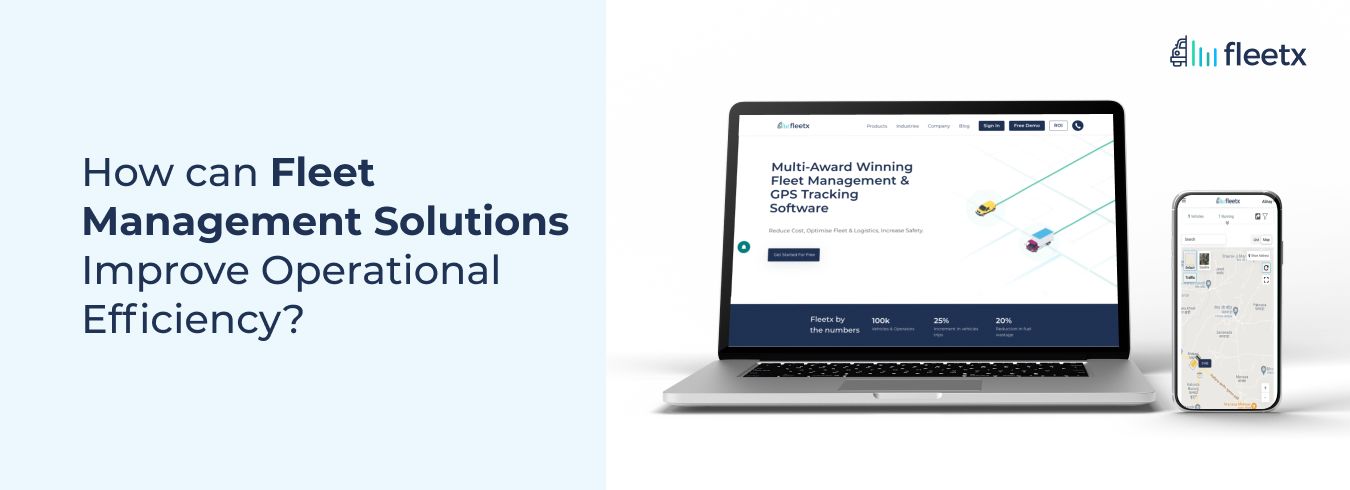
What are fleet management solutions?
Logistics is an essential component for every output-producing company across industries. Logistics operations for any business primarily involve a fleet of vehicles ranging from trucks, cars, machinery, and planes. Fleet Managers are employed by companies to monitor, track and manage each vehicle in the fleet. This could range from small fleets consisting of a couple of vehicles to large-scale fleets involving hundreds of vehicles. However, the entire process of transportations practiced for decades is quite opaque, leading to various inefficiencies in the operations. This is due to the lack of any robust fleet management solution and over-reliance on manual micromanagement.
Fleet management solutions offer custom solutions based on the requirement of the business or transporters. It ranges from vehicle tracking, route planning & optimization, fleet maintenance, and various others. In addition, they provide transparency and more control over operations to business owners as they can track and manage their entire fleet from one place.
The role of technology in fleet management solutions
Technology has played the most significant role in revolutionizing the fleet management industry. For example, GPS-based vehicle tracking has been a game-changer for the industry. Gone are the days when fleet managers would be taking status 24x7 through phones. Instead, technology has made it possible to track vehicular movement for vehicles, making the process transparent and efficient. In addition to that, it also reduces the reliance on drivers for monitoring transport operations.
Regarding route planning and optimization, technology and artificial intelligence have made it possible for fleet operators to choose the fast and most efficient routes beforehand. The most advanced fleet management solutions collect trip and vehicular data from all vehicles in the fleet. This data is processed and analyzed through software algorithms that use machine learning and artificial intelligence to turn this data into useless analysis and statistics. Using this processed data, fleet managers can make informed decisions when planning trip routes for transportation. Deliveries can be more punctual and time-bound as these optimizations offer features like,
- Live ETAs & delays
- Real-time navigation and live-traffic tracking for roads
- Efficient route scheduling
- Improved route performance and maximizing ROI
- Delivery planning, among other features.
Technology offers various other services and features in addition to these essential fleet management solutions. For example, it often happens that vehicles run out of fuel on the route, out of proximity of any fuel-refilling stations. It occurs due to poor fleet management in vehicles.
Fleet management companies like fleetx understand that it is impossible for fleet managers to manually track fuel levels and on-route fuel consumption. Hence, they offer technology-backed solutions to address such problems. Fuel management system, part of fleetx fleet management solution, provides fuel usage insights & analytics to fleet managers. It helps them avoid malpractices and wastage in the form of fuel theft, fuel wastage detection, engine idling, among others. Thus, reducing operational cost and maximize ROI for transport operations.
Different types of fleet management solutions
Companies have varying demands when it comes to fleet management solutions depending on the nature of their operations. For example, the requirement for an e-taxi service would differ from that of a construction company. Hence, fleet management providers also offer solutions that cater to such dynamic needs are discussed below briefly.
Fleet management solution offering vehicle tracking and monitoring
Fleet management solutions offering vehicle tracking solutions are more than maps and navigation. Instead, they provide solutions that provide software that helps locate, track, and manage the entire fleet from one platform with more user-friendly and interactive maps. In addition, geofence technology allows fleet managers to go beyond tracking and provide more dynamic features. This includes dispatch information to manage loading and unloading of goods, live-tracking for more realistic ETAs, and a notification system. Thus, fleet providers and companies can offer more consumer-centric services to their clients with much higher efficiency and transparency.
Fleet management solutions offering route planning and optimization
Fleet management solutions that offer route planning and optimization assist companies and fleet managers choose the most efficient route that is essential for faster delivery of goods. They use real-time satellite data and trip history to plan the most efficient route for each trip. This helps companies reduce their fuel usage significantly and provide much faster delivery of goods to their clients. In conclusion, they automate the entire process of route planning and optimization for the delivery of goods.
Fleet management solutions offering fleet and driver management
Timely maintenance of vehicles is key to increasing the life of vehicles. However, it becomes impossible to track and manage maintenance for all of them due to many vehicles. Fleet maintenance solutions assist fleet managers in automating the tracking and offer notification systems for vehicles requiring maintenance based on usage. This helps companies to maximize their returns from vehicles and extend their life significantly.
Fleet management solutions tracking driver behavior and analytics
In addition to that, they also offer features to track driver behavior and performance. They do so by collecting driving data and reducing instances of speeding and rash driving preventing accidents. It provides a crucial safety feature and helps rank drivers based on performance automatically. Such metrics can also minimize insurance costs, maximize ROI, and improve the overall performance of the entire team.
Choosing the right fleet management solution for your business
It is well-established that fleet management service providers offer many fleet management solutions catering to every transport-related requirement for companies across industries. However, choosing the right fleet management solution is essential based on your operational need to maximize your ROI. Thus, there are specific parameters to consider before selecting a fleet management solution for your business.
Usability and ease-of-use
A fleet management solution needs to be user-friendly and easy to use. Hence, when choosing a fleet management solution for business, it is crucial to go for easy-to-operate software and is customizable to suit business needs.
Accessibility
A fleet solution needs to be accessible from all devices including, desktops, phones, and tablets. An efficient fleet management solution offers flexibility above all. This includes the ability to log in and access from low-bandwidth internet connection to mobile and compatibility with all internet browsers. It should also have an optimized dashboard to summarize important analytics by the touch of a button!
Cost
Another critical feature of sound fleet management is cost. However, the solution should not be so expensive that it nullifies the gain made from increased efficiency. Thus, companies need to consider the price when choosing a solution to maximize ROI.
Technology
Last but not least, the best fleet management solutions are reliant on data. Therefore, they use the latest technology for their product. Thus, companies need to ensure that fleet management technology employs the latest tech in the space, whether Artificial Intelligence or Data Analytics. As better technology translates the higher efficiency and transparency in operations.
Why choose fleetx fleet management solution?
Fleetx offers the most advanced fleet management solutions in the market. It maximizes its reliance on the latest tech in the industry by using artificial intelligence to automate every process of fleet management. With customer satisfaction at its core, fleetx uses highly functional algorithms and state-of-the-art technology to offer the most out of its products to customers to help them improve their operating efficiency and reduce operational cost significantly.
Frequently Asked Questions on Fleet Management Solutions
How to select a fleet management solution? ▼
Few things that should be kept in mind while choosing a fleet management software is that it should be simple to use, budget friendly, installation method should be simple, flexible, simple integration, should provide data insights, should monitor fuel level consumption and provide real-time end-to-end visibility of fleets.
What is a fleet management solution? ▼
A fleet management solution is a technology platform used to track, monitor, manage, and optimize vehicles, drivers, routes, fuel usage, maintenance, and logistics operations from one system. For businesses in India, it is especially useful because fleet operations often involve long-distance routes, fuel cost fluctuations, driver coordination, compliance needs, and delivery delays across cities such as Delhi, Gurgaon, Mumbai, Bengaluru, and Pune.
The best fleet management solutions combine GPS vehicle tracking, route optimization, fuel monitoring, driver behaviour analytics, maintenance alerts, trip reports, and real-time visibility. Instead of relying on manual phone calls or spreadsheets, fleet managers can view vehicle location, ETA, delays, stoppages, route deviations, and driver performance on a dashboard.
For logistics companies, manufacturers, distributors, FMCG brands, construction fleets, and transporters, fleet management software helps reduce operational costs and improve productivity. In India, pricing can vary based on fleet size, features, hardware, and integrations, but many solutions may start from around ₹500 to ₹2,500 per vehicle per month, excluding any hardware or installation costs.
How do fleet management solutions improve operational efficiency? ▼
Fleet management solutions improve operational efficiency by giving companies real-time visibility and control over their vehicles, drivers, routes, fuel consumption, and maintenance schedules. In traditional fleet operations, managers often depend on manual updates from drivers, which can lead to delays, inaccurate ETAs, route inefficiencies, and poor cost control. A digital fleet management system solves this by centralizing key operational data in one dashboard.
For example, a logistics business operating between Delhi NCR, Gurgaon, Mumbai, Pune, and Bengaluru can use fleet tracking to identify delayed vehicles, optimize routes, reduce idle time, prevent unnecessary detours, and improve delivery timelines. This directly supports better customer communication and faster dispatch planning.
- GPS tracking improves vehicle visibility.
- Route optimization reduces delays and fuel wastage.
- Fuel monitoring helps detect theft, leakage, and excessive idling.
- Maintenance alerts reduce breakdowns and downtime.
- Driver analytics help improve safety and productivity.
For Indian fleets, where fuel and driver costs form a major share of operating expenses, even small improvements in route planning and fuel control can lead to significant savings over time.
Which is the best fleet management solution in India? ▼
The best fleet management solution in India depends on the size of the fleet, type of vehicles, business goals, required features, and operational locations. A company managing city deliveries in Delhi NCR may need strong real-time tracking and route planning, while a long-haul transporter operating across Mumbai, Pune, Bengaluru, and North India may need fuel analytics, driver behaviour monitoring, maintenance alerts, and trip-level visibility.
A good fleet management platform should offer GPS vehicle tracking, route optimization, fuel monitoring, driver analytics, fleet maintenance, reports, alerts, and easy mobile access. It should also be scalable enough for small, medium, and enterprise fleets.
When comparing the top fleet management solutions in India, businesses should evaluate:
- Real-time GPS accuracy and dashboard usability.
- Fuel monitoring and theft detection features.
- Route planning and ETA accuracy.
- Driver behaviour and safety analytics.
- Integration with ERP, TMS, or logistics systems.
- Support availability across India.
Cost is also important. Basic tracking solutions may be cheaper, while advanced AI-powered fleet management platforms may cost more but can deliver stronger ROI through fuel savings, better vehicle utilization, and reduced downtime.
How much does fleet management software cost in India? ▼
The cost of fleet management software in India usually depends on the number of vehicles, features required, hardware devices, installation support, software subscription, and level of customization. Basic GPS tracking solutions may start from around ₹500 to ₹1,000 per vehicle per month, while advanced fleet management platforms with fuel monitoring, route optimization, driver analytics, maintenance alerts, video telematics, and integrations may range from ₹1,500 to ₹3,500 or more per vehicle per month.
Hardware costs may be charged separately. GPS devices, fuel sensors, dashcams, AIS-compliant tracking devices, and installation services can increase the initial cost. For enterprise fleets in Delhi, Gurgaon, Mumbai, Bengaluru, Pune, and other logistics hubs, pricing may also vary based on service-level agreements, dashboard customization, API integrations, and support requirements.
Businesses should not choose fleet software only based on the lowest price. A cheaper system may provide location tracking but may not help reduce fuel theft, route delays, maintenance downtime, or driver-related risks. The best approach is to compare total cost with expected savings from improved fuel efficiency, better dispatch planning, reduced idle time, fewer breakdowns, and higher fleet utilization.
Why do businesses in Delhi NCR and Gurgaon need fleet management solutions? ▼
Businesses in Delhi NCR and Gurgaon need fleet management solutions because these regions have dense traffic, high logistics demand, frequent route delays, delivery pressure, and large commercial vehicle movement. Companies operating across Gurgaon, Delhi, Noida, Faridabad, Ghaziabad, and nearby industrial zones often manage multiple vehicles for first-mile, mid-mile, and last-mile logistics. Without real-time visibility, it becomes difficult to track vehicle location, driver performance, delivery status, and route efficiency.
A fleet management system helps companies monitor vehicles in real time, plan better routes, manage delays, reduce fuel wastage, and improve customer communication. For example, a transporter moving goods from Gurgaon warehouses to Delhi retail points can use route optimization and live ETA updates to reduce waiting time and improve delivery reliability.
For Delhi NCR fleets, useful features include geofencing, fuel monitoring, driver behaviour analytics, vehicle maintenance alerts, route deviation alerts, and proof-of-delivery integrations. Cost can vary depending on the features selected, but businesses often evaluate fleet software based on ROI from fewer delays, better vehicle utilization, reduced fuel loss, and improved delivery planning.
How can fleet management software help logistics companies in Mumbai and Pune? ▼
Fleet management software helps logistics companies in Mumbai and Pune by improving visibility, delivery planning, route efficiency, and cost control. Mumbai has high traffic congestion, port-related logistics movement, industrial distribution, and last-mile delivery complexity. Pune has strong manufacturing, automotive, warehousing, and distribution activity. For companies operating between Mumbai, Pune, Navi Mumbai, Bhiwandi, Chakan, and surrounding logistics hubs, real-time fleet visibility can significantly improve operational control.
With fleet management software, managers can track trucks, monitor route deviations, check stoppages, reduce idle time, and generate accurate ETAs. This is especially important for businesses handling time-sensitive shipments, FMCG, automotive parts, construction materials, cold chain logistics, or e-commerce deliveries.
Key benefits for Mumbai and Pune fleets include:
- Better route planning across congested roads and highways.
- Improved vehicle utilization for intercity and intracity trips.
- Fuel monitoring to reduce theft and unnecessary consumption.
- Driver behaviour tracking for safer operations.
- Maintenance alerts to prevent breakdowns during active trips.
For companies managing large fleets, advanced software may cost more than basic GPS tracking, but the savings from fuel control, fewer delays, and better dispatching can justify the investment.
What features should a top fleet management solution include? ▼
A top fleet management solution should include features that help businesses improve vehicle visibility, reduce operating costs, increase driver accountability, and optimize logistics performance. The most important feature is real-time GPS vehicle tracking, which allows fleet managers to know the exact location of every vehicle. However, tracking alone is not enough for modern fleet operations in India.
The best fleet management software should also include route planning, live ETAs, geofencing, fuel monitoring, maintenance alerts, driver behaviour analytics, trip reports, and mobile access. For larger companies in Delhi, Gurgaon, Mumbai, Bengaluru, Pune, and other logistics hubs, integrations with ERP, TMS, warehouse systems, and billing tools can also be important.
- GPS tracking for real-time vehicle visibility.
- Route optimization for faster and more cost-efficient trips.
- Fuel analytics to control wastage, theft, and idling.
- Driver behaviour monitoring for safety and performance.
- Fleet maintenance alerts to reduce breakdowns.
- Reports and dashboards for better decision-making.
- Geofencing alerts for loading, unloading, and route compliance.
A good fleet solution should be easy to use, scalable, mobile-friendly, and capable of supporting both small fleets and enterprise logistics operations.
Is fleet management software useful for small fleets in India? ▼
Yes, fleet management software is useful for small fleets in India because even a small number of vehicles can face issues such as route delays, fuel wastage, unplanned maintenance, driver coordination problems, and poor delivery visibility. Many small transporters, distributors, construction contractors, school transport operators, and local logistics businesses rely on manual updates, which can reduce efficiency and increase costs.
For a small fleet operating in cities such as Delhi, Gurgaon, Mumbai, Bengaluru, Pune, or regional routes across India, a fleet management solution can provide real-time vehicle tracking, trip history, alerts, driver monitoring, and fuel usage visibility. This helps business owners make faster decisions without needing a large operations team.
Small businesses can start with basic features such as GPS tracking, geofencing, route history, and alerts. As the fleet grows, they can add fuel monitoring, maintenance management, driver analytics, and advanced reporting. Entry-level solutions may cost less than enterprise platforms, making them suitable for growing businesses. The main benefit is that owners gain control over vehicle movement, delivery status, and operating costs, which can improve customer service and profitability over time.
How does fleet management software reduce fuel and maintenance costs? ▼
Fleet management software reduces fuel and maintenance costs by helping businesses identify inefficiencies that are difficult to detect manually. Fuel is one of the highest recurring costs for logistics and transport companies in India. Issues such as excessive idling, route deviation, fuel theft, poor driving behaviour, and inefficient route planning can increase monthly expenses significantly.
With fuel monitoring and analytics, fleet managers can track fuel consumption patterns, detect sudden drops, identify unusual refuelling activity, and compare fuel usage across vehicles and routes. Route optimization also helps reduce unnecessary kilometres, which directly lowers fuel usage. Driver behaviour analytics can identify harsh acceleration, overspeeding, and prolonged idling, all of which impact fuel efficiency.
Maintenance costs are reduced through preventive alerts. Instead of waiting for breakdowns, fleet managers can schedule servicing based on distance, usage, engine hours, or maintenance timelines. This is useful for fleets operating across Delhi NCR, Gurgaon, Mumbai, Pune, Bengaluru, and long-haul Indian routes where breakdowns can cause delivery delays and additional repair costs.
By combining fuel analytics, route planning, driver monitoring, and maintenance alerts, fleet management software helps improve vehicle life, reduce downtime, and control total operating costs.
How should companies choose the best fleet management software for their business? ▼
Companies should choose the best fleet management software by first identifying their operational challenges. A business struggling with delivery delays may need route optimization and live ETA tracking, while a transporter facing high fuel costs may need fuel monitoring and analytics. A company managing large fleets across India may need advanced dashboards, integrations, maintenance alerts, and driver performance reports.
Before selecting a solution, businesses should evaluate fleet size, vehicle type, operating regions, required features, budget, hardware needs, and support availability. For example, a fleet in Delhi NCR or Gurgaon may prioritize geofencing and traffic-aware route planning, while a Mumbai or Pune logistics company may focus on intercity tracking, fuel control, and vehicle utilization.
- Check whether the software is easy to use.
- Compare GPS accuracy and real-time tracking quality.
- Review fuel, route, driver, and maintenance features.
- Ask about pricing, hardware, installation, and support costs.
- Ensure the platform can scale as the fleet grows.
- Look for reports that support better business decisions.
The best fleet management solution is not always the cheapest one. It should deliver measurable value through improved efficiency, lower costs, better visibility, and stronger control over daily fleet operations.