
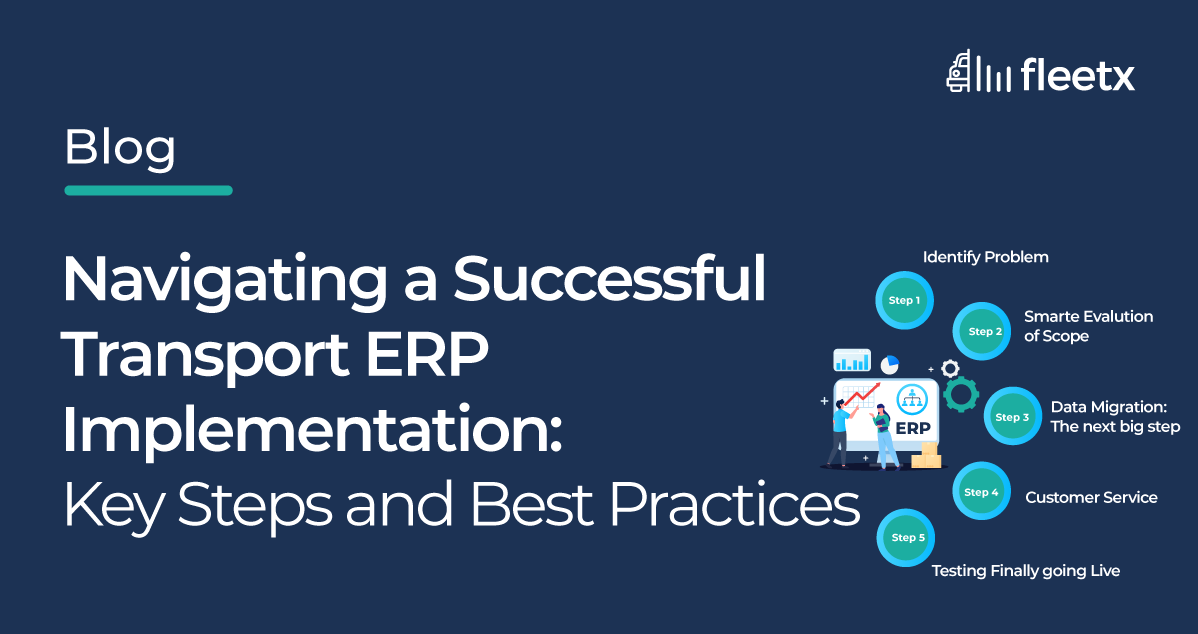
Implementing a Transport ERP system is an action of significance- it will revolutionize the way your fleet operates and generate several benefits for your company. However, the journey to a successful implementation is not without its challenges.
If companies don't follow proper ERP implementation protocols, they may encounter various challenges and potential issues throughout the process. Some of the common situations that arise as a result of improper ERP implementation include:
- Poor user adoption
- Inefficient operational processes
- Data inconsistencies
- Delayed timelines
- Integration challenges
- Insufficient vendor support
- Missed business opportunities
In this article, we will guide you through the key steps and best practices to navigate a successful Transport ERP implementation, and avoid falling into one of the traps mentioned above. By anticipating and addressing these challenges, you can streamline the implementation process and maximize the benefits of your ERP system.
Key Steps to Successful ERP Implementation
Define Clear Objectives and Requirements:
As a first step, it is essential to establish clear business objectives and future requirements. Define what you want to achieve with the ERP system, whether it's improving operational efficiency, enhancing customer service, or gaining better visibility into your fleet. Clearly outlining your goals will guide the implementation process and help you evaluate the success of the ERP system.
Conduct Thorough Vendor Evaluation:
Choosing the right ERP vendor is critical to the success of your implementation. Conduct a thorough evaluation of various vendors, considering factors such as industry fit, product functionality, scalability, customisation and customer support. Engage in detailed discussions and demonstrations to ensure that the chosen ERP system aligns with your specific business requirements.
Plan for Data Migration and Integration:
Migrating and integrating data from existing systems into the new ERP solution can be complex. Develop a detailed plan for data migration, ensuring data accuracy, integrity, and security. Consider the various data sources, formats, and potential challenges during the migration process. Collaborate closely with the ERP vendor to ensure a smooth transition.
Customize and Configure for Your Needs:
Every transport operation has unique requirements. Work closely with the ERP vendor to customize and configure the system according to your specific needs. Identify key business processes and workflows that require customization and ensure they are aligned with industry best practices to avoid complex challenges in the future.
Establish Strong Change Management:
Change management plays a critical role in successful ERP implementations: prepare your workforce for the changes that come with the new system. Communicate the benefits and address any concerns or resistance. Provide comprehensive training programs to ensure users are proficient with the ERP system. Encourage feedback and continuous improvement to drive user adoption and engagement.
Monitor and Evaluate Performance:
Regularly monitor and evaluate the performance of your ERP system after implementation. Establish key performance indicators (KPIs) and metrics to measure the system's effectiveness in achieving your defined objectives. Assess user feedback, system stability, and overall satisfaction to identify areas for improvement and address any issues promptly.
Best Practices for Successful ERP Implementation
Beyond a good implementation strategy, it is also suggested to look at the learnings from previous implementation efforts in other companies. Following these industry best practices can improve your implementation experience, and set your business up for success. A well-executed ERP implementation strategy will streamline your operations, enhance productivity, and drive business growth.
Form a Dedicated Project Team:
Establish a dedicated project team consisting of key stakeholders from various departments within your organization. This team will be responsible for overseeing the implementation process, coordinating activities, and ensuring effective communication between all parties involved.
Set Realistic Timelines and Milestones:
Create a realistic timeline for each phase of the implementation process. Break down the project into manageable milestones to track progress and ensure timely completion. Regularly review and adjust the timeline as necessary to accommodate unexpected challenges or changes in requirements.
Conduct Thorough Testing for Quality Assurance:
Testing and quality assurance are critical to ensure the ERP system functions correctly and meets your business needs. Develop a comprehensive testing plan that includes both functional and integration testing. Involve end-users in the testing process to gather valuable feedback and identify any gaps in the system. Make it an iterative process to create valuable feedback loops that provide relevant data.
Prioritize Data Accuracy and Cleansing:
Data integrity is essential for the success of an ERP implementation. Conduct a thorough data audit to identify inconsistencies, duplicates, and inaccuracies. Develop a data cleansing strategy to rectify these issues before migrating the data to the new system. Establish data governance practices to maintain data accuracy and consistency in the long term.
Provide End-to-End Training and Support:
Invest in comprehensive training programs to ensure that end-users are proficient in using the ERP system. Offer both initial training during the implementation phase and ongoing training to support users as they adapt to the new system. Provide dedicated support channels for users to address any questions or concerns they may have.
How to Measure the Success of a Transport ERP Implementation (KPIs and Business Outcomes)
Implementing a Transport ERP system is only the beginning of the transformation journey. The real value comes from continuously measuring whether the platform is helping the business achieve its operational, financial, and customer service objectives. Many transport companies invest in ERP software but fail to define measurable success metrics, making it difficult to determine whether the implementation has delivered a positive return on investment.
The most successful logistics organisations establish baseline metrics before implementation and compare them against post-implementation performance. This enables leadership teams to quantify improvements in operational efficiency, cost optimisation, customer satisfaction, and business scalability.
For transport companies operating across India, particularly in logistics hubs such as Delhi, Delhi NCR, Gurgaon, Mumbai, Bengaluru, Pune, Chennai, Hyderabad, Ahmedabad, and Kolkata, KPI-driven ERP implementation ensures that business growth is supported by reliable operational data rather than assumptions.
Some of the most valuable performance indicators include fleet utilisation, vehicle turnaround time, trip completion rate, dispatch efficiency, billing cycle duration, invoice accuracy, fuel consumption, preventive maintenance compliance, driver productivity, customer complaint resolution time, and overall logistics cost per kilometre.
A Transport ERP provides real-time dashboards that consolidate information from dispatch operations, finance, maintenance, telematics, GPS tracking, warehouse operations, and customer service. Instead of waiting for weekly reports or manually compiling spreadsheets, managers gain immediate visibility into operational bottlenecks and opportunities for improvement.
For example, if an organisation notices that vehicle turnaround time has increased in one distribution region, managers can investigate loading delays, route planning inefficiencies, documentation issues, or customer scheduling conflicts directly through ERP-generated reports.
Similarly, companies can identify underperforming routes, high-maintenance vehicles, excessive fuel consumption, delayed billing cycles, or recurring driver compliance issues long before they become major business problems.
Continuous KPI monitoring also improves accountability across departments because every operational function contributes measurable performance data.
A mature ERP implementation transforms reporting from historical analysis into predictive decision-making. Instead of simply reporting what happened yesterday, organisations can forecast future maintenance requirements, identify seasonal demand fluctuations, optimise fleet allocation, and improve resource planning.
Businesses that regularly analyse ERP-generated KPIs typically experience:
- Improved fleet utilisation
- Faster trip planning
- Reduced manual administrative work
- Lower fuel and maintenance costs
- Better customer retention
- Higher invoice accuracy
- Reduced operational delays
- Better compliance reporting
- Improved profitability
Perhaps the biggest advantage is that leadership teams no longer make decisions based solely on experience or intuition. Instead, every operational decision is supported by accurate, real-time business intelligence.
As transport businesses continue expanding throughout India, KPI-driven ERP adoption becomes a competitive advantage rather than simply a technology upgrade.
Transport ERP vs Traditional Fleet Management Methods: A Practical Comparison
Many transport businesses continue relying on spreadsheets, disconnected software applications, paper records, manual registers, phone calls, and messaging applications to manage daily fleet operations. While these approaches may work for small fleets, they become increasingly inefficient as organisations grow.
Modern Transport ERP platforms replace fragmented processes with a unified operational ecosystem where every department works from the same source of information.
The difference becomes especially significant for companies managing hundreds of daily trips, multiple branches, numerous customers, and geographically distributed operations.
| Business Function | Traditional Process | Transport ERP Approach | Business Benefit |
|---|---|---|---|
| Trip Planning | Manual planning using spreadsheets and phone calls | Automated trip scheduling with centralized dispatch | Faster dispatch and fewer planning errors |
| Vehicle Tracking | Driver updates through calls or messaging | Live GPS-based tracking integrated into ERP | Real-time operational visibility |
| Freight Billing | Manual invoice preparation | Automated invoice generation | Faster cash flow and fewer billing mistakes |
| Customer Communication | Manual status updates | Real-time shipment visibility and automated notifications | Improved customer satisfaction |
| Fuel Management | Paper fuel logs | Digital fuel monitoring with analytics | Reduced fuel leakage and better cost control |
| Preventive Maintenance | Calendar reminders or manual records | Automated maintenance scheduling | Reduced breakdowns and longer vehicle life |
| Driver Management | Separate records maintained manually | Centralised driver database with performance analytics | Improved compliance and accountability |
| Documentation | Physical paperwork | Digital document repository | Faster audits and easier document retrieval |
| Reporting | Time-consuming spreadsheet consolidation | Real-time dashboards and automated reports | Better decision-making |
| Multi-Branch Operations | Independent branch records | Centralised enterprise-wide visibility | Easier scaling across locations |
For companies expanding across Delhi NCR, Mumbai, Bengaluru, Gurgaon, Pune, and other major logistics corridors, manual processes often create inconsistencies between branches.
For example, dispatch teams may use different naming conventions, finance teams may maintain separate customer databases, while maintenance departments may track vehicle servicing independently.
These disconnected workflows result in duplicated effort, inconsistent reporting, delayed decision-making, and poor visibility.
A Transport ERP eliminates these operational silos by integrating every function into a single platform.
Another significant advantage is scalability.
As businesses acquire additional vehicles, open new branches, expand into new states, or onboard enterprise customers, manual systems become increasingly difficult to manage.
ERP platforms are specifically designed to scale alongside business growth without requiring organisations to redesign their operational processes every few years.
Additionally, ERP platforms simplify compliance management by maintaining complete digital records of trips, invoices, maintenance history, driver documentation, taxation records, permits, and customer contracts.
This significantly reduces administrative effort during audits while improving operational transparency.
For modern logistics companies, adopting a Transport ERP is no longer simply a technology investment—it is an operational strategy that enables long-term business growth.
Building a Future-Ready Transport Business with an Integrated ERP Ecosystem
The logistics industry is evolving rapidly due to digital transformation, artificial intelligence, IoT, predictive analytics, automation, electronic documentation, sustainability initiatives, and increasing customer expectations. As these technologies mature, Transport ERP systems are becoming the digital foundation upon which future-ready logistics businesses are built.
Today's ERP platforms are no longer limited to accounting or dispatch management. They increasingly serve as intelligent operational ecosystems capable of connecting vehicles, warehouses, finance systems, customers, vendors, drivers, mobile applications, telematics devices, route optimisation engines, maintenance software, and business intelligence platforms.
This integrated ecosystem enables organisations to operate with significantly greater efficiency than businesses relying on isolated software applications.
For example, an integrated ERP can automatically:
- Receive transport orders from customers
- Allocate the most suitable vehicle
- Assign the nearest available driver
- Generate trip documentation
- Calculate estimated delivery time
- Monitor GPS movement
- Track fuel consumption
- Schedule preventive maintenance
- Generate freight invoices
- Update customers automatically
- Produce profitability reports after trip completion
Without ERP integration, these activities typically require multiple employees working across separate software systems.
Artificial intelligence is also becoming an increasingly valuable component of Transport ERP platforms.
AI-powered ERP systems can identify unusual operational patterns, recommend optimal vehicle allocation, predict maintenance requirements, estimate delivery delays, optimise routes based on historical traffic conditions, and detect operational anomalies before they impact customers.
Predictive maintenance is another rapidly growing capability.
Instead of waiting for vehicle failures, ERP systems can analyse maintenance history, mileage, engine performance, and telematics data to recommend servicing before breakdowns occur.
This improves vehicle availability while reducing expensive emergency repairs.
Similarly, advanced analytics allow transport companies to identify:
- High-cost delivery routes
- Underperforming vehicles
- Driver behaviour trends
- Customer profitability
- Seasonal transport demand
- Fuel consumption anomalies
- Branch productivity
- Asset utilisation patterns
These insights support more informed strategic planning.
Another major trend is customer self-service.
Many modern ERP platforms provide customer portals where clients can track shipments, download invoices, access proof of delivery documents, monitor service performance, and communicate directly with logistics teams.
This reduces customer support workload while improving transparency.
Businesses implementing ERP today should also consider future integration capabilities.
An ideal Transport ERP should support:
- GPS vehicle tracking
- Electronic Proof of Delivery (ePOD)
- Warehouse Management Systems (WMS)
- Accounting software
- Transport Management Systems (TMS)
- Fuel management solutions
- Driver mobile applications
- API integrations
- IoT sensors
- AI-powered analytics
- Cloud infrastructure
- Business intelligence dashboards
Companies planning for long-term growth should select ERP platforms that continuously evolve with changing logistics technology rather than systems that satisfy only today's operational requirements.
A future-ready Transport ERP is therefore not merely a software solution—it is the digital backbone that enables logistics businesses to become more intelligent, efficient, scalable, and customer-centric in an increasingly competitive transportation industry.
Conclusion
Implementing a Transport ERP system can be a game-changer for your fleet, but it requires careful planning and execution. By following these key steps and best practices, you can navigate the challenges and scale your business to new heights. Just remember to: define clear objectives, choose the right vendor, plan for data migration, customize the system to your needs, establish strong change management, and continuously monitor and evaluate performance. A well-executed Transport ERP implementation will optimize your fleet's operations, improve efficiency, and drive long-term success.
FAQs on Transport ERP Implementation
What is Transport ERP implementation? ▼
Transport ERP implementation is the process of setting up, configuring, testing, and adopting an enterprise resource planning system designed for transporters, fleet owners, logistics companies, and supply chain operators. A Transport ERP helps centralise fleet operations, trip management, billing, driver management, fuel tracking, vehicle maintenance, dispatch planning, documentation, and business reporting in one platform.
In India, transport businesses often operate across multiple branches, cities, warehouses, and customer locations. This makes manual coordination difficult, especially when operations are spread across Delhi NCR, Gurgaon, Mumbai, Bengaluru, Pune, and other logistics hubs. A well-implemented Transport ERP gives teams real-time visibility into vehicle movement, trip status, expenses, pending payments, and operational performance.
The best Transport ERP implementation is not just a software installation. It includes requirement mapping, vendor selection, data migration, workflow configuration, user training, system testing, and post-launch support. Companies that skip these steps may face poor user adoption, inaccurate data, billing delays, integration issues, and low return on investment.
For growing logistics companies, Transport ERP implementation is important because it reduces dependency on spreadsheets, WhatsApp updates, manual registers, and disconnected tools. It helps businesses move towards structured, scalable, and data-driven fleet operations.
Why is Transport ERP important for logistics companies in India? ▼
Transport ERP is important for logistics companies in India because the transport sector deals with high operational complexity, tight delivery timelines, rising fuel costs, vehicle downtime, compliance requirements, and customer demand for real-time visibility. A Transport ERP brings all critical transport functions into one system, helping companies improve efficiency, reduce errors, and make faster decisions.
For Indian fleet operators, especially those working across Delhi, Gurgaon, Mumbai, Bengaluru, Pune, and Delhi NCR, daily operations can involve multiple loading points, route changes, driver coordination, challans, POD collection, freight billing, maintenance checks, and customer updates. Without a central ERP system, these processes often become fragmented and difficult to track.
A Transport ERP can help with:
- Trip planning and dispatch visibility
- Fleet utilisation tracking
- Fuel and expense monitoring
- Driver and vehicle performance analysis
- Faster invoicing and billing reconciliation
- Improved customer communication
- Better compliance and document management
The top benefit is that management gets a single source of truth. Instead of depending on scattered updates from multiple teams, decision-makers can track operations through dashboards, reports, and automated alerts. This makes Transport ERP especially valuable for companies that want to scale their logistics operations across India.
What are the key steps for the best Transport ERP implementation? ▼
The best Transport ERP implementation starts with clear planning and ends with measurable operational improvement. Companies should not treat ERP implementation as a one-time technical activity. It is a business transformation process that affects dispatch teams, finance teams, fleet managers, drivers, branch users, and senior leadership.
The key steps include defining business objectives, mapping current workflows, identifying operational gaps, selecting the right ERP vendor, preparing clean data, configuring modules, testing the system, training users, and monitoring performance after launch. Each step reduces the risk of implementation failure.
For example, a logistics company in Gurgaon may need strong dispatch planning and customer reporting because it serves manufacturing clients in Delhi NCR. A transporter in Mumbai may prioritise port movement visibility, documentation, and billing accuracy. A fleet business in Bengaluru or Pune may focus on technology integrations, real-time dashboards, and scalable workflows.
A strong implementation plan should include:
- Clear goals such as cost reduction, faster billing, or improved fleet visibility
- A dedicated project team from operations, finance, and IT
- Accurate master data for vehicles, drivers, customers, routes, and vendors
- Testing before full rollout
- Training for every user group
- Post-implementation tracking of KPIs
The top ERP implementations succeed when teams focus on adoption, not just software setup.
How much does Transport ERP implementation cost in India? ▼
The cost of Transport ERP implementation in India can vary widely depending on fleet size, number of users, modules required, level of customisation, integrations, training needs, and vendor support. For small and mid-sized transport companies, basic Transport ERP pricing may start from approximately ₹50,000 to ₹2,00,000 for initial setup, while larger enterprise implementations can range from ₹5,00,000 to ₹25,00,000 or more.
Some vendors offer monthly or annual subscription pricing. In such cases, companies may pay per vehicle, per user, or per module. Monthly software costs may range from ₹100 to ₹1,500 per vehicle, depending on features such as GPS integration, fuel monitoring, billing automation, maintenance management, route planning, and analytics dashboards.
In cities like Delhi, Gurgaon, Mumbai, Bengaluru, and Pune, pricing may also depend on implementation complexity. A company with multiple branches across Delhi NCR and Mumbai may need data migration, API integrations, customised reports, finance workflows, and multi-location user access. This can increase the total project cost.
Common cost components include:
- Software subscription or licence cost
- Implementation and setup charges
- Data migration cost
- Customisation cost
- Training and support cost
- Integration cost with GPS, accounting, fuel, or ERP systems
The best way to evaluate cost is to compare it with expected savings from reduced manual work, faster billing, lower leakage, better fleet utilisation, and improved operational control.
Which is the best Transport ERP for companies in Delhi NCR and Gurgaon? ▼
The best Transport ERP for companies in Delhi NCR and Gurgaon is one that supports high-volume transport operations, multi-branch visibility, customer reporting, vehicle tracking, trip management, freight billing, and operational analytics. Delhi NCR and Gurgaon are major logistics and business hubs, with many companies serving manufacturing, retail, e-commerce, automotive, FMCG, and distribution clients.
For businesses operating in this region, the ERP should help manage frequent trips across Delhi, Noida, Faridabad, Manesar, Ghaziabad, Jaipur routes, and northern India corridors. It should also support fast communication between dispatch teams, fleet managers, drivers, finance teams, and customers.
Top features to look for include:
- Real-time trip and vehicle visibility
- Automated freight and invoice management
- Driver and vehicle master management
- Route-wise cost and performance tracking
- Maintenance and fuel expense control
- Customer-wise reporting dashboards
- Integration with GPS and accounting systems
For Gurgaon-based fleet operators, the best Transport ERP should also be scalable because many logistics businesses expand quickly from regional operations to pan-India movement. A good ERP should allow the company to add more vehicles, branches, users, and modules without disrupting existing operations.
Before choosing a vendor, companies should ask for a demo, check industry fit, compare pricing, understand support availability, and evaluate how easily the system can match their current workflows.
What are the top Transport ERP features for Mumbai logistics businesses? ▼
The top Transport ERP features for Mumbai logistics businesses are trip management, port and warehouse movement visibility, billing automation, document tracking, fleet maintenance, driver coordination, customer reporting, and cost analytics. Mumbai is one of India’s most important logistics markets because of its ports, industrial belts, warehouses, distribution networks, and high-density commercial movement.
Transporters in Mumbai often deal with traffic delays, route changes, customer-specific documentation, loading and unloading coordination, and tight delivery schedules. A Transport ERP helps these businesses bring structure and visibility into daily operations.
Important features for Mumbai-based transport companies include:
- Live vehicle and trip status updates
- Digital proof of delivery tracking
- Automated freight calculation
- Branch-wise and customer-wise profitability reports
- Vehicle maintenance reminders
- Fuel and driver expense tracking
- Integration with GPS and finance tools
- Exception alerts for delays or route deviations
Cost is another key factor. For a mid-sized logistics business in Mumbai, ERP implementation may cost anywhere from ₹2,00,000 to ₹10,00,000 depending on customisation, integrations, and number of users. Monthly subscription plans may be suitable for businesses that want to start small and scale gradually.
The best Transport ERP for Mumbai should improve operational visibility, reduce manual coordination, speed up billing, and support city, regional, and long-haul transport workflows.
How long does it take to implement a Transport ERP system? ▼
Transport ERP implementation can take anywhere from 2 weeks to 6 months, depending on the size of the business, complexity of workflows, number of users, data quality, customisation needs, and integration requirements. A small transporter with limited vehicles and standard workflows may complete implementation within 2 to 6 weeks. A large logistics enterprise with multiple branches, custom billing rules, API integrations, and legacy data migration may need 3 to 6 months or more.
In India, many logistics businesses underestimate the time needed for data preparation and user training. Vehicle master data, driver details, customer contracts, route information, rate cards, vendor details, trip history, and pending billing records must be cleaned before migration. Poor data quality can delay the project and reduce ERP effectiveness.
A typical implementation timeline includes:
- Requirement discussion: 1 to 2 weeks
- System configuration: 2 to 4 weeks
- Data migration: 1 to 4 weeks
- Testing and corrections: 1 to 3 weeks
- User training: 1 to 2 weeks
- Go-live and support: ongoing
For businesses in Delhi NCR, Gurgaon, Mumbai, Bengaluru, and Pune, timelines may also depend on the number of branches and stakeholders involved. The best approach is to roll out the ERP in phases, starting with core modules such as trip management, billing, and vehicle tracking before adding advanced analytics and integrations.
What challenges do companies face during Transport ERP implementation? ▼
Companies often face challenges such as poor user adoption, unclear requirements, inaccurate data, delayed timelines, integration issues, resistance to change, and insufficient vendor support during Transport ERP implementation. These challenges are common when businesses treat ERP implementation as a software purchase instead of a structured operational transformation.
One of the biggest issues is unclear process mapping. If a transporter does not clearly define how trips are created, approved, tracked, billed, and closed, the ERP may not match real business workflows. Another major challenge is data inconsistency. Vehicle numbers, driver records, customer rate cards, route data, and billing details must be accurate before migration.
For logistics companies in India, especially those working across Delhi, Gurgaon, Mumbai, Bengaluru, Pune, and Delhi NCR, change management is also critical. Dispatch teams, drivers, finance users, and branch managers may be used to manual methods such as Excel sheets, phone calls, paper documents, and WhatsApp updates. Without training, they may avoid using the ERP properly.
Top challenges include:
- Low employee adoption
- Incomplete data migration
- Customisation delays
- Weak integration with GPS or finance systems
- Lack of leadership involvement
- Unrealistic implementation timelines
The best way to avoid these issues is to create a dedicated project team, involve end-users early, test workflows before launch, and monitor KPIs after implementation.
How can Bengaluru and Pune fleet operators choose the best Transport ERP vendor? ▼
Bengaluru and Pune fleet operators should choose a Transport ERP vendor based on industry fit, scalability, integration capability, ease of use, implementation support, reporting depth, and pricing transparency. Both cities have strong manufacturing, technology, e-commerce, automotive, and distribution ecosystems, so transport companies need ERP systems that can handle complex and fast-moving operations.
The best Transport ERP vendor should understand logistics workflows such as trip creation, dispatch planning, vehicle allocation, driver assignment, fuel tracking, freight billing, maintenance scheduling, and customer reporting. A generic ERP may not be suitable unless it can be customised for transport-specific needs.
Before finalising a vendor, companies should evaluate:
- Whether the ERP supports transport and fleet-specific workflows
- How easily it integrates with GPS, accounting, fuel cards, and customer systems
- Whether dashboards provide real-time operational visibility
- How much training and implementation support is included
- Whether pricing is based on users, vehicles, branches, or modules
- How quickly support teams respond after go-live
For cost planning, small fleet operators in Bengaluru or Pune may start with subscription-based ERP plans, while larger businesses may need custom implementation costing ₹5,00,000 or more. The top vendor is usually the one that can match current workflows while also supporting future growth across India.
What ROI can businesses expect from a successful Transport ERP implementation? ▼
A successful Transport ERP implementation can deliver ROI through lower manual effort, faster billing, reduced operational leakage, improved fleet utilisation, better fuel control, fewer delays, stronger customer visibility, and more accurate decision-making. The exact ROI depends on company size, current inefficiencies, ERP adoption level, and how well the system is integrated into daily operations.
For Indian logistics companies, common savings come from reducing paperwork, avoiding duplicate data entry, identifying underutilised vehicles, tracking driver and fuel expenses, and improving invoice accuracy. A transporter operating across Delhi NCR, Gurgaon, Mumbai, Bengaluru, or Pune may also benefit from faster customer reporting and fewer disputes related to trip status, delivery proof, and billing.
Businesses may see improvement in:
- Billing turnaround time
- Fleet utilisation percentage
- Vehicle downtime
- Fuel expense visibility
- Customer service response time
- Branch-level productivity
- Data accuracy and reporting quality
For example, if a logistics company reduces billing delays by even a few days, it can improve cash flow significantly. If the ERP helps reduce fuel leakage or unnecessary idle time, monthly savings can become substantial across a large fleet.
The best ROI comes when companies track clear KPIs before and after implementation. These may include cost per trip, revenue per vehicle, turnaround time, delayed trips, maintenance cost, and customer complaints. Transport ERP delivers maximum value when it becomes the central operating system for the business.