


Construction vehicles and equipment are a huge investment for companies in this industry. Additionally, the constantly changing and evolving conditions of the construction sector make it even more difficult to receive investments and increase profitability. Ensuring that your business is always on top of its game by cutting costs without sacrificing productivity or efficiency is the need of the hour.
Construction Equipment Management software is critical in reducing wasted time and money. This valuable solution can empower better management of your construction equipment and commercial trucks, ultimately improving operations. Using such an efficient Construction Equipment Management system optimises daily processes for your company as well as aims to do more work at a reduced cost.
Maintain machine uptime and health for lesser operating costs
Machine uptime is critically important for construction businesses, which is why their health is of utmost importance. Equipment that has been well-serviced on time and is capable of performing at its highest capacity is the only way to ensure smooth running. On the other hand, without such a continual and constant tracking of machine or equipment health, you may face unnecessary breakdowns and increase operating costs considerably. You will also get more reliable performance with increased efficiency by monitoring factors such as machine utilisation rate, equipment ageing, active working time, depreciation, and more.
Planned maintenance to keep equipment in check
Planned maintenance refers to a continual check on equipment or machinery to ensure there are no major malfunctions or problems happening. The aim is to prevent these problems through periodic checks to reduce unplanned machine breakdown as well as prevent downtimes in production.
Using Construction Equipment Management software can help businesses do more with less. It helps keep track of the vehicle and equipment and alerts the concerned personnel of any latencies or internal issues much before the machine breaks down. This kind of preemptive planning ensures that servicing and parts are changed without delay and the machine is not rendered useless or broken beyond repair.
Preventive and unplanned maintenance for emergencies
Construction equipment and vehicles that are regularly checked on and maintained have a lower chance of causing accidents, thus instantaneously reducing unforeseen operating and repair costs. Telemetry integration as well as the use of IoT technologies (RFID, Geo-fencing, and such), helps in adding that much-needed extra protection and awareness. Even with a complete plan for maintenance, there are times of unscheduled downtime, thus requiring preventative or unplanned maintenance that may become costly. Additionally, maintenance over-time can also lead to more costs incurred.
Minimised risk and better safety to eliminate theft
All your construction equipment and vehicles need to be in their best shape and be usable for projects, employees, and more. Construction Equipment Management software allows you to keep track of your equipment usage and responsibility levels, as well as monitors improper usage that may lead to additional costs. This insight helps avoid risks and keep track of your contrition equipment by knowing where, how, and when it was last used. It is also a factor that helps in preventing equipment theft, which is a huge problem in the construction industry and costs businesses a lot of money each year.
Minimising risks is a safe way to reduce costs as it allows things to run smoothly and eliminate unnecessary accidents. Reduce personnel injuries and keep your equipment in working order as it also improves equipment profitability. Life-long cost tracking allows for guaranteed accountability as well as compliance with legal regulations.
Keep track of rising and unnecessary fuel costs
Keeping construction machinery and vehicles fueled is a very expensive proposition, especially since petrol prices are at an all-time high. On top of that, fuel theft and unauthorised or incorrect usage of vehicles can only add to rising costs. With Construction Equipment Management software, you can integrate fuel automation systems that help in identifying machinery that has a high fuel consumption. This lets you take quick actions to correct usage and personnel mistakes as well as take the necessary precautions without facing any loss.
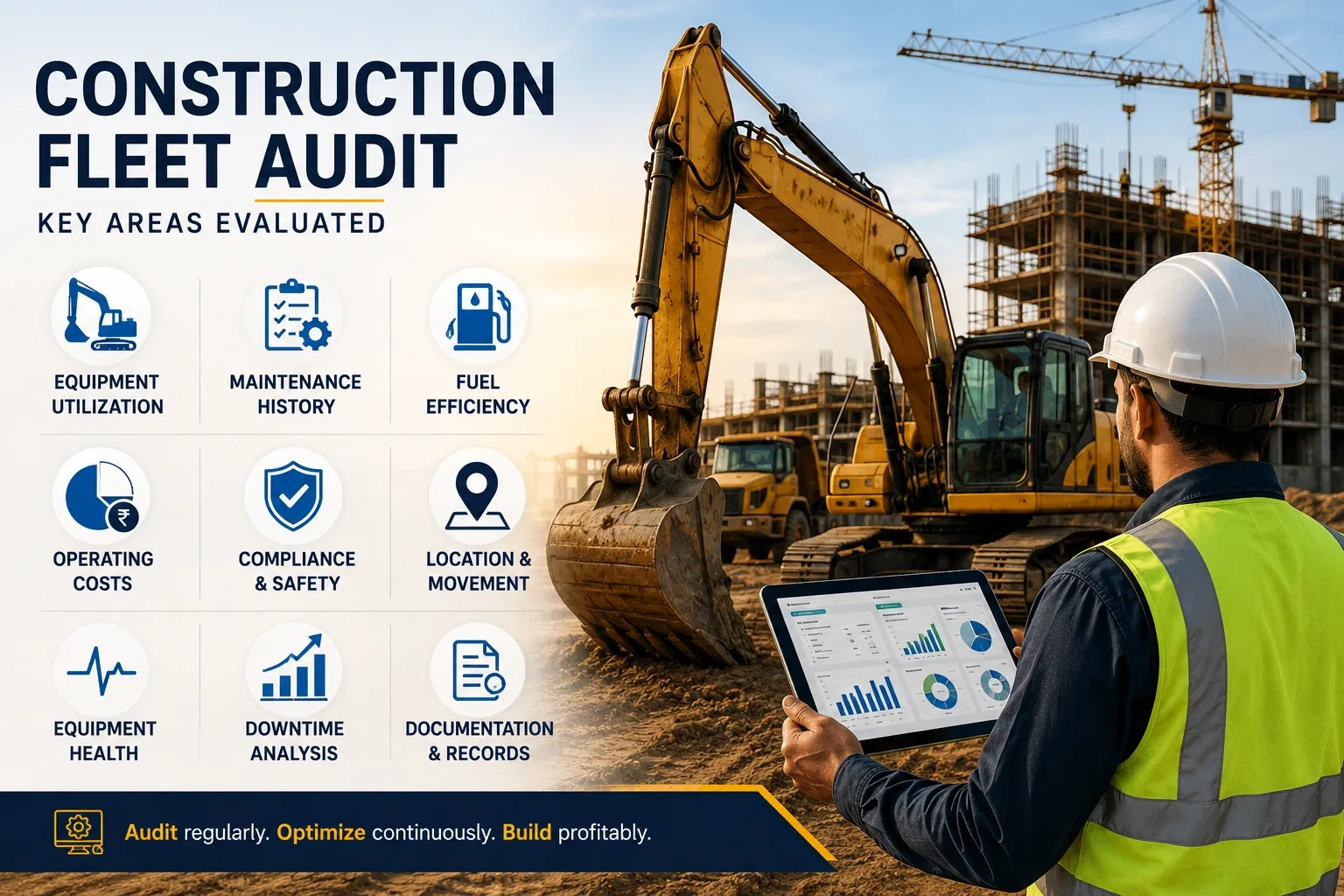
Why Construction Equipment Audits Support Better Project Planning and Profitability
Construction equipment audits are often viewed as a maintenance exercise, but their value extends much further. A well-executed audit provides project managers and business leaders with operational insights that improve resource planning, budgeting, and equipment allocation across multiple construction sites. Rather than reacting to equipment failures after they occur, businesses can use audit findings to optimise future projects, improve asset utilisation, and reduce hidden operational costs.
Business Benefits Beyond Equipment Maintenance
An effective equipment audit contributes to several areas of construction operations that directly influence profitability and project execution.
- Improves project scheduling: Knowing which machines are available, under repair, or nearing scheduled maintenance helps avoid unexpected project delays and last-minute equipment shortages.
- Supports smarter equipment allocation: Audit reports reveal whether certain machines remain idle while similar equipment is overworked on other sites. This enables better utilisation across projects without increasing capital investment.
- Strengthens budget forecasting: Historical audit data provides a clearer understanding of recurring maintenance expenses, operating costs, and equipment replacement timelines, allowing businesses to prepare more accurate project budgets.
- Enhances contractor and client confidence: Well-maintained and regularly audited equipment demonstrates operational reliability, helping construction companies deliver projects on schedule while building trust with clients and stakeholders.
Construction Equipment Audit vs Equipment Inspection
Although these terms are frequently used interchangeably, they serve different purposes within fleet management.
| Aspect | Equipment Inspection | Construction Equipment Audit |
|---|---|---|
| Primary objective | Verify equipment condition and safety | Evaluate operational, financial, and asset performance |
| Frequency | Conducted regularly before or during operations | Performed periodically for strategic fleet evaluation |
| Focus area | Individual machine condition | Overall fleet efficiency and cost optimisation |
| Outcome | Repairs or safety compliance | Better planning, budgeting, utilisation, and investment decisions |
| Business impact | Maintains operational safety | Improves long-term profitability and fleet performance |
Understanding this distinction allows construction businesses to move beyond routine inspections and adopt a more strategic approach to fleet management. While inspections ensure equipment remains safe to operate, audits help identify trends that influence operational efficiency, asset lifecycle planning, and overall business performance.
Building a Data-Driven Construction Fleet Strategy
As construction projects become more complex, equipment decisions can no longer rely solely on experience or periodic manual reviews. Fleet audits generate valuable operational data that helps organisations identify long-term improvement opportunities, optimise equipment investments, and improve decision-making across departments.
When audit findings are reviewed alongside project requirements, equipment utilisation patterns, and financial performance, businesses gain a clearer understanding of how every asset contributes to operational success. This holistic approach not only supports cost-cutting initiatives but also creates a more resilient, productive, and profitable construction fleet capable of meeting future project demands.
Conclusion
Construction Equipment Management Systems for equipment rental services or construction companies have become an indispensable need for construction businesses as they offer sophisticated control over equipment vehicles. Using its cutting-edge technology such as Geo-fencing, telematics, fuel automation, and more can not just help maintain equipment but also prolong its life using a cost-efficient approach. Get real-time tracking for vehicles or machinery location, as well as deep insight into each equipment’s data allowing you to make more accurate decisions.
Keeping a track of percentage of preventive maintenance hours, percentage of reactive maintenance hours, percentage of maintenance overtime hours, maintenance cost as a percentage of revenue, maintenance cost as a percentage of estimated replacement value, equipment financial utilisation, and more - factors that are all beneficial for cost-cutting in your business.
Frequently Asked Questions
What is a construction equipment fleet audit?
A construction equipment fleet audit is a structured evaluation of all machines, heavy equipment, and construction vehicles used by a business to identify opportunities for cost reduction, higher productivity, and better asset utilization. Unlike a routine maintenance inspection, an audit examines operational performance, maintenance records, fuel usage, idle time, equipment availability, lifecycle costs, safety compliance, and utilization patterns. The objective is to determine whether every machine is delivering value to the business while minimizing unnecessary operating expenses.
Construction companies in India increasingly conduct fleet audits because equipment investments represent a significant portion of overall project costs. Whether managing excavators in Delhi NCR, cranes in Mumbai, batching plants in Bengaluru, or earthmoving equipment in Gurgaon and Pune, regular audits help identify underutilized assets, recurring maintenance issues, excessive fuel consumption, and ageing equipment that may no longer be financially viable.
A comprehensive audit also supports better budgeting, project planning, preventive maintenance scheduling, and replacement decisions. Modern construction equipment management software further improves the audit process by collecting telematics data automatically, eliminating manual record keeping, and providing real-time operational insights. Businesses that perform periodic fleet audits generally experience fewer breakdowns, improved equipment availability, longer asset life, and lower overall operating costs, making fleet audits an essential part of construction equipment management.
Why is auditing construction equipment important for reducing project costs?
Construction equipment contributes significantly to the overall cost of infrastructure and commercial projects. Even small inefficiencies—such as excessive idle time, delayed servicing, poor equipment allocation, or high fuel consumption—can substantially increase project expenditure. A construction equipment fleet audit identifies these hidden costs before they affect profitability.
Through regular audits, businesses can determine which assets require preventive maintenance, which machines remain underutilized, and whether repair expenses are beginning to exceed replacement value. The audit also highlights recurring operational issues such as unauthorized equipment usage, excessive engine hours, low utilization rates, or avoidable downtime that often remain unnoticed during day-to-day operations.
For construction companies operating across Delhi, Gurgaon, Mumbai, Bengaluru, Pune, and other rapidly growing Indian cities, equipment availability directly influences project delivery schedules. Delays caused by equipment failure frequently result in labour costs, project penalties, and rental expenses. By identifying operational risks early, audits improve equipment reliability while helping project managers allocate resources more effectively. The result is lower operating costs, higher productivity, improved budgeting accuracy, and stronger return on equipment investment throughout the lifecycle of every construction asset.
What should be included in a construction equipment fleet audit checklist?
An effective construction equipment fleet audit checklist should evaluate operational performance, financial efficiency, maintenance history, safety compliance, and equipment utilization rather than focusing solely on physical inspections. The checklist should provide a complete overview of how every asset contributes to ongoing construction projects.
Typical audit areas include equipment identification, operating hours, preventive maintenance records, breakdown frequency, fuel consumption trends, idle time analysis, utilization rates, repair history, component replacement records, tyre or track condition, hydraulic system performance, emissions compliance, operator inspections, and equipment availability. Companies should also review depreciation, ownership costs, warranty status, insurance documentation, and regulatory compliance wherever applicable.
For businesses managing multiple project locations across India, especially in cities such as Delhi NCR, Mumbai, Gurgaon, Bengaluru, and Pune, maintaining standardized audit checklists ensures consistent reporting across different sites. Many organizations now use construction equipment management software to digitize these checklists, automatically capture equipment performance data, and generate actionable reports. Digital audits reduce manual effort, improve reporting accuracy, and provide management teams with reliable data for maintenance planning, equipment replacement decisions, budgeting, and long-term fleet optimization.
How much does construction equipment management software cost in India?
The cost of construction equipment management software in India depends on several factors, including fleet size, number of users, required features, deployment model, IoT integrations, and implementation complexity. Small contractors managing fewer than 20 assets typically require basic tracking and maintenance capabilities, whereas large construction companies operating hundreds of machines across multiple project sites often need enterprise-grade platforms with telematics, predictive maintenance, fuel monitoring, analytics, and ERP integration.
As a general estimate, cloud-based construction equipment management software may start from around ₹500–₹2,000 per asset per month for standard functionality. Enterprise implementations with GPS tracking, AI-powered analytics, preventive maintenance automation, fuel management, geofencing, and custom reporting can cost significantly more depending on business requirements. Some vendors also charge one-time implementation, onboarding, hardware installation, or training fees.
Construction companies in Delhi NCR, Gurgaon, Mumbai, Bengaluru, and Pune should evaluate software based on long-term return on investment rather than subscription cost alone. A reliable solution can reduce equipment downtime, improve utilization, lower maintenance expenses, minimize fuel losses, and extend equipment life—often generating savings that far exceed the software investment. Before making a purchase, businesses should request a product demonstration, compare pricing models, and confirm scalability for future fleet expansion.
Which is the best construction equipment management software for construction companies?
The best construction equipment management software is one that helps businesses maximize equipment utilization, reduce maintenance costs, monitor fuel consumption, improve asset visibility, and make data-driven decisions using real-time operational insights. Instead of selecting software based solely on price, construction companies should evaluate whether the platform addresses their specific operational challenges and integrates smoothly with existing business processes.
Leading solutions typically provide GPS tracking, telematics integration, preventive maintenance scheduling, equipment health monitoring, utilization reports, idle time analysis, fuel management, geofencing, maintenance alerts, digital inspection records, and centralized dashboards. AI-powered analytics and predictive maintenance capabilities are increasingly becoming important for organizations managing large construction fleets.
Construction businesses operating across India—including Delhi, Gurgaon, Mumbai, Bengaluru, Chennai, Hyderabad, and Pune—often prioritize scalable cloud-based platforms that can support multiple project locations while offering mobile access for site managers. Before investing, compare software based on implementation support, reporting capabilities, customer service, integration options, security, and total ownership cost. The best solution is one that improves operational efficiency, reduces unnecessary expenses, supports future growth, and delivers measurable ROI throughout the equipment lifecycle.
How often should construction equipment fleets be audited?
There is no universal audit schedule because construction equipment usage varies depending on project size, operating conditions, equipment age, and business objectives. However, most industry experts recommend conducting a comprehensive construction equipment fleet audit at least once or twice each year while continuously monitoring operational data through digital fleet management systems.
Organizations handling large infrastructure, mining, road construction, or commercial projects often review equipment performance monthly or quarterly using telematics dashboards and maintenance reports. Critical equipment such as excavators, cranes, loaders, compactors, dump trucks, and batching plants may require more frequent evaluations because unexpected failures can significantly delay ongoing projects.
Construction companies operating in Delhi NCR, Gurgaon, Mumbai, Bengaluru, Pune, and other high-demand regions should also conduct additional audits before launching major projects, after project completion, or before budgeting for new equipment purchases. Seasonal changes, heavy monsoon operations, and changing site conditions can also influence audit frequency. Businesses using construction equipment management software gain an advantage because performance data, maintenance history, fuel consumption, utilization trends, and equipment health are continuously monitored, making periodic audits faster, more accurate, and significantly more actionable than traditional manual reviews.
How can construction companies in Delhi NCR and Gurgaon improve equipment utilization through fleet audits?
Construction companies operating across Delhi NCR and Gurgaon often manage multiple projects simultaneously, making equipment allocation a significant operational challenge. Machines may remain idle at one site while another project experiences equipment shortages, leading to unnecessary rentals, higher transportation costs, and project delays. A construction equipment fleet audit helps identify these inefficiencies by providing accurate information about equipment utilization, availability, operating hours, and deployment patterns.
During an audit, fleet managers can analyze utilization reports, maintenance schedules, fuel consumption, idle hours, and equipment movement to determine whether assets are being used efficiently. Modern construction equipment management software further enhances this process through GPS tracking, telematics, geofencing, and real-time dashboards that provide complete visibility across all project locations.
For contractors working on metro projects, commercial developments, highways, and residential construction in Delhi NCR and Gurgaon, regular fleet audits help reduce equipment idle time, improve project scheduling, and optimize asset allocation. Instead of purchasing additional machinery, businesses can often achieve better productivity simply by reallocating existing equipment based on audit findings. This approach reduces capital expenditure, increases equipment utilization, improves project profitability, and ensures every machine contributes maximum value throughout its operational lifecycle.
How do construction equipment fleet audits benefit companies in Mumbai, Bengaluru, and Pune?
Construction companies in Mumbai, Bengaluru, and Pune frequently operate in fast-paced environments where project deadlines, labour availability, and equipment reliability directly influence profitability. A construction equipment fleet audit helps businesses maintain better control over their assets by identifying inefficiencies before they escalate into costly operational problems.
In Mumbai, where infrastructure and urban development projects often face space and scheduling constraints, equipment downtime can significantly impact project completion timelines. Bengaluru's expanding commercial and technology infrastructure demands reliable fleet availability, while Pune's rapidly growing industrial and manufacturing sectors require efficient equipment utilization across multiple sites. Regular fleet audits provide insights into maintenance performance, equipment availability, operating costs, utilization trends, and fuel efficiency, enabling better planning across these diverse operating environments.
By combining audit findings with construction equipment management software, organizations gain access to real-time operational intelligence that supports preventive maintenance, optimized equipment allocation, and data-driven investment decisions. Businesses can also reduce unnecessary rentals, extend equipment lifespan, improve compliance, and strengthen project planning. Regardless of project size, periodic fleet audits enable construction companies to improve operational efficiency while maintaining better control over costs and long-term asset performance.
What are the biggest mistakes to avoid during a construction equipment fleet audit?
Many construction companies perform fleet audits primarily to satisfy internal reporting requirements, but this approach often overlooks opportunities to improve operational efficiency and reduce long-term costs. One of the most common mistakes is evaluating equipment only on its physical condition without considering utilization, lifecycle costs, maintenance history, fuel efficiency, and business performance. As a result, organizations may continue investing in equipment that no longer delivers adequate value.
Another frequent mistake is relying entirely on manual records. Spreadsheet-based audits are time-consuming and prone to human error, making it difficult to identify performance trends across multiple projects. Businesses also fail to standardize audit criteria, resulting in inconsistent reports from different construction sites. Ignoring idle equipment, postponing preventive maintenance, overlooking recurring repair expenses, and failing to compare repair costs with replacement value can further reduce fleet profitability.
The most effective construction fleet audits combine operational data, financial analysis, maintenance records, and telematics insights into a single decision-making process. Construction equipment management software simplifies this by automating data collection and generating accurate performance reports. Companies that avoid these common mistakes can improve equipment utilization, reduce operating costs, enhance maintenance planning, and make better long-term investment decisions that support sustainable business growth.
How does construction equipment management software improve fleet audits?
Construction equipment management software transforms fleet audits from a manual, time-consuming activity into a continuous, data-driven process. Instead of relying on handwritten inspection reports or spreadsheets, businesses can collect equipment data automatically through GPS tracking, telematics, IoT sensors, and connected maintenance systems. This provides accurate visibility into equipment performance throughout the year rather than only during scheduled audit periods.
The software enables organizations to monitor equipment utilization, fuel consumption, maintenance schedules, idle time, operating hours, breakdown frequency, asset health, and location from a centralized dashboard. Automated alerts help maintenance teams address issues before failures occur, while detailed reporting enables management to compare equipment performance across multiple projects and locations.
For construction businesses across India—including Delhi NCR, Gurgaon, Mumbai, Bengaluru, and Pune—digital fleet audits improve reporting accuracy, simplify compliance, and reduce administrative effort. Managers can quickly identify underperforming assets, optimize equipment allocation, forecast maintenance budgets, and evaluate repair-versus-replacement decisions using reliable operational data. As construction projects become increasingly complex, construction equipment management software has become an essential tool for organizations seeking to reduce costs, improve productivity, maximize asset utilization, and make smarter fleet management decisions based on real-time business intelligence.