

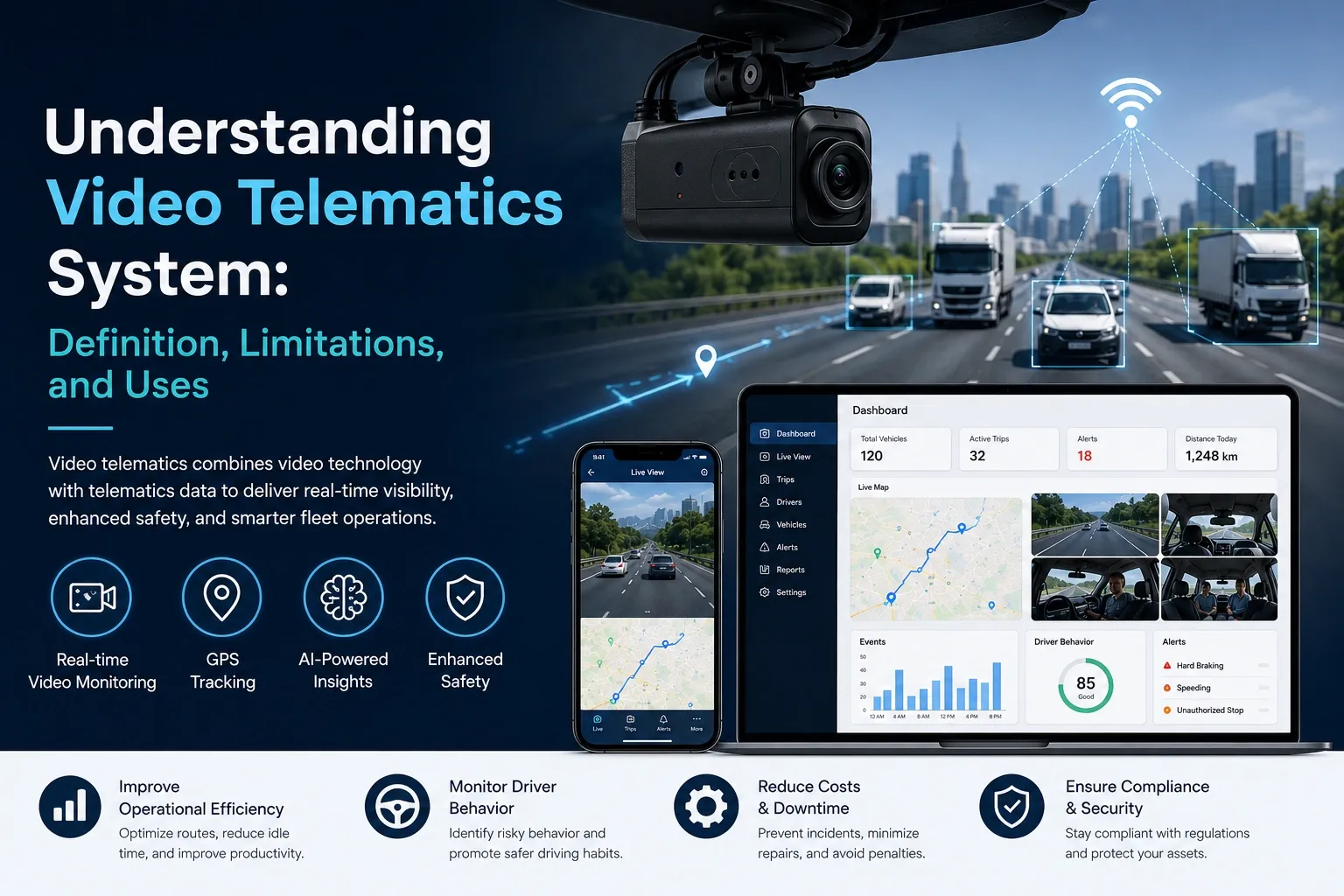
What is video telematics?
A video telematics system, in simple terms, is a system that works by utilizes a camera system integrated with a telematics system that offers real-time vehicle information and analytics. It offers more in-depth information regarding on-road vehicles by offering visual information along with statistics that can be very useful for transporters in several ways such as better transparency, live-feed, insurance, etc. A Video telematics system can also help transporters make their operation more efficient by fixing operational loopholes that can be made visible using a vehicle telematics system.
How does a video telematics system work?
A good vehicle telematics system includes a camera system that is compact, high-resolution, offers large storage capacity, and offers great value for money. Some high-quality telematics cameras offer multiple recording modes, embedded GPS or navigation systems, and are packed with other useful features like an internal microphone, wifi connectivity, and feasibility for cellular internet connection, preferably 4G. Based on the use, users can opt for the camera most fit for their use, which includes a dashboard camera, road and driver-facing camera, or a multi-camera system offering holistic footage from the vehicle. Video telematics is integrated with the existing telematics system in the vehicle to offer video footage either static or in real-time. This data in addition to vehicular and driving-related data is captured, processed, and transmitted to the user for either one vehicle or the entire fleet which can be accessed through a telematics dashboard or software.
Limitations of a video telematics system
Perhaps the biggest limitation of video telematics systems is the automatic video capture capability, which is quite low for a lot of available systems. Most video telematics systems are static and store the captured footage in the device rather than transmitting it to an online server where it is stored. Poor transmission capability of video telematics system can also result in storage getting exhausted often resulting in the video not being captured or available. Additionally, static video telematics systems also run the risk of getting damaged during accidents, and footage being lost defeats the whole purpose of installing the system. Thus, it is crucial to install a video telematics system that offers AI-driven automatic video capturing and seamless transmission to a cloud server making the data safe and available for use from anywhere.
Key Benefits of Video Telematics for Different Fleet Operations
While video telematics is often associated with accident recording, modern systems deliver value across multiple fleet functions. By combining video evidence with GPS tracking, vehicle diagnostics, driver behaviour monitoring, and AI-powered analytics, businesses gain actionable insights that improve operational efficiency and reduce overall fleet costs.
How Different Industries Benefit
Logistics and Freight Transportation
For long-haul logistics operators, video telematics improves shipment visibility while reducing operational risks.
Benefits include:
- Real-time visibility into vehicle movement and driving conditions
- Faster investigation of delivery disputes
- Better route compliance monitoring
- Reduced cargo theft and unauthorized vehicle usage
- Improved customer confidence through transparent operations
Construction and Heavy Equipment Fleets
Construction companies often operate expensive equipment across multiple project sites where visibility is limited.
Video telematics helps by:
- Monitoring equipment movement between locations
- Preventing unauthorized usage after work hours
- Recording incidents around construction sites
- Supporting equipment utilization analysis
- Improving operator accountability
Passenger Transportation
School buses, employee transport services, and public transit operators require a strong focus on passenger safety.
Video telematics enables:
- Continuous monitoring of passenger areas
- Driver distraction detection
- Rapid incident verification
- Better compliance with safety regulations
- Faster emergency response
Business Impact Beyond Safety
Apart from improving road safety, organizations often experience measurable operational improvements:
- Lower accident-related expenses
- Reduced insurance claim disputes
- Improved fleet productivity
- Better driver retention through coaching instead of penalties
- Increased compliance with internal safety policies
- Stronger customer trust due to improved transparency
As organizations continue adopting AI-powered fleet management technologies, video telematics is evolving into a strategic business intelligence tool rather than simply an onboard recording device.
Video Telematics vs Traditional GPS Tracking Systems
Many fleet owners assume that GPS tracking alone provides complete fleet visibility. However, while GPS tracking offers location-based insights, video telematics adds visual intelligence that significantly improves operational decision-making.
| Feature | Traditional GPS Tracking | Video Telematics |
|---|---|---|
| Vehicle location | Yes | Yes |
| Live video visibility | No | Yes |
| Driver behaviour monitoring | Basic | Advanced with AI detection |
| Accident video evidence | No | Yes |
| Driver distraction detection | No | Yes |
| Fatigue monitoring | No | Yes |
| Insurance claim support | Limited | Strong visual evidence |
| Fleet coaching insights | Limited | Comprehensive |
| Event-based recording | No | Yes |
| Operational transparency | Moderate | High |
When Should Businesses Upgrade?
Organizations should consider upgrading from basic GPS tracking to video telematics if they:
- Operate medium or large commercial fleets
- Frequently deal with accident disputes
- Need stronger driver safety initiatives
- Want AI-powered risk detection
- Require better compliance documentation
- Aim to reduce insurance-related costs
Why Businesses Are Making the Shift
Modern fleet management is becoming increasingly data-driven. Companies no longer rely solely on location tracking; they need visual context to understand why an event occurred.
For example, two vehicles may show identical harsh braking alerts. Without video, fleet managers only know that braking occurred. With video telematics, they can determine whether the driver avoided an unexpected pedestrian, reacted to another vehicle, or was distracted. This context enables better coaching, fairer driver evaluations, and more accurate incident analysis.
Best Practices for Successfully Implementing Video Telematics
Installing cameras alone is not enough to maximize the value of a video telematics system. Organizations should combine technology with clear operational processes to achieve meaningful improvements in safety and fleet efficiency.
Before Deployment
Plan your implementation by:
- Identifying the fleet segments that will benefit the most
- Choosing appropriate camera configurations (road-facing, driver-facing, cargo, or multi-camera)
- Defining data retention policies
- Establishing privacy guidelines for drivers
- Integrating the system with existing fleet management software
After Deployment
To maximize ROI:
- Regularly review AI-generated driving events
- Conduct monthly driver coaching sessions
- Use video evidence during safety training
- Monitor recurring driving patterns across the fleet
- Analyze incident trends instead of isolated events
- Periodically update camera firmware and software
Common Mistakes to Avoid
Many organizations fail to achieve expected results because they:
- Install cameras without creating safety policies
- Review footage only after accidents
- Ignore preventive driver coaching
- Fail to integrate telematics with fleet reporting
- Store excessive footage without meaningful analysis
- Overlook driver education regarding system benefits
Measuring Success
Businesses should track performance using measurable KPIs such as:
- Reduction in accident frequency
- Decrease in harsh driving events
- Faster insurance claim resolution
- Improved driver safety scores
- Lower vehicle downtime
- Reduction in unauthorized vehicle usage
- Improved fleet utilization
- Overall reduction in operational costs
By continuously monitoring these performance indicators, organizations can ensure that video telematics contributes not only to safer driving but also to long-term operational excellence, better regulatory compliance, and higher profitability.
Conclusions
Video telematics system offers capability in addition to the ones offered by telematics systems. Integrating your vehicle or fleet with a video telematics system offers users much-needed transparency and offers visual insight of fleet operations being conducted in real-time. Transporters and companies can reap several benefits by integrating their fleet with a video telematics system as it serves as a reliable eyewitness in case of minor collisions and accidents which are quite common particularly in the transportation sector. In addition to that, a video telematics system can also enhance insurance telematics for business owners with offering video footages, thus, making the process of claiming insurance in case of mishaps easier. Lastly, a video telematics system can serve as a great tool for training, improving safety standards, monitoring driver or fleet behaviour, and assisting the transporters in case of dispute or compensation with their clients.
Frequently Asked Questions
What is a video telematics system and how does it improve fleet management?
A video telematics system is an advanced fleet management technology that combines vehicle telematics, AI-powered cameras, GPS tracking, sensors, and cloud-based analytics to provide complete visibility into vehicle operations. Unlike conventional GPS tracking, which primarily reports a vehicle's location, video telematics captures real-time visual evidence along with driving behaviour, vehicle events, and operational data. This combination enables fleet operators to understand not only where a vehicle is but also what happened during an incident.
Modern businesses across logistics, transportation, mining, construction, passenger transport, and distribution increasingly rely on video telematics to improve safety, reduce operating costs, and make faster decisions. AI-powered cameras can detect distracted driving, mobile phone usage, harsh braking, fatigue, speeding, lane departures, and collision risks before they become serious incidents.
Video telematics also strengthens fleet management by helping businesses:
- Reduce accident frequency through proactive driver coaching.
- Improve insurance claim settlement using video evidence.
- Monitor fleet operations remotely from a centralized dashboard.
- Increase driver accountability without constant manual supervision.
- Reduce fuel wastage caused by unsafe driving behaviour.
- Improve customer confidence through greater shipment visibility.
For businesses operating across India, including Delhi NCR, Gurgaon, Mumbai, Bengaluru, and Pune, video telematics has become a critical technology for improving fleet productivity while ensuring driver safety and regulatory compliance. As AI adoption grows within transportation, video telematics is increasingly viewed as an essential component of intelligent fleet management rather than an optional add-on.
How is video telematics different from traditional GPS vehicle tracking systems?
Although both technologies help monitor vehicles, they serve different purposes. Traditional GPS tracking primarily focuses on vehicle location, trip history, speed monitoring, and route optimization. Video telematics goes several steps further by combining GPS data with high-definition video, AI-powered event detection, driver monitoring, and cloud analytics.
Instead of simply notifying fleet managers that harsh braking occurred, video telematics provides visual evidence explaining why the event happened. This additional context enables more accurate accident investigations, fair driver assessments, and faster insurance processing.
Key differences include:
- GPS tracking monitors vehicle location, whereas video telematics records visual driving events.
- Video telematics detects distracted driving, fatigue, and unsafe behaviour using artificial intelligence.
- Fleet managers receive video clips alongside telematics alerts for faster incident analysis.
- Insurance companies often process claims more efficiently when supported by recorded footage.
- Driver coaching becomes more objective using actual driving evidence instead of assumptions.
- Cloud storage protects important footage even if onboard equipment is damaged.
Many organizations initially deploy GPS tracking and later upgrade to video telematics as their fleets expand. Companies operating commercial vehicles in Delhi, Mumbai, Bengaluru, Pune, and Gurgaon increasingly prefer integrated solutions because they improve operational transparency while helping reduce accident-related expenses. For businesses looking to modernize fleet operations, combining GPS tracking with AI-enabled video monitoring offers substantially greater long-term value than relying solely on location tracking.
Why are logistics companies in India adopting video telematics so rapidly?
Indian logistics operations are becoming increasingly complex due to growing e-commerce demand, longer transportation routes, stricter compliance requirements, and higher customer expectations. Video telematics provides fleet operators with the operational visibility needed to manage these challenges more effectively while improving driver safety and reducing overall fleet risk.
Large logistics companies operating across Delhi NCR, Mumbai, Pune, Bengaluru, Chennai, Hyderabad, and Gurgaon manage hundreds or thousands of vehicles every day. Manual monitoring is no longer practical. AI-powered video telematics automates incident detection, driver behaviour analysis, and fleet monitoring while reducing dependence on manual supervision.
Businesses commonly adopt video telematics because it helps:
- Reduce accident-related losses and vehicle downtime.
- Protect fleets against fraudulent insurance claims.
- Monitor driver behaviour continuously.
- Improve cargo security during long-distance transportation.
- Increase customer confidence through better shipment transparency.
- Strengthen compliance with internal safety policies.
- Support data-driven driver training programs.
- Lower long-term operating costs through preventive risk management.
As India's logistics sector continues its digital transformation, video telematics has become one of the fastest-growing fleet technologies. Rather than serving only as an accident recording tool, it now functions as an intelligent decision-support system that helps businesses improve safety, operational efficiency, customer service, and profitability simultaneously. This growing adoption makes video telematics one of the most valuable investments for modern commercial fleet operators.
What is the cost of implementing a video telematics system in India?
The cost of implementing a video telematics system in India depends on several factors, including fleet size, camera configuration, cloud storage requirements, AI capabilities, and software integration. Businesses can choose from basic dashcam-based solutions to enterprise-grade AI video telematics platforms that include driver monitoring, live streaming, event-based recording, GPS tracking, and fleet analytics.
As a general estimate, businesses can expect the following pricing:
- Basic single-camera solution: ₹8,000–₹18,000 per vehicle
- Dual-camera systems: ₹15,000–₹30,000 per vehicle
- AI-powered video telematics: ₹20,000–₹45,000+ per vehicle
- Cloud software subscriptions: ₹500–₹2,500 per vehicle per month depending on features and storage.
Implementation costs may also include installation, SIM connectivity, onboarding, driver training, and integration with existing fleet management or transportation management software. Large fleets operating across Delhi NCR, Gurgaon, Mumbai, Bengaluru, Pune, and other logistics hubs often receive customized enterprise pricing based on fleet size.
Although the upfront investment may appear significant, most businesses recover costs by reducing accidents, insurance claims, fuel wastage, vehicle misuse, maintenance expenses, and legal disputes. Many organizations report measurable improvements in fleet productivity within the first year of deployment. Instead of evaluating only purchase price, companies should calculate the long-term return on investment, which often makes AI-powered video telematics one of the most valuable technology investments for commercial fleets.
Which are the best video telematics solutions for commercial fleets?
The best video telematics solution depends on fleet size, operational complexity, industry requirements, and business objectives. Rather than selecting a system solely based on hardware specifications, organizations should evaluate the complete ecosystem, including AI capabilities, cloud platform, reporting, integrations, customer support, and scalability.
An enterprise-grade video telematics platform should ideally provide:
- High-definition road-facing and driver-facing cameras.
- AI detection for distracted driving, fatigue, harsh braking, speeding, and collisions.
- Live GPS tracking integrated with video events.
- Cloud-based video storage and instant event retrieval.
- Fleet dashboards with analytics and customizable reports.
- Integration with transportation management and fleet management software.
- Mobile applications for fleet managers and supervisors.
- Reliable after-sales support across multiple cities.
Businesses evaluating the best video telematics software in India often compare scalability, ease of deployment, AI accuracy, cloud infrastructure, and total cost of ownership rather than simply comparing camera hardware. Large logistics operators in Delhi, Gurgaon, Mumbai, Bengaluru, Pune, and other transportation corridors generally prefer platforms capable of supporting hundreds or thousands of vehicles while maintaining consistent performance. Choosing a scalable solution also ensures future compatibility as AI features, connected vehicles, and smart transportation technologies continue to evolve.
How do businesses in Delhi, Gurgaon and Mumbai use video telematics differently?
While the core technology remains the same, video telematics is often deployed differently depending on local operating conditions and industry requirements. Metropolitan cities such as Delhi, Gurgaon, and Mumbai present unique transportation challenges that make intelligent fleet monitoring increasingly valuable.
In Delhi and Delhi NCR, fleet operators frequently use video telematics to manage dense urban traffic, monitor driver behaviour, reduce accident claims, and improve compliance for commercial transportation. High vehicle density makes visual evidence particularly useful during insurance investigations and traffic disputes.
In Gurgaon, where many logistics technology companies, corporate fleets, and e-commerce distribution centres operate, businesses focus on operational efficiency. Video telematics helps optimize fleet utilization, improve driver coaching, reduce idle time, and support large-scale enterprise fleet management.
Mumbai's logistics sector often deals with congested roads, port connectivity, time-sensitive deliveries, and long operating hours. Video telematics enables fleet managers to monitor deliveries more effectively while protecting valuable cargo and reducing operational risks.
Across all three cities, organizations commonly use video telematics to:
- Improve driver safety.
- Reduce accident investigations.
- Protect cargo during transportation.
- Lower insurance-related expenses.
- Increase operational transparency.
- Support compliance reporting.
- Strengthen customer confidence through better shipment visibility.
As commercial transportation continues expanding across India's major logistics hubs, video telematics is becoming an important competitive advantage for businesses seeking safer, smarter, and more efficient fleet operations.
What are the biggest challenges businesses face when implementing video telematics?
Although video telematics offers significant advantages for fleet safety and operational efficiency, successful implementation requires proper planning. Many organizations assume that installing cameras alone will solve safety and productivity challenges. In reality, the greatest value comes from combining technology with well-defined fleet policies, driver training, and continuous performance monitoring.
One of the most common concerns is driver acceptance. Employees may initially feel that onboard cameras invade their privacy. Fleet managers can overcome this by clearly communicating that video telematics is designed to improve safety, reduce false accident claims, protect drivers from wrongful accusations, and support coaching rather than constant surveillance.
Other implementation challenges include:
- Selecting the right combination of road-facing, driver-facing, or multi-camera systems.
- Managing cloud video storage and data retention policies.
- Ensuring reliable internet connectivity for real-time uploads.
- Integrating video telematics with existing fleet management software.
- Training fleet managers to interpret AI-generated driving events.
- Maintaining compliance with company privacy and security policies.
- Calculating return on investment beyond hardware costs.
Organizations operating fleets across Delhi NCR, Mumbai, Bengaluru, Pune, Gurgaon, and other major logistics hubs usually achieve the best outcomes by starting with pilot deployments before scaling fleet-wide. Businesses that regularly review AI-generated safety reports, coach drivers using video evidence, and monitor performance metrics often see substantial improvements in accident reduction, operational efficiency, insurance claim resolution, and overall fleet productivity.
How do you choose the right video telematics system for your business?
Selecting the right video telematics solution depends on your fleet size, business objectives, industry, and operational complexity. A small regional fleet transporting goods within one city may require a different solution than a nationwide logistics company managing thousands of commercial vehicles.
Before making a purchase decision, businesses should evaluate whether the solution can scale as operations grow while supporting future AI capabilities and software integrations.
Important evaluation criteria include:
- High-definition video quality during both daytime and nighttime driving.
- AI-powered event detection for fatigue, distraction, harsh braking, speeding, and collisions.
- Cloud storage with secure and fast video retrieval.
- GPS tracking integrated with vehicle diagnostics.
- Real-time alerts and customizable reporting dashboards.
- Compatibility with transportation management systems and ERP platforms.
- Reliable customer support, training, and nationwide service availability.
- Flexible pricing suitable for future fleet expansion.
Businesses operating in Delhi, Gurgaon, Mumbai, Bengaluru, Pune, and across India should also assess vendor experience within their industry, availability of local installation support, software updates, and implementation timelines. The best video telematics solution is not necessarily the one with the lowest purchase price—it is the platform that delivers measurable improvements in driver safety, operational visibility, regulatory compliance, customer service, and long-term return on investment.
What is the future of video telematics in India and commercial fleet management?
The future of video telematics is closely connected with artificial intelligence, connected vehicles, predictive analytics, and smart transportation ecosystems. As commercial fleets become increasingly digital, video telematics is evolving beyond incident recording into an intelligent decision-support platform that continuously analyzes driving behaviour and operational performance.
Modern AI systems are already capable of identifying risky driving patterns before accidents occur. Future developments will integrate video telematics with Advanced Driver Assistance Systems (ADAS), predictive maintenance, route optimization, electric vehicle management, and autonomous fleet technologies.
Businesses can expect future video telematics platforms to offer:
- More accurate AI-based driver behaviour analysis.
- Predictive risk detection before collisions occur.
- Seamless integration with electric and connected vehicles.
- Improved fleet-wide safety benchmarking.
- Automated compliance reporting.
- Real-time operational insights using machine learning.
- Enhanced cloud analytics for enterprise decision-making.
- Greater integration with transportation management ecosystems.
India's rapidly expanding logistics sector, supported by growing e-commerce, infrastructure development, and digital transformation initiatives, is expected to accelerate adoption across Delhi NCR, Gurgaon, Mumbai, Bengaluru, Pune, Hyderabad, Chennai, and other logistics corridors. Organizations investing in AI-enabled video telematics today will be better positioned to improve fleet safety, reduce operating costs, strengthen customer satisfaction, and remain competitive as intelligent transportation technologies continue to reshape commercial fleet management.