
📌 Key Takeaways
🚛 Govern Every Carrier: Bring owned, hired, and third-party fleets under a single control tower for consistent operational oversight.
👀 Eliminate Visibility Gaps: Gain real-time tracking, automated alerts, and actionable insights across every trip and transporter.
🤖 Manage by Exception: AI-powered monitoring highlights only critical deviations, enabling faster response and better resource utilization.
📲 Strengthen OTIF & Compliance: Automated ePOD and SLA tracking improve delivery performance, accountability, and dispute resolution.
📊 Optimize Fleet Productivity: Route intelligence, utilization analytics, and turnaround insights reduce idle time and freight costs.
🏆 Build an Intelligent Distribution Network: Enterprise fleet management software transforms fragmented transporter operations into one governed, data-driven ecosystem.
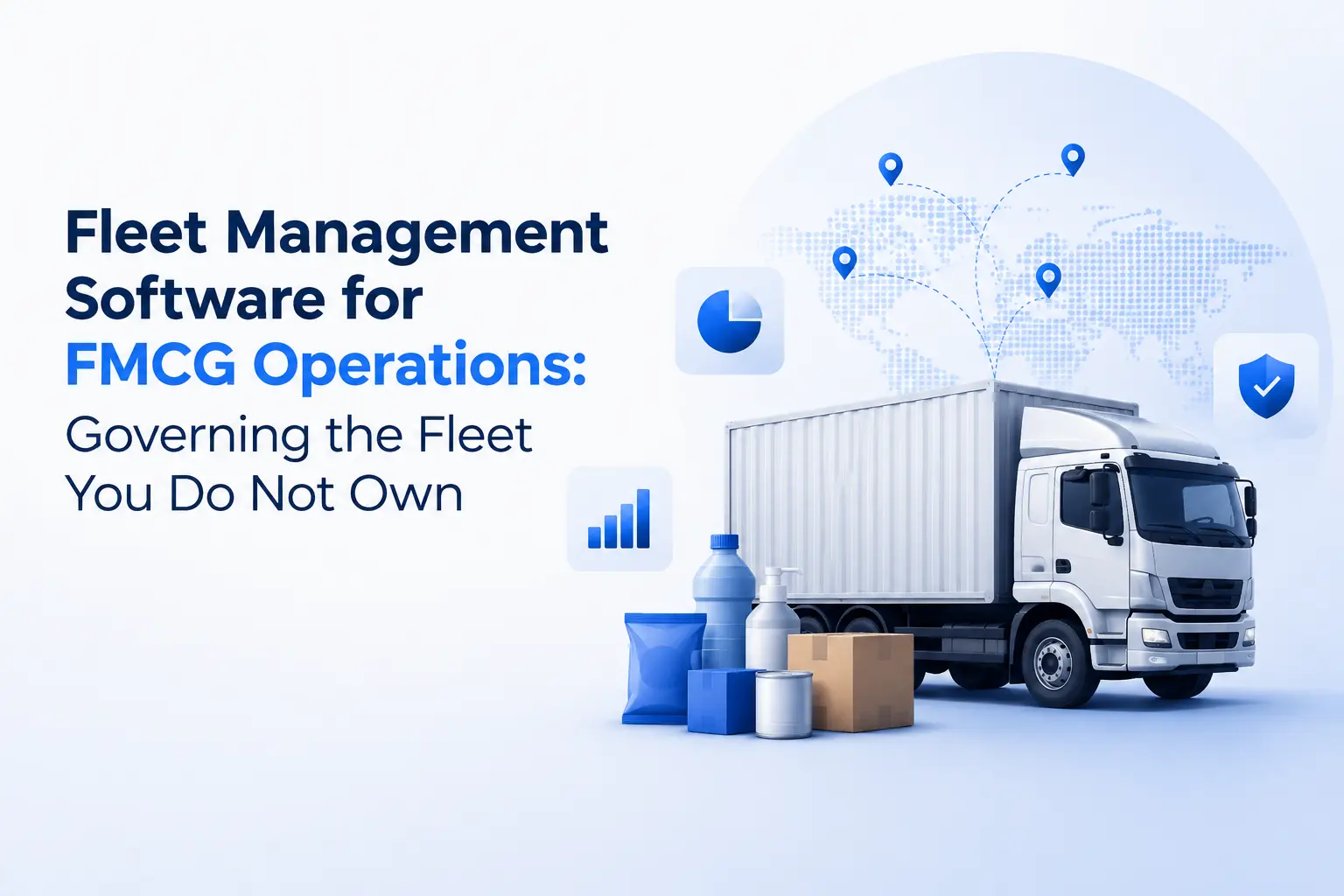
For a large FMCG enterprise, the fleet that reaches the retailer is rarely the fleet it owns. Distribution runs on a shifting web of third-party transporters, market vehicles, and regional carriers, each with its own drivers, discipline, and data. Fleet management software is the layer that brings that fragmented network under one line of sight, turning hundreds of independent trucks into a single governed operation. For supply-chain leaders measured on service, safety, and cost, it has moved from a tracking convenience to a governance system. This guide is written for that audience: the FMCG and logistics leaders who need real control over fleets they do not own.
What Is Fleet Management Software, and Why Does It Matter for FMCG?
Enterprise buyers are often handed several words for the same idea, so it helps to fix the vocabulary. What is fleet management software? It is the platform that plans, tracks, and controls a group of commercial vehicles from a single hub. What is a fleet management system? The same capability is seen as a stack: telematics devices inside the vehicle plus a cloud platform that reads them. When people ask what 'fleet' is in logistics, the answer is simply the pool of vehicles a company uses to move goods, whether owned, leased, or hired. What is fleet management in logistics, then, is the discipline of coordinating that pool so goods arrive on time, in full, and at the lowest sensible cost.
The fleet management services meaning that matters to an FMCG board is narrower and sharper. It is not about counting trucks. It is about governing outcomes across a distribution network the company largely rents. An overview of fleet management systems notes that the number of actively managed vehicles worldwide is expected to pass 180 million by 2028, a signal that connected control is becoming the default rather than the exception. For an operation moving fast, perishable, or brand-sensitive goods, that control is the difference between a stockout and a shelf that stays full.
|
Layer |
What it does |
Why FMCG cares |
|
Telematics hardware |
GPS and sensors capture location, speed, fuel, and engine
health |
Turns a hired truck into a data source you can govern |
|
Connectivity |
Sends vehicle data to the cloud over cellular or satellite
links |
Keeps visibility unbroken across long inter-state lanes |
|
Cloud platform |
Stores, cleans, and unifies data from every transporter |
One source of truth across a multi-carrier network |
|
Driver and ePOD app |
Captures delivery confirmation, photos, and documents |
Closes the proof-of-delivery loop in near real time |
|
Control tower and AI |
Watches trips and raises only genuine exceptions |
Lets a lean team govern thousands of outsourced trips |
Why Is the Visibility Gap Across Carriers the Real Enterprise Problem?
A national FMCG network can run through a hundred or more transporters at once. Each one sends its own updates, in its own format, at its own pace, usually by phone. The result is a visibility gap: the enterprise sees its plants and warehouses clearly, then loses sight of the load the moment it leaves the gate on a hired truck. That blind stretch is where on-time-in-full quietly erodes and where safety incidents surface only after they have already become claims.
The cost of that gap is national in scale. India's logistics spend remains high as a share of GDP, and the government's National Logistics Policy, launched in 2022, targets a reduction to roughly 8 percent of GDP by 2030 from the low-to-mid teens. A DPIIT report on logistics costs cites NCAER estimates placing the figure between 7.8 and 8.9 percent of GDP for 2022-23. The direction is clear: freight efficiency is now a policy priority, and enterprises that cannot see their outsourced fleets cannot take part in it.
• Service risk: a delayed or diverted truck becomes a missed delivery window and a possible stockout at a key account.
• Safety risk: an unmonitored hired driver on a highway is an exposure to accidents, cargo tampering, and brand-damaging incidents.
• Financial risk: without evidence of where a truck stopped and for how long, detention, pilferage, and disputed deliveries all default against the enterprise.
What Does a Control Tower Actually Do?
Two technologies sit underneath every control tower, and enterprise buyers should understand them plainly. What is vehicle telematics? It is the practice of collecting data from a vehicle, its location, speed, fuel, engine health, and driver behaviour, and sending it to a central system over a network link. What is GPS fleet tracking? It is the narrower piece that pinpoints where each vehicle is, in real time, so a trip can be followed from dispatch to delivery. Telematics is the full data stream; GPS tracking is the location layer within it.
A control tower turns that raw stream into governance. Rather than showing an operator a map with a hundred moving dots and expecting them to watch it, a modern control tower monitors every trip continuously and raises only genuine exceptions: a truck stopped too long outside an approved area, a delivery slipping behind its committed window, a driver flagged for fatigue or a harsh event. This is exception management, and it is the only model that scales past a few hundred vehicles.
On the Fleetx fleet management system, the control tower combines live GPS tracking, smart ETAs, automated geofencing, and AI-driven alerts, so arrivals and departures are logged without a phone call and deviations surface the moment they happen. Geofencing in particular converts a vague sense that a truck is late into a specific, timed, attributable event, which is what lets an FMCG operator act before a delay becomes a breach rather than after.
How Kataria Transport Achieved 24×7 Fleet Visibility and Reduced Turnaround Time by 20%
Discover how Fleetx helped eliminate visibility gaps, reduce idle time, improve operational efficiency, and build a proactive fleet management model.
How Do Automated ePOD and Exception Management Protect OTIF?
On-time-in-full, or OTIF, is the metric an FMCG supply chain lives and dies by, and it is fragile in an outsourced model because proof of delivery usually arrives days late, on paper, through the transporter. Automated electronic proof of delivery, or ePOD, closes that loop. Instead of a signed paper challan that travels back with the driver, the delivery is confirmed digitally at the point of drop, with a timestamp, a location, and, where needed, a photo or OTP.
Two things happen when ePOD is automated across an outsourced network. First, OTIF becomes measurable in near real time rather than being reconstructed weeks later from disputed paperwork. Second, the payment cycle to transporters can be tied to verified delivery, which removes a major source of friction and speeds settlement.
How Can Enterprises Govern SLAs Across Third-Party Carriers?
Once trips are visible and exceptions are managed, the enterprise can finally do what outsourced networks have historically made impossible: govern service-level agreements with evidence rather than argument. SLA governance means holding each transporter to agreed standards on timeliness, transit time, detention, safety, and documentation, and proving performance from system data.
This is where fleet management requirements for an enterprise diverge sharply from those of a small owner-operator. An enterprise does not simply need to know where a truck is. It needs:
• a single source of truth across every transporter, so performance is compared on the same terms;
• automated capture of the metrics written into carrier contracts, from OTIF to turnaround time;
• driver-level and vehicle-level scorecards that make accountability specific rather than collective;
• an audit trail strong enough to settle detention, pilferage, and delay disputes.
|
SLA metric |
What it measures |
Why it matters to FMCG |
|
OTIF percentage |
Deliveries on time and in full against commitment |
The headline service number every key account tracks |
|
Transit time adherence |
Actual versus planned lane transit time |
Flags carriers and routes that erode delivery promises |
|
Detention time |
Hours a vehicle waits at plant or customer dock |
Drives freight cost and disputed detention claims |
|
Safety alert resolution |
Share of alerts closed within a set window |
Protects drivers, cargo, and brand exposure on road |
|
ePOD compliance |
Deliveries confirmed with verified digital proof |
Enables faster, dispute-free transporter payment |
How Do You Improve Vehicle Utilization Across an Outsourced Network?
Cost control in truck fleet management ultimately comes down to how hard each vehicle works. Empty running, vehicles travelling without a load between one delivery and the next pickup, is one of the largest hidden costs in Indian road freight, and it stays invisible without data. So, how to improve vehicle utilization across a fleet that the enterprise does not own?
• Measure route-wise utilization to see which lanes consistently run partially empty;
• Use accurate turnaround time prediction to cut the hours a truck sits idle at a plant or dock;
• Optimize routing with algorithms trained on real road data rather than straight-line distance, so trips take the fastest truckable path;
• Flag and reduce unauthorized idling and off-route stops that quietly consume fuel and time.
Fleetx approaches this with truckable routing trained on millions of trip data points, route-wise utilization reporting, and predictive turnaround estimates that together compress the dead time between loads. For an FMCG enterprise, even a small gain in utilization across a large hired fleet compounds into a meaningful reduction in freight cost per case delivered.
Experience Fleetx on Your Own Distribution Network
Discover how Fleetx helps enterprises gain real-time fleet visibility, automate ePOD, improve OTIF, govern third-party transporters, and reduce logistics costs - all through a personalized product demonstration.
What Are the Benefits of Fleet Management Software for FMCG at Scale?
The benefits of fleet management software are easy to list and hard to deliver, which is why scale and proof matter. At the enterprise level, the gains cluster into four areas: service, safety, cost, and compliance. The clearest evidence comes from FMCG operators already running at this scale.
A global FMCG major operating roughly 1,900 vehicles across 190 transporters used a Fleetx safety control tower to resolve 95 percent of safety alerts within 30 minutes and hold a 90 percent issue resolution rate, with driver scorecards covering more than 2,500 drivers. Across video telematics deployments, documented outcomes include up to a 90 percent reduction in accidents and a 40 percent drop in repeat violations, with roughly three times faster incident response.
Those safety numbers are not a side benefit for FMCG; they are OTIF protection. Every accident, detention, or breakdown is a missed window somewhere downstream, so preventing incidents is usually cheaper than expediting freight after them. At platform level, Fleetx reports managing more than 250,000 assets, processing over 50 million data points a day, generating more than 10 million AI predictions daily, automating around 70 percent of routine operations, and delivering roughly 18 percent cost reduction for its customers.
|
Capability |
Legacy GPS / telematics |
AI control tower (Fleetx) |
|
Visibility |
A live map of dots to watch manually |
Continuous monitoring of every trip, exceptions surfaced |
|
Alerting |
Generic threshold alerts, high noise |
Prioritised amber and red exceptions only |
|
Proof of delivery |
Paper challan returned days later |
Automated ePOD with timestamp, location, and photo |
|
Cross-carrier governance |
Separate portals per transporter |
One governed scorecard across every carrier |
|
Scale |
Struggles past a few hundred vehicles |
Built for thousands of outsourced trips daily |
Ownership Is Optional. Governance Is Not.
For an FMCG enterprise, the decision is no longer whether to adopt fleet management software, but whether the platform can govern a distribution network that the company mostly does not own. The tools that matter close the visibility gap across carriers, watch every trip through a control tower, verify delivery with automated ePOD, and turn service-level agreements into evidence. Owned-fleet features are table stakes. Cross-carrier governance at the national scale is the real test.
The enterprises pulling ahead treat their outsourced fleet as a single governed operation, not a hundred separate relationships. That is a management shift as much as a technology one, and the right platform makes it possible.
Frequently Asked Questions (FAQs)
What is the best fleet management software for FMCG companies in India?
How much does fleet management software cost in India?
Can FMCG companies manage third-party transporters using fleet management software?
Which cities benefit the most from fleet management software in India?
How does fleet management software improve OTIF for FMCG companies?
Is fleet management software suitable for distributors operating across Delhi, Gurgaon, and Mumbai?
What features should enterprises look for in top fleet management software?
Can fleet management software integrate with ERP and warehouse systems?
How long does it take to implement fleet management software for an enterprise?
How can enterprises choose the best fleet management software provider in India?