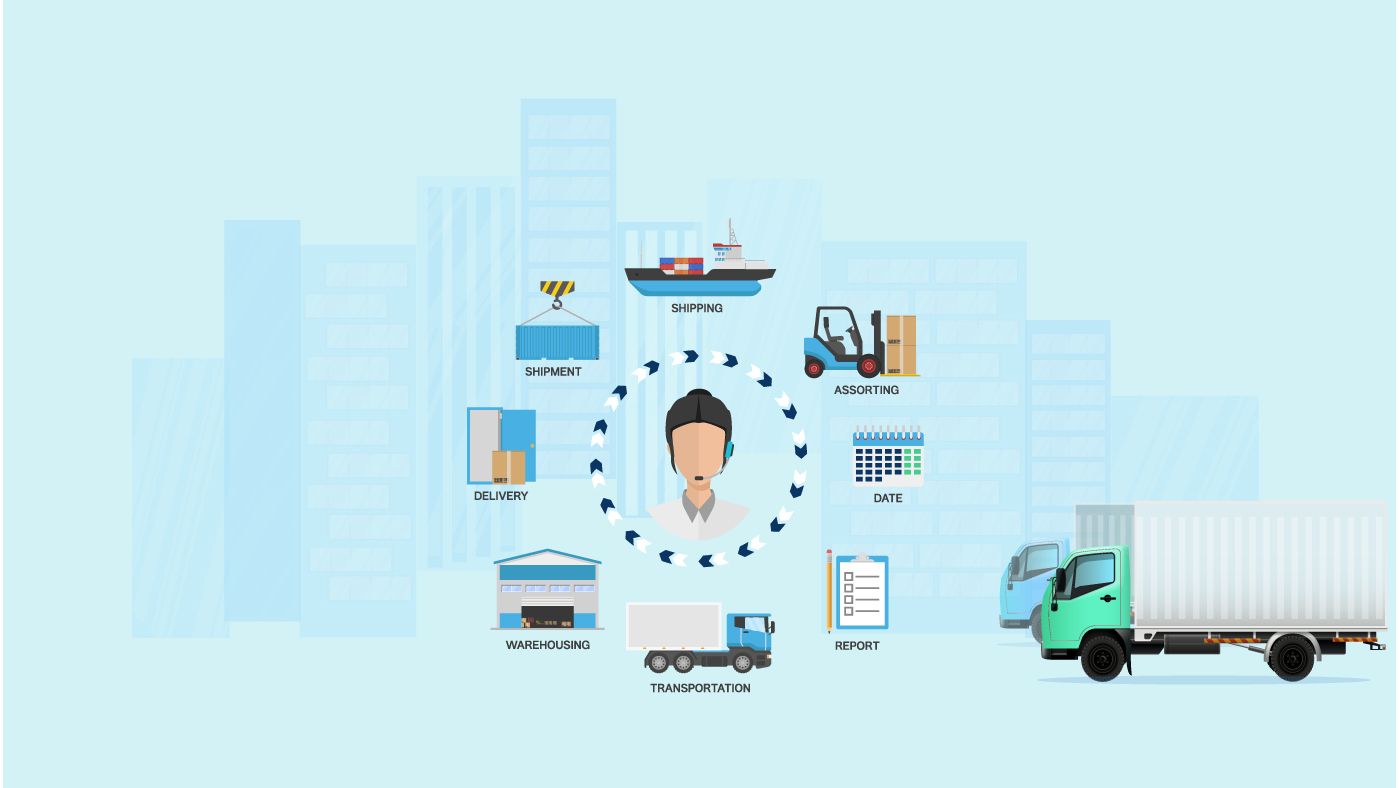
Every supply chain consists of not just the manufacturing and warehousing of products, but their transportation as well. This requires logistics enterprises to undertake several activities such as delivery planning, fleet management, shipment tracking, and more. A small business with only a few shipments on the move can probably handle operations on a small scale by utilising traditional tools like Excel spreadsheets as well as back and forth communication through emails and calls. But once your turnover starts to grow, it will become impossible to properly handle daily processes without a more robust way to control all the activities taking place.
A study by McKinsey has estimated that the current Indian transportation ecosystem has a value loss of about $80 billion, and the inefficiencies are only expected to go up. This is due to the fact that 90% of logistics companies in India are not organised and are owned by people with only one or two trucks. In fact, logistics costs in India account for almost 13% to 15% of the product cost, while 6% is the global average. This current wastage in India’s transport industry is majorly caused due to inefficient logistical practices and processes and equals to around 4.3% of our GDP.
What is TMS or Transportation Management System?
A Transportation Management System offers you everything you need to plan and execute your shipment while having complete visibility over every process taking place. TMS is modular software, which means you can integrate different functions separately and it can consist of many modules. Such ‘control tower’ capabilities allow you to have a complete view of the shipment process, thus capturing pertinent data from manufacturers, customers, and more. This data is also captured in real-time with the use of API or EDI technology for instant updating and can be reviewed later for the purpose of analysing service issues, supply chain performance, financials, and more.
To know more, read our blog - All you need to know about Enterprise Transport Management System
Features of Transportation Management System
Contract Management
Businesses in the transportation and logistics industry face complex challenges when it comes to supply and logistics management, cost management, and strict regulations. With data-driven contract management, companies can get help with managing every stage in the contract process through the shipment cycle. It will allow you to manage complex agreements with the utmost compliance and line item tracking, and delivery schedule management to improve your transportation processes and handle them seamlessly. You can also create and manage the agreement across all vendors with complex procurement as well as Indent logic.
Job Booking - Indent Planning
As a shipper, transportation company, or any logistics service provider (LSP), you must ensure that you are completing your transportation jobs in the best possible time, price, and efficiency. Job Bookings are planned by businesses that are going to send the shipment from the warehouse to the retail shop or from the mining location to the manufacturing plant. This can be done by using prominent Job Booking and Planning features of a TMS that allow you to get low transportation costs, reliable, on-time services, as well as better sourcing and procurement. You can find the best rates from manufacturers, carriers, and more so you can seamlessly transport products between locations. A Transportation Management System provides you with the necessary tools to find vendors, request quotations, assess responses, and find the best for the job.
Indenting - Actual Request
A TMS offers powerful tools for processing and optimising the transportation process. You can view decision-influencing data such as transit times, size loads, price, distances, labor costs, fuel, and more to pick routes that are the fastest and most cost effective. When using a Transportation Management System, you can also execute the major activities needed for freight and transportation management such as shipment bookings with carriers. Real-time visibility into where your fleet or shipment is throughout the transportation cycle as well as GPS features for time and distance measurement make it easier to execute your planning. You also have automated features for auto-indenting based on contract, trigger spot-auction in case of indent failure, and more to support your processes.
Tracking
Logistics businesses that still use a combination of databases and spreadsheets to fulfil orders with their suppliers and customers will find it hard to look beyond what is happening in the day to day. Using a TMS will change the situation drastically and offer ways to work better, smarter, and faster, without losing opportunities and resources. This technology gathers, integrates, and presents resources to make data-driven decisions and get a quick understanding of measured situations.
A Transportation Management System provides companies with complete insight into the thousands of shipments taking place under your management. With a multitude of data available at your fingertips, each shipment can be easily tracked and managed, including its internal and external processes. Visibility and performance management also aids logistics businesses in managing complex motor carrier schedules, diverse freight delivery networks, capacity supply challenges, rising freight rates, and more. With such optimised capabilities, you can also get reporting and analytics features to track carrier performance and other important metrics.
Electronic Proof of Delivery or ePOD
Electronic Proof of Delivery or ePOD is a paperless and seamless way of delivering products while getting real-time updates on progress through the delivery cycle. It lets you track deliveries digitally, while improving the efficiency of processes and enriching your customers’ experience. You can get multi-party Electronic Negotiations on delivery charges and qualities beforehand as well.
No more lost invoices and missed papers, as everything is digital and reduces the need to do manual paperwork. You can also capture signatures electronically and record pickups and deliveries instantly. With real-time tracking, you can keep your customers in the loop and keep them informed on where their shipment has reached with GPS tracking, barcode scanning, photos, and more.
Billing/ Freight Settlement
Freight audits for thousands of transactions can become a very daunting task that is not just manually paperwork-driven, but also cumbersome with almost no optimal results. Using a TMS with audit capabilities can be a game changer as such software automates the entire process by identifying elements such as the invoice total and shipment reference number, and matching it with the earlier decided rates listed in the contract on your Transportation Management System. Such a swift process barely takes 15 to 20 seconds to be completed, that too without you going through stacks of paperwork and email follow-ups. This is also a way for transporters to eliminate leakage via double billing by vendors as everything is recorded in the system.
E Lorry Receipt or eLR
After auditing, carry on to freight settlements and track costs seamlessly by closing orders. Reduce the time it takes for invoices to get cleared and bills to get settled as well as remove any manual errors associated with financials when using a Transportation Management System. Complete orders quicker with a faster procure to pay timeline by using eLRs that provide instant notification of the shipment being delivered. Here, you can get acknowledgement of delivery and completion of the order from both ends to finalise and close the job.
Conclusion
To become a leader in today’s transportation industry, you must think of building a competitive advantage, which can be fulfilled with a Transportation Management System. Such a system can streamline transportation and fleet operations and add crucial data analytics to help your business grow. Beyond improving operational efficiency, a TMS empowers businesses to reduce costs, enhance customer satisfaction, improve on-time deliveries, and make data-driven decisions that support long-term scalability. As supply chains become increasingly complex and customer expectations continue to rise, investing in a robust Transportation Management System is no longer just a technology upgrade, it is a strategic necessity for businesses looking to build resilient, agile, and future-ready logistics operations.
Frequently Asked Questions
What is a Transportation Management System (TMS)?
A Transportation Management System (TMS) is software designed to plan, execute, monitor, and optimise freight movement across the supply chain. It enables businesses to manage transportation operations from shipment planning and carrier selection to dispatch, real-time tracking, freight auditing, billing, proof of delivery, and performance analytics from one centralized platform. Instead of relying on spreadsheets, emails, and phone calls, companies can automate repetitive logistics tasks and improve operational visibility.
A modern Transportation Management System integrates with ERP platforms, Warehouse Management Systems (WMS), GPS tracking devices, ePOD solutions, APIs, and EDI networks to create a connected logistics ecosystem. Businesses gain access to live shipment data, route optimisation, vehicle utilisation reports, fuel insights, and automated documentation that significantly improve efficiency and reduce transportation costs.
Across India, manufacturers, distributors, FMCG companies, retailers, pharmaceuticals, e-commerce businesses, and third-party logistics providers are increasingly adopting Transportation Management Software to streamline operations. Companies operating in logistics hubs such as Delhi NCR, Gurgaon, Mumbai, Bengaluru, Pune, Chennai, and Hyderabad particularly benefit because these cities involve complex transportation networks, multiple warehouses, and large shipment volumes. Whether a business manages ten vehicles or thousands of daily deliveries, implementing a robust TMS helps improve customer service, reduce delays, increase visibility, and support scalable supply chain growth.
Why is Transportation Management Software important for modern logistics operations?
Transportation has become one of the largest cost centres within modern supply chains. Rising fuel prices, increasing customer expectations, labour shortages, congestion, and compliance requirements make manual logistics management inefficient. Transportation Management Software addresses these challenges by automating planning, improving fleet utilisation, reducing empty kilometres, and providing complete shipment visibility throughout the transportation lifecycle.
Instead of coordinating shipments through spreadsheets and multiple phone calls, businesses can manage procurement, contract management, shipment booking, route planning, freight settlement, electronic proof of delivery, invoicing, and analytics from one platform. Decision-makers receive real-time dashboards that help identify delays, optimise routes, improve carrier performance, and minimise operational risks before they impact customers.
This is particularly valuable for businesses operating in India's high-volume logistics corridors including Delhi NCR, Gurgaon, Mumbai, Pune, and Bengaluru, where managing multiple transport partners and daily deliveries can quickly become complicated. Companies using Transportation Management Software often experience improved on-time delivery performance, better customer communication, lower freight costs, faster billing cycles, and increased productivity. As supply chains continue to become more data-driven, a TMS is no longer simply a logistics tool—it has become a strategic investment that supports operational efficiency, business scalability, and long-term competitiveness.
What are the key features of the best Transportation Management System?
The best Transportation Management System (TMS) combines multiple logistics functions into one intelligent platform, helping businesses streamline transportation operations from planning to payment. While requirements vary by industry, modern TMS solutions generally include shipment planning, carrier management, contract management, route optimisation, vehicle tracking, dispatch management, electronic proof of delivery (ePOD), freight auditing, freight settlement, analytics, reporting, and automated documentation. Advanced platforms also integrate with ERP, Warehouse Management Systems (WMS), IoT devices, GPS tracking, APIs, and EDI for real-time information exchange.
Businesses should look for software that provides complete shipment visibility, automated alerts, predictive analytics, digital documentation, fuel monitoring, vehicle utilisation reports, driver performance insights, and customizable dashboards. Scalability is equally important, allowing organisations to expand operations without replacing their logistics technology. Cloud-based deployment, mobile accessibility, security, and seamless third-party integrations further improve operational efficiency.
For businesses operating across Delhi NCR, Gurgaon, Mumbai, Bengaluru, Pune, Chennai, or other logistics-intensive markets, selecting a Transportation Management System that supports multiple warehouses, transport partners, and regional compliance requirements can significantly improve supply chain performance. Rather than focusing solely on price, companies should evaluate implementation support, after-sales service, reporting capabilities, automation features, and long-term return on investment. The right TMS helps reduce transportation costs, improve customer satisfaction, increase delivery accuracy, and provide the operational visibility required for sustainable business growth.
How much does Transportation Management Software cost in India?
The cost of Transportation Management Software in India varies depending on business size, deployment model, number of vehicles, users, integrations, and feature requirements. Small businesses generally opt for cloud-based subscription plans that may start from approximately ₹15,000 to ₹50,000 per month depending on the number of shipments and operational complexity. Mid-sized organisations often require additional automation, analytics, GPS integration, and ERP connectivity, resulting in implementation costs ranging from a few lakhs to several lakhs. Large enterprises managing nationwide logistics networks usually invest in highly customised Transportation Management Systems with enterprise-grade integrations, advanced analytics, AI-powered optimisation, and dedicated support.
Besides software licensing, organisations should also consider implementation expenses such as onboarding, employee training, API integrations, workflow customization, historical data migration, and ongoing maintenance. Businesses should calculate the total cost of ownership rather than evaluating software based only on subscription pricing.
Companies located in Delhi, Gurgaon, Mumbai, Bengaluru, and Pune often achieve faster returns because Transportation Management Software reduces manual workload, optimises freight planning, improves route efficiency, minimises fuel consumption, accelerates freight settlements, and enhances shipment visibility. In many cases, the savings generated through better fleet utilisation and reduced operational inefficiencies outweigh the implementation costs within a relatively short period, making TMS a valuable long-term investment for growing logistics operations.
Which industries benefit the most from Transportation Management Software?
Transportation Management Software delivers value across virtually every industry that moves products between suppliers, warehouses, distributors, retailers, or customers. Manufacturing companies use TMS platforms to coordinate inbound raw materials and outbound finished goods while reducing transportation costs and improving delivery schedules. FMCG businesses rely on transportation software for route optimisation, distributor management, proof of delivery, and high-volume dispatch planning. Retailers and e-commerce companies depend on shipment visibility, last-mile tracking, and automated customer notifications to improve delivery experiences.
Other sectors benefiting from Transportation Management Systems include pharmaceuticals, chemicals, automotive, construction materials, cold chain logistics, food and beverage distribution, mining, steel, cement, and third-party logistics (3PL) providers. Each industry has unique transportation challenges, but all benefit from better visibility, automated planning, reduced paperwork, and improved operational efficiency.
Large logistics markets such as Delhi NCR, Gurgaon, Mumbai, Bengaluru, Pune, Ahmedabad, and Hyderabad experience particularly high transportation complexity because of dense distribution networks and multiple delivery locations. Businesses operating in these regions can significantly improve fleet productivity, optimise freight movement, reduce delays, monitor carrier performance, and strengthen customer satisfaction through a modern Transportation Management System. As supply chains become increasingly digital, TMS adoption continues to grow across industries seeking better control, scalability, and data-driven logistics operations.
How can businesses in Delhi NCR and Gurgaon improve logistics operations using a Transportation Management System?
Delhi NCR and Gurgaon are among India's busiest logistics and distribution hubs, serving industries such as manufacturing, retail, FMCG, automotive, pharmaceuticals, and e-commerce. Managing transportation in these regions is challenging due to heavy traffic, multiple warehouse locations, time-sensitive deliveries, varying customer requirements, and rising transportation costs. A Transportation Management System (TMS) helps businesses overcome these challenges by automating transportation planning, assigning the right carriers, optimising routes, and providing complete visibility into every shipment.
Instead of manually coordinating dispatches through spreadsheets or phone calls, logistics teams can monitor deliveries in real time, receive automated delay alerts, manage electronic proof of delivery (ePOD), track freight costs, and analyse carrier performance from a single dashboard. Businesses can also improve fleet utilisation, reduce empty return trips, automate freight settlement, and make informed decisions using transportation analytics. These capabilities are especially valuable for companies operating multiple warehouses or distribution centres across Delhi, Noida, Faridabad, Ghaziabad, and Gurgaon.
Manufacturers, distributors, and third-party logistics providers in Delhi NCR increasingly adopt Transportation Management Software because it improves operational efficiency while lowering transportation expenses. With better planning and greater shipment visibility, businesses can improve customer satisfaction, reduce manual workload, minimise delays, and create a scalable logistics network capable of supporting future business growth.
Why are businesses in Mumbai, Bengaluru, and Pune investing in Transportation Management Software?
Mumbai, Bengaluru, and Pune are major commercial and industrial centres where transportation plays a critical role in maintaining efficient supply chains. Mumbai supports large-scale port operations, imports, exports, and nationwide freight movement, while Bengaluru is a technology and manufacturing hub with growing e-commerce and electronics industries. Pune continues to expand as an automotive, engineering, pharmaceutical, and industrial manufacturing centre. Businesses operating across these cities often manage high shipment volumes, multiple transport partners, regional warehouses, and demanding customer expectations.
Transportation Management Software enables organisations to centralise transportation planning while providing real-time shipment visibility, automated dispatch management, freight auditing, electronic proof of delivery, route optimisation, and performance reporting. Companies gain better control over transportation costs while improving delivery reliability and customer communication. Managers can monitor fleet performance through dashboards, identify operational bottlenecks, reduce fuel wastage, and improve resource utilisation using data-driven insights.
Whether managing regional deliveries within Mumbai, interstate freight from Pune, or nationwide distribution from Bengaluru, a Transportation Management System helps businesses improve logistics efficiency without increasing operational complexity. As competition continues to grow, investing in transportation automation allows organisations to scale operations, improve profitability, strengthen customer service, and maintain a competitive advantage across India's rapidly evolving logistics sector.
How do you choose the best Transportation Management Software for your business?
Selecting the best Transportation Management Software depends on your business size, shipment volumes, operational complexity, and future growth plans rather than choosing the platform with the most features. Businesses should begin by identifying operational challenges such as manual dispatch planning, poor shipment visibility, delayed deliveries, inefficient carrier management, rising freight costs, or disconnected logistics systems. Understanding these requirements helps narrow the selection process.
Key evaluation criteria include shipment planning capabilities, route optimisation, real-time tracking, contract management, freight auditing, billing automation, electronic proof of delivery, reporting, analytics, ERP integration, Warehouse Management System compatibility, API support, scalability, security, mobile accessibility, and customer support. Companies should also assess implementation timelines, onboarding assistance, product training, system customization, and future upgrade options before making a decision.
Businesses operating across India, including Delhi NCR, Gurgaon, Mumbai, Bengaluru, Pune, Chennai, and Hyderabad, should prioritise software that supports multi-location operations, regional compliance, multiple transport partners, and expanding logistics networks. The ideal Transportation Management System should not only improve today's operations but also support long-term digital transformation. Choosing the right solution enables organisations to reduce transportation costs, improve customer satisfaction, enhance operational visibility, and build a resilient supply chain capable of adapting to changing market demands.
What return on investment (ROI) can businesses expect after implementing a Transportation Management System?
While the exact return on investment (ROI) depends on shipment volume, fleet size, and operational complexity, most businesses begin seeing measurable improvements after implementing a Transportation Management System (TMS). The software helps reduce transportation costs by automating shipment planning, optimising routes, improving vehicle utilisation, minimising empty return trips, reducing paperwork, and shortening freight settlement cycles. These efficiencies translate into lower operating expenses and better resource utilisation.
Apart from direct cost savings, businesses also benefit from increased visibility across the supply chain. Real-time shipment tracking, automated alerts, digital proof of delivery (ePOD), freight analytics, and carrier performance reports help logistics teams identify bottlenecks before they affect customers. Faster billing, improved compliance, fewer manual errors, and better communication with transport partners further contribute to operational improvements. Management teams also gain valuable insights that support data-driven decision-making and long-term planning.
For organisations operating across logistics-intensive regions such as Delhi NCR, Gurgaon, Mumbai, Bengaluru, Pune, Chennai, and Hyderabad, the benefits are even more significant because transportation networks are larger and more complex. As shipment volumes increase, the value delivered by a TMS grows accordingly. Beyond reducing costs, businesses often experience higher customer satisfaction, improved on-time deliveries, increased productivity, and a stronger competitive position, making Transportation Management Software a strategic investment rather than simply another operational expense.
Can a Transportation Management System integrate with ERP, WMS, GPS tracking, and other business software?
Yes. Modern Transportation Management Systems are designed to integrate seamlessly with existing enterprise applications, allowing businesses to create a connected digital supply chain. Most enterprise-grade TMS platforms support integrations with ERP systems, Warehouse Management Systems (WMS), GPS tracking solutions, accounting software, telematics devices, APIs, Electronic Data Interchange (EDI), inventory platforms, CRM systems, and freight marketplaces. These integrations eliminate data silos and reduce manual data entry across departments.
When systems communicate automatically, shipment information flows in real time from order creation to warehouse dispatch, vehicle allocation, transportation planning, proof of delivery, invoicing, and payment reconciliation. This improves operational visibility while reducing errors caused by duplicate or inconsistent data. Logistics managers can monitor inventory availability, shipment progress, carrier performance, delivery status, and financial reporting through a unified dashboard instead of switching between multiple software platforms.
For businesses operating multi-location supply chains across India—including Delhi, Gurgaon, Mumbai, Bengaluru, Pune, Ahmedabad, and Chennai—integrated Transportation Management Software enables faster decision-making and greater operational efficiency. As organisations continue investing in digital transformation, choosing a TMS with flexible integration capabilities ensures that the software can adapt to future technologies, support business expansion, and deliver long-term value without requiring major infrastructure changes.