

Preventive maintenance is one of the most affordable ways to increase a vehicle's lifespan, boost fleet efficiency, and reduce vehicle breakdowns, hence maintenance of fleet is important. Preventive maintenance that is scheduled optimizes uptime, guarantees the security of your assets while they are in movement, and provides up to a 545% ROI.
Assets and vehicles can live much longer with preventive maintenance which reduces the replacement chances, and if there are fewer chances of replacement, the ROI will increase automatically. In addition, as maintenance checks are usually carried out after hours, costs associated with downtime are normally not increased. Ignoring routine preventative maintenance tasks can eventually affect a business's financial status.
In our previous blog, we discussed what preventive maintenance is and how the checklist should be carried out. In this blog, we’ll go in-depth about defects and inspections done for preventive maintenance and how checklists are made.
Preventive Maintenance Inspections
Preventive Maintenance Inspection is a methodical procedure for determining performance flaws and indications of degradation in any asset, fleet or piece of equipment through the evaluation of its present state. Since the inspection identifies problems and specifies a maintenance scope, maintenance frequently comes after the inspection. These are simple checks that can assist in identifying wear or damage early on, preventing the need for major component repairs. These inspections cover particular items, like record repairs, routine repairs, indicate inspection interval, indicate repair/replace, etc. Pre- and post-inspections are two different sorts of inspections that are performed.
Pre/Post Trip inspection
Establishing effective communication between drivers and management is a crucial component of preventive maintenance. Pre-trip inspections done properly prevent the driver from leaving the facility in a vehicle that has an unfixed issue. A thorough post-trip inspection allows the shop enough time to address any issues that are found before the truck is sent back out on the road.
The use of the driver's daily vehicle inspection checklist, which is either a pre-trip or post-trip inspection, is a simple technique to ensure and document vehicle data. Every good and complete inspection demands trained drivers, but the driver should also be able to spot any faults and report them immediately. All checklists must be kept in the vehicle's permanent file so that information is always accessible and may be reviewed as needed. The vehicle driver must clearly complete and sign the pre- and post-trip inspection paperwork.
The following items should be checked during a pre-trip and post-trip inspection, at the very least, per reports on vehicle fleet maintenance:
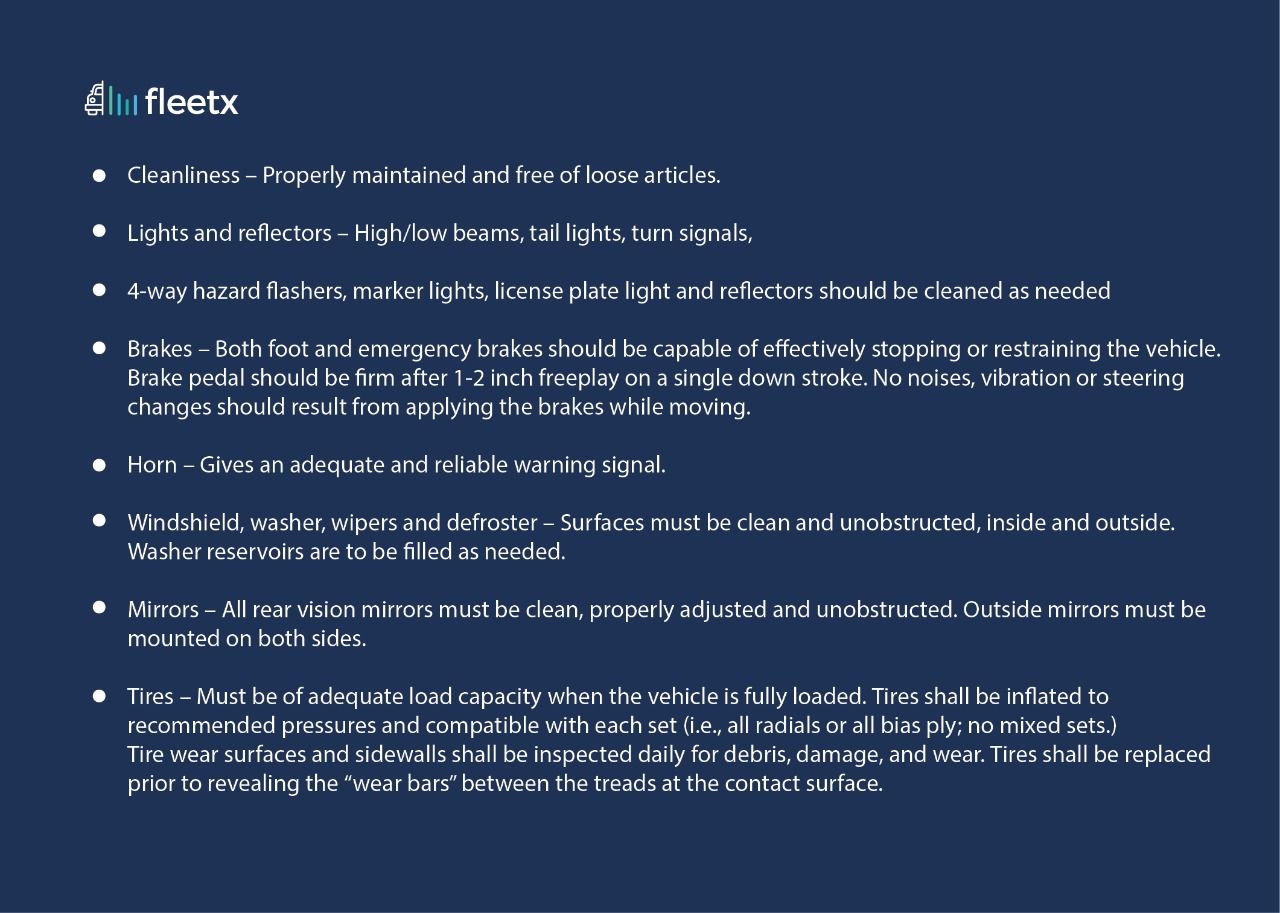
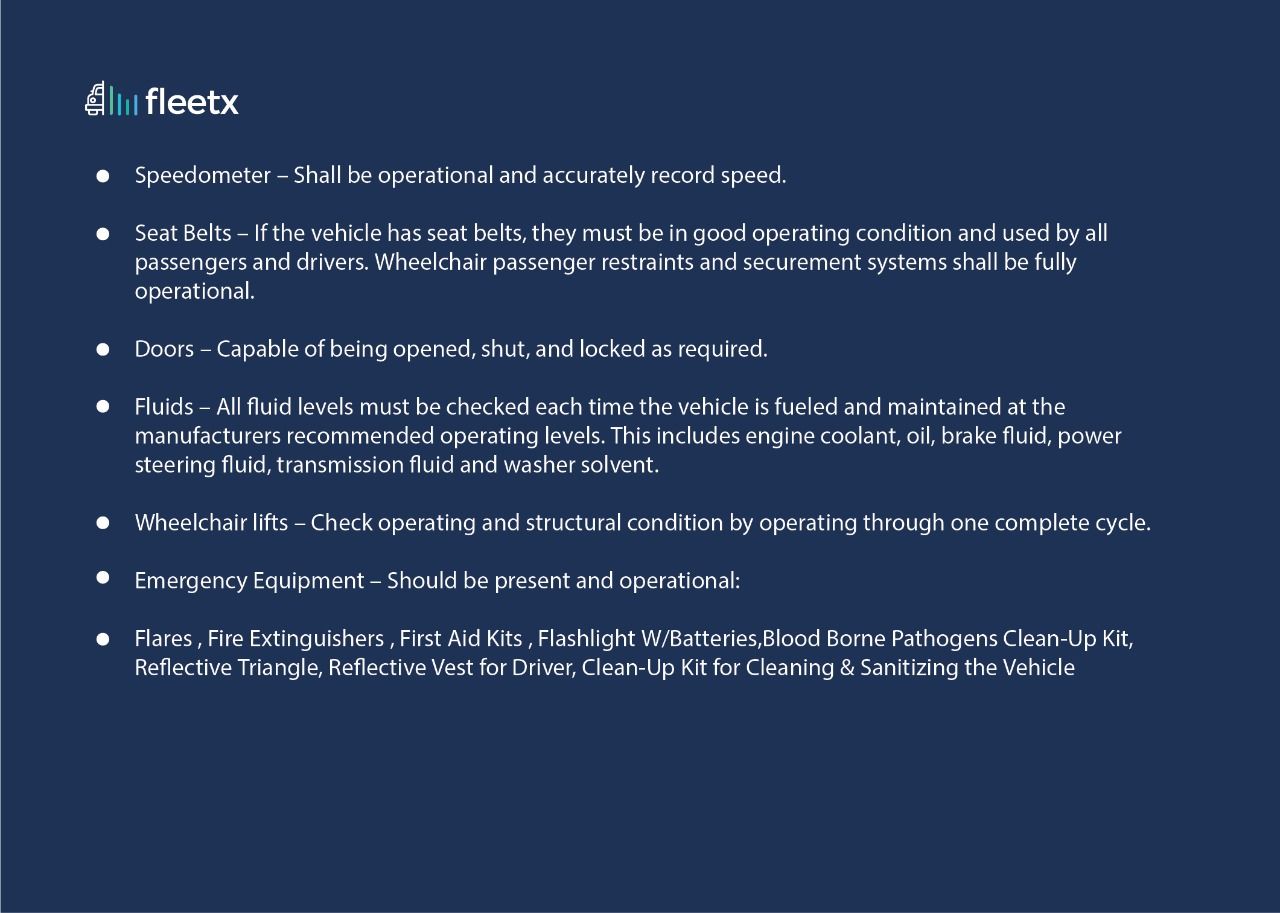
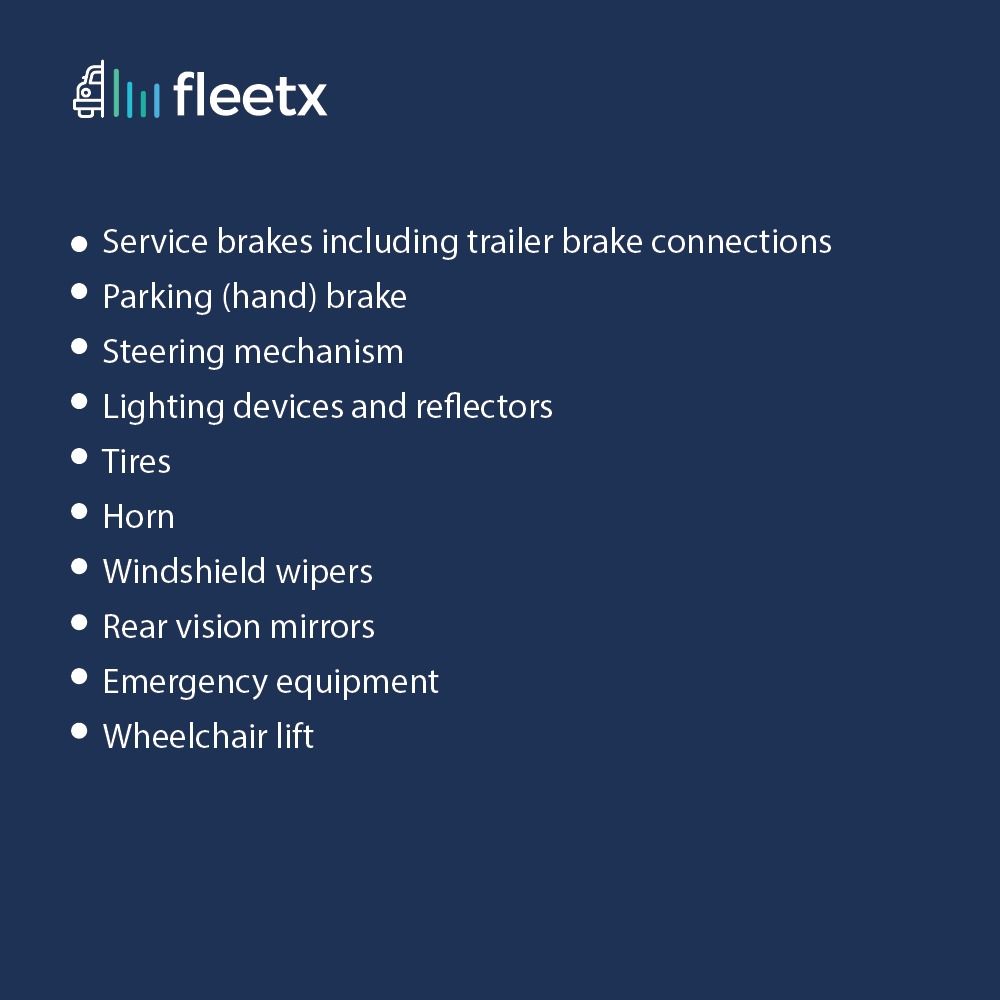
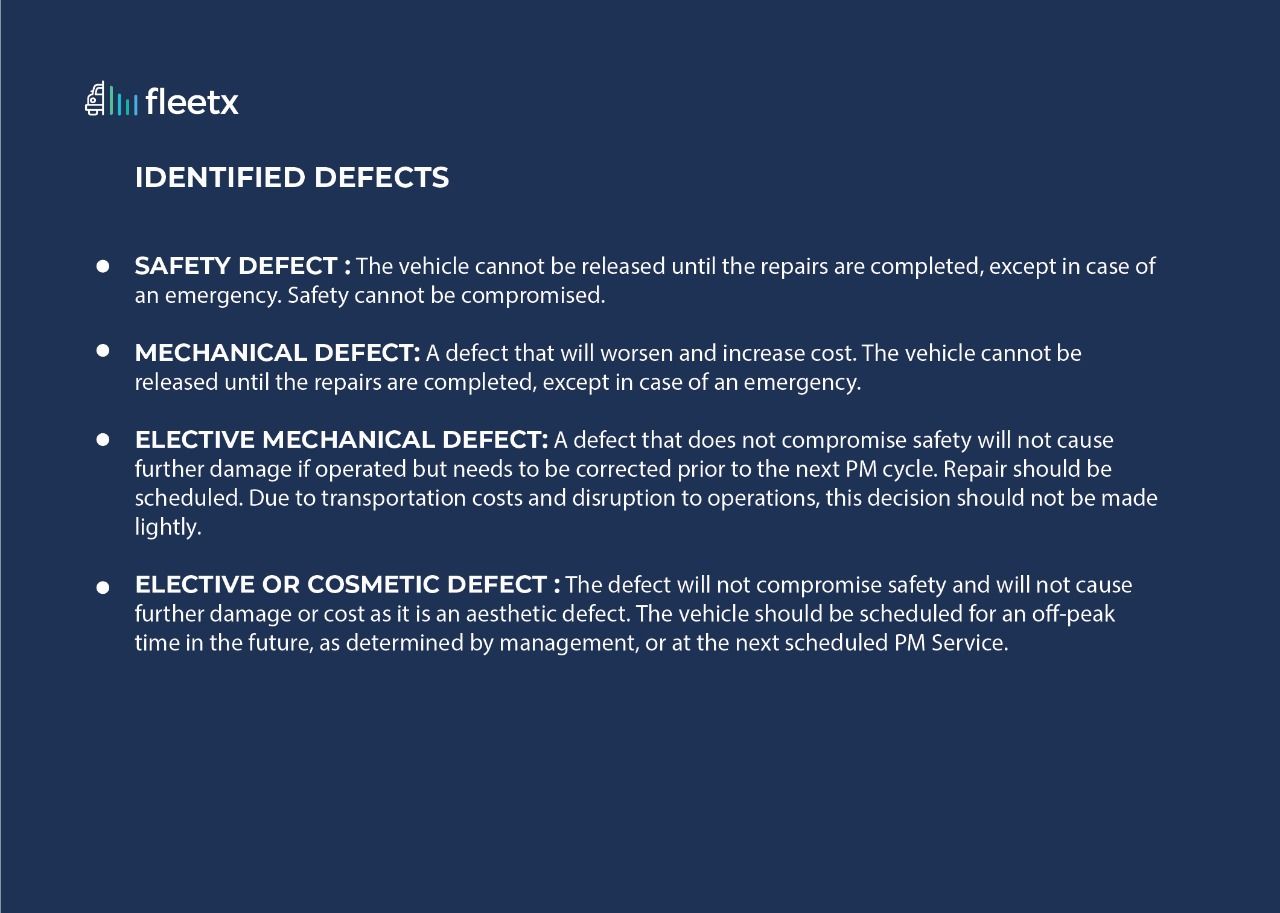
Drivers should report any defects found during the specified set of inspections as soon as feasible because they could impact vehicle operation and safety and cause a breakdown.
What are the Steps to Create a Plan for Preventive Maintenance
Each firm has a unique mix of assets and fleets, and each has varied needs and demands based on those needs. There will never be a set maintenance checklist, but the quality will always depend on how well you understand the requirements for your fleets and machinery.
Vehicle data, best maintenance practices, and adjusting it to your company's needs are all steps in the process of developing your own checklists for your organization. Here are some recommendations to get you going with it:
Valuable data: Be specific with all the assets and vehicle models for each item on your checklist. The paperwork and documentation should be created meticulously so that it can be evaluated as needed. Your technicians and drivers will do duties correctly if you are precise and specific in your instructions.
Potential Team: While working on the preventive maintenance plan , there are different types of assets and they all need different levels of supervision. All the different kinds of jobs need different expertise and it is important to have the right people onboard, so that valuable insights can be taken into consideration.
Safety guidelines: Be sure to include any necessary safety precautions when drafting the preventive maintenance task for your list. Include safety cautions for each checklist.
Regular update: Your PM checklist should be revised frequently to reflect equipment upgrades, business expansion, problems your maintenance team encounters, modifications to standard operating procedures, and adjustments to production methods. Remote access to the checklist makes it simpler because it provides access from anywhere at any time. As they may send notifications and reminders, remote updates can enable holding sessions on a regular calendar basis.
What is the Role of Preventive Maintenance in Building a Resilient Fleet
Today's logistics industry operates in an environment where customer expectations, fuel costs, regulatory requirements, and delivery timelines continue to evolve. Fleet operators are expected to deliver goods safely and on time while maximizing vehicle utilization and minimizing operational costs. In such a dynamic landscape, preventive maintenance is no longer just a maintenance activity—it is a strategic approach that strengthens fleet resilience and supports uninterrupted business operations.
A resilient fleet is one that can continue operating efficiently despite challenges such as heavy traffic, adverse weather, increasing freight demand, fluctuating fuel prices, or unexpected operational disruptions. Preventive maintenance contributes to this resilience by ensuring vehicles remain roadworthy, reliable, and ready for deployment. Instead of reacting to breakdowns after they occur, businesses can anticipate maintenance needs, schedule repairs during planned downtime, and keep their fleets operating at optimal performance.
For fleet operators managing commercial vehicles across India, including Delhi NCR, Gurgaon, Mumbai, Bengaluru, and Pune, this proactive approach is becoming increasingly valuable. Whether transporting FMCG products, construction materials, pharmaceuticals, retail goods, or industrial equipment, maintaining vehicle reliability directly impacts customer satisfaction, operational efficiency, and overall profitability.
Why Fleet Resilience Matters More Than Ever
Several factors are making fleet resilience a business priority for logistics companies across India.
- Growing e-commerce and retail distribution networks demand faster and more predictable deliveries.
- Urban congestion in cities such as Delhi, Mumbai, and Bengaluru increases vehicle wear due to frequent braking, idling, and stop-and-go traffic.
- Long-haul freight routes require vehicles to operate continuously under varying road and weather conditions.
- Rising fuel and operational costs make unexpected repairs significantly more expensive than planned maintenance.
- Businesses increasingly rely on accurate delivery schedules to meet customer expectations and service-level agreements (SLAs).
In this environment, even a single unplanned vehicle breakdown can create a ripple effect across multiple deliveries, affecting customer commitments, driver schedules, and overall fleet productivity. Preventive maintenance helps reduce these risks by ensuring vehicles remain operational and dependable throughout their service lifecycle.
How Preventive Maintenance Strengthens Business Operations
Beyond reducing vehicle breakdowns, preventive maintenance creates measurable operational advantages that benefit every stage of fleet management.
Improves fleet availability
Vehicles that follow planned maintenance schedules spend less time undergoing emergency repairs, allowing businesses to maximize fleet utilization and complete more trips with the same assets.
Supports consistent delivery performance
Reliable vehicles contribute to fewer service disruptions and help businesses maintain on-time deliveries, particularly for time-sensitive industries such as cold chain logistics, FMCG distribution, pharmaceuticals, and e-commerce.
Simplifies maintenance planning
Scheduled servicing enables maintenance teams to allocate technicians, spare parts, and workshop resources more efficiently instead of responding to unexpected breakdowns.
Extends asset lifecycle
Routine inspections and timely replacement of wear components reduce excessive strain on critical systems such as engines, transmissions, braking systems, and suspension, helping commercial vehicles remain productive for longer periods.
Improves operational visibility
When preventive maintenance is integrated with digital fleet management systems, fleet managers gain complete visibility into vehicle health, service history, maintenance schedules, and repair records, enabling better planning and decision-making.
Supports business scalability
As fleet sizes increase, standardized preventive maintenance processes make it easier to manage hundreds or even thousands of vehicles across multiple operating locations without compromising maintenance quality.
Fleet Operations With vs Without Preventive Maintenance
| Operational Area | Without Preventive Maintenance | With Preventive Maintenance |
|---|---|---|
| Fleet Availability | Unexpected breakdowns reduce vehicle availability | Planned servicing keeps more vehicles road-ready |
| Delivery Performance | Higher risk of delayed deliveries | More consistent and reliable delivery schedules |
| Maintenance Planning | Reactive repairs disrupt operations | Maintenance activities are scheduled efficiently |
| Repair Costs | Expensive emergency repairs and breakdown recovery | Better control over maintenance expenditure |
| Vehicle Lifecycle | Components wear out faster | Longer vehicle lifespan through regular servicing |
| Workshop Efficiency | Unpredictable repair workload | Better allocation of technicians and workshop resources |
| Customer Satisfaction | Service disruptions affect customer experience | Improved reliability and customer confidence |
| Business Growth | Difficult to scale operations consistently | Standardized maintenance supports fleet expansion |
Why This Matters for Fleet Operators Across India
Operating conditions differ significantly across India's logistics corridors, making preventive maintenance strategies even more important.
In Delhi NCR and Gurgaon, commercial vehicles frequently encounter heavy urban traffic, prolonged idling, and high delivery volumes, increasing stress on engines, braking systems, and cooling components.
In Mumbai, coastal humidity, dense traffic, and continuous freight movement can accelerate wear on electrical systems, brakes, tyres, and suspension components, requiring regular inspections to maintain vehicle reliability.
For fleets operating in Bengaluru and Pune, growing industrial activity and expanding distribution networks often require vehicles to alternate between city deliveries and long-distance transportation. Maintaining consistent preventive maintenance schedules helps ensure vehicles remain dependable across varying operating conditions.
Businesses managing nationwide logistics networks also benefit from standardized maintenance practices because they improve consistency across multiple branches, workshops, and fleet locations while simplifying compliance and service documentation.
Signs Your Fleet Maintenance Strategy May Need Modernization
Even organizations following routine maintenance schedules should periodically evaluate whether their maintenance processes remain effective as operations grow. The following indicators may suggest that it's time to modernize the maintenance strategy:
- Increasing frequency of unplanned vehicle breakdowns.
- Rising maintenance expenses despite regular servicing.
- Difficulty tracking service history across multiple vehicles.
- Missed maintenance schedules due to manual planning.
- Limited visibility into vehicle health and maintenance status.
- Frequent repeat repairs involving the same components.
- Delays caused by vehicles becoming unavailable unexpectedly.
- Maintenance records stored across multiple spreadsheets or paper-based systems.
- Challenges coordinating maintenance activities across multiple cities or branches.
- The growing fleet size is making manual maintenance management increasingly difficult.
Modern fleet management platforms that combine preventive maintenance scheduling with telematics, digital inspections, and automated service reminders help address these challenges while improving maintenance efficiency, operational visibility, and long-term fleet reliability.
To Conclude
Preventive maintenance helps companies to manage compliance and inspection requirements, it extends the life of equipment, saves downtime, eliminates demands for maintenance costs, and avoids expensive emergency repairs. Having an efficient maintenance inspection is crucial, and it should be carried out since it brings the important components of fleets and assets together. Thus, sticking to a solid preventive maintenance plan makes it simple for technicians, drivers, and benefits the overall revenue of the business.
Frequently Asked Questions
What is preventive maintenance in fleet management? ▼
Preventive maintenance in fleet management is a planned and systematic process of servicing commercial vehicles before mechanical failures occur. Instead of waiting for a truck, trailer, or commercial vehicle to break down, fleet operators perform scheduled inspections, oil changes, tyre checks, brake inspections, coolant replacement, battery testing, and component servicing at predefined intervals based on mileage, engine hours, or time.
For logistics companies across India, preventive maintenance has become one of the most effective ways to improve fleet availability, reduce repair costs, and extend vehicle lifespan. Businesses operating in Delhi NCR, Gurgaon, Mumbai, Bengaluru, and Pune often deal with heavy traffic, long-haul routes, frequent stop-start driving, and varying weather conditions. These factors accelerate vehicle wear and make routine maintenance even more critical.
A modern preventive maintenance strategy also includes digital inspection checklists, automated maintenance reminders, vehicle health monitoring, telematics integration, and service history tracking through fleet management software. Instead of relying on spreadsheets or manual records, fleet managers receive alerts before servicing is due, helping reduce unexpected downtime and improve maintenance planning.
Ultimately, preventive maintenance protects fleet assets, improves road safety, supports regulatory compliance, minimizes emergency breakdowns, and enables businesses to deliver goods on time. It is considered one of the most cost-effective operational practices for transport companies looking to improve fleet efficiency while lowering long-term ownership costs.
Why is preventive maintenance important for commercial fleets in India? ▼
Preventive maintenance plays a critical role in keeping commercial fleets reliable, safe, and profitable. India's logistics sector operates under challenging conditions including congested city roads, long-distance highways, extreme temperatures, seasonal rainfall, and demanding delivery schedules. These operating conditions increase stress on engines, brakes, tyres, cooling systems, suspensions, and electrical components.
Fleet operators in Delhi, Gurgaon, Mumbai, Bengaluru, and Pune often manage hundreds of vehicles transporting FMCG products, construction materials, pharmaceuticals, retail goods, and industrial equipment. A single unexpected breakdown can delay multiple deliveries, increase fuel consumption, affect customer satisfaction, and generate expensive emergency repair bills.
Preventive maintenance helps reduce these risks by ensuring every vehicle undergoes scheduled inspections before major failures develop. Regular servicing also improves fuel efficiency, extends tyre life, reduces engine wear, lowers emissions, and keeps vehicles compliant with safety regulations.
Businesses using preventive maintenance alongside fleet management software benefit from automated maintenance schedules, digital inspection records, repair history, workshop planning, and real-time alerts. This allows fleet managers to plan maintenance during off-peak hours instead of disrupting delivery operations.
For growing logistics companies, preventive maintenance is no longer simply a repair strategy. It has become a business strategy that increases uptime, improves operational efficiency, reduces maintenance costs, supports customer commitments, and enables sustainable fleet expansion across India.
How much does preventive maintenance for commercial fleets cost in India? ▼
The cost of preventive maintenance depends on fleet size, vehicle type, maintenance frequency, operating conditions, and whether businesses use manual maintenance processes or digital fleet maintenance software. While exact costs vary, preventive maintenance is almost always less expensive than emergency repairs resulting from unexpected vehicle failures.
For many transport companies across India, routine servicing may include engine oil replacement, filter changes, brake inspections, tyre rotation, battery testing, lubrication, coolant replacement, and suspension checks. Depending on the commercial vehicle category, scheduled maintenance generally ranges between ₹8,000 and ₹40,000 per vehicle annually, while heavy commercial vehicles operating long-haul routes may require higher maintenance budgets.
Fleet maintenance software implementation also varies depending on business size. Small and medium logistics companies may spend anywhere between ₹500 and ₹3,000 per vehicle per month for cloud-based fleet management platforms offering preventive maintenance scheduling, inspection workflows, telematics integration, service reminders, and maintenance reporting.
Businesses operating in Delhi NCR, Gurgaon, Mumbai, Bengaluru, and Pune often find that investing in preventive maintenance significantly reduces expensive roadside breakdowns, towing costs, delayed deliveries, overtime labour, and unplanned workshop visits. Over the vehicle lifecycle, these savings frequently outweigh the cost of scheduled servicing.
Instead of viewing preventive maintenance as an expense, successful fleet operators consider it an investment that improves operational reliability, asset utilization, customer satisfaction, and long-term return on investment.
Which is the best preventive maintenance software for fleet management? ▼
The best preventive maintenance software is one that automates maintenance scheduling while providing complete visibility into vehicle health, inspections, repair history, service reminders, and maintenance costs. Modern fleet management platforms combine preventive maintenance with GPS tracking, telematics, fuel monitoring, driver management, and digital inspections to create a centralized fleet operations platform.
Businesses evaluating the best preventive maintenance software should look for features such as automated service reminders, customizable maintenance schedules, digital pre-trip and post-trip inspections, vehicle health diagnostics, maintenance history, spare parts management, mobile applications, workshop planning, and maintenance analytics.
For logistics companies operating across India—including Delhi, Gurgaon, Mumbai, Bengaluru, and Pune—cloud-based software provides the flexibility to monitor vehicles across multiple branches without relying on manual spreadsheets. Fleet managers can identify overdue services, schedule repairs proactively, monitor recurring faults, and generate reports that improve long-term maintenance planning.
The top preventive maintenance software also integrates with transportation management systems (TMS), GPS tracking solutions, IoT devices, and AI-powered telematics to predict maintenance needs before failures occur. This helps businesses maximize vehicle uptime while reducing maintenance expenses.
Before selecting a platform, companies should evaluate scalability, implementation support, ease of use, mobile accessibility, reporting capabilities, integration options, and total cost of ownership to ensure the software aligns with their operational requirements and future fleet growth.
What are the top preventive maintenance best practices for fleets operating in Delhi NCR, Gurgaon, and Mumbai? ▼
Fleet operators working in Delhi NCR, Gurgaon, and Mumbai face unique operational challenges that make preventive maintenance even more important. Heavy traffic congestion, long idle times, stop-and-go driving, poor road conditions in some industrial areas, seasonal monsoon rains, and high delivery volumes increase wear on commercial vehicles much faster than normal highway operations.
The best preventive maintenance strategy begins with scheduled servicing based on mileage, engine hours, or manufacturer recommendations rather than waiting for components to fail. Daily pre-trip and post-trip inspections should include checks for tyres, brakes, lights, coolant levels, engine oil, steering, suspension, and battery health. Drivers should also report unusual noises, vibrations, warning lights, or performance issues immediately.
Fleet managers should digitize inspection records instead of maintaining paper logs. Modern fleet management software enables automated maintenance reminders, digital inspection checklists, service history tracking, and maintenance analytics, helping workshops prioritize repairs before they become costly breakdowns.
For fleets operating across Delhi NCR and Gurgaon, brake systems, cooling systems, and clutch components require frequent monitoring due to continuous urban traffic. In Mumbai, additional attention should be given to electrical systems, corrosion prevention, and tyre inspections because of coastal humidity and heavy rainfall. Combining preventive maintenance with telematics and GPS tracking improves vehicle availability, minimizes downtime, enhances driver safety, and supports consistent delivery performance throughout the year.
How does preventive maintenance improve fleet efficiency and reduce operating costs? ▼
Preventive maintenance directly contributes to higher fleet efficiency by ensuring commercial vehicles remain available, reliable, and fuel efficient throughout their operational lifecycle. Instead of reacting to unexpected mechanical failures, businesses schedule servicing proactively, allowing repairs to be completed before breakdowns disrupt logistics operations.
Routine maintenance reduces excessive engine wear, improves tyre performance, optimizes fuel consumption, and extends the lifespan of expensive components such as transmissions, suspension systems, braking assemblies, and cooling systems. This significantly lowers emergency repair expenses and minimizes costly roadside assistance or towing services.
For logistics companies operating across India, particularly in Delhi, Gurgaon, Mumbai, Bengaluru, and Pune, improved fleet availability means more completed trips, better vehicle utilization, and stronger customer satisfaction through consistent on-time deliveries. Businesses also benefit from reduced overtime labour, improved workshop planning, and fewer delivery disruptions caused by unexpected vehicle failures.
Fleet management software further enhances preventive maintenance by automating service schedules, tracking maintenance costs, monitoring vehicle health, and generating performance reports. Fleet managers gain complete visibility into repair trends, recurring faults, and asset performance, enabling better budgeting and strategic decision-making.
Ultimately, preventive maintenance reduces the total cost of ownership while increasing operational reliability, making it one of the highest-return investments for businesses managing commercial transportation fleets.
How can businesses choose the top fleet maintenance software in India? ▼
Selecting the top fleet maintenance software requires evaluating both current operational needs and long-term business growth. While many solutions offer maintenance scheduling, the best platforms integrate preventive maintenance with GPS tracking, telematics, transportation management, fuel monitoring, driver management, inspection workflows, and maintenance analytics.
Businesses should prioritize software that supports automated maintenance reminders, customizable service intervals, digital pre-trip and post-trip inspections, repair history tracking, maintenance budgeting, workshop scheduling, mobile applications, and cloud accessibility. Integration with IoT sensors and vehicle telematics provides real-time visibility into engine health and predictive maintenance opportunities.
For transport companies operating across Delhi NCR, Gurgaon, Mumbai, Bengaluru, Pune, and other logistics hubs, scalability is equally important. As fleets expand across multiple cities, centralized maintenance management allows businesses to maintain consistent servicing standards while reducing administrative effort.
Implementation should also be evaluated carefully. Businesses should compare onboarding support, employee training, data migration, reporting capabilities, customer support, software updates, and integration flexibility before making a purchasing decision. Choosing software based solely on price may result in missing advanced capabilities that generate greater operational savings over time.
The ideal fleet maintenance platform should simplify maintenance planning, improve fleet visibility, reduce downtime, support compliance, and help organizations build a more reliable and profitable logistics operation.
Can preventive maintenance support business growth for logistics companies across India? ▼
Yes. Preventive maintenance plays a significant role in supporting long-term business growth because reliable vehicles are essential for scaling logistics operations successfully. As transport companies expand their fleets, customer base, and delivery network, manual maintenance processes become increasingly difficult to manage. Missed servicing schedules, incomplete inspection records, and reactive repairs often result in higher maintenance costs and reduced fleet availability.
By implementing standardized preventive maintenance processes, businesses create consistent servicing procedures for every vehicle regardless of operating location. This is especially valuable for fleets serving Delhi NCR, Gurgaon, Mumbai, Bengaluru, Pune, and interstate freight corridors where vehicles operate under different environmental and traffic conditions.
Preventive maintenance also strengthens customer relationships. Reliable vehicles improve delivery consistency, reduce shipment delays, and enhance overall service quality. These operational improvements help logistics providers meet contractual service-level agreements while maintaining customer confidence.
When preventive maintenance is integrated with fleet management software, organizations gain centralized visibility into maintenance schedules, inspection reports, repair history, and fleet health across multiple branches. Managers can allocate workshop resources efficiently, forecast maintenance expenses accurately, and make data-driven decisions regarding vehicle replacement or expansion.
As businesses continue adopting AI-powered fleet management and connected vehicle technologies, preventive maintenance becomes a strategic advantage that supports operational efficiency, profitability, compliance, and sustainable growth throughout India's rapidly evolving logistics industry.