
The Problem No One Talks About Loudly Enough
India's road freight economy moves over $157 billion worth of goods every year. It is the backbone of manufacturing, FMCG distribution, cement logistics, steel supply chains, and e-commerce last-mile. But the moment a truck leaves the loading dock, something troubling happens: it largely disappears.
Drivers call in when they feel like it. Estimated times of arrival are exactly that - estimates. Fuel fills up at dhabas with no accountability. Route deviations go undetected for hours. Breakdowns arrive as surprises rather than as the predictable maintenance events they almost always are. And when a consignment is delayed or a freight bill disputed, the investigation starts from scratch because there is no authoritative record of what actually happened.
This is the visibility gap. And the technology that closes it is a vehicle telematics system.
According to Airtel Business (April 2026), approximately 95% of India's fleet management market remains untapped. Full-stack fleet management platform penetration sits at roughly 5%. Basic GPS compliance tracking has grown to cover 40 to 45% of trucks due to the AIS-140 mandate, but compliance tracking and operational intelligence are entirely different things. The gap between them is where billions of rupees in fuel waste, freight disputes, and avoidable breakdowns live every year.
This guide covers the complete picture: the telematics system definition, how a telematics device works, what vehicle telematics companies actually offer, what a vehicle telematics system price looks like in practice, and how platforms like Fleetx go beyond tracking to deliver genuine operational intelligence.
What Is Telematics? The Definition That Actually Matters
The formal telematics system definition: a discipline that combines telecommunications and informatics to transmit data from a remote object - typically a vehicle - to a central system for monitoring, analysis, and action. The word itself is a portmanteau of 'telecommunications' and 'informatics', coined in the 1970s but not practically relevant for fleet management until the convergence of GPS, cellular networks, and cloud computing in the 2000s.
For a fleet manager today, what is telematics in practice? It is the ability to know - at any moment, from any location - exactly where each vehicle is, how fast it is moving, whether the driver is behaving safely, what the fuel level reads, whether the engine is signalling a fault, and whether the shipment is going to arrive on time. It is the difference between managing a fleet by phone calls and managing it by data.
The Four Technologies Inside Every Telematics Device
A modern telematics device installed in a commercial vehicle combines four technologies working simultaneously:
• GNSS receiver (GPS, GLONASS, or NavIC): Captures precise vehicle coordinates, updated every 30 seconds to 2 minutes depending on platform configuration. NavIC, India's own satellite navigation system, improves accuracy across the subcontinent versus GPS alone.
• Cellular modem (2G, 4G, or 5G): Transmits location and event data to the cloud platform. Modern devices carry eUICC (embedded SIM) technology, allowing seamless carrier switching without physical SIM changes - critical for vehicles that travel across state boundaries with varying network coverage.
• Accelerometer and gyroscope: Captures vehicle motion events with precision. Hard braking, harsh acceleration, sharp cornering, sudden lane changes, and rollover events are all detectable at the hardware level before any software logic is applied.
• OBD or CAN bus interface: Connects directly to the vehicle's onboard computer. Engine fault codes, RPM, coolant temperature, battery voltage, odometer readings, and fuel consumption data flow from the vehicle's own sensors directly into the telematics platform - no estimation required.
All four data streams flow continuously to a cloud platform, where they are processed, visualised, and acted upon. This is the mechanical foundation of telematics vehicle tracking as it is practised in 2026.
How a Vehicle Telematics System Works: The Full Architecture
A complete vehicle telematics system has four distinct layers. Understanding this architecture helps fleet operators ask better questions during vendor evaluations and avoid the common mistake of buying hardware that the software cannot fully utilise.
Layer 1: Hardware
The physical telematics device installed in or on the vehicle. The core unit handles GNSS and engine data. Peripheral sensors extend coverage: fuel-level probes for fuel consumption accuracy, temperature sensors for cold chain compliance, tyre pressure monitoring systems for heavy multi-axle vehicles, and dashcams for driver safety programmes. In India, AIS-140 compliance requires a certified VLTD (Vehicle Location Tracking Device) with an emergency panic button in every commercial vehicle - making hardware fitment a legal obligation, not a choice.
Layer 2: Connectivity
Data moves from the device to the cloud over cellular networks. India's 4G infrastructure now covers most national and state highway corridors, enabling reliable real-time transmission across the major freight lanes. Where network coverage is thin - tribal districts, mountain corridors, remote mining zones - good devices buffer trip data locally and upload the complete log when connectivity resumes, ensuring no journey data is lost. The Department of Telecommunications reports India's 5G user base reached 365 million by July 2025, unlocking low-latency vehicle-to-cloud communication on modern highways.
Layer 3: Platform
The software brain of the system. It ingests raw vehicle data, applies business logic (geofence alerts, speed threshold warnings, route deviation flags), stores historical records for audit and analysis, and presents actionable intelligence through web dashboards, mobile apps, and APIs. Platform architecture choices - cloud-native versus on-premise, open API versus closed ecosystem - have large implications for integration with existing ERP, WMS, and TMS systems.
Layer 4: Intelligence
Where advanced platforms separate from basic trackers. The intelligence layer applies machine learning to raw data to generate predictive insights: which vehicle is likely to break down in the next 72 hours, which route consistently underperforms on fuel efficiency, which driver's behaviour pattern statistically correlates with accident risk. This is not tracking. This is decision support.
|
Layer |
Function |
Technologies |
Without It |
|
Hardware |
Captures vehicle data at
source |
GPS unit, fuel sensor, OBD
port, dashcam |
No data |
|
Connectivity |
Transmits data to cloud |
4G LTE, eUICC SIM,
satellite backup |
Data trapped on device |
|
Platform |
Processes and visualises
data |
Cloud dashboard, mobile
app, APIs |
Raw numbers, no insight |
|
Intelligence |
Generates predictive
decisions |
ML models, AI agents,
anomaly detection |
Reactive, not proactive |
Vehicle Telematics System in India: Context, Scale, and the Two-Speed Market
The vehicle telematics system in India market has been shaped by two very different forces running in parallel: government mandates that created a compliance-driven hardware baseline across the national fleet, and commercial demand from large enterprises that pushed the market toward operational intelligence.
The AIS-140 Mandate: What It Did and What It Did Not Do
The Automotive Industry Standard 140 (AIS-140), enforced by the Ministry of Road Transport and Highways (MoRTH), mandated certified Vehicle Location Tracking Devices in all commercial vehicles. This drove basic GPS penetration in trucks from approximately 20% in FY2021 to 40 to 45% by FY2024, according to BlackBuck's SEBI-filed industry report. That is a significant infrastructure foundation.
But AIS-140 compliance devices solve one problem: legal fitment. They transmit location and emergency alerts to state transport servers. They do not deliver fuel monitoring, driver behaviour analytics, predictive maintenance, route optimisation, freight settlement, or any of the operational capabilities that actually move the needle on fleet profitability. The compliance layer and the intelligence layer are separated by an enormous functional gap - and that gap is precisely where most Indian fleet operators are still stuck.
An AIS-140 device tells you where your truck is. A full vehicle telematics system tells you whether it should be there, how efficiently it got there, and what you need to do before it leaves again.
FLEETX.AI — Vehicle Telematics Intelligence
Market Size and Growth
India's vehicle telematics system in India market is one of the fastest-growing technology segments in the country, driven by AIS-140 compliance, e-commerce logistics expansion, and rising enterprise demand for operational intelligence:
|
Market
Segment |
2025 Value
(USD) |
Projected
Value |
CAGR |
|
Fleet Telematics Platforms |
$1.68 Billion |
$4 Billion by 2032 |
13.2% |
|
Vehicle Tracking Market |
$2.3 Billion |
$5.42 Billion by 2030 |
15.2% |
|
Telematics & Fleet
Safety Systems |
$1.40 Billion |
$4.35 Billion by 2030 |
25.4% |
|
Vehicle Telematics (broad) |
$2.4 Billion |
$6.9 Billion by 2031 |
18.9% |
Sources: MarkntelAdvisors, IMARC Group, MarqStats, MobilityForesights (2025 to 2026)
The Six Core Capabilities of a Vehicle Telematics System
A mature vehicle telematics system delivers value across six capability areas. Each one addresses a specific operational pain point that fleet operators in India face daily.
1. Real-Time Location and Geofencing
Live GPS location updated every 30 to 60 seconds is the baseline capability of any telematics vehicle tracking platform. But the real value comes from the logic built around it. Geofencing allows operators to define virtual boundaries around loading bays, customer sites, restricted zones, and fuel station stop patterns. The moment a truck crosses a boundary in either direction, an automated alert fires - no human monitoring required.
For multi-plant FMCG or cement shippers managing dozens of dispatch points, geofence-based auto check-in and check-out replaces the manual gate entry process entirely. For bulk commodity shippers, geofence alerts on unauthorised stops flag potential theft or route deviation in real time. For fleet managers running vehicles in non-permit zones, boundary breach alerts prevent compliance violations before they become penalties.
Advanced platforms extend this with AI-driven ETA prediction: rather than showing a static estimated arrival time based on distance and speed, the system calculates arrival probability based on historical trip performance on the same route, current traffic conditions, and vehicle-specific patterns. Fleet operators report that AI-powered smart ETAs reduce customer complaint calls by 30 to 40% simply by setting more accurate expectations upfront.
2. Driver Behaviour Monitoring and Scoring
The accelerometer inside a telematics device captures every motion event throughout the journey. Hard braking events, harsh acceleration, sharp cornering, excessive speeding, and prolonged idling are all recorded with timestamps and GPS coordinates. These events are weighted by severity and rolled into a per-driver safety score, updated after every trip.
The impact of active driver behaviour monitoring is well documented. Fleets that implement scoring programmes consistently report:
• 15 to 25% reduction in fuel consumption, primarily from reducing aggressive acceleration and excess idling
• 30 to 40% reduction in accident frequency, driven by speeding reduction and improved hazard awareness
• 10 to 20% reduction in tyre wear and brake pad replacement costs
• Significant improvement in insurance premium negotiations with carriers
According to MoRTH's annual road accident report, driver error accounts for over 85% of road accidents in India. Driver behaviour monitoring is one of the highest-impact applications of telematics data precisely because it addresses the root cause, not the symptom.
3. Fuel Monitoring and Anti-Theft
Fuel is the single largest controllable operating cost for Indian fleets, typically consuming 40 to 55% of total vehicle operating expense. Manual fuel records - driver-reported fills, estimated consumption per kilometre - are notoriously inaccurate and routinely manipulated. A fuel sensor integrated with the telematics platform provides a completely different level of accountability.
Fuel sensors capture the tank level continuously throughout the journey. Sudden drops in fuel level - which correspond to no engine load and no movement - indicate pilferage. The system flags these events immediately with the precise location, time, and volume of unexplained fuel loss. Across large fleets, operators consistently find that 3 to 8% of fuel expenditure was being lost to pilferage before telematics was deployed.
Beyond pilferage detection, fuel analytics correlate consumption with route, load weight, driver identity, and vehicle type. This enables fleet managers to identify underperforming vehicles and drivers, benchmark performance across the fleet, and set evidence-based fuel consumption targets.
4. Predictive Maintenance
Most Indian fleet breakdowns are not sudden mechanical failures. They are the end point of a gradual degradation process that generates warning signals days or weeks before the failure occurs - signals that are only visible if you are reading engine data continuously. CAN bus or OBD integration in a telematics device captures these signals: coolant temperature trending upward over successive trips, oil pressure readings outside normal range, brake system fault codes appearing intermittently, and battery voltage declining on overnight readings.
Predictive maintenance algorithms analyse these patterns and generate service alerts before failure occurs. The operational impact is significant:
• 35% reduction in breakdown frequency, according to Fleetx's fleet maintenance data across manufacturing sector clients
• 45% reduction in unplanned downtime, meaning vehicles spend more time generating revenue and less time at roadside repair shops
• 70% reduction in unexpected failures when preventive schedules are actively followed based on telematics-driven alerts
• Lower average repair cost per incident - catching a cooling system issue early costs far less than an engine replacement after an overheating failure
According to NITI Aayog's transport data, telematics-enabled predictive maintenance has delivered an average 15% reduction in maintenance costs for commercial fleets in India. The actual figure for fleets that actively act on maintenance alerts - rather than logging and ignoring them - is significantly higher.
5. Route Optimisation and Dispatch Planning
Manual route planning for a fleet of 50 or more vehicles is an exercise in educated guessing. Dispatchers work from experience, phone calls with drivers, and Google Maps - none of which factors in vehicle-specific permit zones, current load weight versus road restrictions, historical turn-around-time performance on specific routes, or the cost implications of different sequencing options for multi-drop deliveries.
Route optimisation in a full-stack telematics platform addresses all of these variables simultaneously. AI algorithms calculate optimal routes factoring in:
• Live traffic conditions and known congestion hotspots on the planned corridor
• Vehicle-specific restrictions: height, weight, axle load, permit zone boundaries
• Historical TAT (turnaround time) performance on the same lane across the telematics platform's dataset
• Multi-drop sequencing to minimise total distance and maximise delivery density
• Driver hours and rest stop requirements
Platforms trained on millions of historical trip data points deliver materially better route recommendations than any individual dispatcher's experience. Fleet operators consistently report 10 to 20% reductions in total kilometres driven and 15 to 25% improvements in on-time delivery performance after deploying AI route optimisation.
6. Compliance, Documentation, and Freight Settlement
Indian fleet operators manage a complex compliance environment: AIS-140 VLTD requirements, e-way bill generation and reconciliation, vehicle fitness certificate renewals, driver licence and medical certificate expiry, permit validity across state boundaries, and insurance renewal cycles. Missing any of these creates operational stoppage, financial penalties, or both.
A telematics platform with integrated compliance management maintains a digital document repository for every vehicle, generates automated alerts before expiry dates, and in advanced implementations, integrates directly with government portals (VAHAN for vehicle registration, Sarathi for driver licences) for real-time validation.
At the freight settlement layer, telematics data provides the authoritative source of truth for invoice reconciliation: GPS-validated trip distance versus billed distance, FASTag-confirmed toll records, geofence timestamps for detention time calculation, and ePOD (electronic proof of delivery) confirmation. This eliminates the manual dispute resolution process that can hold up freight payments for 30 to 60 days.
Types of Telematics Devices: A Practical Comparison
The telematics device selection decision has direct implications for data quality, installation complexity, and system capability. Here is a practical breakdown of the main hardware categories available in India:
|
Device Type |
Best For |
Data
Captured |
AIS-140
Compliant |
Indicative
Cost |
|
Hardwired VLTD Unit |
All commercial vehicles
(mandatory) |
Location, ignition, speed,
panic alerts |
Yes (ICAT certified) |
Rs. 3,000-8,000 |
|
OBD/CAN Dongle |
LCVs, cars, mixed fleet
assets |
Engine codes, diagnostics,
location, behaviour |
Varies |
Rs. 2,500-6,000 |
|
Fuel Level Sensor |
Trucks, tankers, heavy
vehicles |
Real-time tank level, fill
events, drain events |
No (add-on) |
Rs. 5,000-12,000 |
|
AI Dashcam |
Driver safety, insurance,
accident evidence |
Video, ADAS alerts, phone
use, drowsiness, seatbelt |
No (add-on) |
Rs. 8,000-25,000 |
|
Temperature Sensor |
Reefer, pharma, dairy cold
chain |
Cargo compartment
temperature, door events |
No (add-on) |
Rs. 4,000-10,000 |
|
TPMS (Tyre Pressure) |
Long-haul multi-axle trucks |
Per-tyre pressure and
temperature in real time |
No (add-on) |
Rs. 15,000-35,000/vehicle |
|
Electronic Lock (eLock) |
High-value cargo, pharma,
FMCG |
Lock/unlock events, tamper
alerts, location |
No (add-on) |
Rs. 8,000-18,000 |
Note: Hardware prices are indicative ranges for devices only. They exclude installation labour, SIM plan, and monthly platform subscription. ICAT certification for AIS-140 compliance is verified at icat.in.
Vehicle Telematics System Price: Understanding the Total Cost of Ownership
The question of vehicle telematics system price is almost always misframed in initial conversations. Fleet operators ask for the per-device cost when they should be asking for the total cost of ownership across 36 months - hardware, connectivity, platform, installation, and support - benchmarked against the operational savings the system actually delivers.
The Full Cost Stack Per Vehicle
|
Cost
Component |
Basic
Tracking Only |
Full Fleet
Management |
AI Platform
(Fleetx-tier) |
|
Hardware (amortised over 3
years) |
Rs. 100-200/month |
Rs. 250-500/month |
Rs. 500-900/month |
|
SIM + Connectivity |
Rs. 80-150/month |
Rs. 100-200/month |
Rs. 150-300/month |
|
Platform Subscription
(SaaS) |
Rs. 200-400/month |
Rs. 500-1,200/month |
Rs. 1,200-2,500/month |
|
Installation (one-time,
amortised) |
Rs. 50-100/month |
Rs. 80-150/month |
Rs. 100-200/month |
|
Total Approximate
Monthly Cost |
Rs. 430-850/vehicle |
Rs. 930-2,050/vehicle |
Rs. 1,950-3,900/vehicle |
Where the ROI Actually Comes From
A full-stack vehicle telematics system price looks very different when viewed as an operational investment rather than a technology expense. Here is a realistic ROI breakdown for a fleet of 50 trucks operating primarily on long-haul routes in FMCG or manufacturing logistics:
|
Savings
Category |
Typical
Saving Range |
Applicable
Fleet Size |
Key
Mechanism |
|
Fuel cost reduction |
8-15% of fuel spend |
All fleet sizes |
Idling control, pilferage
detection, route efficiency |
|
Maintenance cost reduction |
10-20% of maintenance
budget |
All fleet sizes |
Predictive alerts replacing
breakdown repairs |
|
Driver overtime and
productivity |
15-25% utilisation
improvement |
Fleets of 20+ vehicles |
Route optimisation, reduced
idle time at origin/destination |
|
Freight dispute resolution |
30-60 day payment cycle to
under 10 days |
Fleets with contracted
carriers |
GPS-validated trip records,
ePOD evidence |
|
Insurance premium reduction |
5-15% on commercial vehicle
insurance |
Larger enterprise fleets |
Driver safety score
programmes, dashcam evidence |
|
Compliance penalty
avoidance |
Elimination of AIS-140
fines |
All commercial vehicles |
Certified VLTD fitment and
uptime monitoring |
For a fleet of 50 trucks running a combined fuel spend of Rs. 2.5 crore per month, a 10% fuel saving alone delivers Rs. 25 lakhs in monthly savings - against a full-stack platform cost of roughly Rs. 10 to 15 lakhs per month for 50 vehicles. The typical payback period for a full-stack deployment is 6 to 18 months. For fuel-heavy operations with active pilferage problems, payback can occur within the first quarter.
How Fleetx Approaches Vehicle Telematics: Beyond Tracking to Intelligence
Fleetx describes itself not as a GPS tracking company but as an AI intelligence layer for physical operations - managing, running, and optimising fleet and transport businesses 24/7, without requiring human intervention at every step. This distinction matters because it defines what the platform actually delivers versus what a basic vehicle telematics system delivers.
The platform is built on a five-product stack, each addressing a distinct operational layer, all connected through a single AI engine:
|
Fleetx
Product |
What It
Solves |
Key
Capabilities |
|
Fleet Visibility (FMS) |
The live tracking and
visibility gap |
Live GPS tracking, smart
ETAs, AI control tower, auto geofencing, eLock integration, live location
sharing |
|
Transport Management
System (TMS) |
The dispatch and planning
gap |
AI dispatch agents, 3D load
building, truckable route optimisation, ePOD management, freight audit and
payment |
|
Fuel Monitoring (Fuel
AI) |
The fuel loss and
accountability gap |
Real-time fuel level
sensors, pilferage detection, consumption benchmarking, per-trip fuel
analytics |
|
Video and Camera (Video
Telematics) |
The driver safety and
incident evidence gap |
AI dashcams, ADAS alerts,
drowsiness detection, phone use detection, driver scoring, incident clips |
|
Transport ERP |
The fragmented back-office
gap |
End-to-end transport
business operations from a single screen: billing, vendor management,
compliance |
The AI Agent Architecture: What Makes Fleetx Different
Most vehicle telematics companies provide data and leave action to humans. Fleetx's differentiator is what it calls the Agentic Lifecycle - a framework of AI agents that do not just surface information but actively plan, execute, and resolve logistics operations without waiting for human instruction.
The Agentic Lifecycle follows a six-stage process for every shipment:
- Input Data: The system automatically collects shipment requests from ERP, WMS, APIs, email, and external systems. Vehicle availability, driver details, route constraints, and contract rate cards are gathered simultaneously.
- Plan Intelligently: AI agents auto-assign trips based on truck availability, route efficiency, load capacity, and delivery windows. The 3D Load Building Agent maximises fill rates while sequencing loads for fast unloading at multi-drop destinations.
- Review Exceptions: Before dispatch, the system surfaces only the decisions that require human input. Routine dispatch happens automatically. The dispatcher's attention is directed to genuine exceptions.
- Dispatch Automatically: Confirmed trips are dispatched with route instructions pushed directly to the driver app. Geofences are auto-generated at origin, destination, and all intermediate stops.
- Proof and Settlement: The ePOD Agent monitors delivery confirmation. If a trip is marked 'Delivered' without ePOD evidence, the system flags it instantly, classifies accountability, and initiates automated follow-up to the responsible party — via WhatsApp, SMS, or platform notification - without dispatcher involvement.
- Performance Insights: AI-generated reports on route performance, driver scores, fuel efficiency, and freight cost trends are available on-demand, customised to the operator's KPI framework.
Fleetx's TMS has processed over 12 lakh trips and Rs. 4,000 crore in logistics cost for one of India's largest cement manufacturers — tracking 90% of shipments, reducing order-to-dispatch time by 15%, and delivering over Rs. 50 crore in freight cost reduction.
FLEETX.AI — TMS in Action: Cement Sector
Fleetx Fleet Visibility: The Four Capability Pillars
The Fleet Visibility product - Fleetx's core telematics vehicle tracking module - is structured around four capability pillars that together close the gap between basic GPS compliance and full operational intelligence:
Visibility
Live GPS tracking with smart ETAs across owned and contracted assets. Auto geofencing at all configured locations. One-click live location sharing with customers and partners, eliminating 'where is my truck' calls. The AI Control Tower aggregates exceptions across the fleet and surfaces them by severity, enabling operations teams to manage by exception rather than monitoring every vehicle individually.
Connected IoT
iCAT-certified AIS-140 trackers with IRNSS and GPS support. OBD and CAN bus interfaces for engine data. eLock integration for high-security cargo. Temperature sensor support for cold chain. Large battery backup with tamper-proof design for assets that are frequently unmanned. Web FOTA (firmware over the air) for seamless device updates without field technician visits.
Routing and Dispatch
AI-assisted routing algorithm trained on millions of trip data points across geographies. Accurate TAT prediction with deviation alerts that fire before delays become crises. Route-wise utilisation reporting that identifies empty-mile patterns. Predictive maintenance alerts generated from vehicle health data and integrated into the dispatch planning workflow.
Reporting and Analytics
AI-generated custom reports that adapt to the operator's templates and KPI definitions. Access to pre-built operational, cost, and performance reports across the fleet. Third-party API integrations with over 300 enterprise systems. Self-paced onboarding through Fleetx Academy. Unified analytics suite covering vehicle, driver, route, and freight dimensions in a single environment.
Fleetx in the Field: Industry Outcomes
Fleetx serves over 3.5 lakh vehicles across enterprise clients in manufacturing, FMCG, cement, steel, pharma, and 3PL sectors. A selection of verified outcomes from the platform's case study library:
|
Industry /
Client Type |
Metric |
Outcome |
Source |
|
Steel Manufacturing (AMNS
India) |
Route deviation |
Reduced from 10% to under
2%; 30% reduction in overspeeding |
Fleetx case study |
|
FMCG (Global enterprise) |
Safety issue resolution |
90% issue resolution rate
via AI control tower |
Fleetx case study |
|
Steel (Multi-billion dollar
enterprise) |
Delivery confirmation |
98% delivery confirmation
rate; disputes eliminated |
Fleetx case study |
|
Passenger Transport
(FlixBus India) |
Driver behaviour visibility |
Real-time monitoring across
290+ buses deployed within 6 months |
Fleetx case study |
|
Cement (Large Indian
manufacturer) |
Freight cost saving |
Rs. 50 crore+ freight cost
reduction; 90% shipments tracked |
Fleetx TMS page |
|
Pharma (Leading India
pharma cos) |
Logistics cost reduction |
12 to 15.7% logistics cost
reduction; 20% efficiency improvement |
Fleetx TMS page |
Fleetx is recognised as an industry leader by multiple technology and logistics associations, and is listed as a leading platform in the India automotive telematics market by MarketsandMarkets (2026).
Vehicle Telematics Companies in India: Navigating the Vendor Landscape
The vehicle telematics companies landscape in India has four distinct tiers, each serving a different segment of the market and offering meaningfully different levels of operational capability.
|
Vendor Tier |
Pricing |
Core
Strength |
Limitation |
Best For |
|
AI-Native Platforms
(Fleetx) |
Medium-High |
Full agentic lifecycle:
dispatch, tracking, fuel, ePOD, freight settlement |
Requires ERP integration
effort for full value |
Enterprise fleets, FMCG,
cement, steel, 3PL |
|
GPS-First Providers
(LocoNav/Eagle.ai, WheelsEye) |
Low-Medium |
AIS-140 compliance, broad
installed base |
Limited operational
intelligence beyond tracking |
SME fleets,
compliance-first deployments |
|
Telecom-Bundled (Airtel
Business, JioThings) |
Low |
Connectivity reliability,
simple billing |
Shallow fleet management
feature depth |
Owner-operators, basic
tracking needs |
|
Global Players (Samsara, ZF
SCALAR) |
High |
World-class AI video
telematics and ADAS |
India-specific features
(e-way bill, VAHAN) still developing |
Large fleets prioritising
safety systems |
When evaluating vehicle telematics companies, the most important filter is not the feature list but the use-case match. A company running 500 trucks across cement or steel logistics has fundamentally different requirements from a 3PL managing 50 last-mile delivery vehicles or a cold chain operator managing 30 reefer trucks. The vendor who wins on price for the second scenario may be entirely inadequate for the first.
AIS-140 and the Regulatory Framework for Vehicle Telematics in India
Any Indian fleet operator evaluating a vehicle telematics system in India must understand the regulatory context. Non-compliance creates financial penalties, fitness certificate rejection, and operational stoppage at state checkposts.
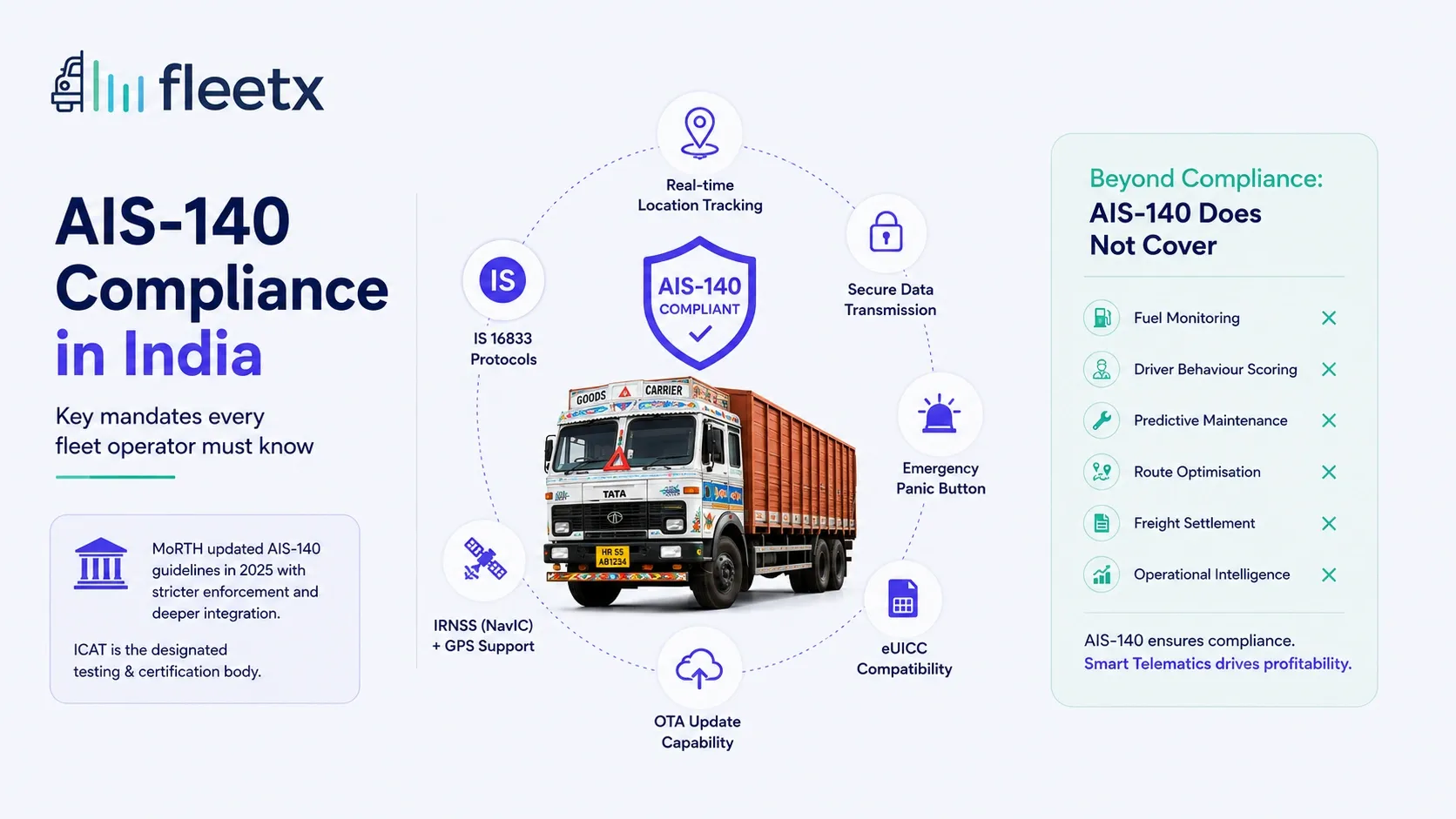
What AIS-140 Mandates
• A certified VLTD (Vehicle Location Tracking Device) in every commercial vehicle, including trucks, buses, and taxis
• Real-time location transmission to state transport server backends over standardised protocols
• An emergency panic button (for passenger-carrying vehicles) that triggers an automatic alert to the nearest police control room
• eUICC (embedded SIM) compatibility for seamless network switching without physical SIM replacement
• IS 16833-compliant communication protocols for device-to-server data exchange
• OTA (Over-The-Air) update capability for firmware maintenance without field visits
• IRNSS (NavIC) alongside GPS for improved India-specific positioning accuracy
MoRTH issued updated AIS-140 compliance guidelines in 2025 with stricter enforcement and deeper integration with state transport authority systems. ICAT (International Centre for Automotive Technology) is the designated testing and certification body. Full technical specifications are available at icat.in and the MoRTH official portal.
Beyond Compliance: What AIS-140 Does Not Cover
AIS-140 mandates location data transmission. It does not mandate - or even enable - fuel monitoring, driver behaviour scoring, predictive maintenance, route optimisation, freight settlement, or any of the operational intelligence that drives fleet profitability. Operators who treat AIS-140 fitment as a completed telematics deployment are leaving significant operational value on the table.
The DPIIT's National Logistics Policy identifies limited technology adoption among small and mid-size fleet operators as a key structural barrier to India's logistics efficiency. The policy sets an explicit target to reduce logistics cost as a percentage of GDP from 8 to 9% toward the global benchmark of 5 to 6% - a target that cannot be achieved through compliance tracking alone.
A Practical Buyer's Framework: 10 Questions Before You Sign
With dozens of vehicle telematics companies competing for business in India, vendor selection is a high-stakes decision that deserves a structured evaluation process. Here are the ten questions that surface the differences that actually matter at the operational level.
- Does it cover your entire freight movement, including contracted and spot-market trucks without GPS devices? A platform that integrates FASTag data, SIM-based tracking, and carrier-reported updates alongside owned vehicle GPS creates genuine end-to-end visibility.
- Is the hardware ICAT-certified for AIS-140? Ask for the certification number and verify it directly. Non-certified hardware creates compliance risk at fitness renewal.
- What is the actual GPS ping interval? 'Real-time' means different things to different vendors. For active dispatch management, you need updates every 30 to 60 seconds. Ask for the default and whether it is configurable.
- How does the system handle network gaps? Devices should buffer data locally and upload complete trip logs when connectivity resumes, with no data loss. Ask to see the data continuity policy.
- What ERP, WMS, and TMS integrations are pre-built? A telematics platform without enterprise integration creates a data silo. Ask for the vendor's API documentation and a list of live integrations with systems you already use.
- How is freight settlement handled? Does the platform generate GPS-validated trip records that can be used directly for carrier invoice reconciliation? If not, you are solving half the problem.
- What is the implementation timeline and field installation process for your fleet size? Large fleet deployments require vehicle downtime planning, field technician scheduling, and quality control. Ask for a detailed project plan.
- How is driver data privacy managed? Transparent scoring, driver access to their own data, and coaching-first policies reduce labour relations friction. Ask for the vendor's data governance policy.
- What does the support model look like in Year 2 and Year 3? Hardware replacement, SIM management, firmware updates, and platform support after initial deployment are where many vendor relationships deteriorate. Ask for SLA documentation.
- What is the total cost of ownership across 36 months, including all components? Get a line-by-line breakdown: hardware, connectivity, platform, installation, support. Compare it against a realistic ROI projection based on your current fuel spend, maintenance budget, and freight dispute frequency.
The Future of Vehicle Telematics: What Is Coming in India
The next phase of the vehicle telematics system in India market will be defined by four converging developments that will reshape both the technology and the competitive landscape.
Satellite-Based Toll Collection and Mandatory OBU Fitment
The Government of India has announced plans to transition from FASTag to a satellite-based toll collection system for trucks and buses by 2026 to 2027. This requires all commercial vehicles to carry onboard units (OBUs) capable of GPS-based distance tracking for per-kilometre toll calculation. When implemented, this effectively mandates a new layer of telematics hardware across India's 12.5 million commercial vehicles — creating the largest single hardware deployment event in Indian fleet technology history and a massive demand surge for integrated platform solutions.
AI Agents Replacing Human Dispatch Coordination
The trajectory of platforms like Fleetx points toward a future where the majority of routine fleet decisions - trip assignment, route selection, load planning, exception follow-up, freight settlement - happen autonomously through AI agents, with humans managing by exception rather than by active coordination. This shift is already underway for large enterprise fleets. It will reach mid-market fleets of 20 to 100 vehicles within three to five years as platforms mature and implementation costs decline.
EV Fleet Telematics
As electric commercial vehicles enter India's fleet market in meaningful numbers, telematics vehicle tracking systems must evolve to address battery-specific monitoring: state of charge, charging behaviour analytics, range prediction under varying load and temperature conditions, and integration with public charging infrastructure. Fleet operators transitioning to EV will need platforms that handle both conventional and electric vehicles in a unified dashboard - a capability gap that is already creating differentiation among forward-looking vendors.
Usage-Based Insurance
Indian insurers are beginning to offer UBI (usage-based insurance) programmes that set commercial vehicle premiums based on actual driving behaviour captured through telematics. Fleets with strong driver safety scores and verifiable accident history data are already accessing meaningful premium reductions. As UBI becomes more widespread, the telematics platform becomes a financial instrument as much as an operational one - directly reducing a major cost line for every connected vehicle.
Multi-Modal and Cross-Border Visibility
India's ULIP (Unified Logistics Interface Platform), operated by DPIIT, recorded over 100 crore API transactions in March 2025 - a sign of genuine digital integration momentum across modes. As rail, port, and road data converge on unified platforms, telematics systems that can ingest multi-modal data and present a single shipment view across all movement legs will deliver substantially higher value than single-mode trackers.
The Visibility Gap Is a Choice, Not a Condition
India's $157 billion road freight sector does not have a volume problem. It has a visibility problem. And that visibility problem is not structural - it is a technology adoption gap that narrows every year as platforms become more capable, more accessible, and faster to deploy.
A vehicle telematics system, at its most basic level, tells you where your trucks are. At its most advanced - the level that platforms like Fleetx operate at - it tells you where they should be, how efficiently they got there, whether the freight was delivered correctly, whether the driver drove safely, whether the engine needs attention, and what the whole operation will cost before the invoice arrives.
The fleet operators who understand this distinction - between compliance tracking and operational intelligence - are the ones building durable cost and service advantages in India's most competitive logistics markets. The operators who do not are losing money that a vehicle telematics system would have saved.
95% of India's fleet management market is untapped. The operators who move first build the largest advantages - Airtel Business, April 2026
Frequently Asked Questions
The best vehicle telematics system is one that goes beyond GPS tracking and delivers real-time operational intelligence. Indian fleet operators should look for features like live truck tracking, AI-powered route optimisation, fuel monitoring, driver behaviour analysis, predictive maintenance, geofencing, dashboard reporting, and ERP or TMS integration. For companies operating across Delhi NCR, Gurgaon, Mumbai, Pune, Chennai, Bengaluru or pan-India routes, a cloud-based platform offers greater visibility and scalability than standalone GPS devices. Enterprises should also verify AIS-140 compatibility, API integrations, uptime, customer support, analytics capabilities, and reporting before making a decision. The ideal solution depends on fleet size, cargo type, compliance requirements, and operational complexity rather than simply choosing the cheapest option.
Vehicle telematics system prices in India vary depending on hardware, software features, sensors, and subscription plans. A basic GPS tracking solution generally costs between ₹3,000 and ₹7,000 per vehicle, while AI-powered telematics platforms typically range from ₹8,000 to ₹20,000+ for hardware, along with monthly software subscriptions ranging from approximately ₹300 to ₹1,500 per vehicle. Large enterprises in Delhi, Gurgaon, Mumbai, Ahmedabad and Hyderabad often negotiate customised pricing for fleets of hundreds or thousands of trucks. Additional modules such as AI dashcams, fuel sensors, tyre pressure monitoring, cold-chain temperature sensors and predictive maintenance may increase the overall investment but usually deliver significant operational savings.
A GPS tracker primarily answers one question: where is the vehicle? A vehicle telematics system answers much more. It provides location, driver behaviour, fuel usage, idle time, route deviations, engine diagnostics, maintenance alerts, trip history, compliance reports, and AI-generated operational insights. Many Indian transport companies initially install GPS devices to satisfy AIS-140 compliance requirements, but later upgrade to full telematics platforms to improve profitability and customer service. Businesses moving freight between Delhi, Mumbai, Jaipur, Surat, Chennai and Bengaluru increasingly rely on telematics because operational visibility directly impacts delivery performance and fuel costs.
A complete telematics platform is not legally mandatory for every commercial vehicle, but AIS-140 certified Vehicle Location Tracking Devices are mandatory for several commercial vehicle categories in India. However, AIS-140 compliance only fulfils regulatory requirements and does not provide advanced fleet intelligence. Many logistics companies, manufacturers and transporters operating in Gurgaon, Delhi, Mumbai and other logistics hubs voluntarily deploy advanced telematics platforms to reduce fuel theft, improve fleet utilisation, increase safety and automate dispatch operations.
Almost every fleet-intensive industry benefits from telematics, but the highest returns are typically seen in logistics, 3PL, FMCG distribution, cement, mining, steel, pharmaceuticals, construction, oil and gas, employee transportation, school buses and cold-chain logistics. Companies with frequent inter-city operations between Delhi, Gurgaon, Mumbai, Pune, Nagpur, Hyderabad and Kolkata often save considerably on fuel, maintenance and delivery delays. Fleets transporting high-value or temperature-sensitive cargo especially benefit from continuous visibility and automated alerts.
Instead of comparing only hardware prices, evaluate the overall platform. Look for AI-powered analytics, cloud dashboards, mobile applications, predictive maintenance, fuel monitoring, driver scoring, live support, implementation capability, API integrations, data security, customer references and scalability. Ask whether the provider serves enterprise fleets across India and whether they can support operations in Delhi NCR, Mumbai, Chennai, Bengaluru and remote transport corridors. Choosing the right implementation partner is often more valuable than selecting the lowest-priced device.
Yes. Modern SaaS pricing has made vehicle telematics accessible even for fleets with five to twenty trucks. Many providers offer subscription-based pricing that eliminates heavy upfront software investments. Small fleet owners operating in Delhi, Gurgaon, Mumbai, Lucknow, Jaipur and Indore often start with GPS tracking and later expand into AI dashcams, fuel monitoring and fleet analytics as their business grows. Even a modest reduction in fuel wastage, idle time or route deviations can recover the investment relatively quickly.
Yes. One of the biggest benefits of telematics is improved fuel management. The system identifies excessive idling, harsh acceleration, overspeeding, route deviations, unauthorised fuel fills and possible fuel theft. Managers can compare driver performance and optimise routes using actual operational data instead of assumptions. For transport companies running long-haul freight between Delhi, Mumbai, Ahmedabad, Chennai and Bengaluru, even a small percentage improvement in fuel efficiency can translate into substantial annual savings across the fleet.