
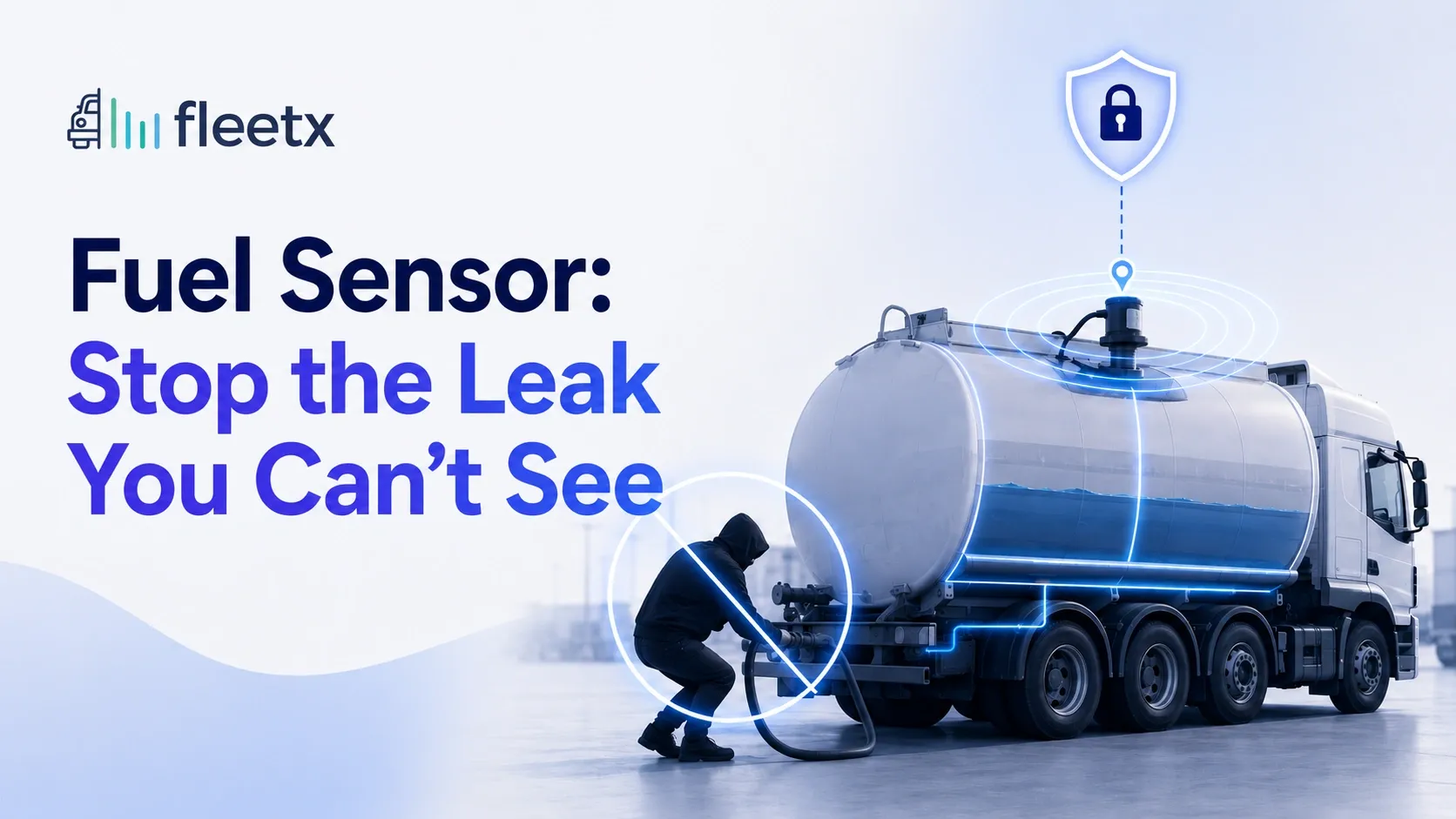
Picture a forty-foot diesel tanker leaving a depot at full tank, headed for a delivery six hours away. Somewhere on that route, a length of rubber pipe gets pushed into the tank, and over twenty minutes, sixty litres quietly disappear into a jerry can on the side of the highway. The trip sheet still says full tank at departure and a reasonable level at arrival. Nobody questions it. Nobody can, because nobody was watching the tank in between.
This is the exact gap a fuel sensor is designed to close. It is one of the smallest pieces of hardware in a vehicle, often no bigger than a tube the length of a forearm, yet it sits at the center of one of the largest cost lines in any transport business. Diesel and petrol typically account for a third to nearly half of total fleet operating cost, which means a problem hiding inside the fuel tank is rarely a small problem.
This guide covers the subject from every angle a buyer or fleet manager actually needs: what a fuel sensor is, how it works, what the different types cost in the real market including current fuel sensor price in India ranges, how a fuel sensor for trucks price is actually built up, and how real fleets are using sensor data to stop theft within seconds rather than discovering it months later. Wherever it is relevant, the guide also pulls in deployment data from Fleetx, whose fuel monitoring platform processes data from sensors installed across thousands of commercial vehicles and heavy equipment.
One thing worth setting straight before going further: a fuel sensor is not a luxury add-on reserved for large corporate fleets with dedicated technology budgets. It is closer to a basic accounting control, the same category of tool as a cash register or an invoice ledger, except applied to a liquid asset that is far easier to siphon, dilute, or misreport than cash ever was. Any business running even a handful of diesel or petrol powered vehicles is, in effect, managing a moving inventory of fuel that needs the same discipline applied to any other valuable, depletable asset.
What Is a Fuel Sensor and What Does the Term Actually Mean?
In plain terms, the fuel sensor meaning comes down to this: it is a small electronic device fitted inside or alongside a vehicle's fuel tank that continuously measures how much fuel is present and sends that reading to a display, a control unit, or a remote monitoring platform. It is the component standing between a guess and a fact when someone asks how much fuel is actually in a tank right now.
The simplest version of this technology has existed for almost as long as the automobile itself, in the form of the float-and-resistor mechanism behind a car's dashboard fuel gauge. What has changed dramatically over the last decade is precision, connectivity, and the ability to detect not just how much fuel exists, but exactly when, where, and how a sudden change in that level occurred. That shift, from a dashboard gauge to a connected monitoring device, is what turned the fuel sensor from a convenience feature into a fleet management tool.
It is also worth being precise about terminology, since the market uses several names interchangeably. A fuel level sensor, fuel sender unit, and fuel gauge sending unit generally refer to the same category of device, while a fuel flow sensor is a related but distinct technology that measures the rate of fuel passing through a line rather than the static level inside a tank. Both fall under the broader category of fuel monitoring hardware, and serious fleet platforms typically use level sensors as the primary theft and consumption detection tool because they directly observe what is inside the tank rather than inferring it from engine behavior.
How Does a Fuel Sensor Actually Work?
Understanding the fuel sensor working principle matters because it explains why some sensors are far more reliable than others, and why a cheap sensor can quietly cost a fleet more in false alarms and missed theft than it saves in upfront price.
Most fuel sensors used in commercial fleets today rely on one of four core measurement principles.
Capacitive sensing
A capacitive fuel sensor uses two metal plates submerged inside the tank, separated by a small gap. Fuel and air have different electrical properties, called dielectric constants, so as the fuel level rises or falls between the plates, the capacitance of the assembly changes in a measurable, predictable way. This change is converted into a fuel level reading and transmitted as an analog or digital signal. Capacitive sensors are the dominant choice for commercial vehicles because they have no moving parts to wear out, which makes them durable on rough roads and resistant to vibration-related failure.
Ultrasonic sensing
An ultrasonic fuel sensor is typically mounted on the outside or top of the tank and measures fuel level by sending a sound wave downward and timing how long it takes to bounce back off the fuel surface. Because it does not need to be submerged in fuel, it is easier to retrofit onto certain tank shapes, though it can be more sensitive to foaming, sloshing, or unusual tank geometry.
Resistive or float-based sensing
This is the older, simpler mechanism still found in many passenger vehicles and some basic commercial setups, where a float connected to a variable resistor rises and falls with the fuel level, changing the electrical resistance read by the gauge. It is inexpensive but mechanically wears out over time and offers lower precision than capacitive or ultrasonic alternatives.
Hydrostatic or pressure-based sensing
A hydrostatic sensor calculates fuel level indirectly by measuring the pressure exerted by the column of fuel above it, since a taller column of liquid exerts more pressure at the bottom of the tank. This method works well for tall, narrow tanks such as those on stationary storage units or larger trucks.
|
Sensor Type |
Core
Mechanism |
Typical
Accuracy |
Best Suited
For |
|
Capacitive |
Measures change
in capacitance between two plates as fuel level changes |
Within 1 to 2% |
Trucks, buses,
construction equipment, tankers |
|
Ultrasonic |
Times a sound
wave reflecting off the fuel surface |
Within 2 to 3% |
Tanks where
submersion is difficult, irregular shapes |
|
Resistive
(float) |
Mechanical
float moves a resistor as level changes |
Within 5 to 10% |
Passenger cars,
light commercial vehicles, low-budget setups |
|
Hydrostatic
(pressure) |
Calculates
level from fluid pressure at the tank base |
Within 2 to 4% |
Tall storage
tanks, stationary diesel generators |
Once the raw level reading is captured, a GPS-enabled fuel monitoring system pairs it with location, timestamp, and vehicle speed data, then applies algorithms to separate genuine refuelling and consumption from sudden, unexplained drops that indicate theft or pilferage. This pairing of raw sensor data with contextual intelligence is really where the value of a modern system lives, since the sensor alone only tells you a number, not what that number means.
What Types of Fuel Sensors are Commonly Used in Vehicles?
Beyond the core measurement principle, fuel sensors are also categorized by how they are installed and what kind of output they produce, and this distinction matters a great deal when comparing products in the market.
• Inbuilt or OEM sensors: fitted by the vehicle manufacturer and usually feeding only the dashboard gauge, with limited or no connectivity to external monitoring systems.
• Aftermarket capacitive sensors: installed after purchase, specifically for fleet monitoring, typically connected to a GPS tracking device that relays data to a central dashboard.
• Analog output sensors: transmit a continuous voltage or current signal, simple to integrate but more prone to electrical noise over long cable runs.
• Digital or RS485 output sensors: transmit data in a structured digital format, offering more stable, noise-resistant readings, particularly valuable on larger vehicles with longer wiring distances between the tank and the control unit.
For a fleet manager comparing options, the practical rule of thumb is straightforward: an OEM dashboard gauge is built for the driver's convenience, not for fleet-level theft detection or reporting, and should never be relied upon as the sole data source for any business serious about controlling fuel cost.
What Myths Get in the Way of Buying a Fuel Sensor?
A surprising number of fleet owners delay this purchase for years based on assumptions that simply do not hold up once examined.
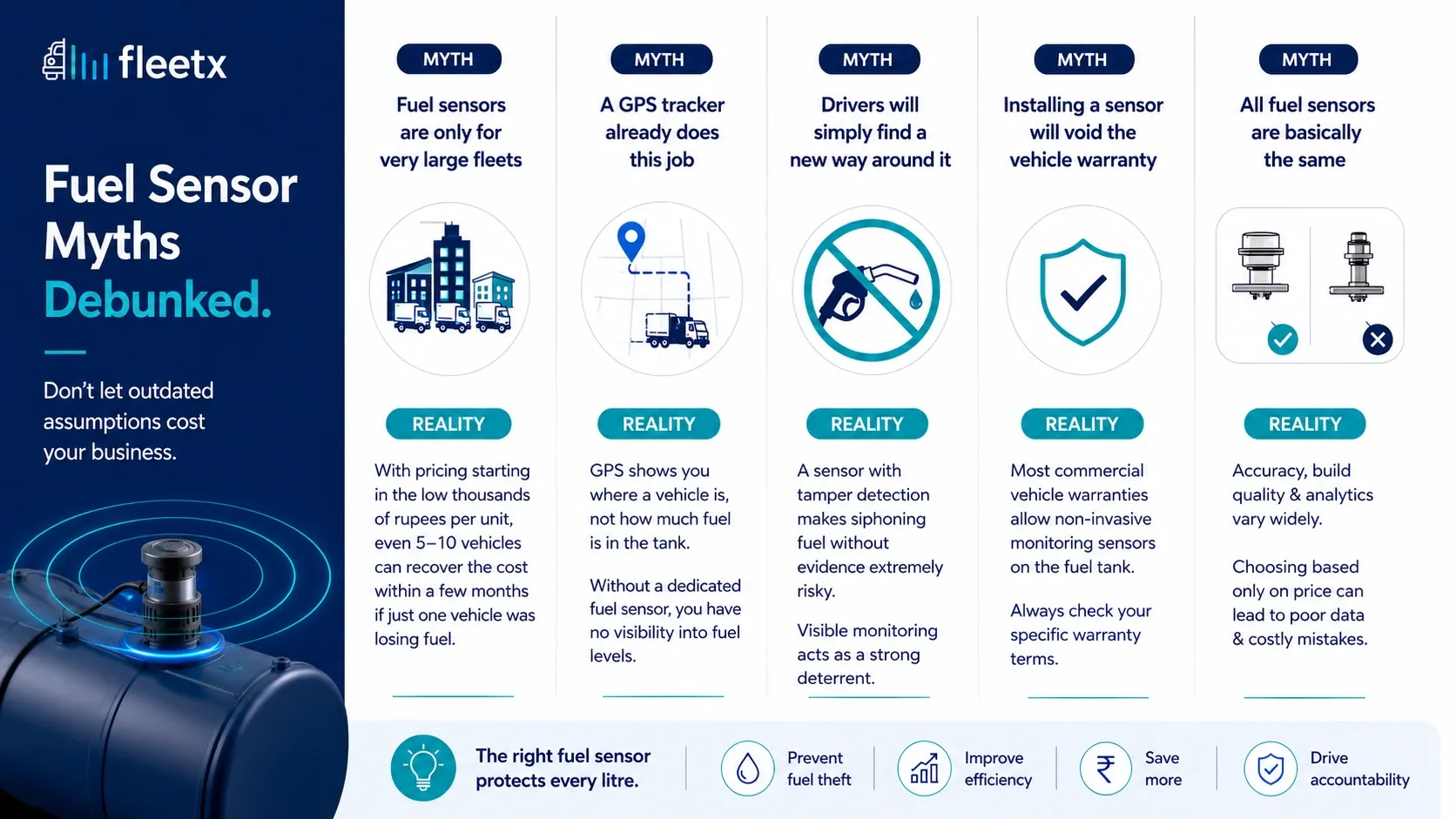
Myth: fuel sensors are only for very large fleets
This belief probably made sense a decade ago when hardware and platform costs were higher, but with current pricing starting in the low thousands of rupees per unit, even a five or ten vehicle operation can recover the cost within a few months if even one vehicle was previously experiencing undetected pilferage.
Myth: a GPS tracker already does this job
A standard GPS tracker tells you where a vehicle is. It says nothing about how much fuel is in the tank unless a dedicated fuel sensor is wired into the same system. Many fleet owners discover this gap only after a theft incident, when they realize their tracking data shows the vehicle's location perfectly but has no record of the fuel level at all.
Myth: drivers will simply find a new way around it
It is true that no single device makes theft physically impossible. What a properly installed sensor with tamper detection does is remove the ability to siphon fuel without immediate, logged evidence, which changes the economics of theft from low-risk to high-risk for the person attempting it. In practice, the presence of visible monitoring is itself a meaningful deterrent, independent of how many actual thefts get caught after installation.
Myth: installing a sensor will void the vehicle warranty
This concern is occasionally valid for certain manufacturer warranty terms, but most commercial vehicle warranties distinguish between modifications to the engine or drivetrain and the addition of a non-invasive monitoring sensor to the fuel tank. It is worth checking the specific warranty document, but this should not be treated as a blanket reason to avoid fuel monitoring altogether.
Myth: all fuel sensors are basically the same
This is perhaps the most expensive myth on this list, because it pushes buyers toward comparing only the sticker price rather than accuracy, build quality, and the strength of the analytics layer behind the hardware. Two sensors that look identical on a spec sheet can produce very different real-world outcomes once installed, particularly in how well each one tells a genuine theft event apart from ordinary road vibration.
How Much Does a Fuel Sensor Cost?
This is, understandably, the question most buyers actually want answered first, and the honest answer is that fuel sensor price varies widely depending on sensing technology, accuracy rating, output type, and whether GPS integration and a monitoring dashboard are bundled in or sold separately.
Based on current market listings across India's major industrial supply platforms, here is a realistic breakdown of fuel sensor price in India by category.
|
Sensor
Category |
Typical
Price Range (INR) |
What You
Are Paying For |
|
Basic float or
resistive sensor |
Rs 550 to Rs
2,500 |
Entry-level
accuracy, no GPS integration, manual reading only |
|
Standard
capacitive sensor (sensor only) |
Rs 3,500 to Rs 7,500 |
Better
accuracy, suitable for GPS pairing, no bundled hardware |
|
Capacitive
sensor with GPS device bundle |
Rs 10,000 to Rs
15,000 |
Sensor plus
tracking hardware, basic dashboard access |
|
High-accuracy
industrial-grade sensor |
Rs 15,000 to Rs
20,000+ |
Precision
suited for tankers, construction equipment, audit-grade reporting |
It is worth treating these numbers as directional rather than fixed, since pricing shifts with order volume, brand, warranty length, and ongoing platform or subscription fees that some vendors bundle separately from the hardware itself. A genuinely useful comparison should always include the total cost of ownership, meaning hardware, installation, calibration, and any recurring software fee, rather than comparing the sensor price in isolation.
What Determines the Fuel Sensor for Trucks Price?
Trucks present a different pricing equation than passenger vehicles because tank size, mounting depth, and operating conditions are far more demanding. A fuel sensor for trucks price is shaped by several specific factors that buyers should evaluate before comparing quotes.
• Tank depth and probe length: larger truck and tanker tanks need a longer capacitive probe, which directly increases material cost and, in some cases, requires a custom-cut sensor.
• Number of tanks per vehicle: trucks with dual saddle tanks need two synchronized sensors rather than one, roughly doubling the hardware cost for that vehicle.
• Output and connectivity type: RS485 digital sensors generally cost more than basic analog sensors but offer materially better reliability for the long cable runs typical in heavy trucks.
• Build quality and certification: sensors designed for harsh vibration, temperature extremes, and rough terrain typically carry a premium over sensors built for lighter-duty use.
• Bundled GPS hardware and platform fees: many vendors price the sensor as part of a package with a GPS tracking unit and a monthly software subscription, which changes the comparison from a one-time hardware cost to a blended cost over the contract period.
For a transport company evaluating multiple vendor quotes for a fuel sensor truck rollout across a fleet, the most reliable comparison method is to calculate cost per vehicle per year, including hardware amortized over its expected lifespan plus any subscription fee, rather than comparing the upfront unit price alone. A slightly more expensive sensor with a five-year service life and stable digital output is almost always cheaper over time than a low-cost analog sensor that drifts out of calibration within eighteen months.
How Do You Calculate Real ROI on a Fuel Sensor Investment?
Vendors routinely quote percentage savings figures, but a fleet manager presenting a business case to finance needs an actual worked number, not a generic claim. The calculation is simpler than it looks once the inputs are laid out clearly.
|
Input |
Example
Value |
|
Fleet size |
50 trucks |
|
Average monthly
fuel spend per truck |
Rs 1,20,000 |
|
Total monthly
fleet fuel spend |
Rs 60,00,000 |
|
Estimated theft
and pilferage loss (10% of spend, a conservative industry estimate) |
Rs 6,00,000 per
month |
|
Sensor and GPS
bundle cost per vehicle |
Rs 12,000 one
time |
|
Total hardware
cost for 50 vehicles |
Rs 6,00,000 one
time |
|
Monthly
platform or subscription fee (illustrative) |
Rs 500 per
vehicle, Rs 25,000 for fleet |
|
Conservative
theft reduction after deployment (50% of prior loss recovered) |
Rs 3,00,000
saved per month |
Using these illustrative numbers, the one-time hardware investment of six lakh rupees is recovered in exactly two months purely from theft reduction, before even accounting for additional savings from reduced idling, better driving behavior, and fewer disputed fuel card transactions. This is consistent with industry-wide reports that most fleets recover their fuel monitoring investment within six to eighteen months, depending on fleet size and the severity of prior fuel theft.
The most important variable in this calculation is the starting assumption about theft and pilferage as a percentage of fuel spend. A fleet with strong existing manual controls might start closer to three to five percent leakage, while a fleet with minimal oversight, multiple owner-operators, and long unsupervised routes can see this figure run considerably higher. Running the actual audit recommended earlier in this guide, rather than relying on an industry average, produces a far more credible number for an internal business case.
Why Do Commercial Truck Fleets Need Fuel Sensors So Badly?
Fuel is consistently the single largest controllable operating cost for a commercial fleet, often outweighing driver wages, tolls, and maintenance combined. According to the United States Energy Information Administration's data on diesel pricing, diesel prices have shown sustained volatility over the past several years, which means even small percentage losses to theft or inefficiency compound into significant absolute cost as fuel prices rise.
For a heavy commercial truck running long-haul routes, the opportunities for fuel loss are numerous and often invisible without a sensor in place.
• Stationary theft: fuel siphoned from a parked truck overnight or during an extended halt, often through a hose inserted into the tank cap.
• In-transit pilferage: a slower, more deliberate form of theft where small amounts are drained gradually during a trip, designed specifically to stay under the radar of basic monitoring.
• Excessive idling: drivers leaving the engine running during long loading or unloading waits, particularly in hot or cold climates, which burns fuel without producing any distance traveled.
• Inflated trip sheets: manual fuel logs that overstate consumption to cover for diverted fuel, which is extremely difficult to catch without an independent sensor-based record.
• Inefficient driving behavior: harsh acceleration, overspeeding, and poor gear usage that increase fuel burn without any single driver realizing the cumulative cost.
The common thread across all five is that none of them are visible from a paper logbook or an end-of-month fuel bill. They only become visible when fuel level is tracked continuously, in real time, against location and vehicle activity, which is precisely what a properly installed fuel sensor enables.
What Does a Month Without Fuel Monitoring Actually Cost a Fleet?
It helps to make this concrete rather than abstract. Take a mid-sized fleet of thirty trucks running long-haul routes, spending roughly thirty-five lakh rupees a month on diesel combined. Without any sensor-based monitoring, the fleet manager's only real signal that something is wrong is a mileage figure that looks slightly worse than expected, or a driver complaint about running low on a route that should have had plenty of fuel left.
Neither signal arrives quickly, and neither points to a specific cause. A mileage dip could mean theft, could mean a tyre pressure issue, could mean a new driver with heavier acceleration habits, or could simply mean a stretch of hilly terrain on a particular route. Without sensor data to separate these possibilities, the investigation typically defaults to asking the driver directly, which rarely produces an honest answer if theft is actually the cause.
Run this same fleet for a month with fuel sensors installed, and the picture changes entirely. A sudden eighteen-litre drop on truck fourteen, recorded at 2 a.m. outside a known halt point with no corresponding distance covered, becomes a specific, time-stamped, location-tagged incident rather than a vague suspicion. A pattern of gradual, below-average mileage across three specific drivers becomes a targeted coaching conversation rather than a fleet-wide guess. The underlying fuel spend has not changed, but the fleet manager's ability to act on it has changed completely, and that difference compounds every single month the system stays in place.
What Problems Does a Fuel Sensor Solve Beyond Just Catching Theft?
Theft prevention tends to dominate the conversation because it is the most dramatic use case, but a well-implemented fuel sensor delivers value across several other areas that often add up to a larger total saving than theft recovery alone.
|
Problem |
How a Fuel
Sensor Helps |
|
Inaccurate fuel
budgeting |
Provides exact
consumption per vehicle and per route instead of relying on average estimates |
|
Unverified fuel
card transactions |
Cross-checks
reported fuel fills against actual tank level increase to catch invoice
padding |
|
Vehicle and
driver performance gaps |
Surfaces which
vehicles or drivers consistently consume more fuel per kilometer than the
fleet average |
|
Route planning
blind spots |
Identifies
routes with unusually high consumption that may indicate poor road conditions
or inefficient paths |
|
Maintenance
scheduling |
Flags vehicles
with rising fuel consumption trends that often precede a mechanical issue,
such as injector wear |
|
Heavy equipment
fuel waste |
Tracks
engine-hour based consumption for stationary equipment like generators and cranes,
not just moving vehicles |
That last point on heavy equipment is often overlooked. A diesel generator or a crane running continuously at a construction site burns fuel based on engine hours rather than distance, and without sensor-based monitoring, fuel waste on this kind of equipment frequently goes completely untracked, simply because nobody is checking a vehicle that never leaves the site.
How Is Raw Fuel Sensor Data Turned Into Actionable Fleet Intelligence?
A fuel sensor on its own only produces a stream of numbers. The real operational value appears once that stream is processed, contextualized, and turned into alerts and reports a fleet manager can actually act on. This is also the point where the difference between a basic sensor vendor and a true fuel monitoring platform becomes obvious, since the hardware itself is fairly commoditized while the intelligence layer built on top of it is where most of the genuine differentiation, and most of the actual savings, actually live.
Anomaly detection separates real theft from noise
Raw sensor readings naturally fluctuate due to vehicle tilt, road vibration, and temperature changes affecting fuel density. A mature monitoring platform applies algorithms that distinguish this normal noise from a genuine theft event, since flagging every minor fluctuation as a theft alert quickly trains fleet managers to ignore the system altogether.
Location tagging turns a number into an investigation lead
A sudden fuel drop becomes far more useful once it is paired with GPS coordinates, a timestamp, and the driver assigned to the vehicle at that moment. Instead of a vague suspicion, the fleet manager gets a specific, defensible record: this vehicle lost this many litres, at this exact location, at this exact time, under this driver's watch.
Pattern analysis catches slow, deliberate pilferage
The most sophisticated theft is rarely a single dramatic drop. It is a gradual drain over an extended period, deliberately designed to look like normal consumption. Detecting this requires comparing actual consumption against an expected baseline calculated from route, load, and vehicle type, which is a level of analysis a basic dashboard gauge simply cannot perform.
Reconciliation closes the loop on fuel card fraud
When fuel card transaction data is matched automatically against the actual rise in tank level recorded by the sensor at the same station and time, discrepancies between what was paid for and what was actually delivered into the tank become immediately visible, removing a common channel for invoice-based fraud.
What Should You Check Before Buying a Fuel Sensor?
With dozens of vendors offering similar-sounding specifications, a structured evaluation checklist prevents an expensive mistake. Most buyers compare two or three quotes side by side based on price alone, then discover months later that the cheaper option lacked tamper detection, had no clear calibration process, or simply could not integrate with the GPS hardware already installed across the fleet. The checklist below is built specifically to surface those gaps before a contract is signed rather than after.
• Accuracy rating under real conditions, not just the lab-tested figure, since vibration and temperature swings on actual roads often degrade accuracy below the advertised number.
• Sensor material and build quality, particularly corrosion resistance for sensors that will sit submerged in diesel for years.
• Compatibility with existing GPS and telematics hardware, so the sensor does not require a complete rip-and-replace of equipment already installed across the fleet.
• Tamper and disconnect alerts, since a sensor that silently stops reporting when someone disconnects it provides zero protection exactly when protection is needed most.
• Warranty period and after-sales support, because a sensor failure six months after installation with no support channel effectively wastes the entire investment.
• Calibration process and frequency, since even good sensors drift slightly over time and need periodic recalibration to maintain accuracy.
It also helps to ask any vendor directly how their system tells the difference between a real theft event and a false positive caused by the truck going over a pothole or climbing a steep incline. A vendor without a clear, specific answer to that question is likely selling a sensor, not a monitoring system.
How Does Fuel Sensor Installation Actually Work?
Installation is a more involved process than many first-time buyers expect, and rushing it is one of the most common reasons a fleet later experiences inaccurate readings.
• Tank inspection: the installer first checks tank shape, depth, and material to confirm the correct probe length and sensor type for that specific vehicle.
• Drilling and mounting: a precisely sized opening is made in the tank to fit the sensor housing, sealed to prevent any leakage or contamination.
• Wiring and connection: the sensor is wired either directly to a GPS tracking unit or to an intermediate data logger, depending on the chosen architecture.
• Initial calibration: the sensor's raw output is mapped against the actual known volume of the tank at multiple fill levels, since tank shape is rarely a perfect cylinder and a flat conversion formula would produce inaccurate readings.
• Final testing: the installer verifies that readings update correctly during a controlled fuel fill and drain test before signing off on the installation.
Skipping or rushing the calibration step is the single most common cause of buyer complaints about inaccurate fuel sensors, far more often than an actual hardware defect. A sensor calibrated against a generic formula rather than the specific tank's true volume curve will show consistent, predictable looking errors that can be mistaken for theft or, worse, mask real theft underneath the noise.
How Long Does a Fuel Sensor Last and What Maintenance Does It Need?
A capacitive sensor with no moving parts, properly installed and protected from physical damage, typically lasts five to seven years under normal commercial operating conditions, though this varies with fuel quality, vibration exposure, and how often the tank is opened for other servicing.
• Periodic recalibration: recommended roughly once a year, or sooner if readings start showing a consistent offset against manual dipstick checks.
• Visual inspection during routine servicing: checking the sensor housing and wiring connections whenever the vehicle is already in for scheduled maintenance avoids a separate dedicated visit.
• Fuel quality monitoring: contaminated or adulterated fuel can accelerate sensor wear and produce unreliable readings, which is itself often a signal worth investigating separately.
• Software and firmware updates: for sensors paired with a digital monitoring platform, keeping the connected software current ensures continued compatibility and access to improved anomaly detection algorithms as they are released.
Budgeting for this ongoing maintenance, rather than treating the sensor as a single fixed purchase, is what separates fleets that get five or more years of reliable service from fleets that experience a slow decline in accuracy and eventually stop trusting the system altogether.
What Mistakes Do Fleets Make When Choosing or Installing Fuel Sensors?
• Buying purely on the lowest upfront price, which often means accepting a basic resistive sensor with accuracy too poor to reliably distinguish theft from normal fluctuation.
• Skipping proper calibration after installation, leading to systematic errors that erode trust in the entire monitoring system within the first few months.
• Ignoring tamper protection, which leaves an obvious loophole for any driver determined to disconnect the sensor before draining fuel.
• Treating the sensor as a one-time purchase rather than budgeting for periodic recalibration and occasional replacement as part of ongoing fleet maintenance.
• Not training fleet staff on how to interpret alerts, resulting in a system that generates useful data nobody actually reviews or acts on.
• Mixing incompatible hardware across the fleet without standardizing on a small number of sensor models, which complicates maintenance, spare parts, and staff training over time.
Most of these mistakes share a root cause: treating the fuel sensor purely as hardware rather than as the foundation of an ongoing data discipline. The hardware is necessary but not sufficient on its own.
How Does a Fuel Sensor Compare to Other Fuel Theft Prevention Methods?
Fuel sensors are not the only tool fleets use to control fuel loss, and it helps to see where they sit relative to the older, more manual approaches many operators still rely on.
|
Method |
How It
Works |
Key
Limitation |
|
Manual dipstick
checks |
Driver or
supervisor physically measures tank level with a stick or rod |
Infrequent,
easy to falsify, no time or location record |
|
Locking fuel
caps |
Physical lock
restricts access to the tank opening |
Determined
thieves can still drill, pick, or bypass the lock |
|
Trip sheet
reconciliation |
Manual
comparison of distance covered against fuel consumed |
Labor
intensive, detects loss only after the fact, easy to manipulate |
|
Fuel card
monitoring alone |
Tracks where
and when fuel purchases were made |
Says nothing
about whether that fuel actually reached the tank |
|
Fuel sensor with
GPS integration |
Continuous,
automated tank level tracking tied to location and time |
Requires proper
installation, calibration, and tamper protection to be fully effective |
The pattern across the first four methods is that they are either reactive, easily defeated, or both. A locked fuel cap slows down an opportunistic thief but does little against someone with basic tools and enough time. A trip sheet reconciliation catches large, obvious discrepancies eventually, but by the time someone notices, the theft has often been running for weeks or months. A fuel sensor is the only method on this list that provides continuous, automated, time-stamped evidence rather than a periodic manual check, which is precisely why it has become the default standard for any fleet serious about controlling this cost.
Stop Fuel Theft Before It Hits Your Bottom Line
Detect fuel theft, pilferage, excessive idling, and inefficient fuel usage in real time. Fleetx automatically tracks every litre consumed, generates instant alerts, and helps reduce fleet fuel costs with AI-powered fuel intelligence.
How Does Fleetx Use Fuel Sensor Data to Catch Theft in Real Time?
Fleetx's fuel monitoring platform is a useful real-world reference point because it has processed an unusually large volume of live sensor data across commercial fleets and heavy equipment, which makes its detection patterns and outcomes more statistically reliable than a single anecdotal case.
Across its deployed base, Fleetx has processed over 200,000 hours of live fuel data and detected more than 35 million litres of fuel theft, generating over 60,000 fuel-related event alerts to date. On average, fleets using the platform have reported an 11 percent reduction in overall fleet fuel costs, alongside more than 18,000 litres saved specifically through reduced engine idling, and over 24,000 hours of fuel data tracked across construction machinery such as cranes and diesel generator sets.
What makes the detection approach notable is the speed and specificity of the alert. A sudden fuel drop while a vehicle is stationary is flagged with location, volume lost, and the assigned driver logged in under sixty seconds, turning what used to be a months-later discovery into an immediate, actionable event. The platform also separately classifies fuel pilferage, meaning the slower, deliberate draining pattern typically associated with a pipe inserted during transit, as a distinct event category from sudden stationary theft, since the two require different investigation and response approaches.
Real customer outcomes reinforce the scale of impact. One steel-transport operator running a 125-vehicle fleet reported curbing both pilferage and driver-led diesel theft after deployment, with daily reporting time dropping from three to four hours down to just thirty to thirty-five minutes, a direct result of no longer needing to manually cross-check trip sheets against fuel bills. A pan-India logistics operator similarly reported that real-time fuel level visibility and theft alerts replaced what had previously been a reactive, dispute-heavy process, translating directly into measurable fuel cost savings and improved company profitability.
|
Metric |
Fleetx
Platform Data |
|
Hours of live
fuel data processed |
200,000+ |
|
Litres of fuel
theft detected and reported |
35 million+ |
|
Fuel event
alerts fired to date |
60,000+ |
|
Average
reduction in overall fleet fuel cost |
11% |
|
Litres saved
through reduced engine idling |
18,000+ |
|
Hours of
construction machinery fuel data tracked |
24,000+ |
|
Theft alert
speed for stationary fuel drops |
Under 60
seconds |
Two design choices behind this kind of accuracy are worth calling out specifically. First, the algorithm is built to distinguish genuine theft from calibration drift, sensor noise, and vehicle tilt, which keeps false positives low enough that fleet managers continue to trust and act on every alert rather than tuning them out. Second, the platform is built for universal sensor compatibility with major capacitive and ultrasonic sensors already in the market, meaning a fleet does not need to rip out and replace existing hardware across a mixed fleet just to gain this level of monitoring.
Which Industries Depend Most Heavily on Fuel Sensor Technology?
While any diesel or petrol powered fleet benefits from fuel monitoring, the urgency and payback period differ sharply by sector, largely based on how much unsupervised running time a typical vehicle or asset accumulates.
|
Industry |
Why Fuel
Loss Risk Is High |
Typical
Sensor Priority |
|
Long-haul road
transport and logistics |
Extended
unsupervised routes, overnight halts at unfamiliar locations |
Dual capacitive
sensors on all line-haul trucks |
|
Construction
and mining |
Heavy equipment
running continuously at remote sites with limited supervision |
Engine-hour
based tracking on cranes, excavators, and generators |
|
Cement and bulk
material transport |
High vehicle
count, thin per-trip margins where small losses compound fast |
Fleet-wide
standardized sensors with centralized reporting |
|
Agriculture and
farm equipment |
Diesel-powered
tractors and pumps operating in open fields with little oversight |
Basic
capacitive sensors paired with simple alerting |
|
Oil, gas, and
field services |
High-value fuel
transport with strict chain-of-custody requirements |
High-accuracy
industrial-grade sensors with audit-ready reporting |
|
Public
transport and bus fleets |
Large
depot-based fleets refuelled by multiple staff across shifts |
Sensor data
reconciled against fuel card and pump transaction logs |
Construction and mining deserve particular attention because the assets involved, cranes, excavators, and diesel generator sets, often sit unattended for hours or days at a remote site, which makes them an easier target for theft than a truck that is actively being driven and observed. Tracking fuel by engine hours rather than distance is the detail that makes monitoring meaningful for this category, since a stationary generator running continuously can lose a significant volume of fuel without a single kilometer being recorded anywhere.
How Does Fuel Sensor Technology Compare Across Different Vehicle and Equipment Types?
Not every asset in a mixed fleet needs the same sensor configuration. Matching the right type of monitoring to the right asset class avoids both overspending on equipment that does not need precision tracking and underprotecting equipment that genuinely does.
|
Asset Type |
Recommended
Sensor Approach |
Primary
Monitoring Goal |
|
Long-haul
trucks and tankers |
Dual capacitive
sensors for saddle tanks, digital RS485 output |
Theft and
pilferage detection over long routes |
|
Light
commercial vehicles |
Single
capacitive sensor, analog or basic digital output |
Consumption
tracking and route efficiency |
|
Buses and passenger
transport |
Capacitive
sensor with idling and overspeeding alerts |
Driver behavior
and fuel cost control |
|
Construction
equipment (cranes, excavators) |
Capacitive
sensor with engine-hour based tracking |
Equipment
runtime fuel accounting |
|
Diesel generator
sets |
Hydrostatic or
capacitive sensor for stationary tanks |
Theft
prevention on unattended equipment |
|
Marine vessels |
Hydrostatic
sensor suited to tank shape and pressure range |
Long-duration
consumption tracking |
What Does the Future of Fuel Sensor Technology Look Like?
Tighter integration with AI-based driver coaching
Fuel sensor data is increasingly being combined with driving behavior data such as harsh braking and overspeeding to generate individualized driver coaching recommendations, rather than simply flagging theft after the fact.
Predictive consumption modeling
Rather than only reporting what happened, newer platforms are beginning to forecast expected fuel consumption for a planned route based on load, weather, and historical data, allowing fleet managers to flag a deviation the moment a trip starts running hotter than expected, instead of waiting until it is already complete.
Universal compatibility as a baseline expectation
As fleets increasingly run mixed hardware from different vendors accumulated over years of vehicle purchases, the ability for a monitoring platform to work with whatever capacitive or ultrasonic sensors are already installed, rather than forcing a complete hardware replacement, is becoming a baseline requirement rather than a competitive differentiator.
Regulatory alignment with vehicle tracking mandates
In India, fuel sensors are increasingly being bundled into broader vehicle tracking deployments aligned with the AIS-140 standard issued under the Ministry of Road Transport and Highways, since fleets already installing certified GPS tracking hardware for compliance are finding it operationally efficient to add fuel monitoring at the same time rather than as a separate later project.
Emissions and sustainability reporting
As more businesses face pressure to report carbon emissions across their logistics operations, accurate fuel consumption data per vehicle and per route is becoming a direct input into emissions calculations rather than a separate cost-only metric. A fuel sensor that was originally installed purely for theft prevention is increasingly doing double duty as the data source behind a company's sustainability reporting, which adds another layer of return on an investment that may have been justified on cost grounds alone.
How Should a Fleet Get Started With Fuel Sensors Today?
• Audit current fuel loss first, by comparing fuel card spend against actual distance covered for at least one full month, to establish a realistic baseline before evaluating any vendor.
• Prioritize the highest-risk vehicles, typically long-haul trucks and tankers running overnight halts, rather than installing sensors fleet-wide on day one.
• Insist on a calibration plan, not just a sensor purchase, and confirm in writing how and how often recalibration will happen.
• Test the alert accuracy before full rollout, by running a pilot on a small number of vehicles and tracking how many alerts turn out to be genuine versus false positives.
• Train dispatchers and supervisors on response protocol, so a theft alert results in an immediate, defined action rather than simply sitting unread in a dashboard.
• Review savings data monthly, comparing fuel cost per kilometer before and after deployment to validate the investment with real numbers rather than assumptions.
A fuel sensor is a small piece of hardware solving a problem that is anything but small. Diesel and petrol remain the highest controllable cost most fleets carry, and the gap between guessing how much fuel is actually being used and knowing it with certainty is exactly the gap that separates a fleet quietly bleeding margin from one that has turned its biggest expense into its most closely managed asset. The technology to close that gap is mature, affordable relative to the savings it generates, and, as the deployment data throughout this guide shows, already proving itself across hundreds of thousands of vehicles every day.
The fleets that benefit most are rarely the ones with the most expensive hardware. They are the ones that treat the sensor as the starting point of a discipline rather than the end of a project, calibrating it properly, training staff to act on its alerts, and reviewing the resulting data on a fixed schedule rather than only after something has already gone wrong. That discipline, more than any single feature on a spec sheet, is what ultimately decides whether a fuel sensor pays for itself in weeks or sits installed and unused while fuel continues to disappear exactly as it did before.