
A truck idles outside a warehouse gate for forty minutes because nobody told the driver which dock to use. A shipment reaches a customer two days late because the routing decision was made on a whiteboard instead of live traffic and load data. A fleet manager discovers a fuel pilferage pattern three months after it started, not three hours. None of these are rare stories. They are the daily reality for businesses that still treat transportation as a series of disconnected phone calls, spreadsheets, and tribal knowledge rather than a managed, measurable system.
This is exactly the gap that logistics transportation management is built to close. It is not a single tool or a single department's job. It is the discipline, and increasingly the software layer, that connects planning, execution, visibility, and financial settlement across every vehicle, shipment, and route a company operates. Done well, it turns transportation from a cost center that quietly bleeds margin into a function that can be measured, optimized, and defended in front of the board.
This guide breaks the subject down the way a logistics head actually thinks about it: what the term means, why it matters more in 2026 than it did five years ago, what a real system is built from, how it compares to adjacent tools like fleet management software, and how a business should actually go about adopting one. Along the way, it draws on real deployment data from Fleetx, an AI-native transport management platform operating across more than ten countries, to ground the discussion in actual outcomes rather than theory. Wherever a related concept comes up, such as route optimization software, freight audit and payment software, or AIS-140 compliant vehicle tracking, it is called out so the piece also works as a reference for anyone researching the wider transportation technology category.
What Does Logistics Transportation Management Actually Mean?
At its simplest, logistics transportation management is the planning, execution, tracking, and financial reconciliation of moving goods from one point to another, across road, rail, air, or sea, in the most efficient way possible. The Council of Supply Chain Management Professionals defines transportation management as the function responsible for the physical movement of goods, and it sits inside the broader discipline of supply chain management alongside warehousing, inventory, and order fulfilment.
In practice, the term covers four overlapping layers of work:
• Planning: deciding which carrier, vehicle, or mode should carry a shipment, and on what route, before it ever leaves the origin.
• Execution: dispatching the load, tracking it in real time, and managing exceptions like breakdowns, delays, or detours.
• Visibility: giving every stakeholder, from the warehouse supervisor to the end customer, an accurate, live picture of where a shipment actually is.
• Settlement: auditing freight invoices, reconciling proof of delivery, and closing the loop on cost so that what was planned matches what was actually billed.
When all four layers run on connected software rather than isolated spreadsheets and phone calls, the result is usually called a transportation management system, commonly shortened to TMS. According to Gartner's research on supply chain technology, a modern AI-driven TMS is now expected to handle multi-modal planning, real-time visibility, and carrier collaboration in a single platform rather than as bolted-on modules.
It also helps to be precise about what the term does not mean. Logistics transportation management is not the same as supply chain management as a whole, which also includes procurement, inventory planning, warehousing, and demand forecasting. Transportation is one function inside that larger system, but it is often the most visible one, because it is the part customers, regulators, and finance teams actually see in the form of delivery timelines, fuel bills, and compliance certificates.
It is also worth separating the function from the software. A company can practice good transportation management discipline with nothing more than a structured spreadsheet and a strict process, just as a company can own expensive software and still manage transportation poorly because nobody enforces the workflow. The software matters because it scales discipline beyond what manual effort can sustain once a fleet grows past a handful of vehicles or a handful of lanes, not because the software itself is the goal.
Why has Logistics Transportation Management Become a Boardroom Priority?
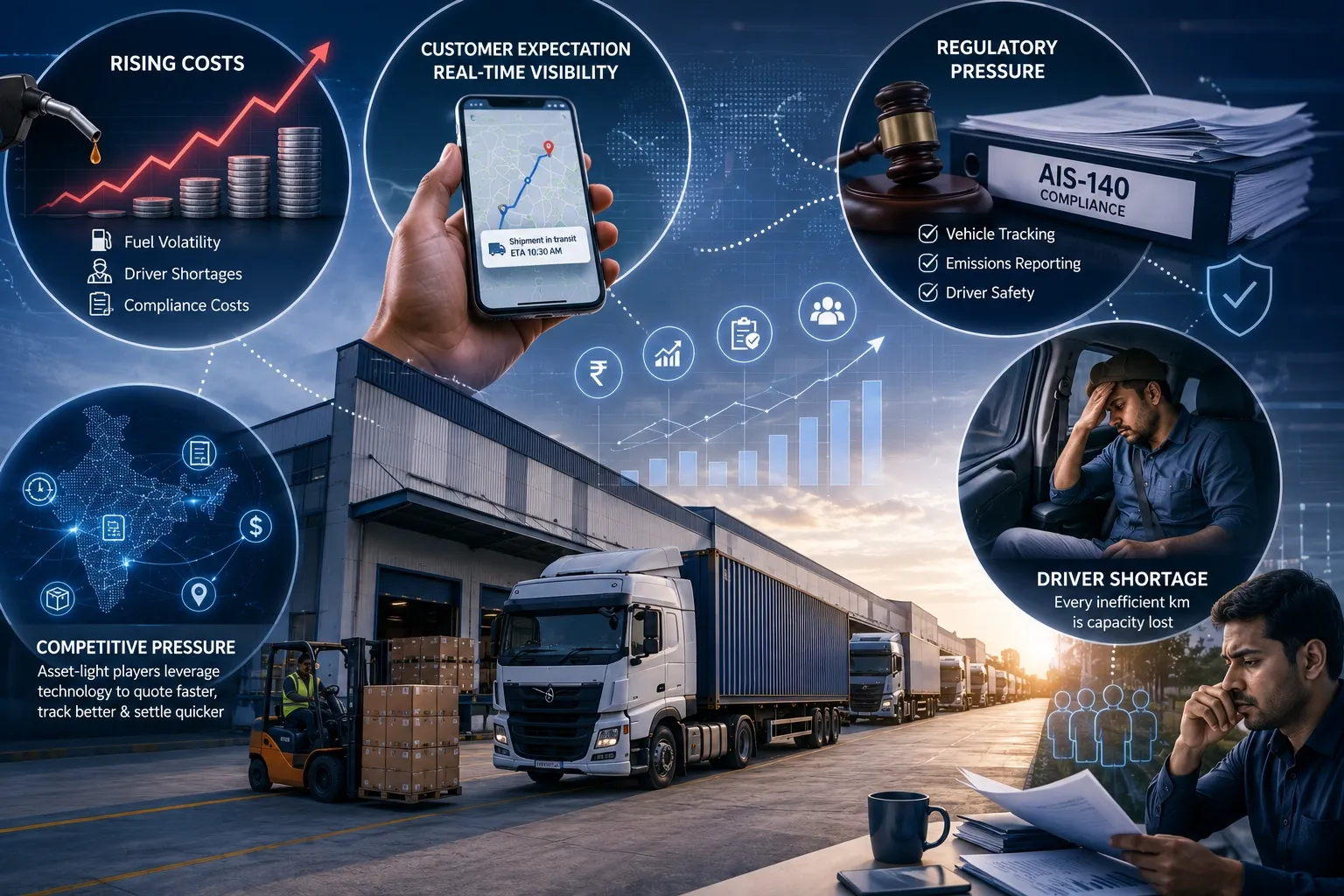
Transportation used to be treated as an operational afterthought, a line item handled by whoever was closest to the loading bay. That has changed for three structural reasons.
Freight costs are now too large to manage informally
Fuel price volatility, driver shortages, and rising compliance costs have pushed transportation spend into double digits as a share of revenue for many manufacturing and FMCG companies. The World Bank's Logistics Performance Index consistently shows that countries with weaker transportation coordination carry significantly higher logistics costs as a percentage of GDP, which translates directly into thinner margins for the businesses operating inside those markets.
Customers expect courier-level visibility from every shipper
Once consumers got used to tracking a parcel by the minute, that expectation bled into B2B freight as well. A buyer placing a bulk industrial order now expects the same kind of real-time GPS fleet tracking transparency that a retail customer gets from an e-commerce app.
Regulatory pressure has tightened, not loosened
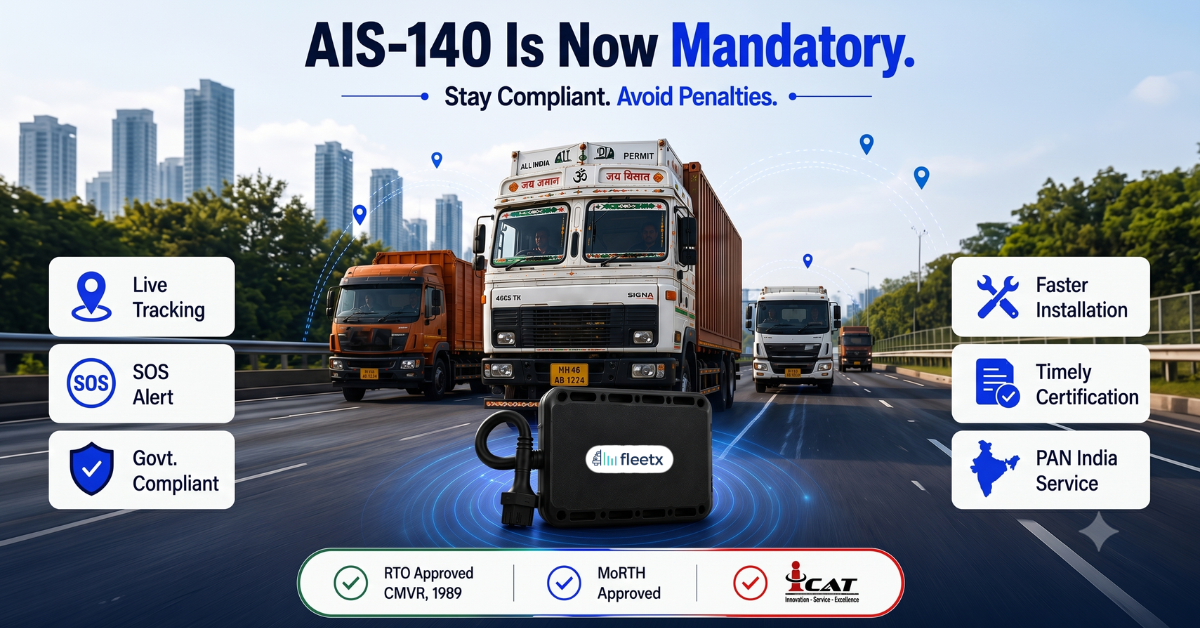
Government mandates around vehicle tracking, emissions reporting, and driver safety have made manual compliance tracking risky and expensive. In India, for example, the Ministry of Road Transport and Highways' AIS-140 standard requires public service and commercial vehicles above a certain category to carry standardized GPS tracking and panic button devices, which has pushed compliance from a paperwork exercise into a live data requirement.
Put together, these pressures mean that a company without a structured freight transportation management platform is not just operationally behind, it is financially and legally exposed.
Competitive pressure from asset-light logistics players
A growing number of asset-light 3PLs and digital freight brokers now compete purely on the strength of their technology stack rather than the size of their owned fleet. These players can quote faster, track more accurately, and settle invoices quicker than traditional operators, which forces even legacy fleet owners to adopt comparable technology simply to remain competitive on service levels, not just on price.
Driver shortages make every kilometer more expensive to waste
Across multiple markets, the pool of qualified commercial drivers has not kept pace with freight volume growth. When driver hours are scarce, every inefficient route, every unnecessary detour, and every avoidable wait at a loading dock represents capacity the business cannot get back. This scarcity has turned route and load efficiency from a nice-to-have into a direct constraint on how much freight a company can actually move in a given month.
What are the Core Components of a Logistics Transportation Management System?
A complete system is rarely one feature. It is a stack of capabilities that work together. The table below maps the components most enterprise buyers look for, along with the business question each one answers.
|
Component |
What It
Does |
Business
Question It Answers |
|
Order and load
planning |
Consolidates
shipment requests and builds optimal loads |
Are we filling
every vehicle to capacity? |
|
Carrier and
route selection |
Chooses the
best carrier, vehicle, and path for each load |
Are we using
the cheapest, fastest, safest option every time? |
|
Real-time
tracking |
Streams live
GPS and telematics data |
Where exactly
is this shipment right now? |
|
Exception
management |
Flags delays,
breakdowns, or deviations automatically |
What is going
wrong before the customer notices? |
|
Freight audit
and payment |
Matches
invoices against contracted rates |
Are we being
billed correctly by every carrier? |
|
Driver and
compliance management |
Tracks
licenses, hours of service, and safety scores |
Are we legally
and operationally compliant? |
|
Analytics and
reporting |
Aggregates
cost, time, and performance data |
Which lanes, carriers,
or vehicles are actually profitable? |
Not every business needs every component on day one. A regional distributor might start with load planning and real-time tracking, while a national 3PL will need the full stack including freight audit and payment software and multi-carrier rate management from the outset.
A useful way to sequence adoption is to map each component against the cost of not having it. Real-time tracking and exception management tend to deliver the fastest visible win because they directly reduce the volume of reactive phone calls, which makes them a sensible starting point for most companies. Freight audit and analytics typically deliver the largest financial recovery but take longer to show results, since they require several months of accumulated data before patterns become statistically reliable. Compliance and driver management sit somewhere in between, urgent when regulation is strict, but otherwise able to follow once the core planning and visibility layers are stable.
How Does a Transportation Management System Differ From a Traditional Fleet Management Tool?
This is one of the most common points of confusion for buyers, and the distinction matters because the two systems solve different problems even though they often share data.
|
Aspect |
Fleet
Management System (FMS) |
Transportation
Management System (TMS) |
|
Primary focus |
The vehicle:
location, health, fuel, driver behavior |
The shipment:
planning, routing, cost, and delivery |
|
Core question |
Is the vehicle
running safely and efficiently? |
Is the shipment
moving at the lowest cost and fastest time? |
|
Typical users |
Fleet
supervisors, maintenance teams |
Logistics
planners, supply chain managers |
|
Key data
captured |
GPS location,
fuel consumption, idle time, engine diagnostics |
Order details,
freight rates, carrier performance, delivery SLAs |
|
Common outputs |
Maintenance
alerts, fuel reports, driver scorecards |
Optimized
routes, load plans, freight invoices, on-time delivery rates |
|
Best suited for |
Owners of a
private vehicle fleet |
Shippers, 3PLs,
and businesses managing multi-carrier freight |
In reality, the strongest setups do not force a choice between the two. A unified platform that combines AI-powered fleet management with transportation planning gives a company both the vehicle-level operational data and the shipment-level financial data in one place, which is increasingly what enterprise buyers are asking for instead of stitching together two separate vendors.
What Problems Does Logistics Transportation Management Solve on the Ground?
It helps to move past definitions and look at the specific operational pain points that push companies to finally invest in a structured system. Most logistics heads do not wake up one day and decide to evaluate transportation management software out of curiosity. They get pushed into it by one or two recurring problems that have become too expensive or too embarrassing to keep tolerating, and the rest of the capability set tends to get adopted once that initial problem is solved and the broader value becomes visible.
• Empty or partially loaded trucks: without consolidated planning, vehicles routinely leave at 60 to 70 percent capacity, quietly inflating cost per shipment.
• Manual route planning: dispatchers relying on memory or static maps cannot account for live traffic, weather, or road closures, leading to missed delivery windows.
• Invisible detention and demurrage charges: without automated tracking of dock times, companies absorb avoidable penalty costs for months before anyone notices the pattern.
• Disputed freight invoices: carriers sometimes bill for accessorial charges, fuel surcharges, or weight discrepancies that were never agreed upon, and manual auditing catches only a fraction of these.
• Driver safety blind spots: harsh braking, overspeeding, and fatigue are invisible until an accident forces the issue, by which point the cost is far higher than prevention would have been.
• Customer service escalations: without shared visibility, every late delivery turns into a manual investigation involving multiple phone calls before anyone can tell the customer what happened.
Each of these problems is solvable individually with a workaround, but they compound. A business running five or six workarounds at once is, in effect, running an informal transportation management system, just without the data, audit trail, or scalability that a real platform provides.
What Changes on the Ground Before and After a Real System Is in Place?
It is worth walking through a single ordinary day, because the difference between manual and managed transportation rarely shows up as one dramatic failure. It shows up as dozens of small frictions that add up.
Before a structured system is in place, a typical morning for an operations manager starts with a string of phone calls to confirm which vehicles actually left the yard overnight, since the dispatch sheet from the previous evening is often already out of date by the time anyone checks it. A delayed shipment is usually discovered only when a customer calls to ask where it is, at which point the operations team has to call the driver, the depot, and sometimes the carrier just to reconstruct what happened. A disputed freight invoice sits in an email thread for two or three weeks while finance, the carrier, and operations go back and forth on whether a detention charge was legitimate. By the time the day ends, most of the team's energy has gone into explaining problems after they occurred rather than preventing them.
After a connected transportation management system is running properly, the same day looks structurally different, even though the underlying business is identical. Vehicle status, route progress, and delivery confirmation are visible on a single screen without anyone needing to make a call. A shipment that is trending toward a missed delivery window triggers an automatic alert hours before the delivery time, giving the team a chance to intervene, reroute, or proactively inform the customer instead of being caught off guard. A disputed invoice is flagged and classified automatically based on GPS, FASTag, and ePOD evidence, with the relevant party notified the same day instead of weeks later. The operations manager spends the day managing exceptions that genuinely need human judgment, rather than manually reconstructing routine information that the system should have surfaced on its own.
Neither version of this day is hypothetical. Both are accurate descriptions of how the same role functions before and after a real platform replaces a phone-and-spreadsheet workflow, and the gap between them is the most concrete way to explain why logistics transportation management has shifted from a nice-to-have to an operational necessity.
What Hidden Costs Does Poor Transportation Management Create?
The costs above are visible once someone goes looking for them, but the more damaging costs are the ones that never show up as a distinct line item and instead get absorbed quietly into overall operating expense, year after year, without ever being attributed to their actual root cause.
|
Hidden Cost |
Where It
Comes From |
Typical
Business Impact |
|
Phantom fuel
loss |
Pilferage,
idling, or inefficient routing not flagged in real time |
Erodes margin
silently across the whole fleet |
|
Customer churn
from unreliable delivery |
Repeated missed
SLAs without root-cause visibility |
Lost repeat
business, often without an obvious trigger |
|
Over-insured or
under-insured fleet risk |
No accurate
driver safety or incident data to inform premiums |
Higher
insurance cost or uncovered liability exposure |
|
Manual labor
cost of reconciliation |
Staff hours
spent manually checking invoices and trip sheets |
Headcount tied
up in low-value administrative work |
|
Opportunity
cost of underutilized assets |
Vehicles
running below optimal capacity or sitting idle |
Lower revenue
per vehicle than the fleet is capable of generating |
None of these costs are dramatic enough on their own to trigger an emergency review, which is exactly why they survive for years inside otherwise well-run companies. A structured transportation management approach does not eliminate them overnight, but it makes them visible, and visibility is almost always the first step toward correction.
How Is Artificial Intelligence Changing Logistics Transportation Management?
The last few years have shifted transportation technology from rule-based automation to predictive and prescriptive intelligence. This is not a marketing repackaging of old GPS tracking, the underlying capability has genuinely changed.
From reactive tracking to predictive planning
Earlier systems told a dispatcher where a vehicle was. Modern platforms predict where it will be in two hours, whether it will miss its delivery window, and what corrective action to take before the delay happens. This shift relies on machine learning models trained on historical route, traffic, and weather data rather than static rules. Fleetx's agentic transport management platform, for instance, is built around a continuous loop of input data, intelligent planning, exception review, automated dispatch, proof and settlement, and performance insight, with AI agents handling each stage rather than waiting for a human planner to push every shipment forward manually.
Predictive maintenance instead of scheduled maintenance
Rather than servicing a vehicle on a fixed calendar, predictive maintenance for trucks uses engine diagnostic data to flag a likely component failure before it happens, reducing both breakdown frequency and unnecessary servicing costs.
AI-assisted load and route optimization
Optimization engines can now process hundreds of variables, vehicle capacity, driver hours, toll costs, delivery windows, and traffic patterns, in seconds, producing route plans that would take a human planner hours to construct manually. McKinsey's research on supply chain digitization notes that companies adopting advanced analytics in logistics planning have reported meaningful reductions in both transportation cost and delivery lead time, though results vary significantly by the maturity of the underlying data.
Computer vision for driver safety
AI dashcams now detect drowsiness, distraction, and unsafe following distance in real time, turning driver safety from a post-incident investigation into a live intervention tool.
Demand and capacity forecasting
AI models are increasingly used to forecast freight demand by lane, season, and customer segment, which allows planners to pre-position vehicles and negotiate carrier capacity in advance rather than scrambling for trucks during a sudden volume spike. This is particularly valuable for businesses with strong seasonal patterns, where the cost of being caught short on capacity during a peak period can be far higher than the cost of holding slightly excess capacity during a slow one.
Conversational and natural language interfaces
A newer development is the ability for planners and managers to query a transportation system in plain language, asking questions like which lanes had the highest detention cost last month, rather than building a custom report manually. This lowers the skill barrier for using analytics day to day and makes data-driven decisions accessible to operations staff who are not trained analysts.
What Does AIS-140 Compliance Have to Do With Transportation Management?
For fleets operating in India, compliance is not an optional add-on; it is a legal precondition for operating certain categories of commercial and public service vehicles. AIS-140 is the Automotive Industry Standard issued under the oversight of the Ministry of Road Transport and Highways that mandates standardized vehicle tracking devices with GPS, GPRS connectivity, and panic button functionality for public transport and certain commercial vehicles.
The reason this matters for transportation management specifically, rather than just fleet management, is that compliance data does not exist in isolation. A vehicle that cannot pass AIS-140 verification cannot legally operate on certain routes or fulfil certain government and enterprise contracts, which means non-compliance directly threatens the planning and execution layers of transportation management, not just the legal department.
A well-built platform treats AIS-140 compliant vehicle tracking as a baseline data layer that also feeds into route planning, safety scoring, and audit reporting, rather than a separate siloed requirement that someone checks once a year.
How Should a Business Choose Between Build, Buy, or Hybrid Transportation Management Models?
Once a company accepts it needs a structured system, the next decision is how to acquire one. There is no universally correct answer, but the trade-offs are consistent enough to lay out clearly.
|
Model |
Best For |
Key
Advantage |
Key Risk |
|
Build in-house |
Very large
enterprises with dedicated engineering teams |
Full control
over features and data ownership |
Long
development time and high ongoing maintenance cost |
|
Buy a SaaS
platform |
Mid-size to
large shippers and 3PLs wanting fast deployment |
Quick rollout,
continuous vendor-driven updates |
Less
customization for highly unique workflows |
|
Hybrid
(platform plus custom modules) |
Enterprises
with one or two non-standard processes |
Speed of a SaaS
core with flexibility where it matters most |
Requires
careful API and integration management |
For most mid-market and enterprise logistics teams, the SaaS or hybrid route wins simply on time to value. A transportation management software for fleet operators that is already built, tested, and continuously updated by a vendor will typically reach operational use in weeks rather than the twelve to eighteen months an in-house build usually takes, and that gap compounds in lost savings every month it remains open.
What Metrics Actually Prove Transportation Management ROI?
Vendors love to throw around percentage improvements without context. The metrics below are the ones that hold up to scrutiny in a finance review, because they tie directly to cost, revenue protection, or risk reduction.
|
Metric |
What It
Measures |
Why Finance
Cares |
|
Cost per kilometer
or per shipment |
True landed
transportation cost |
Direct line to
gross margin |
|
On-time
delivery rate |
Percentage of
shipments meeting SLA |
Protects
customer contracts and penalty clauses |
|
Vehicle
utilization rate |
Capacity used
versus capacity available |
Identifies
wasted asset spend |
|
Freight invoice
accuracy rate |
Percentage of
invoices matching contracted rates |
Recovers
leakage from billing errors |
|
Idle and
detention time |
Non-productive
vehicle and driver hours |
Surfaces
avoidable penalty and labor cost |
|
Fuel
consumption per route |
Actual versus
expected fuel burn |
Flags pilferage
or inefficient routing |
|
Maintenance
cost per vehicle |
Repair spend
relative to fleet age and usage |
Validates
predictive maintenance investment |
A useful discipline is to baseline every one of these metrics for thirty to sixty days before go-live, then track the same numbers monthly after rollout. Without a documented baseline, any improvement claim is just an assertion, and finance teams are right to be skeptical of assertions.
What Do Real-World Transportation Management Deployments Actually Achieve?
Numbers in a vendor brochure are easy to dismiss, so it is worth looking at documented outcomes from live deployments rather than projected estimates. Fleetx currently serves over five lakh vehicles across more than ten countries, processing over one billion data points a day, and its enterprise rollouts give a useful, sector-specific picture of what a mature logistics transportation management system can realistically deliver once it is fully adopted.
|
Industry /
Deployment |
Scale |
Key Results |
|
One of India's
largest cement manufacturers |
50,000
vehicles, 12 lakh trips, ₹4,000 crore logistics cost |
90% of
shipments tracked, 15% reduction in order-to-dispatch time, over ₹50 crore in
freight cost reduction |
|
Unified
logistics automation for a large enterprise |
5,000-plus
vehicles, ₹700 crore freight invoices, 360,000 ePODs |
Invoicing cycle
shortened by 3 weeks, 15% improvement in dispatch efficiency, 4% reduction in
freight cost |
|
Leading
pharmaceutical companies in India |
Multi-validated
pharma supply chains |
12 to 15.7%
reduction in logistics cost, 20% efficiency improvement, ₹77 lakh worth of
theft detected |
|
ArcelorMittal
Nippon Steel India (Fleetx video telematics) |
Large-scale
steel logistics network |
Route deviation
cut from 10% to under 2%, 30% reduction in overspeeding incidents |
Across Fleetx's broader customer base, AI-driven route planning has been shown to cut fuel consumption by 15 to 25 percent while reducing empty miles and detention charges, and automated documentation has reduced administrative overhead by up to 40 percent. Most businesses implementing this kind of system report achieving full return on investment within six to twelve months, with on-time delivery performance typically improving by 25 to 35 percent once route planning, exception handling, and freight settlement are all running on the same connected platform instead of separate disconnected tools.
What stands out across these deployments is that the gains rarely come from a single feature in isolation. The cement manufacturer's 90 percent shipment tracking coverage fed directly into faster dispatch decisions, and the pharma sector's theft detection capability was only possible because route, vehicle, and consignment data were already being captured continuously rather than checked periodically. This is the practical argument for treating transportation management as a connected system rather than a collection of point solutions.
Which Industries Gain the Most from Logistics Transportation Management?
While every freight-dependent business benefits from better planning and visibility, the specific pain points and payback periods differ meaningfully by sector. The table below summarizes where the highest-value use cases tend to sit.
|
Industry |
Primary
Pain Point |
Highest-Value
Capability |
|
Cement and
building materials |
High-volume
bulk dispatch with thin per-tonne margins |
Dispatch
automation and freight cost control at scale |
|
Steel and heavy
manufacturing |
Long-haul
routes with high overspeeding and deviation risk |
Video
telematics and route deviation alerts |
|
Pharmaceuticals |
Product
integrity, theft risk, and strict delivery accountability |
Tamper
detection, ePOD, and multi-point validation |
|
FMCG and
consumer goods |
High shipment
frequency with tight delivery windows |
Real-time
tracking and proactive safety control |
|
Third-party
logistics (3PL) |
Managing
multiple clients and carriers on one platform |
Multi-tenant
architecture and client-wise margin analysis |
|
Cold chain and
perishables |
Temperature
excursions and spoilage risk in transit |
Temperature
sensor integration and automated alerts |
Third-party logistics providers deserve a specific mention because their requirements differ structurally from a single shipper managing its own fleet. A 3PL needs a multi-client and multi-tenant architecture that keeps each customer's data separate, customer-specific workflows and billing rules, white-label tracking portals, and margin analysis broken down by individual client and lane. Platforms built for this use case allow 3PLs to scale operations by 50 to 100 percent in volume without a proportional increase in administrative headcount, since the system absorbs the coordination work that would otherwise require hiring more planners.
What Role Does Route Optimization Software Play Inside Transportation Management?
If transportation management is the overall system, route optimization is one of its most financially impactful engines, because the route a vehicle takes determines fuel cost, delivery time, and driver hours all at once.
Modern route optimization software for logistics typically factors in:
• Live traffic and road condition data
• Delivery time windows committed to customers
• Vehicle capacity and load compatibility
• Driver working hour limits and rest requirements
• Toll and fuel cost differences across alternate paths
The practical impact shows up most clearly in last-mile delivery optimization, where the final leg of a shipment's journey is disproportionately expensive because it involves multiple stops, small load sizes, and unpredictable urban traffic. Even a five to ten percent improvement in last-mile routing efficiency can materially change unit economics for high-frequency delivery operations.
For companies operating across road, rail, and sometimes air or sea for the same set of customers, route optimization extends into multi-modal transportation management, where the system has to compare cost and time trade-offs not just between routes but between entirely different modes of transport for the same shipment.
Load building is the part of this process that is most often left to manual estimation, even at companies that have already automated routing. Fleetx's 3D load building agent addresses this by sequencing loads computationally to maximize available space while still ordering cargo for fast and easy unloading at multi-stop deliveries, which matters because a route can be perfectly optimized on paper and still lose money if the trucks running it are not loaded efficiently.
How Does Freight Audit and Payment Fit Into the Bigger Picture?
Freight audit is the part of transportation management that finance teams care about most directly, because it sits at the intersection of operations and accounts payable.
Manually auditing freight invoices against contracted rates, fuel surcharges, and accessorial charges is slow and error-prone, and most companies without automated freight audit and payment software end up paying a portion of invoices that contain billing discrepancies simply because nobody has time to check every line item against the original contract.
An automated audit layer typically performs three checks before approving payment:
• Rate verification against the negotiated carrier contract
• Accessorial charge validation to confirm charges like detention or fuel surcharge were actually incurred
• Proof of delivery matching to confirm the shipment was actually completed as billed
This is also where electronic proof of delivery, or ePOD, has become a meaningful upgrade over paper-based confirmation. Fleetx's ePOD agent, for example, analyzes shipment evidence such as photos, signatures, and location records in real time to detect delivery exceptions automatically, then assigns accountability and drives resolution without manual chasing. On Fleetx's own platform data, this kind of automated dispute workflow has been shown to cut manual dispute investigation effort by up to 70 percent and resolve disputes three to five times faster than manual follow-up, simply by replacing reactive phone calls with automatic detection, classification, and escalation.
A strong freight audit layer typically goes a step further than basic rate checking by cross-validating distance using GPS and FASTag toll data against the contracted clause, automatically flagging overbilling beyond a defined tolerance, and reconciling loaded weight against invoice weight and the ePOD document so that all three figures have to agree before payment is approved.
Beyond cost recovery, this audit trail also becomes valuable during carrier contract renegotiation, since a company with twelve months of accurate billing and performance data has a much stronger negotiating position than one relying on memory and anecdote.
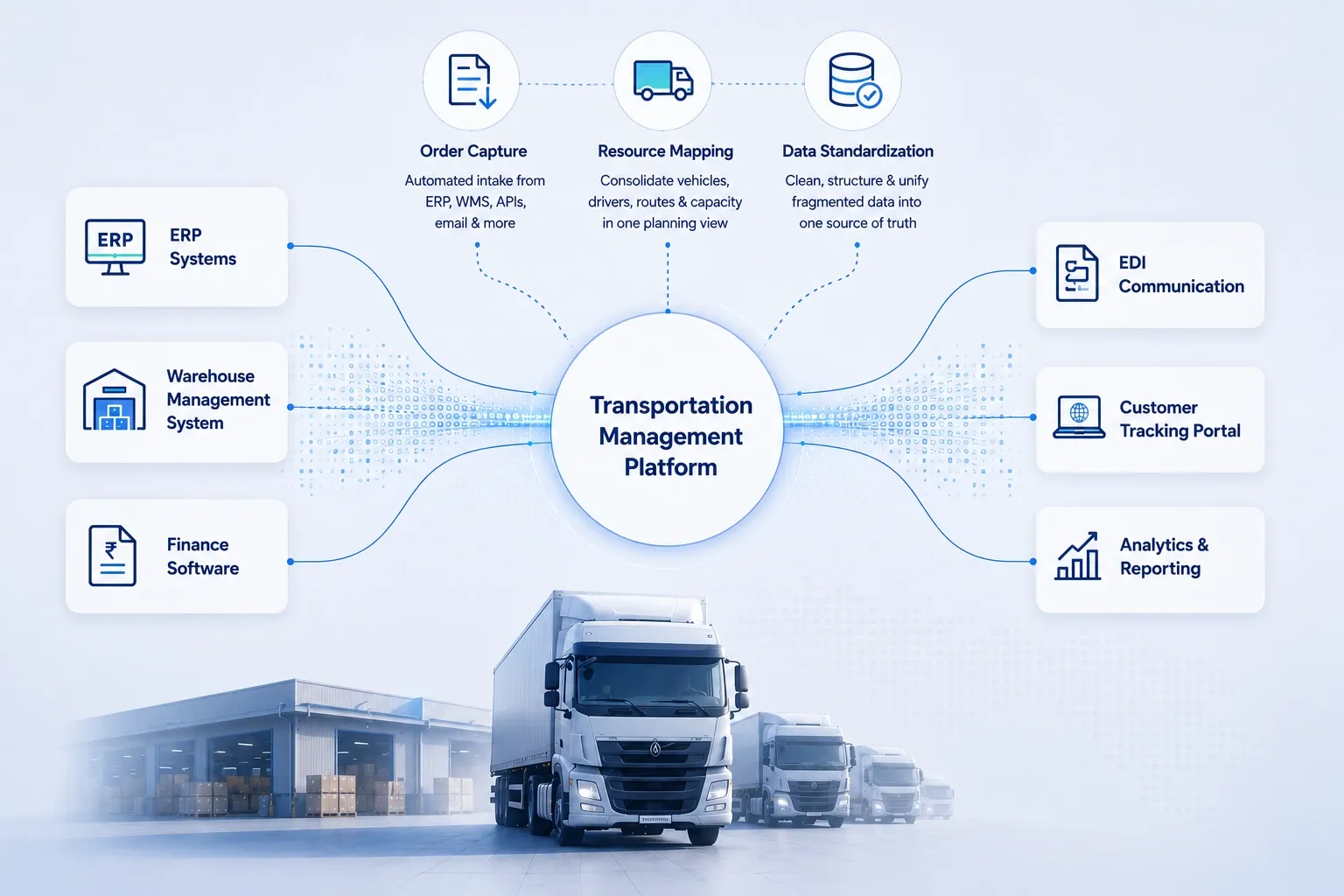
How Does Data Integration Tie Transportation Management Into the Rest of the Business?
None of the capabilities described so far work well in isolation. A transportation management platform is only as useful as the data flowing into and out of it, and that data typically originates in systems the logistics team does not directly control, such as the ERP, the warehouse management system, and finance software.
A well-architected integration layer typically handles three jobs at once:
• Order capture: automatically pulling shipment requests from ERP systems, warehouse management software, APIs, and even email-based orders, rather than requiring manual re-entry into the transportation platform.
• Resource mapping: consolidating vehicle, driver, route, and capacity information sourced from long-term contracts, requests for quotation, and spot auctions into one planning view.
• Data standardization: cleaning and structuring this fragmented operational data into a consistent format so that planning, dispatch, and reporting are all working from the same accurate source of truth.
Electronic data interchange, commonly known as EDI, remains the backbone of carrier-to-shipper communication for many large enterprises, and any serious transportation platform needs to support it alongside modern API-based integrations. Customer-facing self-service tracking portals have also become a baseline expectation rather than a premium feature, since large enterprise customers increasingly expect to check shipment status themselves rather than calling a logistics coordinator for an update.
The practical lesson for any company evaluating a platform is to treat integration depth as a primary selection criterion, not an afterthought to be solved during implementation. A system that cannot cleanly absorb data from the existing ERP will end up creating a second, parallel data entry process, which defeats much of the efficiency gain the platform was supposed to deliver in the first place.
What are the Biggest Mistakes Companies Make When Implementing Transportation Management Systems?
Even well-resourced companies get implementation wrong in fairly predictable ways. Recognizing these patterns in advance is often the difference between a smooth rollout and a stalled one.
Implementation timelines vary considerably based on organizational readiness and the complexity of the existing technology landscape. A small business adopting a cloud-based platform with basic carrier integrations can typically go live within four to eight weeks. Mid-market companies that need ERP integration, carrier onboarding, and workflow configuration usually need three to six months. Large enterprises with multiple business units, custom integrations, and extensive carrier networks can take six to twelve months or longer. Understanding which bracket a company falls into before signing a contract prevents the common mistake of expecting an enterprise-scale rollout to behave like a small business deployment.
• Treating it as an IT project instead of an operations project, which leads to a system that is technically functional but ignored by the dispatchers and drivers who are supposed to use it daily.
• Skipping the data cleanup step, since route, customer, and carrier data carried over from spreadsheets often contains errors that quietly corrupt every report the new system produces.
• Trying to automate everything on day one instead of phasing rollout by region, fleet segment, or use case, which overwhelms teams and increases resistance to adoption.
• Underestimating change management, particularly with drivers and dispatchers who have run operations informally for years and see a new system as surveillance rather than support.
• Ignoring integration requirements with existing ERP, warehouse management, or accounting systems, which forces teams back into manual data entry and defeats the purpose of automation.
• Underinvesting in training for dispatchers and drivers, since even an intuitively designed platform requires some structured onboarding before users trust it enough to abandon their old manual workarounds entirely.
• Not defining success metrics before go-live, which makes it impossible to prove value later and leaves the project vulnerable during the next budget review.
Most of these mistakes share a common root cause: treating the rollout as a one-time technology purchase rather than an ongoing operational change. The companies that get the most value from a system tend to revisit their configuration, workflows, and reports every quarter in the first year, adjusting based on what the data actually shows rather than assuming the initial setup will remain correct indefinitely.
What Does the Future of Logistics Transportation Management Look Like?
A few directions are already visible enough to plan around rather than speculate about.
Agentic AI moving from advisory to autonomous decision making
Early transportation systems suggested a route or flagged an exception for a human to decide on. The next generation of platforms is moving toward agentic systems that can autonomously rebook a delayed shipment, renegotiate a carrier slot, or reroute a vehicle without waiting for manual approval, with humans reviewing outcomes rather than approving every step.
Deeper integration of sustainability and emissions data
As emissions reporting requirements expand globally, transportation platforms are increasingly expected to calculate and report carbon output per shipment, not just cost and time, which is pushing supply chain visibility software to add environmental metrics as a standard, not optional, feature.
Consolidation of fleet and transportation platforms into one system
The historical divide between fleet management and transportation management is narrowing as vendors build unified platforms that combine vehicle health, driver safety, route planning, and freight financials into a single data layer, reducing the integration burden that previously fell on the buyer.
Greater reliance on real-time data over periodic reporting
Monthly or weekly reports are giving way to live dashboards, because the cost of reacting to a problem a week after it started is simply too high in a market where customer expectations and fuel costs both move daily.
Shared visibility networks between shippers and carriers
Historically, shippers and carriers each maintained their own version of shipment status, which often disagreed with each other and created friction during disputes. The direction of travel now is toward shared, single-source-of-truth visibility, where both parties see the same live data on location, delivery confirmation, and exceptions. This reduces the back-and-forth that traditionally consumed hours of coordination time per shipment and shifts the relationship from adversarial dispute resolution to collaborative problem solving.
What Should a Transportation Management Vendor Evaluation Checklist Include?
Once a company decides to buy rather than build, the evaluation process determines whether the eventual rollout succeeds or stalls. The following checklist covers the areas that tend to separate a platform that delivers real value from one that looks impressive in a sales demo but struggles in daily operations.
• Data ownership and export rights: confirm the company retains full ownership of its operational data and can export it in a usable format if it ever switches vendors.
• Integration depth, not just integration claims: ask for a working reference of the platform connected to a similar ERP or accounting system, not just a slide listing supported integrations.
• Compliance coverage for the specific operating region, including AIS-140 or equivalent local mandates, rather than a generic global compliance claim.
• Scalability of the pricing model, since a per-vehicle pricing structure that looks affordable at fifty vehicles can become disproportionately expensive at five hundred if there is no volume tiering.
• Quality of exception alerting, tested by asking how the system behaves when a vehicle goes offline, a route deviates significantly, or a delivery window is missed.
• Mobile usability for drivers and field staff, since a system that only works well on a desktop dashboard will see poor adoption from the people actually executing deliveries.
• Reference customers in a comparable industry and fleet size, because a platform built primarily for parcel delivery may not translate well to heavy industrial freight, and vice versa.
Running every shortlisted vendor through this same checklist, rather than evaluating each one on its own marketing pitch, makes the final comparison far more objective and far easier to defend internally when the decision is questioned later. It is also worth requesting a sandbox or pilot environment using a sample of the company's own real shipment data rather than a generic demo dataset, since performance on clean demo data rarely reflects how a platform behaves once it is exposed to the inconsistencies of a real operational environment.
How Should a Logistics Team Get Started With Transportation Management Today?
For a team that has read this far and is convinced of the need but unsure where to begin, a practical starting sequence looks like this:
• Audit current state first. Document existing routes, costs, and delivery performance for thirty to sixty days before evaluating any vendor.
• Identify the single biggest pain point, whether that is freight billing errors, late deliveries, or fuel pilferage, and prioritize a solution that addresses it first rather than buying every module at once.
• Check compliance requirements early, particularly AIS-140 or equivalent regional mandates, since retrofitting compliance after a platform is already deployed is far more expensive than building it in from the start.
• Insist on integration capability with existing ERP and accounting systems before signing any contract.
• Pilot with one region or one fleet segment before a company-wide rollout, and use that pilot to validate the ROI metrics covered earlier in this guide.
• Build internal champions among dispatchers and drivers early, since adoption succeeds or fails based on whether the people using the system daily trust it.
Transportation will always involve some unpredictability: weather, traffic, mechanical failure, and human error are not going away. What a structured logistics transportation management approach changes is how quickly a business sees a problem, how accurately it understands the cost of that problem, and how fast it can correct course before a delay becomes a lost customer. That shift, from reacting after the fact to managing in real time, is the entire value proposition, and it is increasingly not optional for any company that depends on freight moving on time.
The deployments referenced throughout this guide, from a cement manufacturer tracking 90 percent of its shipments to a pharmaceutical network detecting lakhs of rupees in theft that would otherwise have gone unnoticed, share one underlying pattern. None of these results came from a single feature working in isolation. They came from connecting planning, execution, visibility, and settlement into one system that gets more accurate the longer it runs. That is the practical definition of a mature transportation management capability, and it is a realistic destination for any logistics team willing to start with an honest audit of where its freight cost and time are actually going today.