
Supply chains are delicate and complicated due to their reliance on constantly shifting customer expectations. A supply chain without properly managed logistics cannot guarantee high value. As a result, one of the most important aspects of any supply chain's quality is logistics.
Logistics and supply chain management are concepts that are used interchangeably. Some claim that supply chain management is the "new" logistics and that there is no distinction between the two concepts. Nevertheless, despite their mutually beneficial relationship, each serves different qualities and has unique roles and responsibilities. Despite advances in technology, logistics management has been around for a long time. Supply Chain Management, however, is a contemporary field that dates back to the 19th century.
The logistics sector is in a disorganized state in India. Given the general perception of logistics being a manpower-driven industry, there are poor facilities and high levels of loss. Companies can develop a competitive advantage by optimizing operations, enhancing customer service, and better understanding the importance of logistics management in any supply chain.
Why are logistics & Supply Chain Management interconnected?
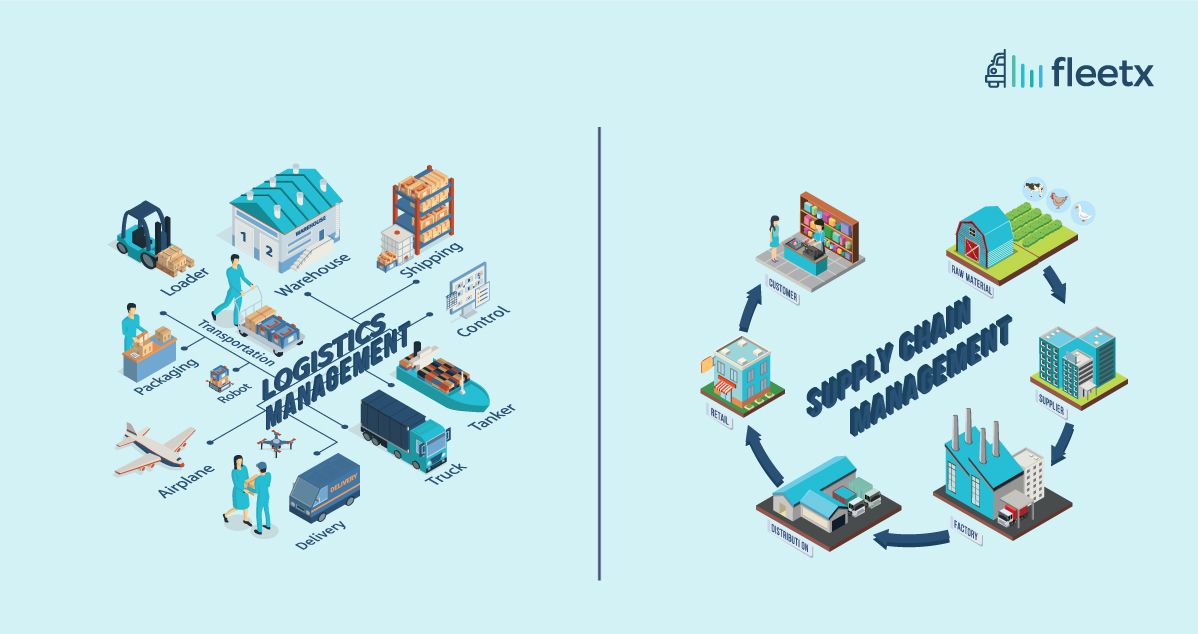
SCM covers the complex procedures required to find and purchase raw materials and finally produce finished items. SCM employs logistics to get products to customers, but its ultimate goals are to improve financial performance and strengthen a company's competitiveness.
In other aspects, SCM establishes the strategy and oversees everyday logistical operations that take place in manufacturing plants, distribution centers, and other facilities. Whether the customer is a producer, distributor, or consumer, logistics is the part of the supply chain that keeps or distributes finished products or services. Delivering products and services to customers on time and at a fair price is the aim of logistics.
Forward logistics and forward supply chain management are accomplished with effort, but many firms also need to understand the "backward" process, and they should be aware that reverse supply chain management and reverse logistics management are quite distinct from one another.
The transfer of products from customer to vendor, or at least one step backwards in the supply chain, is referred to as a reverse supply chain. Supply chain can be termed as a 360-degree supply chain, which means the product is sent backwards to the original source from where it came from. For instance, these days many fabrics are designed and made sustainable so that it can be capable of going back to nature or can be recycled. Reverse logistics, on the other hand, is a higher-level viewpoint that covers the complete process of organizing, executing, and managing goods. Reverse logistics is required for all actions that involve managing returns of defective items, picking up empty packaging, or even collecting old home appliances and other used goods.
What is supply chain management?
The handling of a good or service's full manufacturing flow, from the raw materials to the delivery of the finished product to the customer, is known as supply chain management. A business establishes a network of suppliers to distribute the product from raw material suppliers to businesses (retailers) that deal with customers directly.
What is logistics management?
Planning, implementing, and controlling the efficient, effective forward and reverse flows and storage of products, services, and associated information between the point of origin and the site of consumption to fulfil customer needs is known as logistics management. It includes inbound and outbound logistics, fleet management, order fulfilment, warehousing, inventory control, etc.
Major Differences Between Logistics Management and Supply Chain Management
Supply Chain Management (SCM) and Logistics Management are often used interchangeably, but they serve different purposes within business operations. Logistics is a component of supply chain management that focuses on the movement, storage, and delivery of goods, while SCM takes a broader approach by overseeing the entire flow of products, information, finances, and relationships across the supply chain network. Understanding the distinction between the two helps organizations optimize operations, improve efficiency, and achieve long-term business goals.
Differences between Logistics Management and Supply Chain Management:
| Basis of Comparison | Logistics Management | Supply Chain Management (SCM) |
|---|---|---|
| Definition | The process of planning, implementing, and controlling the movement and storage of goods, services, and information. | The strategic management of the entire supply chain network from sourcing raw materials to delivering finished products to customers. |
| Scope | Narrower in scope and focused primarily on transportation, warehousing, and inventory management. | Broader in scope and includes procurement, production, logistics, supplier management, distribution, and customer service. |
| Primary Focus | Efficient movement and storage of products. | Coordination and optimization of all supply chain activities. |
| Objective | Ensure products are delivered to the right place, at the right time, and at the lowest possible cost. | Create an integrated supply chain that maximizes value and provides a competitive advantage. |
| Business Function | An operational function within the supply chain. | A strategic business function that oversees the entire network. |
| Decision-Making Level | Mostly operational and tactical decisions. | Strategic, tactical, and operational decisions. |
| Key Activities | Transportation, warehousing, inventory control, order fulfillment, and distribution. | Supplier management, procurement, demand planning, production planning, logistics, and customer relationship management. |
| Performance Metrics | Delivery time, transportation costs, inventory turnover, and order accuracy. | Supply chain efficiency, profitability, customer satisfaction, supplier performance, and overall business growth. |
| Technology Used | Transportation Management Systems (TMS), Warehouse Management Systems (WMS), GPS tracking, and route optimization tools. | Enterprise Resource Planning (ERP), SCM software, AI-driven forecasting, analytics platforms, and integrated supply chain solutions. |
| Relationship with Customers | Focuses on timely and accurate product delivery. | Focuses on delivering overall customer value throughout the supply chain journey. |
| Relationship with Suppliers | Limited interaction related to product movement and inventory. | Extensive collaboration with suppliers to ensure uninterrupted supply and operational efficiency. |
| Competitive Advantage | Improves operational efficiency and service quality. | Builds long-term strategic advantage through end-to-end supply chain optimization. |
While logistics and supply chain management have different responsibilities, they are highly dependent on one another. Logistics ensures the physical movement and storage of goods, whereas supply chain management coordinates all activities that make the movement possible. A company may have a well-designed supply chain strategy, but without efficient logistics execution, customer expectations cannot be met. Similarly, even the most efficient logistics operations cannot achieve their full potential without effective supply chain planning. Together, they form the foundation of efficient business operations, cost optimization, customer satisfaction, and sustainable growth.
Similarities Between Supply Chain Management and Logistics Management
Although Supply Chain Management (SCM) and Logistics Management are distinct concepts, they are highly interconnected and work together to ensure the smooth flow of goods, information, and services. Both functions contribute to operational efficiency, customer satisfaction, and business growth. While SCM focuses on the broader coordination of the supply chain network, logistics focuses on the movement and storage of products within that network. The key similarities between the two:
| Similarity Area | Supply Chain Management (SCM) | Logistics Management | Common Objective |
|---|---|---|---|
| Product Flow | Manages the complete movement of products from suppliers to customers | Manages transportation and storage of products | Ensure products reach customers efficiently |
| Customer Satisfaction | Focuses on delivering value through an optimized supply chain | Ensures timely and accurate deliveries | Improve customer experience and loyalty |
| Information Management | Coordinates information across suppliers, manufacturers, and distributors | Tracks shipment, inventory, and transportation data | Enable informed decision-making |
| Cost Optimization | Reduces procurement, production, and distribution costs | Minimizes transportation and warehousing expenses | Improve profitability and operational efficiency |
| Supplier and Partner Coordination | Works with suppliers, manufacturers, and distributors | Coordinates with carriers, warehouses, and delivery partners | Create seamless collaboration across the network |
| Operational Efficiency | Optimizes end-to-end supply chain processes | Improves transportation and inventory processes | Reduce delays and eliminate inefficiencies |
| Inventory Management | Ensures optimal inventory planning across the supply chain | Controls inventory storage and movement | Prevent stockouts and excess inventory |
| Business Growth | Supports long-term competitive advantage | Supports reliable product delivery and service quality | Drive organizational success |
| Technology Adoption | Uses ERP, SCM platforms, AI, and analytics | Uses TMS, WMS, GPS tracking, and automation tools | Improve visibility and performance |
| Performance Measurement | Monitors supply chain KPIs and strategic goals | Tracks logistics KPIs such as delivery time and transportation costs | Continuously improve performance |
Both SCM and logistics ultimately revolve around the same network of suppliers, manufacturers, distributors, wholesalers, retailers, and customers. Neither can function effectively without the other. An efficient supply chain strategy requires strong logistics execution, while successful logistics operations depend on proper supply chain planning and coordination. Together, they create a synchronized system that helps businesses reduce costs, improve service levels, increase visibility, and gain a sustainable competitive advantage in increasingly complex global markets.
Why Supply Chains Need Good Logistics Management
Any supply chain needs logistics since it is a key component of the chain and because it also serves the following purposes:
- lowering expenses and increasing effectiveness.
- supplying the appropriate goods at the appropriate time to achieve customer satisfaction and organizational effectiveness.
- offering a quick and efficient shipping alternative, starting with inbound and ending with outgoing logistics.
- supplying to the location of the consumer quickly and providing the most affordable place to produce the items.
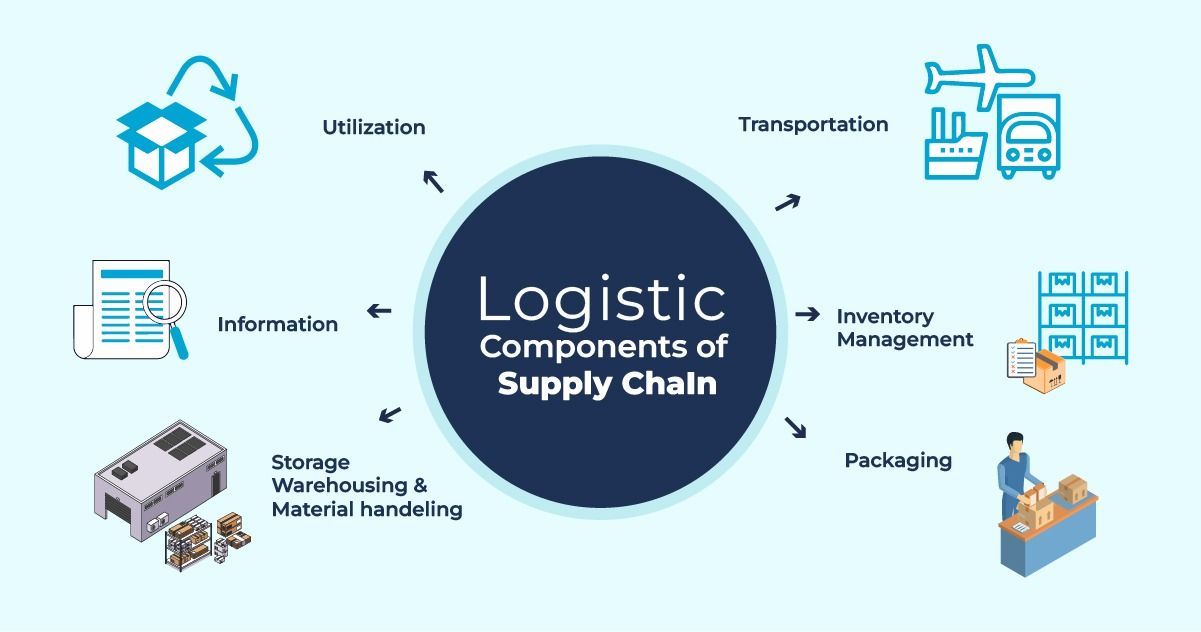
How Modern Logistics Technology Improves Supply Chain Performance
The role of logistics has evolved far beyond transportation and warehousing. In today's digital economy, businesses require real-time visibility, predictive analytics, automation, and data-driven decision-making to remain competitive. Modern logistics systems are increasingly powered by Transportation Management Systems (TMS), Logistics Management Systems (LMS), Artificial Intelligence (AI), Internet of Things (IoT), GPS tracking, route optimization, and predictive analytics.
Traditional logistics operations often suffer from delayed deliveries, poor vehicle utilization, inventory mismatches, communication gaps, and rising operational costs. These challenges directly impact the entire supply chain, causing disruptions that affect manufacturers, distributors, retailers, and end customers.
An efficient logistics system integrates every movement of goods into a single connected ecosystem. This integration allows businesses to monitor inventory levels, shipment status, vehicle performance, and delivery timelines from a centralized platform. Instead of reacting to problems after they occur, organizations can identify risks proactively and take corrective actions before disruptions impact customers.
For example, real-time GPS tracking enables logistics managers to monitor vehicle locations continuously. If a shipment encounters unexpected traffic congestion, route optimization software can recommend an alternative route to maintain delivery schedules. Such visibility improves customer satisfaction while reducing fuel consumption and operational expenses.
Predictive analytics is another important advancement. By analyzing historical shipment data, seasonal demand patterns, weather conditions, and market trends, logistics systems can forecast future requirements more accurately. This helps organizations optimize inventory levels, reduce stockouts, and prevent excess inventory carrying costs.
Automation also plays a critical role in modern logistics management. Tasks such as order processing, shipment scheduling, proof of delivery collection, invoice generation, and carrier allocation can be automated. This reduces manual errors and allows teams to focus on strategic planning rather than administrative work.
The Internet of Things (IoT) has further transformed logistics operations. IoT-enabled sensors can monitor temperature, humidity, vehicle health, cargo conditions, and driver behavior in real time. This capability is particularly valuable for industries dealing with pharmaceuticals, food products, chemicals, and cold chain logistics, where product integrity must be maintained throughout transportation.
Artificial Intelligence is increasingly being used to improve logistics efficiency. AI-powered systems can predict vehicle breakdowns, recommend optimal delivery routes, forecast demand fluctuations, and identify inefficiencies across supply chain networks. Businesses leveraging AI-driven logistics solutions often achieve better asset utilization and improved operational performance.
Cloud-based logistics platforms have also made logistics management more accessible for organizations of all sizes. Small and medium enterprises can now access enterprise-grade logistics capabilities without investing heavily in infrastructure. This democratization of technology enables businesses to compete effectively in increasingly complex supply chain environments.
As customer expectations continue to rise, businesses can no longer rely solely on traditional logistics processes. Companies that embrace digital logistics technologies gain improved visibility, enhanced agility, better customer experiences, and stronger competitive advantages. Efficient logistics systems have become strategic business enablers rather than merely operational functions.
Industry-Wise Importance of Efficient Logistics Systems in Supply Chain Management
Although logistics principles remain consistent across industries, the challenges and priorities vary significantly depending on the nature of products being transported and customer expectations. Efficient logistics systems enable organizations across multiple sectors to maintain operational continuity and achieve supply chain excellence.
Manufacturing Industry
Manufacturers depend heavily on uninterrupted material flow. Delays in raw material procurement can halt production lines and result in substantial financial losses. Efficient logistics systems ensure timely delivery of components, better inventory planning, and seamless coordination between suppliers and manufacturing facilities.
Manufacturing organizations also benefit from improved demand forecasting, optimized transportation schedules, and reduced inventory carrying costs. By synchronizing logistics operations with production planning, manufacturers can improve overall equipment effectiveness and operational efficiency.
Retail and E-commerce
Retail and e-commerce businesses operate in highly competitive markets where customer experience is a critical differentiator. Consumers increasingly expect same-day delivery, accurate order tracking, and hassle-free returns.
Efficient logistics systems help retailers manage inventory across warehouses, fulfilment centers, and stores while maintaining visibility throughout the delivery process. Route optimization and last-mile delivery solutions ensure faster deliveries and lower transportation costs.
Reverse logistics also becomes essential in retail operations, allowing businesses to manage returns efficiently while minimizing losses. Organizations with robust logistics systems can improve customer satisfaction, increase repeat purchases, and strengthen brand loyalty.
Pharmaceutical Industry
The pharmaceutical sector requires highly controlled logistics processes due to strict regulatory requirements and product sensitivity. Many medicines and vaccines must be transported within specific temperature ranges to maintain effectiveness.
Efficient logistics systems support cold chain management through IoT-enabled temperature monitoring, real-time alerts, and compliance reporting. These capabilities reduce product spoilage, ensure regulatory compliance, and maintain patient safety.
Pharmaceutical companies also benefit from end-to-end shipment visibility, helping them respond quickly to disruptions and maintain uninterrupted healthcare supply chains.
Food and Beverage Industry
Food products are highly perishable and require rapid transportation from production facilities to consumers. Any delays can lead to spoilage, waste, and financial losses.
Efficient logistics systems help food and beverage companies optimize routes, monitor temperature conditions, and maintain product freshness. Real-time tracking enables companies to identify potential delays and take immediate corrective actions.
Supply chain visibility is especially important for food safety and traceability. Businesses must often track products throughout their journey to comply with food safety regulations and manage recalls effectively when necessary.
Automotive Industry
Automotive manufacturing depends on complex supplier networks and just-in-time inventory systems. Components often arrive from multiple suppliers located across different regions and countries.
Efficient logistics systems help automotive companies coordinate inbound and outbound transportation while maintaining precise delivery schedules. Any disruption in logistics operations can impact production lines and increase manufacturing costs.
Digital logistics solutions provide greater visibility into supplier performance, inventory movement, and transportation efficiency, enabling automotive companies to improve resilience and reduce operational risks.
Construction Industry
Construction projects require the timely availability of equipment, machinery, and materials. Delays in logistics can directly impact project timelines and increase costs.
Efficient logistics systems enable better planning, equipment utilization, and material movement. GPS-enabled fleet tracking helps project managers monitor deliveries and ensure resources are available when needed.
Construction organizations can also reduce fuel costs and improve asset productivity through route optimization and real-time fleet monitoring.
FMCG Industry
Fast-Moving Consumer Goods companies handle large volumes of products with short replenishment cycles. Efficient logistics systems help maintain product availability while minimizing warehousing and transportation costs.
Demand forecasting, inventory optimization, and automated distribution planning enable FMCG organizations to respond quickly to changing consumer preferences and market conditions.
As consumer demand becomes increasingly dynamic, logistics efficiency becomes a major competitive advantage in the FMCG sector.
Conclusion
It is important to understand the importance of logistics in any supply chain management so that one can conceptualize how they can achieve overall efficiency in the supply chain process.
The path to effective supply chain management is paved by reliable, cost-effective logistics. For successful logistics, there should be an efficient supply chain management process. The bar has been raised for supply chain management and logistics as a result of the requirements established by companies that distribute goods. Having said that, adopting the most recent technology advancements will be necessary for everyone who wants to keep up. The use of technology is essential for supply chain management and logistics management success in every domain.
Frequently Asked Questions (FAQs)
What are 3 types of efficient supply chain strategies?
The three major types of efficient supply chain strategies are strategic, tactical, and operational supply chain management. Strategic supply chain management focuses on long-term business goals such as supplier selection, network design, technology investments, and expansion planning. Tactical supply chain management translates those strategies into medium-term plans related to inventory management, warehouse allocation, transportation planning, and demand forecasting. Operational supply chain management handles day-to-day activities such as order processing, shipment tracking, inventory replenishment, and delivery execution.
Successful organizations integrate all three levels to create a responsive and cost-effective supply chain. For example, a manufacturer in Delhi NCR may use strategic planning to establish regional distribution centers, tactical planning to forecast seasonal demand, and operational planning to ensure timely deliveries to customers. Similarly, businesses in Mumbai, Bengaluru, Gurgaon, and Pune rely on coordinated supply chain strategies to reduce costs, improve customer service, and maintain business continuity.
Modern technologies such as Transportation Management Systems (TMS), Warehouse Management Systems (WMS), Artificial Intelligence (AI), and predictive analytics help companies optimize all three supply chain levels. An efficient combination of strategic, tactical, and operational supply chain management enables organizations to improve visibility, reduce delays, increase profitability, and create a sustainable competitive advantage in increasingly complex logistics environments.
What are the three types of logistics?
The three primary types of logistics are Inbound Logistics, Outbound Logistics, and Reverse Logistics. Inbound logistics involves the movement of raw materials, components, and supplies from vendors to manufacturing facilities or warehouses. Efficient inbound logistics ensures uninterrupted production and helps businesses avoid inventory shortages.
Outbound logistics focuses on the storage, transportation, and distribution of finished products from warehouses to customers, retailers, or distributors. It plays a critical role in customer satisfaction because delivery speed, accuracy, and reliability directly impact the customer experience. Companies across India, including major logistics hubs such as Delhi, Gurgaon, Mumbai, Pune, and Bengaluru, increasingly rely on route optimization and real-time tracking solutions to improve outbound logistics performance.
Reverse logistics manages the movement of products from customers back to businesses for returns, repairs, recycling, refurbishment, or disposal. As e-commerce continues to grow, reverse logistics has become a critical part of modern supply chains. Efficient reverse logistics helps businesses reduce waste, recover value from returned products, and improve sustainability. Together, inbound, outbound, and reverse logistics create a comprehensive logistics framework that supports operational efficiency, cost reduction, and long-term customer satisfaction.
What is the difference between logistics management and supply chain management?
Logistics management and supply chain management are closely related but differ in scope and objectives. Logistics management focuses primarily on the movement, storage, and delivery of goods, services, and information. Activities such as transportation management, warehousing, inventory control, route planning, and order fulfillment fall under logistics.
Supply chain management (SCM), on the other hand, encompasses the entire network involved in creating and delivering products. SCM includes procurement, supplier management, production planning, inventory management, logistics, distribution, and customer service. Logistics is therefore considered a subset of supply chain management rather than a separate discipline.
For example, a manufacturing company in Gurgaon may use supply chain management to coordinate suppliers, production facilities, distributors, and customers, while logistics management ensures raw materials and finished products move efficiently between these points. Businesses in Delhi NCR, Mumbai, Bengaluru, and Pune increasingly invest in integrated supply chain solutions to improve visibility and reduce operational costs. Understanding the distinction between logistics and supply chain management helps organizations optimize resources, improve customer satisfaction, and gain a competitive advantage in rapidly changing markets.
Why is an efficient logistics system important for supply chain success?
An efficient logistics system is one of the most important components of a successful supply chain because it directly affects product availability, customer satisfaction, operational efficiency, and profitability. Even a well-designed supply chain strategy can fail if products do not reach customers on time or inventory is not managed effectively.
Efficient logistics systems improve transportation planning, inventory visibility, warehouse operations, fleet utilization, and delivery performance. Businesses can reduce fuel costs, minimize delays, improve order accuracy, and respond more effectively to market demand fluctuations. Logistics also enables better coordination between suppliers, manufacturers, distributors, and retailers.
In India, where supply chains often span multiple states and transportation networks, logistics efficiency is especially critical. Organizations operating across Delhi NCR, Mumbai, Bengaluru, Pune, and Gurgaon face challenges such as traffic congestion, rising transportation costs, and increasing customer expectations. Technologies such as GPS tracking, AI-powered route optimization, Transportation Management Systems (TMS), and predictive analytics help businesses overcome these challenges. By improving visibility and operational control, an efficient logistics system strengthens overall supply chain performance and contributes significantly to long-term business growth.
What are the biggest logistics challenges faced by businesses in India?
Businesses across India face several logistics challenges that can impact supply chain efficiency and profitability. Common issues include transportation delays, rising fuel costs, fragmented carrier networks, inefficient route planning, poor inventory visibility, infrastructure bottlenecks, and limited real-time tracking capabilities.
Urban logistics hubs such as Delhi, Mumbai, Bengaluru, Pune, and Gurgaon often experience heavy traffic congestion, which can affect delivery schedules and increase operational costs. Businesses also struggle with fluctuating customer demand, driver shortages, and complex interstate transportation requirements.
Another major challenge is maintaining end-to-end visibility throughout the supply chain. Without accurate tracking and reporting, companies may experience stockouts, delivery delays, and customer dissatisfaction. Modern logistics technologies help address these challenges by providing real-time shipment visibility, automated dispatch planning, predictive analytics, and route optimization. Businesses that adopt digital logistics solutions can significantly improve delivery performance, reduce transportation expenses, and enhance customer experiences. As supply chains become increasingly complex, overcoming logistics challenges has become essential for maintaining competitiveness in both domestic and global markets.
How does technology improve logistics and supply chain management?
Technology has transformed logistics and supply chain management by providing greater visibility, automation, and data-driven decision-making capabilities. Modern businesses use Transportation Management Systems (TMS), Warehouse Management Systems (WMS), GPS tracking, Artificial Intelligence (AI), Internet of Things (IoT), and predictive analytics to optimize operations and improve efficiency.
Real-time tracking allows logistics managers to monitor shipments continuously and respond quickly to disruptions. AI-powered route optimization helps reduce fuel consumption and improve delivery timelines. Predictive analytics assists businesses in forecasting demand, managing inventory levels, and identifying potential supply chain risks before they occur.
Companies operating in major commercial centers such as Delhi NCR, Mumbai, Bengaluru, Gurgaon, and Pune increasingly rely on digital logistics platforms to streamline operations. Automation reduces manual errors, improves order accuracy, and accelerates decision-making processes. Cloud-based logistics software also enables collaboration between suppliers, carriers, warehouses, and customers through a centralized platform. By leveraging technology, businesses can reduce operational costs, improve customer satisfaction, increase supply chain visibility, and build more resilient logistics networks capable of adapting to changing market conditions.
What are the key benefits of implementing a Transportation Management System (TMS)?
A Transportation Management System (TMS) is a technology platform that helps businesses plan, execute, monitor, and optimize transportation operations. Companies use TMS solutions to improve shipment visibility, reduce transportation costs, enhance delivery performance, and streamline logistics workflows.
One of the biggest advantages of a TMS is real-time visibility. Logistics teams can track vehicles, shipments, and delivery statuses from a centralized dashboard. This helps reduce delays, improve communication, and increase customer satisfaction. A TMS also enables route optimization, helping businesses minimize fuel consumption and improve fleet utilization.
Organizations across India, including businesses in Delhi NCR, Gurgaon, Mumbai, Pune, and Bengaluru, increasingly adopt TMS platforms to manage growing transportation complexity. Additional benefits include automated dispatch planning, digital proof of delivery, carrier performance monitoring, and data-driven reporting. By improving transportation efficiency and reducing manual processes, a TMS helps businesses lower operating expenses while maintaining high service levels. For companies looking to scale operations and improve supply chain visibility, a Transportation Management System has become an essential logistics technology investment.
How much does logistics management software cost in India?
The cost of logistics management software in India varies depending on business size, required features, number of users, fleet size, and implementation complexity. Small businesses typically spend between ₹20,000 and ₹1,00,000 annually for basic logistics software with shipment tracking, route planning, and reporting capabilities.
Mid-sized organizations often invest between ₹1 lakh and ₹10 lakh per year for advanced solutions that include Transportation Management Systems (TMS), Warehouse Management Systems (WMS), fleet tracking, analytics dashboards, and integration capabilities. Large enterprises with nationwide logistics operations may spend significantly more depending on customization requirements and deployment scale.
Businesses operating in Delhi, Gurgaon, Mumbai, Bengaluru, and Pune often evaluate software based on return on investment rather than upfront cost alone. Modern logistics platforms can reduce transportation expenses, improve fleet utilization, enhance customer service, and automate manual processes. When evaluating logistics software pricing, organizations should consider implementation costs, training requirements, support services, integration capabilities, and future scalability. Selecting the right solution can deliver substantial operational savings and long-term business value.
Which industries benefit the most from efficient logistics and supply chain management?
Virtually every industry benefits from efficient logistics and supply chain management, but some sectors depend on it more heavily than others. Manufacturing companies require reliable logistics to ensure uninterrupted material flow and maintain production schedules. Delays in transportation or inventory shortages can directly impact output and profitability.
Retail and e-commerce businesses depend on fast deliveries, accurate inventory management, and efficient return processes to meet customer expectations. Pharmaceutical companies rely on logistics systems to maintain cold chain compliance and ensure product safety. FMCG businesses use logistics to manage high-volume distribution networks and maintain product availability.
Automotive, food and beverage, construction, chemicals, and healthcare industries also rely heavily on supply chain efficiency. Across major commercial centers such as Delhi NCR, Mumbai, Bengaluru, Pune, and Gurgaon, businesses increasingly invest in logistics technology to improve visibility and operational control. Efficient logistics helps organizations reduce costs, improve customer experiences, increase asset utilization, and build more resilient supply chains. Regardless of industry, businesses that optimize logistics operations are better positioned to compete in today's fast-changing marketplace.
What is the role of AI and automation in modern logistics management?
Artificial Intelligence (AI) and automation are transforming logistics management by helping businesses make faster, smarter, and more accurate decisions. AI-powered systems analyze large volumes of transportation, inventory, and operational data to identify patterns, predict disruptions, and optimize logistics performance.
Automation reduces manual effort in activities such as dispatch planning, shipment allocation, invoicing, proof of delivery collection, inventory tracking, and reporting. AI-driven route optimization helps reduce fuel costs while improving delivery timelines. Predictive maintenance systems can identify vehicle issues before breakdowns occur, reducing downtime and maintenance expenses.
Organizations throughout India, particularly in logistics-intensive markets such as Delhi NCR, Mumbai, Bengaluru, Pune, and Gurgaon, increasingly use AI-enabled logistics platforms to improve efficiency. Automation also enhances scalability by enabling businesses to handle growing shipment volumes without significantly increasing workforce requirements. As customer expectations continue to rise, AI and automation provide the visibility, speed, and operational intelligence needed to build resilient and future-ready logistics networks.
Which are the best logistics software solutions for businesses in India?
The best logistics software solution depends on business size, industry requirements, shipment volumes, and operational complexity. Organizations generally look for features such as real-time tracking, route optimization, fleet management, transportation planning, warehouse management, analytics, and integration capabilities.
Businesses operating across India often evaluate logistics platforms based on scalability, ease of implementation, customer support, reporting capabilities, and return on investment. Companies in Delhi, Gurgaon, Mumbai, Pune, and Bengaluru frequently prioritize software that can manage multi-location operations while providing end-to-end supply chain visibility.
A top logistics software platform should enable businesses to monitor shipments in real time, optimize transportation routes, reduce operational costs, automate workflows, and improve customer communication. Cloud-based deployment, mobile accessibility, AI-powered insights, and integration with ERP systems have become increasingly important selection criteria. Before choosing a logistics solution, organizations should assess current challenges, future growth plans, and technology requirements to ensure long-term operational success and scalability.
How can businesses in Delhi, Gurgaon, Mumbai, Bengaluru, and Pune improve logistics efficiency?
Businesses operating in major Indian commercial centers face unique logistics challenges, including traffic congestion, increasing transportation costs, growing customer expectations, and complex distribution networks. Improving logistics efficiency requires a combination of technology, process optimization, and data-driven decision-making.
Organizations can start by implementing real-time fleet tracking and route optimization tools to reduce delays and improve vehicle utilization. Transportation Management Systems (TMS) help streamline dispatch planning, shipment monitoring, and carrier management. Inventory visibility solutions reduce stockouts and improve warehouse efficiency.
Businesses in Delhi NCR and Gurgaon often focus on last-mile delivery optimization due to dense urban traffic conditions. Companies in Mumbai may prioritize port connectivity and distribution efficiency, while businesses in Bengaluru and Pune often emphasize technology-driven logistics management. Additional strategies include automating manual workflows, using predictive analytics for demand forecasting, improving supplier collaboration, and monitoring key logistics performance indicators. By adopting modern logistics technologies and best practices, businesses can reduce costs, improve service quality, and build stronger, more resilient supply chains.