

How driver monitoring and AI dashcams address fatigue and distraction in long-haul cement and bulk dispatch.
In one of the most cited naturalistic driving studies ever run, researchers found that driver inattention, meaning distraction, fatigue, or simply looking away in the final seconds, was involved in close to 70 to 80 percent of all crashes. Not brake failure. Not tyre blowouts. Attention. The single most decisive safety variable in a truck is whether the person behind the wheel is fully present in the three seconds before an incident occurs. This is the core issue Fleetx has addressed for several clients and continues to hone its offering.
Now scale that to a cement and bulk transport network running close to 50,000 vehicles, a mix of bulkers and tankers moving clinker, cement, fly ash, and ready-mix on long-haul dispatch across the country. A large share of those trips run through the night, over remote plant-to-site corridors, on tight ready-mix delivery windows, driven by a workforce stretched thin by a chronic driver shortage. Every one of those night runs is an inattention risk waiting to be triggered. This is the story of how a fleet at that scale stopped treating inattention as an act of fate and started attacking it directly, using a driver monitoring system built into an AI dashcam for trucks, tied to a dash cam with GPS tracking, and closed out through driver coaching software. The problem was the 70 percent. The tool was the camera that could see it coming.
Why Should Cement Fleets Care?
The phrase describes a simple, brutal fact. The large majority of road crashes trace back not to the machine but to a lapse in human attention. The landmark naturalistic study behind the figure, run using in-vehicle cameras and sensors and later drawn on heavily by the US National Highway Traffic Safety Administration (NHTSA), found that inattention preceded nearly 80 percent of crashes and around two-thirds of near-crashes. Distraction and fatigue were the recurring culprits. The implication is uncomfortable but freeing: if attention causes the problem, then anything that reliably restores attention in the moment can prevent a large share of crashes.
India lives this at scale. The Ministry of Road Transport and Highways (MoRTH) recorded 480,583 road accidents in its Road Accidents in India 2023 report, which claimed 172,890 lives, the highest ever, roughly 20 deaths every hour. Human behaviour dominates the causes, with overspeeding alone linked to about 68 percent of fatalities, and distraction and fatigue filling much of the remainder. Research from the Transportation Research and Injury Prevention Centre at IIT Delhi adds a sharp edge for freight operators: national highways are about 2 percent of India's road length but carry a hugely disproportionate share of accidents and deaths, and highways are exactly where cement bulkers and tankers spend their working lives.
For a cement fleet, the 70 percent inattention problem is not an abstract safety statistic. It is a direct hit on three things the business cannot afford to lose: the driver, the vehicle, and the delivery window. A bulker that leaves the road at 2 a.m. on a remote corridor is a fatality risk, a written-off asset, a missed ready-mix pour that ruins a customer's slab, and an insurance claim that pushes next year's premium higher. Inattention is where all of those costs are born, which is why the camera that can detect it earns its place faster in bulk transport than in almost any other segment.
Why Do Cement and Bulk Carriers Have a Worse Fatigue Problem Than Most?
Not all fleets carry the same inattention risk. A city delivery van doing short daytime hops is a different animal from a cement bulker running 600 kilometres overnight from a plant to a project site. Bulk and cement transport concentrates almost every fatigue and distraction risk factor into the same trip, which is why the segment feels the 70 percent problem more acutely than most:
• Long-haul, night-heavy dispatch: Clinker and cement move long distances, and a large share of dispatch runs overnight to hit morning delivery windows. Night driving is where fatigue and micro-sleep peak, exactly when a driver is least able to self-correct.
• Remote, monotonous corridors: Plant-to-site routes often run through sparsely populated stretches with little to keep a tired mind engaged. Monotony is a documented driver of drowsiness on long-haul freight.
• Punishing delivery pressure: Ready-mix concrete has a shelf life measured in hours. That schedule pressure pushes drivers to keep going when they should rest, trading fatigue for on-time delivery.
• Heavy vehicles, higher consequence: A loaded bulker or tanker carries enormous kinetic energy. When inattention causes a crash, the outcome is far more severe than in a light vehicle, both for the driver and for whoever is in the way.
• A stretched, rotating driver pool: The persistent shortage of trained commercial drivers means fleets often run less experienced or overworked drivers, and every good driver becomes an asset worth protecting rather than losing to a preventable crash.
• Fragmented, multi-transporter operations: Large cement networks dispatch through dozens or hundreds of attached transporters, each with its own habits and no common safety standard, which makes inattention invisible until it turns into an incident report.
This is the operating reality behind the hero of this story. Picture the fleet's overnight dispatch board on any given night: hundreds of bulkers and tankers on long-haul legs, drivers deep into their hours, corridors dark and quiet. Before driver monitoring, the fleet had no way to know which of those cabs held a driver whose eyes were starting to close until a call came in about a crash. The goal was to close that blind spot, to see fatigue and distraction while there was still time to act, and to do it at a scale of tens of thousands of vehicles without drowning the operations team in noise.
How Does an AI Dashcam for Trucks Actually See Inattention Before It Becomes a Crash?
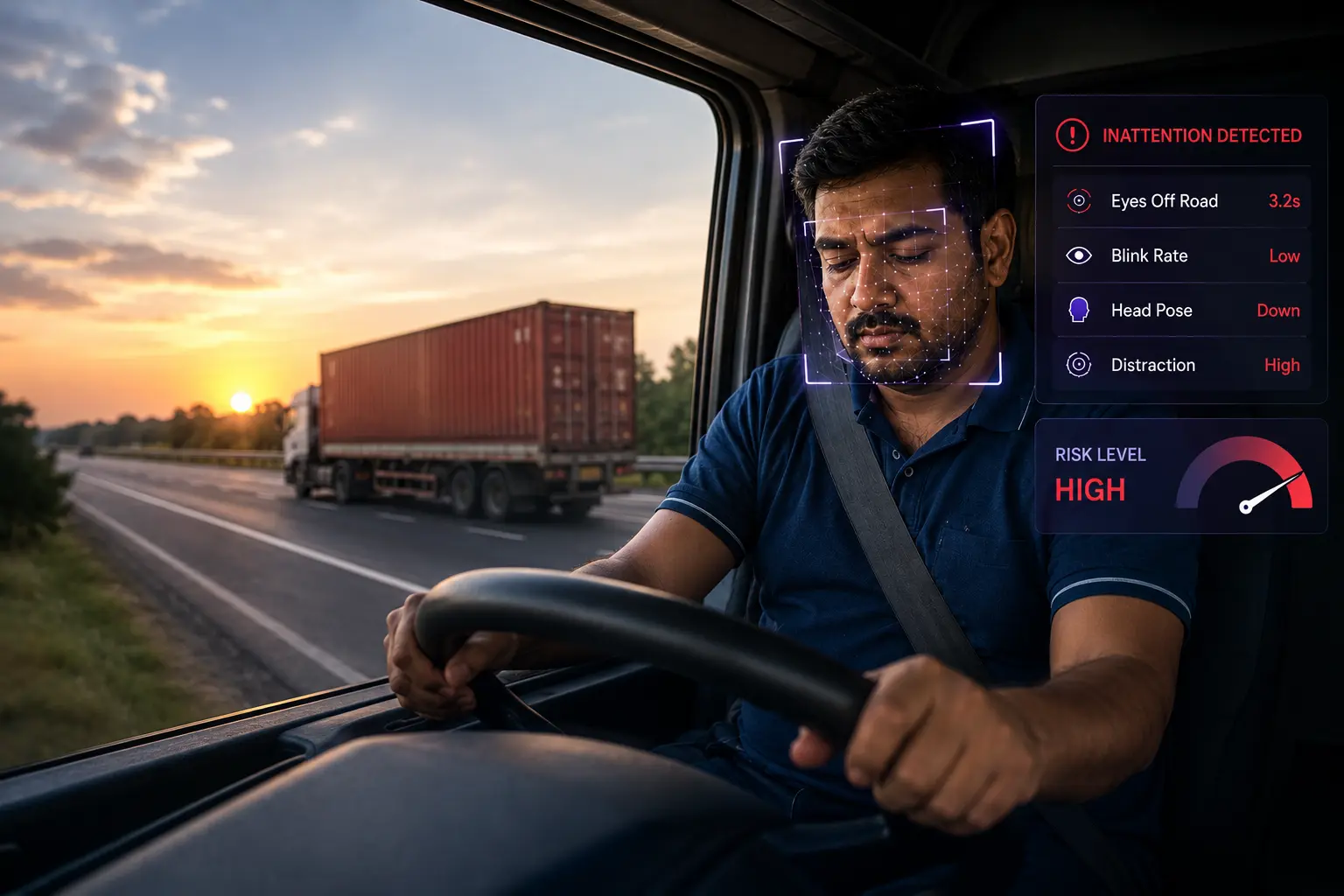
An ordinary dashcam records a loop that someone reviews after a crash. It is a witness, not a guard. An AI dashcam for trucks is built around live computer vision that understands what it is seeing in real time, and for the inattention problem, the critical half of that intelligence is the Driver Monitoring System, or DMS, the part of the camera pointed at the driver rather than the road.
The two intelligence layers do complementary jobs, and it is worth knowing which one addresses inattention:
|
Intelligence Layer |
What It Watches |
Inattention Events It Catches |
|
DMS (driver-facing) |
The person behind the wheel |
Fatigue, drowsiness, eye closure, yawning, distraction,
phone use, smoking, no seatbelt, face mismatch |
|
ADAS (road-facing) |
The world outside the truck |
Forward collision risk, lane departure, tailgating,
pedestrian in path |
For a cement bulker on a night run, the DMS layer is the one doing the heavy lifting against inattention. When the camera detects the drooping eyelids and slowing reaction that signal the onset of fatigue, or catches a driver glancing at a phone, it does not file a report for tomorrow. It intervenes in the same moment. On a capable platform such as the one detailed on the Fleetx video telematics page, the camera detects fifteen distinct alert types, delivers an in-cabin AI voice intervention in under two seconds, and speaks in seven Indian languages including Hindi, English, Tamil, Marathi, Kannada, and Telugu. A drowsy driver on a lonely corridor gets a spoken warning, in his own language, telling him to stop for rest before the micro-sleep becomes a fatality. That is the mechanism by which a camera attacks the 70 percent problem: it restores attention in the three seconds that decide everything.
The difference between the two categories of device is stark when you frame it around inattention rather than video quality.
|
Capability |
Ordinary Dashcam |
AI Dashcam With Driver Monitoring |
|
Fatigue and drowsiness |
Not detected |
Detected live, with instant voice alert |
|
Distraction and phone use |
Not detected |
Detected and flagged in real time |
|
When it acts |
After the crash |
In the seconds before the crash |
|
Driver correction |
None |
Self-correction via in-cab alert |
|
Location context |
Rarely |
GPS on every event via dash cam with GPS tracking |
|
Review effort |
Hours of raw footage |
Event-ranked clips, severity first |
|
Outcome |
Evidence of the crash |
Prevention of the crash, plus evidence |
This is why buyers in the dash cam for trucks India market have shifted from asking how many megapixels a device has to asking what it can detect and how fast it can intervene. The camera is only a sensor. Against inattention, the value is entirely in the intelligence, and in whether that intelligence was trained on Indian road conditions rather than borrowed from highways that behave nothing like ours.
Why Does a Dash Cam With GPS Tracking Matter So Much for Bulk Dispatch?
Detecting a fatigue event is only half the job. Knowing where and when it happened, on which corridor, in which vehicle, under which driver, is what turns a detection into something the operations team and the coaching team can actually use. That is the role of a dash cam with GPS tracking, and for a national bulk network dispatching across thousands of routes, it is not optional.
When video, location, and telematics fuse, every inattention event becomes a full data point rather than an orphan clip. A drowsiness alert on a night run is stamped with the exact coordinate, the road segment, the speed at the moment, the time, and the driver on that trip. Now the fleet can see patterns that were invisible before: which corridors produce the most fatigue events, which shifts, which time windows, which drivers. For bulk dispatch specifically, the combination pays off in ways a control room feels immediately:
• Geofencing plant and site: Draw virtual boundaries or a geofence around cement plants, weighbridges, and delivery sites, and get alerts with video the moment a bulker enters or leaves, confirming genuine stoppages against unexplained ones.
• Real-time visibility on remote corridors: A 4G dash cam with GPS streams events and live video over the cellular network as they happen, so a fatigue alert on a lonely stretch reaches the control room in seconds rather than at the end of a two-day trip.
• Live location plus live eyes: A wireless dash cam with GPS tracking lets a manager watch a vehicle move on a map and pull up a live HD stream from the cab at the same time, seeing the dot and the reality behind it together.
• Cargo and tanker accountability: Tie a load-facing view to location data, and the fleet knows precisely where and when a tanker valve or a cargo door was accessed, which matters for pilferage, adulteration, and false damage claims on bulk loads.
• Incident reconstruction that holds up: When a crash does happen, GPS turns clips into a second-by-second timeline of location, speed, and video, which is exactly what insurers and courts want, and what protects a bulker driver wrongly blamed simply for being the bigger vehicle.
Connectivity is what makes all of this live rather than a next-day download. For a network running long-haul across the country, a 4G dash cam in India setup means the data does not sit on a memory card waiting to be collected. It also means supervision scales: a good dashcam with GPS tracker India deployment pairs with a dash cam with GPS tracking app, so a supervisor overseeing hundreds of bulkers can check location, live view, and inattention alerts from a phone. GPS answers where, video answers what, and telematics answers how, and only when a device fuses all three does it become a system a 50,000-vehicle fleet can actually run on.
What Should a Cement Fleet Look for in the Best Dash Cam With GPS in India?
At fleet scale, a wrong buying decision multiplies across tens of thousands of vehicles, so the evaluation deserves discipline. If the goal is attacking inattention on long-haul bulk dispatch, these are the criteria that separate a device still earning its keep in year three from one quietly unplugged by month three. Anyone shortlisting the best dash cam with GPS in India for a bulk fleet should weigh:
• Driver monitoring that actually catches fatigue: The whole premise rests on reliable DMS. Demand real night-run detection of drowsiness, eye closure, and distraction, not just daytime demo footage.
• AI trained on Indian roads: Models tuned on foreign data misread Indian corridors and mixed traffic. Ask what data trained the system. A platform learning from billions of India-specific data points every month will simply be more accurate here.
• Sub-two-second in-cab intervention, in the driver's language: A warning a tired driver cannot understand changes nothing. Multilingual voice alerts are what convert a detection into a corrected behaviour on a night run.
• Genuine night video and fast retrieval: Bulk incidents cluster after dark. Insist on clear night footage and the ability to find and pull the exact clip in minutes, not hours.
• Deep integration with operations: The camera should connect to GPS, fuel, maintenance, and trip data so events carry full context and feed dispatch and coaching, not sit in an isolated app.
• Court-admissible, compliant storage: Look for a tamper-resistant archive that retains footage long enough to matter and aligns with AIS-140, India's standard for vehicle tracking and safety devices.
• Reliable connectivity and on-ground support: A wireless dash cam with GPS tracking is only as good as its network link and the team that installs and services it across every operating region.
• Transparent, scalable pricing: Across 50,000 vehicles, hidden subscription fees and surprise charges become budget-breaking. Insist on knowing the full cost before signing.
On compliance, it helps to know what AIS-140 is. It is an Automotive Industry Standard, framed under MoRTH and certified through bodies such as the Automotive Research Association of India (ARAI), specifying requirements for vehicle location tracking and safety features in commercial transport. A dashcam with GPS tracker India buyers can rely on fits this world cleanly rather than fighting it.
How Much Does AI Dash Camera Price Come To Across 50,000 Vehicles?
At single-vehicle scale, buyers obsess over the hardware sticker. At fleet scale, that instinct is dangerous because AI dash camera price is only one line in a much larger equation, and the smallest one. What actually determines the economics is the total cost against the avoided cost across the whole life of the deployment.
At the device level, connected truck cameras in India commonly range from roughly ₹8,000 to ₹25,000 per unit, depending on the number of camera channels, the depth of AI on board, and the connectivity built in. A basic single-lens recorder sits at the bottom. A dual-facing or triple-facing 4G dash cam with GPS carrying full DMS and ADAS sits toward the top. But across 50,000 vehicles, the recurring and operational costs dwarf that number, so the honest budget looks at the whole stack:
|
Cost Component |
What It Covers |
Why It Matters at Fleet Scale |
|
Hardware |
Camera units, sensors, SIM, install kits |
One-time, but multiplied by tens of thousands |
|
Installation |
Fitting and calibration across the network |
Rollout speed decides how long dispatch is disrupted |
|
Software subscription |
The AI platform, dashboards, alerts, storage |
The recurring cost, and where inattention value lives |
|
Connectivity |
4G data plans that stream events live |
No connectivity, no real-time night-run alerts |
|
Cloud archive |
Compliant retention of event and trip footage |
Longer, AIS-140 aligned retention protects you legally |
|
Support and coaching |
Onboarding, driver enablement, service |
At scale, weak support quietly kills adoption |
Now set that against what inattention costs. A single prevented night-run collision on a loaded bulker, one written-off tanker avoided, one won insurance dispute, or one fraudulent claim defeated can pay for thousands of cameras. When you model AI dash camera price across a large cement fleet, the recurring platform and connectivity costs are trivial next to the cost of the crashes the system prevents. This is why enterprise buyers at this scale almost always prefer a bundled model, where hardware, software, connectivity, and support come as one predictable price with no surprises, over a low headline hardware cost that hides recurring fees. When comparing quotes, compare the whole system over three years, and ask every vendor to show not just what it costs but what fleets like yours saved after deploying it. A vendor who can only talk about the camera and not about inattention outcomes is selling a recorder with a nicer interface.
How Do the Camera Options Compare for a National Bulk Transport Network?
The market looks like a hundred products but really sorts into four categories, and for a fleet chasing the 70 percent inattention problem, the category matters more than the brand. The comparison below, drawn from how Fleetx frames its own video telematics against the alternatives, shows why.
|
Capability |
Unified AI Platform (e.g. Fleetx) |
Basic Dashcam |
GPS Tracker + Camera |
Global Enterprise Tool |
|
Driver monitoring for inattention |
15 alerts, fatigue and distraction detected live |
Motion or impact only |
None |
Trained on US or EU data |
|
In-cab intervention |
AI voice under 2 seconds, 7 languages |
Push, often ignored |
No response |
15 minute plus lag |
|
Fleet management and TMS |
Unified in one system |
Standalone app |
No operations link |
Heavy API work required |
|
India road AI training |
31 billion plus data points a month |
No learning |
No AI |
US or EU data only |
|
Deployment time |
72 hours, 600 plus engineers |
Self-install, weeks |
Weeks |
8 to 16 week trial |
|
Court-admissible archive |
90 days, AIS-140 aligned |
7-day overwrite |
None |
Sold as an add-on |
|
Pricing model |
Bundled, predictable |
Hardware only |
Hardware cost |
USD pricing |
The pattern is easy to miss. A basic dashcam gives you footage of the crash you failed to prevent. A GPS tracker with a camera bolted on gives you location and footage that rarely talk to each other. A global enterprise tool is powerful but often built for foreign roads, priced in dollars, and slow to deploy across a fragmented Indian bulk network. A unified AI platform designed for Indian fleets tries to collapse the camera, the GPS, the driver monitoring, the coaching, and the compliance into one system that installs fast and speaks the corridor's language. For a 50,000-vehicle cement operation dispatching through many transporters, the unified approach is the only one that scales without turning into a systems-integration project that never ends.
What Is Driver Coaching Software, and Why Can't Cameras Fix Inattention Alone?
Here is the trap that catches fleets who buy hardware and stop there. A camera that flags ten thousand fatigue and distraction events and does nothing structured with them is an expensive anxiety machine. Detection is not improvement. The bridge between the two is driver coaching software, and for the inattention problem it is the part of the system that decides whether the 70 percent actually falls.
Driver coaching software takes the raw stream of inattention events the AI dashcam produces, the 2 a.m. drowsiness flag, the phone glance, the repeated tailgating, and turns it into something a human can act on. It scores each driver on real on-road behaviour rather than reputation. It separates the driver who had one rough night from the driver with a chronic fatigue pattern who is dispatched on night runs he cannot safely handle. And it feeds that back into a loop of review, conversation, and follow-up that changes behaviour over weeks. This is the layer people mean when they talk about driver training software, a driver coaching program, or driver training software solutions. The names differ, the job is the same: convert inattention data into safer drivers. A strong platform does several things at once:
• Assigns every driver a behaviour-based safety score that updates from actual events, not opinion.
• Ranks inattention incidents by severity, so coaches spend limited time on the fatigue events that could kill someone, not on trivia.
• Links every event to a specific driver, vehicle, and route using face-match, so accountability is fair and clear across many transporters.
• Surfaces historical trends, so a fleet can see whether a driver's inattention is improving, plateauing, or worsening.
• Flags who needs coaching and who deserves recognition, because rewarding attentive drivers matters as much as correcting risky ones.
Notice what this assumes. The cameras and telematics generate the raw inattention events, but the actual reduction in the 70 percent happens in the workflow: the coaching conversation, the follow-up, the scorecard, a driver knows their route assignment depends on. If a vendor dazzles you with clips and dashboards but cannot show how events get owned, categorized, resolved, and coached down over time, they are showing you a recorder, not a coaching system. The best driver training software is judged not by how many inattention events it catches, but by how few of them keep happening after coaching.
How Do You Build a Driver Coaching Program Across 50,000 Drivers Without Losing Them?
The fastest way to sink a driver monitoring rollout is to let drivers experience it as a surveillance and punishment tool. If the camera feels like a spy that only ever gets people in trouble, drivers cover the lens, unplug the unit, and treat every fatigue alert as harassment. At the scale of a national cement network dispatched through many transporters, that resistance can quietly kill the whole program. A good driver coaching program is designed from the start to feel like support, which is a change-management challenge as much as a technology one. The most effective programs tend to follow a rhythm:
- Frame it honestly as protection first. Tell drivers the camera exists to protect them, from fatigue that could kill them on a night run, from false blame when a bulker is wrongly held responsible simply for being the bigger vehicle. Show a real clip where footage exonerated a driver.
- Lead with the in-cab alert, not the manager report. The private, in-the-moment voice warning that lets a driver self-correct builds trust far faster than a report that lands on a supervisor's desk the next day.
- Score fairly and transparently. Drivers should see their own score, understand exactly what moves it, and know the same rules apply across every transporter. A black-box score no one can see breeds resentment.
- Coach with video, not lectures. Ten minutes over an actual clip of a near-miss on a familiar corridor teaches more than any printed fatigue policy. Keep it specific, keep it about the behaviour, keep it human.
- Reward attentive drivers loudly. Recognition, incentives, and preferred route assignments for high scorers turn safety from a stick into a status symbol, and this single move shifts culture more than any penalty.
- Close the loop and prove it. Show drivers, as a group, that fatigue and distraction events are falling and scores are rising. When people see the program working, they buy in and defend it.
The contrast between the old way and the new way is really a contrast between two philosophies of managing drivers, and it is worth making explicit for anyone rolling this out at scale.
|
Dimension |
Reactive, Punitive Approach |
Proactive Coaching Approach |
|
When you act |
After a crash or a complaint |
In the moment, and in weekly review |
|
What drivers feel |
Watched and blamed |
Supported and coached |
|
Data used |
One cherry-picked clip |
Full inattention trend over time |
|
Coaching style |
Reprimand and paperwork |
Conversation over real footage |
|
Attentive drivers |
Ignored |
Recognised and rewarded |
|
Result |
Resentment, hidden cameras |
Falling inattention, real trust |
The tool either supports this culture or undermines it. The best driver training software makes fair scoring, quick video review, and clear trend reporting almost effortless, so coaches actually coach instead of drowning in footage from 50,000 vehicles. Driver training software solutions that bury that workflow under complexity get abandoned, and an abandoned safety program is worse than none, because it costs money and teaches drivers that management was never serious about the 70 percent in the first place.
What Did the Numbers Look Like After Fleetx Driver Monitoring Went Live?
The proof of an inattention program is whether the events actually fall and stay down. The pattern that emerges from real AI video telematics deployments is consistent enough to plan around, and it is the reason a fleet at 50,000 vehicles keeps investing rather than treating cameras as a one-time compliance purchase. Across Fleetx deployments, the documented outcomes cluster like this:
• Up to 90 percent reduction in accidents where the full detect-alert-coach loop is followed.
• 40 percent drop in repeat violations, which is the clearest possible sign that coaching is beating inattention rather than just recording it.
• 3x faster incident response as night-run alerts move from hours to minutes.
• 60 percent less manual video review because AI ranks the fatigue and distraction events that matter instead of leaving humans to scrub raw footage from thousands of cabs.
For the 50,000-vehicle cement network in this story, that translates into a simple operational arc. Before, night-run inattention was invisible until a crash exposed it. After driver monitoring went live, the DMS fatigue and distraction alerts began correcting drivers in the moment, the GPS-tagged event data revealed which corridors and shifts produced the most inattention, and the driver coaching software turned that into targeted coaching and scorecards across the workforce. The 70 percent stopped being a fact of nature and became a number the fleet could push down, quarter after quarter. Two verified deployments show the same machinery working at real scale:
FlixBus India: AI eyes on 100 percent of a 200-bus fleet
FlixBus India partnered with Fleetx to run an AI-enabled dashcam safety program across 100 percent of its fleet of 200 intercity buses, rolled out in phases of fifty units. The dual-lens dashcams pair road-facing and driver-facing views and specifically target the inattention behaviours that matter on long intercity runs: driver fatigue, mobile phone usage, and camera obstruction. Alerts land instantly with a 24*7 traffic control team that now runs weekly real-time driver support interactions, and FlixBus reports measurable improvements in driver behaviour across the network. The company tied the program to MoRTH's push for technology-enabled safety, and Fleetx's leadership framed it as proof that real-time telematics and AI analytics can create scalable solutions that save lives and drive discipline across fleet operations. The parallel to cement bulkers is direct: long routes, tired drivers, high consequence, and the same DMS answer.
A global FMCG major: one control tower over 1,900 vehicles and 2,500 drivers
At closer to bulk-network scale, a global FMCG major, described in Fleetx's analysis of truck camera systems, ran an Indian distribution network of roughly 190 transporters, about 1,900 vehicles, and more than 2,500 drivers. Before deployment, safety monitoring varied wildly from transporter to transporter with no common standard, exactly the fragmentation a large cement fleet faces. With a single Fleetx Safety Control Tower over the whole network, the operation resolved 95 percent of safety alerts within 30 minutes, held a 90 percent issue resolution rate, and turned more than 2,500 drivers into a measurable, coachable workforce with individual scorecards. The lesson maps straight onto cement dispatch: the cameras generate the inattention events, but the value comes from governance, from issues being owned, categorized, and closed against the clock.
None of these outcomes comes from the camera alone. They come from driver monitoring, GPS-tagged context, and the coaching workflow operating as one system. Remove any single piece, and the 70 percent stops falling.
How Do You Roll This Out Across a National Cement Network Without Stalling Dispatch?
The fear at this scale is real: installing driver monitoring across tens of thousands of bulkers and tankers, dispatched through many transporters, without freezing operations for months. Global enterprise tools often do involve trials stretching eight to sixteen weeks and installations measured in months. It does not have to be that way. A deployment built for scale, such as Fleetx's model of a 72-hour rollout backed by more than 600 field engineers, is designed to avoid exactly that. The sequence that keeps cement moving while the system goes live tends to look like this:
- Define the risk you are attacking first. For bulk and cement, that is night-run fatigue and distraction, so prioritise DMS, in-cab intervention, and a 4G dash cam in India that streams from remote corridors.
- Phase the installation by corridor or transporter. Roll out in batches, learn, and adjust, rather than betting the whole network on day one.
- Integrate with existing dispatch and telematics. Connect cameras to the GPS, fuel, maintenance, and trip systems already running so inattention events arrive with full context instead of creating another disconnected dashboard.
- Onboard drivers before hardware. Set the protection-not-punishment tone, show the exoneration case, and bring transporters into the standard before the first camera powers on.
- Stand up the control tower workflow. Decide who owns night-run alerts, how fast they must respond, and how issues close. The 95 percent within 30 minutes benchmark only works if that ownership is designed in advance.
- Baseline and measure from week one. Record accident, inattention, and response numbers before rollout so the improvement is provable at budget time. What you do not measure, you cannot defend.
Rollout is where most safety programs quietly fail, not because the technology is weak but because the human and multi-transporter change management was an afterthought. Treat that with the same seriousness as the hardware install, and a 50,000-vehicle program actually sticks.
Where Is Driver Monitoring Headed for India's Cement and Bulk Fleets?
The direction is clear, and it moves from recording toward prediction. First-generation dashcams recorded. Second-generation AI dashcams detect fatigue and distraction and intervene in real time, which is where the fight against the 70 percent problem lives today. The next generation, already emerging, is predictive: by fusing live video with telematics signals such as hours on the road, braking patterns, corridor risk, and time of night, these systems increasingly flag a high-risk fatigue situation before the driver even feels it. The camera stops being a witness and becomes a co-pilot that knows the driver is heading toward danger.
This aligns with where policy is pushing. MoRTH's safety agenda, India's commitments under the United Nations Decade of Action for Road Safety 2021 to 2030 to halve road deaths, the World Health Organization framing of road safety as a preventable epidemic, and the broader Viksit Bharat vision for 2047 all lean on data-backed, technology-enabled transport. A cement fleet that attacks inattention now is not just cutting its own costs and protecting its own drivers. It is getting ahead of a regulatory and cultural shift that is only accelerating.
There is also a quieter shift in what the data becomes. As driver monitoring matures, the inattention scorecard turns into a real operations and HR asset, feeding hiring, insurance negotiations, incentives, and route assignment on night-heavy corridors. The archive becomes a legal shield for bulker drivers. The alert stream becomes a live fatigue map of the network. The camera in the cab stops being a device the fleet bought and becomes the infrastructure its safety operation runs on.
What Should a Bulk Fleet Take Away From This?
If you remember nothing else, hold on to these, because they decide whether a driver monitoring investment actually pushes the 70 percent down:
• Inattention, meaning fatigue and distraction, is involved in roughly 70 to 80 percent of crashes, and it hits cement and bulk fleets hardest because of long-haul, night-heavy dispatch.
• An AI dashcam for trucks with a strong driver monitoring system is what sees inattention coming and corrects it in the seconds that decide everything.
• A dash cam with GPS tracking turns each fatigue event into a usable data point, and a 4G dash cam with GPS plus a dash cam with GPS tracking app make it real time and supervisable across thousands of vehicles.
• The best dash cam with GPS in India for bulk transport is the one with reliable night DMS, India-trained AI, sub-two-second multilingual alerts, AIS-140 aligned storage, and on-ground support, not the flashiest spec sheet.
• AI dash camera price should be judged on total cost against avoided cost. One prevented night-run bulker crash can pay for thousands of cameras.
• Driver coaching software is what actually moves the number. Cameras detect inattention, coaching reduces it, and without the coaching workflow the detection is just noise.
• A driver coaching program built as support, not surveillance, with fair scoring and rewards, is what keeps 50,000 drivers on side, and the best driver training software makes that workflow effortless.
• Verified deployments, from FlixBus India's 200 buses to a 1,900-vehicle FMCG network, show the full loop delivering up to 90 percent fewer accidents, 40 percent fewer repeat violations, 3x faster response, and 60 percent less manual review.
Ready to Attack the Inattention Problem in Your Fleet?
If you run cement, bulk, or tanker dispatch and the night-run fatigue risk keeps you up, the gap between reading this and acting on it is smaller than it looks. See how an AI dashcam for trucks, a dash cam with GPS tracking, and driver coaching software work together against inattention on Indian corridors: explore the Fleetx video telematics platform and schedule a demo with your own routes, bulkers, and drivers in the frame. The camera is ready to see fatigue before it becomes a crash. The only question is whether your fleet is ready to let it start preventing the next night-run incident instead of just recording it.