
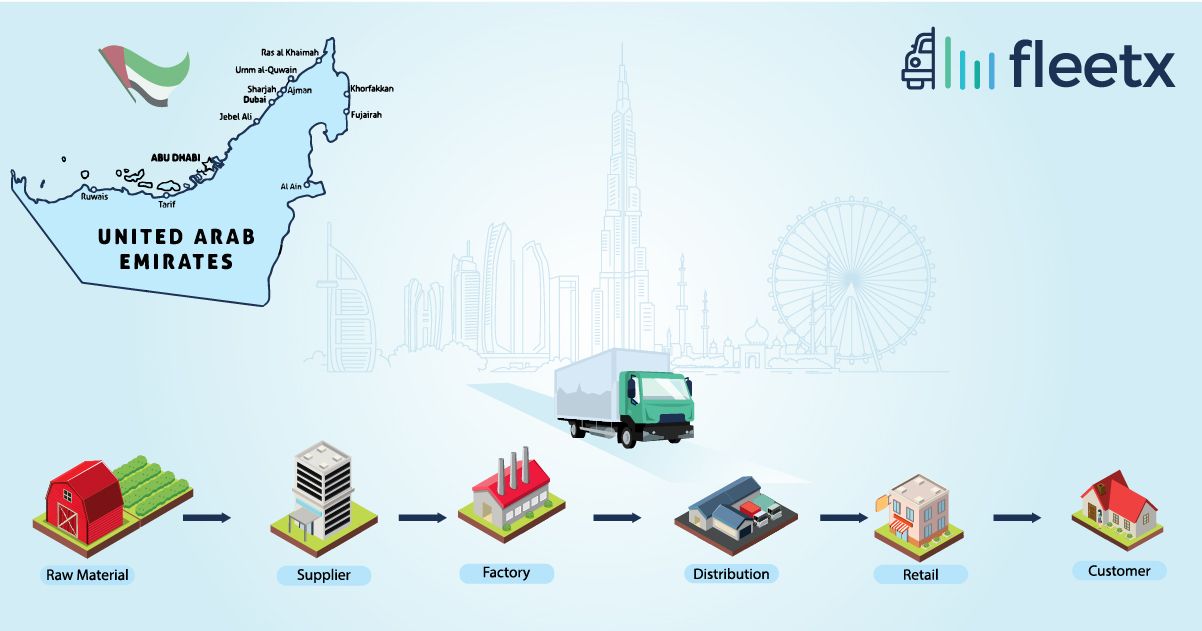
The United Arab Emirates is one of the most important countries in the world from a logistics & supply chain perspective. Seven emirates make up the country: Abu Dhabi, Dubai, Sharjah, Ajman, Umm Al-Quwain, Fujairah, and Ras Al Khaimah. UAE has seen a shift from being a logistics hub to a supply chain nerve centre primarily for Asia, Europe, and MEA. The shift has resulted from economic diversification, effective implementation of the national logistics plan, and digital transformation by private and public entities across the region. Investments in the logistics and supply chain sector are also key reasons for developing UAE's supply chain industry.
According to IMARC Group, the UAE logistics market was valued at USD 54.5 billion in 2024 and is projected to reach USD 95.2 billion by 2033, growing at a steady CAGR of 5.7%. The rapid growth of e-commerce in the region, especially in the post-pandemic economy, has positively impacted the logistics and supply chain industry. Consumer preference is rapidly shifting from conventional stores to e-commerce. As a result, logistics service providers are rapidly expanding and improving their transportation and distribution operations to cater to these e-commerce businesses. Thus, we can confidently presume a positive correlation between advancement in e-commerce and improving supply chain operations within the region.
The boost in logistics and supply chain operations and its increasing share in the region's economy has allowed the Emirates to focus on other non-petrochemical sectors, witnessing stagnation, such as manufacturing, which further boosts demand for supply chain services. However, despite the advancements, the supply chain industry remains fragmented and unorganised with several vendors. The COVID-19 pandemic affected supply chain operations in the region, with road transport being affected due to the sealing of borders. Moreover, the pandemic has forced several logistics operators to shift to remote work. The shift highlighted several regional supply chain problems, particularly the ineffective shift to remote operations, affecting the supply chain.
Logistics and Supply Chain challenges in the UAE
The fragmented logistics and supply chain sector present several challenges to the efficiency and growth of operations. This section looks at some of the most pressing challenges plaguing the country's supply chain operations.
Road transportation-related challenges
A growing population and influx of expatriates in key economic centres in the UAE continue to worsen traffic congestion. Traffic congestion can lead to delays in shipping which further reduces the fleet's and drivers' productivity. Moreover, traffic delays also lead to high fuel usage and negatively impact fuel efficiency, further adding to the cost of operation. Additionally, most drivers in UAE are expatriates from other Asian countries with little to no experience on roads in UAE and relatively lower wages. As a result, they tend to speed to make more deliveries, increasing the safety risk for the vehicle and cargo.
Fluctuations in fuel price affect operating costs
The fuel cost is the most significant expense for transportation. Despite being a major oil & gas exporter, the Emirates has also not been immune to fluctuations in fuel prices globally. Prices at fuel pumps are set based on benchmarks provided by S&P Global, with an additional margin added to compensate retailers for transportation & logistics. The Fuel prices in UAE have risen over 74% since January 2022, thus, having a ripple effect on the cost of transportation and the supply chain. The diesel price rose as high as 4.76 AED or 103.58 INR per litre in July 2022, with the current price being around 4.14 AED or 90.09 INR in August 2022. Such sharp fluctuation in fuel prices also leads to fluctuations in the cost of the supply chain in the region, thus, hindering businesses from planning for long-term efficiency in the supply chain. Thus, it becomes crucial for businesses to improve fuel management and efficiency for their fleet.
Lack of automation in warehousing
Increasing e-commerce in the region has led to an exponential increase in demand for warehouses. However, most warehouses in the UAE still operate with little technological integration. Lack of automation also leads to issues like inaccurate inventory management affecting the cost, efficiency, and innovation in supply chain operations. The resistance to automation is propelled due to cheap labour. Increasingly, warehouse automation service providers are witnessing an increase in demand for automation services, primarily by small and medium-sized businesses in the region.
Inaccurate inventory management
Manually operated warehouses are more prone to inventory error since it requires workers to manage it manually. Lack of information & technology integration in inventory management also means they are not updated in real time, thus, reducing the efficiency and accuracy of operation.
Lack of data and insights from operations
E-commerce supply chains are relatively fast-moving when compared to other industrial supply chains. Thus, inventories need to be constantly updated, and orders must be simultaneously processed, packaged, and shipped to keep up with the supply and demand of goods. Lack of technology in such operations means there is little data and insights for businesses to analyse and fix supply chain bottlenecks and inefficiencies.
Given rising demand, the government has also taken several positive measures to improve the regional supply chain infrastructure and transportation connectivity. One such initiative includes Dubai Silk Road Strategy, which aims to boost air and sea freight and enhance logistical integration. Several other initiatives include free zones (for example, Jebel Ali Free Zone) to improve logistics services and offers, increasing the number of special freight corridors, and setting up Integrated Logistics Centres and EV and battery logistics hubs, among others. All these policy decisions will aid integration and digitalisation and promote sustainability in the supply chain operations.
Using technology to tackle supply chain challenges in the UAE
The UAE continues to rank among the world's most digitally advanced nations. According to GSMA Intelligence, mobile connections in the UAE stood at 219.4% of the total population as of early 2024 — one of the highest rates globally. Internet penetration in the UAE reached 99% at the start of 2024, with virtually the entire population online. On internet speeds, the UAE has consistently topped global charts — ranking 1st globally for mobile internet speed with an average download of 539.84 Mbps as of mid-2025, according to Ookla's Speedtest Global Index. The UAE's broader infrastructure and competitiveness credentials are equally impressive: according to the IMD World Competitiveness Yearbook 2024, the UAE ranked 7th globally overall, 2nd in Economic Performance, and 4th in Government Efficiency. Taking account of the key variables to make the supply chain more efficient, the UAE is doing remarkably well on all of them, thus making it ripe for disruption with sufficient resources in its arsenal.
There are certain measures or solutions businesses in the UAE can implement to tackle supply chain problems and make them more efficient.
Using route planning systems for transport operations
Businesses can implement smart route planning and scheduling software to ensure their fleet takes the most efficient routes during shipping. Route planning software uses live traffic data and past trip data to provide the most efficient route to drivers. Moreover, in case of disruptions on the desired route, the software provides rerouting options in real-time. Thus, helping fleets to reduce their travel time and provide an accurate ETA to customers.
Using driver behaviour analytics for improving safety
Businesses can integrate driver behaviour analytics into their fleet to curb such instances, tackle the safety issue, and bring down human errors during operations. Driver analytics software can further assist logistics operators in training and incentivising drivers to enhance safety during their operations.
Other transport management tools to improve efficiency and reduce cost
Several other technological solutions are helping businesses and logistics service providers improve their operating efficiency and supply chain visibility, helping them bring the cost of operations down. A fuel management solution can help businesses manage their fuel better and improve fuel efficiency, while a vehicle tracking system allows businesses to gain more visibility in their ongoing operations. Several fleet management companies offer more innovative solutions, such as EV fleet management solutions, to aid businesses in transitioning their operations toward a more sustainable supply chain.
In conclusion, shifting from traditional supply chain management to a more digitalised and integrated one can be pressing and may incur initial costs. However, their multiple benefits can help businesses run more profitably and sustainably, which is the need of the hour. Thus, businesses should shed their apprehensions and integrate their supply chain operations with technology, particularly in countries like the UAE, where the existing infrastructure is more than capable of integrating technology into its supply chain ecosystem.
Strengthening Supply Chain Resilience in the UAE: Strategies for Long-Term Business Continuity
The UAE has established itself as one of the world's most strategically positioned logistics hubs, connecting Asia, Europe, and Africa through an extensive network of ports, airports, highways, and free trade zones. While this connectivity provides significant opportunities for businesses, it also exposes supply chains to a variety of global risks. Events occurring thousands of kilometres away, including geopolitical tensions, shipping disruptions, inflation, natural disasters, supplier insolvencies, cyberattacks, and changing trade regulations, can quickly affect logistics operations within the UAE. As a result, businesses are increasingly recognising that supply chain resilience has become just as important as supply chain efficiency.
Supply chain resilience refers to an organisation's ability to anticipate, prepare for, respond to, and recover from disruptions while maintaining operational continuity. Unlike traditional supply chain management, which primarily focuses on reducing costs and improving operational efficiency, resilient supply chains are designed to adapt quickly when unexpected situations arise. Businesses that invest in resilience are better positioned to minimise financial losses, maintain customer trust, and sustain long-term growth even during periods of uncertainty.
One of the most effective ways to build resilience is through supplier diversification. Many organisations continue to rely heavily on a limited number of suppliers because doing so simplifies procurement and often reduces purchasing costs. However, this strategy creates significant operational risk. If a single supplier experiences production delays, financial instability, labour shortages, or transportation disruptions, the entire supply chain may be affected.
Instead of depending on one source, UAE businesses should establish a diversified supplier network that includes multiple qualified vendors across different geographical regions. Diversification reduces dependency while ensuring that procurement operations can continue even if one supplier becomes temporarily unavailable. Businesses should regularly evaluate supplier performance based on quality, delivery reliability, compliance standards, financial stability, and production capacity to maintain a balanced supplier portfolio.
Geographical diversification is equally important. Procuring products from suppliers located across different countries reduces exposure to regional disruptions such as political conflicts, natural disasters, or transportation bottlenecks. For organisations serving customers across the GCC and wider Middle East, sourcing from multiple international markets can significantly improve operational flexibility.
Inventory management also plays a critical role in supply chain resilience. For many years, organisations focused heavily on lean inventory strategies that minimised storage costs by maintaining only limited stock. Although lean inventory improves operational efficiency during stable market conditions, it leaves businesses vulnerable when unexpected disruptions occur.
Modern supply chains increasingly balance efficiency with preparedness by maintaining strategic inventory reserves for essential products and components. Safety stock allows organisations to continue serving customers during temporary supplier delays or transportation interruptions. The objective is not to increase inventory indiscriminately but to determine appropriate buffer levels based on demand variability, supplier reliability, lead times, and product criticality.
Demand forecasting supports this approach by helping businesses anticipate seasonal fluctuations, promotional campaigns, economic conditions, and customer purchasing behaviour. Accurate forecasting reduces both stock shortages and excess inventory, improving service levels while optimising working capital.
Another essential aspect of resilience is strengthening relationships with logistics partners. Transportation providers, warehouse operators, customs brokers, and freight forwarders all contribute to supply chain performance. Businesses that treat logistics partners as long-term strategic collaborators rather than transactional vendors often experience better operational coordination during periods of disruption.
Regular communication, clearly defined service-level agreements, shared performance objectives, and contingency planning improve coordination across the logistics ecosystem. Collaborative relationships also allow businesses to respond more quickly when alternative transportation routes or emergency distribution plans become necessary.
Cross-border logistics is particularly important for organisations operating within the UAE because international trade accounts for a significant portion of regional economic activity. Customs procedures, import regulations, documentation requirements, and trade agreements continue to evolve across different markets. Companies that actively monitor regulatory developments can reduce the likelihood of delays caused by documentation errors or compliance issues.
Maintaining accurate trade documentation, ensuring compliance with customs regulations, and periodically reviewing import and export procedures contribute significantly to uninterrupted cross-border operations. Businesses should also establish contingency plans for alternative ports, border crossings, and transportation corridors whenever feasible.
Business continuity planning forms another pillar of resilient supply chain management. Every organisation should prepare structured response plans for high-impact operational scenarios such as supplier failures, warehouse closures, transportation interruptions, cybersecurity incidents, equipment breakdowns, labour shortages, and severe weather conditions.
An effective continuity plan clearly defines organisational responsibilities, communication protocols, escalation procedures, recovery priorities, and alternative operating methods. Employees should receive periodic training so they understand their responsibilities during emergencies. Regular simulation exercises help organisations identify weaknesses in their response strategies before real disruptions occur.
Risk assessments should become an ongoing management activity rather than a one-time exercise. Supply chain risks continuously evolve due to changing geopolitical conditions, market dynamics, regulatory reforms, environmental challenges, and technological developments. Businesses should periodically evaluate both internal and external risks while assigning probability and impact ratings to each identified threat.
Common operational risks include supplier concentration, transportation delays, inventory shortages, equipment failures, cybersecurity threats, fluctuating fuel costs, labour availability, demand volatility, and regulatory changes. Understanding these risks enables management teams to allocate resources more effectively toward mitigation initiatives.
Financial resilience is another often-overlooked component of supply chain stability. Unexpected disruptions frequently increase transportation expenses, procurement costs, insurance premiums, and inventory carrying costs. Organisations should regularly evaluate their financial preparedness by maintaining contingency budgets, reviewing insurance coverage, diversifying revenue streams, and improving cash flow management.
Contract management also contributes to operational resilience. Procurement contracts should clearly define delivery expectations, quality standards, force majeure clauses, penalty provisions, alternative sourcing arrangements, and dispute resolution mechanisms. Well-structured agreements provide greater operational certainty during periods of uncertainty while reducing legal complications.
Customer communication becomes especially important whenever disruptions affect delivery schedules. Transparent communication strengthens customer confidence even when delays cannot be completely avoided. Businesses should provide proactive updates regarding shipment status, revised delivery timelines, available alternatives, and corrective actions being implemented. Honest and timely communication often preserves customer relationships far more effectively than delayed or incomplete information.
Workforce resilience represents another critical success factor. Employees remain central to supply chain performance regardless of technological advancements. Organisations should invest in continuous employee training, cross-functional skill development, leadership succession planning, and workplace safety programmes. Cross-trained employees enable businesses to maintain operations even when certain teams experience staffing shortages or unexpected absences.
Warehouse resilience deserves equal attention. Distribution centres should establish contingency procedures for equipment failures, utility interruptions, inventory inaccuracies, and seasonal demand surges. Optimising warehouse layouts, maintaining preventive equipment maintenance schedules, and implementing regular inventory audits help minimise operational disruptions while improving service reliability.
Transportation resilience extends beyond vehicle availability. Businesses should periodically review fleet capacity, carrier availability, route diversity, and emergency transportation arrangements. Maintaining relationships with multiple transport providers ensures greater flexibility during periods of unusually high demand or unexpected capacity shortages.
Environmental sustainability increasingly complements supply chain resilience. Efficient resource utilisation, waste reduction, responsible sourcing, and energy-efficient logistics practices not only support sustainability objectives but also reduce operational dependency on scarce resources. Sustainable supply chains are generally more adaptable because they emphasise long-term resource optimisation rather than short-term operational gains.
Scenario planning provides organisations with an opportunity to prepare for future uncertainties before they materialise. Management teams can evaluate various hypothetical situations, including port congestion, supplier bankruptcy, fuel price volatility, trade restrictions, or extreme weather events and develop practical response strategies for each scenario. Scenario planning improves organisational preparedness while reducing decision-making delays during actual disruptions.
Finally, resilience should be viewed as an ongoing competitive advantage rather than simply a risk management initiative. Organisations capable of maintaining reliable service during challenging market conditions often strengthen customer loyalty, improve market reputation, and capture new business opportunities when competitors struggle to recover.
As global trade networks continue evolving, UAE businesses that prioritise supplier diversification, strategic inventory planning, collaborative partnerships, business continuity, proactive risk management, workforce preparedness, and operational flexibility will be significantly better equipped to navigate uncertainty. Building resilience today enables organisations not only to withstand future disruptions but also to create stronger, more reliable, and more sustainable supply chains capable of supporting long-term growth in an increasingly interconnected global economy.
Traditional Supply Chains vs Resilient Supply Chains
| Aspect | Traditional Supply Chain | Resilient Supply Chain |
|---|---|---|
| Primary Objective | Cost optimisation | Business continuity with efficiency |
| Supplier Strategy | Limited suppliers | Diversified supplier network |
| Inventory Planning | Minimal inventory | Strategic safety stock based on risk |
| Risk Management | Reactive | Continuous risk assessment and mitigation |
| Business Continuity | Limited contingency planning | Comprehensive continuity planning |
| Cross-Border Operations | Dependent on fixed routes | Alternative logistics corridors and ports |
| Customer Communication | Reactive updates | Proactive and transparent communication |
| Workforce Strategy | Role-specific skills | Cross-trained workforce for flexibility |
| Performance Focus | Operational efficiency | Efficiency, adaptability, and resilience |
| Long-Term Outcome | Lower costs but higher disruption risk | Sustainable operations with faster recovery from disruptions |
Essential Supply Chain KPIs UAE Businesses Should Track for Better Logistics Performance
The UAE has established itself as one of the world's leading logistics and trade gateways, connecting businesses across Asia, Europe, Africa, and the Middle East. With world-class ports, airports, free zones, and road infrastructure, companies operating in the UAE are expected to maintain high levels of operational efficiency while meeting growing customer expectations for speed, visibility, and reliability.
However, investing in infrastructure and technology alone is not enough to build a high-performing supply chain. Businesses must also measure operational performance consistently to understand where improvements are needed and ensure every stage of the supply chain is operating efficiently. This is where Key Performance Indicators (KPIs) become invaluable.
Whether managing domestic deliveries across Dubai, Abu Dhabi, Sharjah, and the Northern Emirates or coordinating international freight movements through the UAE's logistics hubs, businesses should monitor a structured set of KPIs to evaluate transportation, warehousing, inventory, procurement, and customer service performance. Regular KPI tracking enables organisations to identify inefficiencies early, reduce operating costs, improve customer satisfaction, and make data-driven decisions that support long-term growth.
The following KPIs are among the most important metrics businesses operating in the UAE should monitor to strengthen supply chain performance and improve overall operational resilience.
1. On-Time In-Full (OTIF)
One of the most important KPIs UAE businesses should monitor is On-Time In-Full (OTIF). This metric measures the percentage of customer orders delivered within the promised timeframe and with the complete quantity requested.
For organisations serving customers across multiple emirates or managing cross-border deliveries within the GCC, maintaining a high OTIF score is essential for ensuring service reliability. Poor OTIF performance often highlights underlying operational issues such as inventory shortages, warehouse delays, supplier inconsistencies, or transportation bottlenecks.
Regularly monitoring this KPI enables businesses to improve delivery consistency, strengthen customer trust, and reduce the costs associated with delayed or incomplete orders.
2. Perfect Order Rate
Another KPI every UAE business should track is the Perfect Order Rate, which measures whether an order reaches the customer without any operational errors.
A perfect order is delivered:
- On time
- In the correct quantity
- Without damage
- With accurate documentation
- Without requiring returns or follow-up corrections
For businesses handling large shipment volumes through logistics hubs such as Jebel Ali, Khalifa Port, or Dubai South, maintaining a high perfect order rate helps minimise reverse logistics costs while improving customer satisfaction and operational efficiency.
3. Inventory Turnover
Inventory Turnover measures how efficiently inventory moves through the supply chain over a specific period.
Given the UAE's role as a regional distribution hub, many businesses manage inventory destined not only for domestic customers but also for neighbouring GCC markets. Monitoring inventory turnover helps organisations maintain the right inventory levels while avoiding excessive storage costs and reducing the risk of obsolete stock.
Maintaining an appropriate turnover rate enables businesses to optimise warehouse capacity while ensuring products remain readily available to meet customer demand.
4. Forecast Accuracy
Forecast Accuracy is another KPI businesses operating in the UAE should review regularly.
Demand patterns often fluctuate during Ramadan, Eid, shopping festivals, tourism peaks, and major international exhibitions, making accurate demand forecasting particularly important. Businesses that consistently monitor forecast accuracy can improve procurement planning, inventory allocation, warehouse capacity management, and transportation scheduling.
Improved forecasting reduces stock shortages, excess inventory, emergency procurement, and unnecessary operational costs while enabling businesses to respond more effectively to changing market conditions.
5. Order Cycle Time
Order Cycle Time measures the total time taken to fulfil a customer order, from order placement to final delivery.
For businesses competing in the UAE's fast-paced logistics environment, shorter order cycle times can become a significant competitive advantage. Monitoring this KPI allows organisations to identify delays occurring during order processing, warehouse operations, transportation, customs clearance, or last-mile delivery.
Reducing cycle time improves customer satisfaction while increasing overall operational responsiveness.
6. Cash-to-Cash Cycle Time
Supply chain performance directly influences business profitability.
Cash-to-Cash Cycle Time measures how long it takes for a business to recover cash invested in inventory after paying suppliers.
For UAE businesses involved in international trade, improving this KPI supports healthier cash flow, stronger working capital management, and greater financial flexibility. Organisations can shorten the cash-to-cash cycle by improving inventory planning, reducing order fulfilment times, and accelerating customer payments.
7. Inventory Accuracy
Maintaining accurate inventory records is fundamental to efficient supply chain operations.
Inventory Accuracy compares physical inventory with inventory recorded within warehouse management systems.
For businesses operating multiple warehouses or distribution centres across the UAE, inaccurate inventory records can lead to shipment delays, incorrect customer commitments, emergency procurement, and reduced warehouse productivity.
Regular inventory audits, barcode verification, and disciplined inventory management processes significantly improve this KPI.
8. Warehouse Picking Accuracy
Warehouse efficiency has a direct impact on customer satisfaction.
Warehouse Picking Accuracy measures how frequently warehouse teams select the correct products for customer orders without errors.
As warehouse demand continues to grow across logistics clusters such as Dubai South, Jebel Ali Free Zone, Abu Dhabi Industrial City, and Sharjah's industrial areas, improving picking accuracy helps businesses reduce fulfilment errors, minimise returns, and improve overall warehouse productivity.
9. Fleet Utilisation
Businesses operating commercial vehicle fleets across the UAE should continuously monitor Fleet Utilisation.
This KPI measures how effectively transportation assets are being used relative to their available capacity.
Efficient fleet utilisation becomes increasingly important for organisations managing deliveries between Dubai, Abu Dhabi, Sharjah, Ras Al Khaimah, Fujairah, and other emirates, where balancing vehicle availability with customer demand directly impacts profitability.
Improving fleet utilisation helps reduce unnecessary operating costs while maximising transportation capacity.
10. Transportation Cost per Shipment
Transportation expenses remain one of the highest operational costs within supply chain management.
Monitoring Transportation Cost per Shipment enables businesses to understand how efficiently transportation resources are being utilised.
For organisations operating within the UAE, transportation costs may be influenced by fuel prices, inter-emirate travel distances, vehicle maintenance, toll charges where applicable, and cross-border GCC transportation requirements.
Tracking this KPI enables businesses to identify cost-saving opportunities while maintaining service quality.
11. Delivery Success Rate
Another KPI every UAE business should monitor is the Delivery Success Rate, which measures the percentage of deliveries completed successfully during the first delivery attempt.
High first-attempt delivery rates reduce transportation costs, improve fleet productivity, minimise repeat deliveries, and strengthen customer satisfaction.
Businesses can improve this KPI by maintaining accurate customer information, improving communication before delivery, and optimising delivery scheduling.
12. Customer Satisfaction Score
Customer expectations continue to increase across the UAE's highly competitive logistics market.
Businesses should regularly measure Customer Satisfaction Scores (CSAT) to understand how customers perceive delivery speed, order accuracy, communication quality, and overall service performance.
Customer feedback provides valuable operational insights that support continuous improvement while strengthening long-term customer relationships.
13. Return Rate
The Return Rate measures the percentage of customer orders that are returned after delivery.
A high return rate may indicate issues such as incorrect order fulfilment, damaged products, poor packaging, or inventory inaccuracies.
Analysing return trends enables businesses to identify recurring operational problems and implement improvements that reduce waste while enhancing customer confidence.
14. Carbon Emissions per Shipment
Sustainability is becoming an increasingly important consideration for businesses operating within the UAE's logistics sector.
Monitoring Carbon Emissions per Shipment helps organisations evaluate the environmental impact of transportation operations while identifying opportunities to improve fuel efficiency and reduce emissions.
Improving this KPI supports corporate sustainability initiatives while enhancing operational efficiency through better route planning and resource utilisation.
15. Warehouse Space Utilisation
Warehouse infrastructure represents a significant operational investment.
Warehouse Space Utilisation measures how effectively available warehouse capacity is being used.
As demand for industrial and warehousing space continues to grow across major logistics zones in the UAE, businesses should regularly evaluate storage efficiency to maximise available capacity without compromising operational flexibility.
Optimising warehouse layouts and inventory placement improves productivity while supporting future business expansion.
Why UAE Businesses Should Review These KPIs Regularly
Monitoring supply chain KPIs should be an ongoing management practice rather than a periodic reporting exercise. The UAE's logistics environment continues to evolve rapidly due to expanding trade volumes, increasing e-commerce activity, infrastructure development, changing customer expectations, and regional supply chain integration.
Regular KPI reviews help businesses identify emerging operational issues before they become significant challenges, evaluate the effectiveness of improvement initiatives, optimise resource allocation, and strengthen collaboration across procurement, warehousing, transportation, and customer service functions.
It is equally important to evaluate KPIs collectively rather than individually. For example, improving inventory turnover while reducing On-Time In-Full performance may indicate insufficient inventory levels. Similarly, reducing transportation costs at the expense of delivery reliability can negatively affect customer satisfaction and long-term business growth.
By establishing a balanced KPI framework, businesses operating in the UAE can continuously improve operational efficiency, strengthen supply chain visibility, reduce costs, enhance customer experience, and build more resilient logistics operations capable of supporting sustainable growth.
Comparison of Supply Chain KPIs That Help UAE Businesses Improve Logistics Performance
| KPI | What It Measures | Why It Matters for UAE Businesses | Improvement Focus |
|---|---|---|---|
| On-Time In-Full (OTIF) | Orders delivered on time and in full | Maintains reliable deliveries across the UAE and GCC | Improve planning, warehouse coordination, and transport scheduling |
| Perfect Order Rate | Error-free order fulfilment | Reduces returns and improves customer satisfaction | Improve warehouse accuracy and documentation |
| Inventory Turnover | Inventory movement efficiency | Optimises warehouse capacity and inventory investment | Better demand planning and inventory control |
| Forecast Accuracy | Demand planning accuracy | Supports seasonal demand planning and inventory allocation | Continuous forecasting refinement |
| Order Cycle Time | Time from order placement to delivery | Enables faster fulfilment in competitive markets | Streamline order processing and logistics operations |
| Cash-to-Cash Cycle | Time between supplier payment and customer payment | Improves working capital management | Faster collections and inventory optimisation |
| Inventory Accuracy | Accuracy of warehouse inventory records | Prevents stock discrepancies and fulfilment delays | Regular inventory audits and barcode verification |
| Warehouse Picking Accuracy | Correct product selection | Improves fulfilment quality and reduces returns | Employee training and warehouse process optimisation |
| Fleet Utilisation | Productive use of transport assets | Maximises transportation efficiency across emirates | Better fleet planning and capacity utilisation |
| Transportation Cost per Shipment | Average logistics cost | Controls transportation expenditure | Shipment consolidation and efficient route planning |
| Delivery Success Rate | Successful first-attempt deliveries | Improves customer experience while reducing repeat delivery costs | Better delivery scheduling and communication |
| Customer Satisfaction Score | Customer perception of service | Measures overall logistics performance | Continuous customer experience improvements |
| Return Rate | Percentage of returned orders | Identifies fulfilment and packaging issues | Improve order accuracy and quality control |
| Carbon Emissions per Shipment | Environmental impact of logistics | Supports sustainability objectives | Improve fuel efficiency and reduce unnecessary travel |
| Warehouse Space Utilisation | Storage capacity efficiency | Maximises warehouse productivity and supports business growth | Optimise warehouse layout and storage planning |
Conclusion
The UAE has firmly established itself as a global logistics and supply chain hub, but sustaining this position requires businesses to move beyond traditional operational practices and embrace a more strategic approach to supply chain management. While addressing challenges such as traffic congestion, fluctuating fuel prices, warehousing inefficiencies, and limited operational visibility remains important, organisations must also focus on building resilient supply chains, monitoring the right performance metrics, and continuously improving operational processes. By strengthening supplier networks, improving inventory planning, measuring critical supply chain KPIs, and leveraging the UAE's world-class logistics infrastructure, businesses can enhance efficiency, reduce costs, and deliver a more reliable customer experience. As regional and international trade continues to expand, organisations that prioritise adaptability, operational excellence, and data-driven decision-making will be better positioned to navigate future disruptions and achieve sustainable long-term growth. Investing in supply chain improvement today is not simply about solving present-day operational challenges; it is about creating a future-ready logistics ecosystem capable of supporting the UAE's continued growth as one of the world's leading trade and logistics centres.
Frequently Asked Questions
What is supply chain improvement?▼
Why is supply chain improvement important in the UAE?▼
What are the biggest supply chain challenges in the UAE?▼
How can technology improve supply chain performance?▼
Can businesses in India benefit from UAE supply chain best practices?▼
How does supply chain visibility improve business performance?▼
Supply chain visibility gives businesses real-time access to inventory, shipment and operational information. This helps identify bottlenecks earlier, improve coordination between warehouses and transport teams, minimise delivery delays and support better customer communication. For organisations operating across the UAE, greater visibility also improves planning accuracy and enables faster responses to unexpected disruptions.
Which KPIs should businesses monitor for supply chain improvement?▼
Businesses should regularly monitor KPIs such as On-Time In-Full (OTIF), inventory turnover, forecast accuracy, order cycle time, fleet utilisation and transportation cost per shipment. Reviewing these metrics together helps organisations improve operational efficiency, control costs, optimise resources and continuously strengthen overall supply chain performance.
How can SMEs improve their supply chains without major investment?▼
Small and medium-sized businesses can begin with practical improvements such as digitising inventory records, monitoring logistics KPIs, improving supplier communication and adopting cloud-based logistics software. These incremental changes often deliver measurable improvements in productivity, visibility and customer satisfaction without requiring significant capital investment.
Why is supply chain resilience important?▼
A resilient supply chain enables businesses to continue operating during supplier delays, transportation disruptions or unexpected market changes. Diversifying suppliers, maintaining contingency plans and reviewing operational risks regularly help organisations minimise disruption, recover faster and maintain consistent service levels for customers.
How can Fleetx help businesses improve supply chain operations?▼
Fleetx offers solutions for transportation management, GPS tracking, route optimisation, fleet visibility and operational analytics. These capabilities help businesses reduce logistics costs, improve delivery performance, enhance decision-making and build more connected, efficient and resilient supply chain operations.