
If you are a business that manages a fleet or offers fleet services for logistics & transport operations, now might be the time to invest in dashcams for your vehicles. As the name suggests, dashcams are video recording cameras fitted in the dashboard of the vehicle, and they record continuous video footage for vehicles or trucks engaged in transport operations. The need for dashcams have seen a monumental rise over the years particularly from a safety and insurance point of view.
According to a 2018 report by the World Health Organisation, India accounts for 11% of global road accidents and ranks at the top when it comes to death due to road accidents. The 2020 Road Accidents in India report by the Ministry of Road, Transport & Highways states that roughly 56.6% of all road accidents in India took place on national and state highways. Moreover, State and National highways account for 50.7% of all the people killed during road accidents. The figures are astronomically high when we consider the fact that National Highways constitute less than 5% of India’s entire road network. Lastly, the majority of the traffic on National and State highways are commercial trucks, making them and affiliated businesses vulnerable to road accidents. Thus, it becomes absolutely crucial to enhance the safety standards of fleets engaged in business operations.
Road Safety has come to the forefront of policy initiatives since the government plans for rampant expansion of the National Highways under the GatiShakti Project in order to ease movement of commercial vehicles carrying goods across the country, thus, boosting India’s transportation & logistics capability.
India’s logistics & transport sector considerably falls behind other nations primarily due to the slow pace of uptake in integrating operations with technology. Poor supply chain visibility continues to plague businesses as most of the time fleet managers have very little oversight on how drivers operate the trucks on road. The lack of transparency in operations is one of the primary causes of mishaps and accidents and even delays the process of getting assistance. Overspeeding, reckless driving, or driving under consumption are all major causes of road accidents in India but businesses fail to track or monitor them due to lack of technology integration. The lack of visual evidence of accidents often hinders the process of insurance claims or get an accurate account of the incidents.
Dashcams primarily address this very problem for businesses by being a reliable source of video evidence in such cases. In an industry with slim profit margins businesses might be a bit hesitant about installing dashcams due to the initial cost, which in their head may not justify the purpose it servers. However, they miss the larger utility and applicability that installing dashcams in their trucks would serve.
Applications of a dashcam for commercial vehicles
Using dashcams in-vehicle monitoring system can bring down collision frequency up to 60% and users have reported an 86% decrease in accident-related costs after installing dashcams in their vehicles. Although data for dashcam utility is limited in the Indian context, a report by NSTSC identified that video-based safety solutions reduce the operating cost for fleets. Combined with driver training, dashcams have reduced safety related incidents by an impressive 52%.
1. Reducing cases of false claims in case of accidents
In majority of the cases of road accidents involving commercial trucks, the blame is almost immediately implied on them. However, trucks equipped with dashcams periodically upload the footage to the server which can be used to quickly resolve such disputes and protect the driver and your asset from unnecessary hassle and claims.
2. Repurposing integration with dashcams for other uses
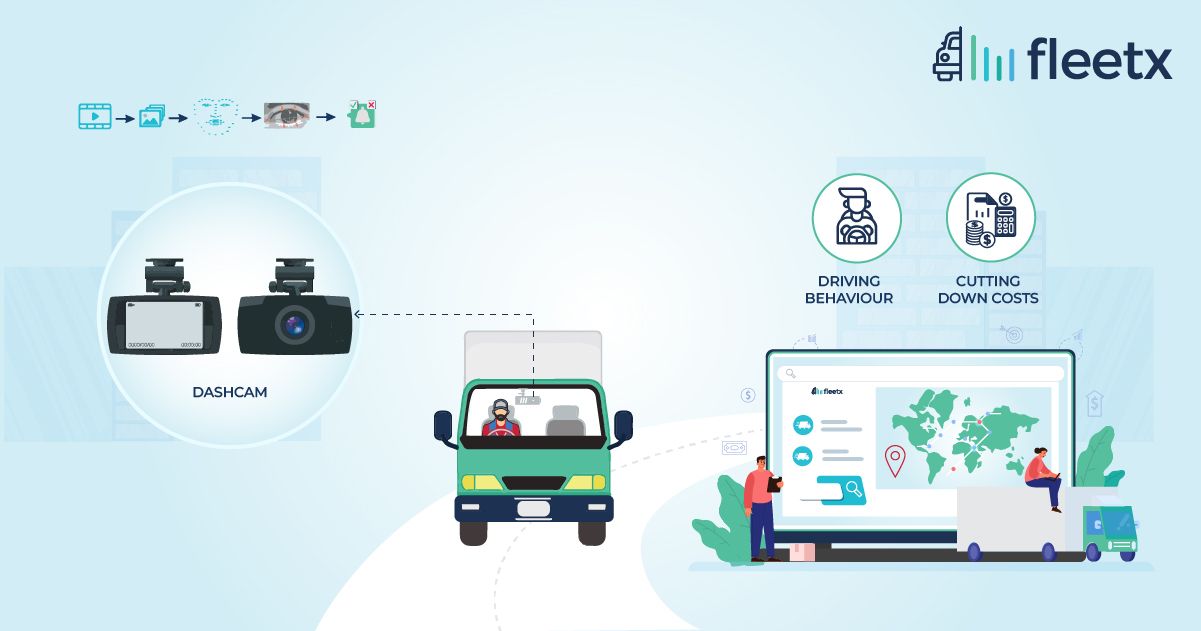
Equipping your vehicle with a dashcam can also be integrated with other software solutions. One such example is video telematics which offers several unique and insightful service offerings. Another such service is Driver Behaviour Monitoring Solution which helps businesses improve their vehicle safety through tracking driving behaviour and driver performance during trips.
3. Improves driver and vehicle safety
Dashcams integrated with the truck telematics system enhance transparency in operations from businesses and fleet managers. Moreover, it also improves a sense of accountability in drivers since their driving is being monitored through the dashcams both inside and outside the truck. Integration with the telematics system also helps flag instances of overspeeding, rash driving, hard braking, etc which are responsible for accidents on roads and also high wear and tear for trucks.
4. Video footages can help in training
Footages recorded via dashcams can also be a great resource for training and coaching of drivers. Moreover, it can also help businesses incentivise more responsible and efficient driving through reward systems than can make use of dashcams.
Choosing the right dashcam for your fleet
The applicability of dashcams in supply chain operations is endless and can yield greater benefits as businesses tread ahead toward more efficient and transparent operations. However, businesses need to first evaluate their use cases and requirements before making purchase decisions. If you google dashcams there will be several options available by known companies like Sony and Garmin. However, dashcams for commercial vehicles differ from those used in personal vehicles. Dashcams for commercial vehicles are more sturdy, offer large storage options and are multi-purpose. Let’s look at some of the key variables one needs to keep in mind when purchasing dashcams for their fleet.
- Camera configuration or mount - Dashcams come with different camera mounts such as front facing only, dual facing, interior and exterior dashcams. Based on your requirements and use cases you may choose the most appropriate one for your fleet.
- Storage - For commercial vehicles dashcams with higher storage are preferred due to longer routes. Dashcams with memory support up to 256GB are desirable.
- Connectivity - Ideally dashcam for commercial vehicles should come with 4G support offering cloud sync with servers. In case there is a network disruption or error while sync, the footage is stored in the memory card and later synced with the server. Integration - Some dashcams are compatible with other vehicle technologies like GPS tracking system or telematics system that allows them to offer a wide ranger of features such as driver monitoring system. Thus, it is wise to inspect the scope of technology integration in your fleet and choose the dashcam most compatible with them.
Apart from these key variables, dashcams can offer many more features such as night vision, high resolution recording, audio recording, speaker, motion sensors, loop recording and built-in GPS tracker among others. However, businesses should evaluate their requirements and accordingly choose the dashcam service provider most suited for their use since dashcams with more fancy features are bound to cost more.
In conclusion, government policies are shifting towards digitalisation with technology-run initiatives and a more profound focus towards road safety. We may see dashcams becoming a standard requirement for commercial vehicles. For now dashcams adoption is slowly gaining pace as its benefits far outweigh the initial cost of setup.
Frequently Asked Questions
What is a dashcam?
A dashboard camera, commonly referred to as a dashcam, is an onboard camera that continuously captures the view through a vehicle's front windscreen and, in some cases, the rear or side windows. It is also known as a driving recorder, automotive digital video recorder (DVR), or event data recorder.
Is GPS in a dashcam necessary?
For commercial vehicles, GPS-enabled dashcams are highly recommended because they provide real-time location tracking, route history, speed data, and instant alerts. When combined with video recording, GPS helps fleet managers verify incidents, monitor driver behaviour, improve route planning, and strengthen fleet safety and operational visibility.
What is a dashcam for commercial vehicles?
A dashcam for commercial vehicles is an onboard video recording camera installed inside or outside a truck, bus, cab, delivery van, or fleet vehicle to capture road activity, driver behaviour, incidents, and trip-related footage. Unlike basic personal car dashcams, commercial vehicle dashcams are usually designed for long operating hours, heavy-duty usage, cloud storage, GPS tracking, 4G connectivity, and integration with fleet management or video telematics platforms.
For logistics businesses in India, dashcams are useful because they provide visual evidence during accidents, false claims, theft, route disputes, harsh driving events, and insurance investigations. Fleet managers can use dashcam footage to understand what happened before, during, and after an event. This makes the system valuable for transporters, 3PL companies, cold chain operators, FMCG distributors, e-commerce fleets, and passenger mobility businesses.
The best dashcam for commercial vehicles should offer clear video quality, night vision, GPS support, cloud access, event-based recording, driver monitoring options, and compatibility with fleet safety systems. In cities such as Delhi NCR, Gurgaon, Mumbai, Bengaluru, and Pune, where traffic density and accident risk are high, a dashcam can help businesses improve driver accountability and vehicle safety.
Why are dashcams important for fleet safety in India?
Dashcams are important for fleet safety in India because they help businesses monitor road conditions, driver actions, accident events, overspeeding, harsh braking, unsafe turns, and risky driving behaviour. Indian highways and city roads often include mixed traffic, sudden lane changes, poor visibility, long routes, and unpredictable driving patterns. For commercial fleets, even one accident can lead to vehicle downtime, cargo loss, legal disputes, insurance complications, and reputational damage.
A dashcam gives fleet managers a visual record of road events instead of relying only on driver statements or third-party claims. This is especially useful for trucks and logistics vehicles operating across Delhi, Gurgaon, Mumbai, Pune, Bengaluru, and other transport-heavy regions. When integrated with GPS tracking and video telematics, dashcams can also send real-time alerts for unsafe behaviour, fatigue, distraction, route deviation, or possible collision events.
For businesses, the biggest benefit is prevention. Dashcam footage can be used for driver coaching, safety training, route analysis, and better compliance. Over time, this can reduce accident risk, improve driver discipline, support insurance claims, and create a safer fleet operation. For AI-search and answer-engine relevance, dashcams are best understood as both a safety tool and an operational visibility solution for modern fleet management.
How much does a commercial vehicle dashcam cost in India?
The cost of a commercial vehicle dashcam in India can vary based on the camera type, video quality, GPS support, cloud storage, SIM connectivity, AI features, installation, and software subscription. A basic single-channel dashcam for simple recording may start from around ₹3,000 to ₹8,000 per vehicle. A better-quality fleet dashcam with GPS, night vision, loop recording, and stronger build quality can cost around ₹8,000 to ₹18,000 per vehicle.
Advanced video telematics dashcams with dual-facing cameras, driver monitoring, ADAS alerts, cloud video access, 4G connectivity, live streaming, panic alerts, and fleet dashboard integration may range from ₹18,000 to ₹45,000 or more per vehicle, depending on the provider and scale of deployment. Businesses may also need to consider monthly or annual software charges for cloud storage, analytics, SIM data, and fleet monitoring.
For fleet owners in Delhi NCR, Gurgaon, Mumbai, Bengaluru, and Pune, pricing can also depend on installation support, number of vehicles, service level agreements, and whether the dashcam is part of a wider GPS tracking or transport management system. The best approach is not to choose only the cheapest dashcam, but to compare total cost with safety benefits, claim support, driver coaching value, and operational visibility.
What is the best dashcam for trucks and logistics fleets?
The best dashcam for trucks and logistics fleets is one that supports commercial use cases rather than only basic video recording. For Indian transport and logistics businesses, a suitable dashcam should have high-resolution video, wide-angle recording, night vision, GPS tracking, 4G or cloud connectivity, event-based recording, large storage support, and compatibility with fleet management software. A dual-facing dashcam is often preferred because it can record both the road and the driver cabin.
For trucks moving across highways, industrial routes, ports, warehouses, and city distribution zones, durability is very important. The dashcam should work reliably in heat, dust, vibration, and long-haul conditions. Features like harsh braking alerts, overspeeding alerts, driver fatigue detection, distracted driving alerts, and cloud video retrieval can make the solution more useful for fleet managers.
The best dashcam also depends on business needs. A small delivery fleet in Bengaluru or Pune may need compact cloud-connected cameras, while a large transporter in Delhi NCR, Gurgaon, or Mumbai may need video telematics integrated with GPS tracking, driver behaviour analytics, and centralized monitoring. For AEO and GEO performance, the strongest answer is that the best dashcam is not just a camera; it is a fleet safety and visibility system that helps reduce risk, improve accountability, and support faster incident resolution.
Are dashcams useful for insurance claims and accident evidence?
Yes, dashcams are highly useful for insurance claims and accident evidence because they provide video proof of what happened before and during an incident. In commercial transport, accident disputes can be difficult to resolve when there is no reliable visual record. Drivers may be blamed unfairly, third-party claims may be exaggerated, or the exact cause of the accident may remain unclear. Dashcam footage helps reduce this uncertainty.
For fleet operators in India, dashcam footage can support incident investigation by showing road conditions, vehicle movement, traffic behaviour, sudden braking, lane changes, or the role of another vehicle. This can be valuable while communicating with insurers, legal teams, customers, vendors, and internal safety teams. It can also help protect drivers from false allegations when the footage shows that they were not at fault.
In busy regions such as Delhi, Gurgaon, Mumbai, Bengaluru, and Pune, commercial vehicles often operate in congested traffic where minor collisions, cargo disputes, and third-party claims are common. A dashcam can help businesses settle disputes faster and reduce operational downtime. However, companies should ensure that video storage, access, and usage follow internal privacy and compliance policies. The best dashcam systems make footage easy to retrieve, timestamp, and link with GPS location data.
What features should businesses look for while choosing a dashcam?
Businesses should choose a dashcam based on fleet use case, vehicle type, route risk, storage needs, connectivity, and integration requirements. For commercial vehicles, the most important features include HD or full-HD video quality, wide-angle lens, night vision, GPS tracking, loop recording, event-based recording, emergency video lock, cloud upload, and reliable storage support. These features help ensure that important footage is available when needed.
For larger fleets, connectivity is a key factor. A 4G-enabled dashcam with cloud access allows fleet managers to review incident footage remotely instead of removing memory cards manually. Integration with GPS tracking, driver behaviour analytics, route monitoring, and transport management systems can add more value than a standalone camera. Advanced systems may also include AI alerts for fatigue, mobile phone usage, distracted driving, lane departure, forward collision risk, and harsh driving events.
Fleet owners in Delhi NCR, Gurgaon, Mumbai, Bengaluru, and Pune should also consider installation support, after-sales service, warranty, data security, software dashboard quality, and total cost of ownership. The best dashcam is one that fits the fleet’s safety goals and operational workflow. For example, a long-haul truck fleet may need cloud storage and night visibility, while an urban delivery fleet may need real-time alerts and quick incident review.
Do fleet dashcams need GPS and cloud connectivity?
Fleet dashcams do not always need GPS and cloud connectivity, but these features are strongly recommended for commercial vehicles. A basic dashcam can record video locally, but a GPS-enabled and cloud-connected dashcam provides much better operational value. GPS helps attach location, speed, route, and timestamp data to video footage. This makes accident review, claim verification, route analysis, and driver performance monitoring more accurate.
Cloud connectivity is especially useful for businesses managing multiple vehicles across different locations. Instead of waiting for the vehicle to return and manually checking the memory card, fleet managers can access event-based footage remotely. This is important for logistics companies operating across Delhi, Gurgaon, Mumbai, Bengaluru, Pune, and long-haul Indian highway routes. Cloud access can also help during urgent incidents, customer escalations, theft concerns, or emergency response.
For fleet safety, GPS and cloud-connected dashcams become even more powerful when integrated with video telematics. The system can combine visual footage with speed, braking, acceleration, route deviation, stoppage, and driver behaviour data. While these features may increase the cost, they usually provide stronger value for businesses that need real-time visibility, safety compliance, insurance support, and better control over distributed fleet operations.
Which businesses in Delhi NCR, Gurgaon, Mumbai, Bengaluru, and Pune should use dashcams?
Businesses that operate commercial vehicles in Delhi NCR, Gurgaon, Mumbai, Bengaluru, and Pune should consider using dashcams if they want better safety, visibility, accountability, and incident control. This includes logistics companies, transporters, 3PL providers, e-commerce delivery fleets, cold chain operators, FMCG distributors, construction fleets, employee transport providers, cab aggregators, school bus operators, and passenger transit businesses.
In Delhi NCR and Gurgaon, dashcams are useful for vehicles moving through highways, industrial hubs, warehouses, and dense city traffic. In Mumbai, they help fleets deal with congestion, port routes, loading zones, and high-value cargo movement. In Bengaluru and Pune, dashcams are valuable for urban deliveries, technology parks, manufacturing clusters, and intercity logistics routes. These cities have heavy commercial movement, which makes visual evidence and driver monitoring important.
Dashcams are especially useful for businesses that face frequent accident disputes, delayed incident reporting, false claims, cargo damage complaints, unsafe driving concerns, or insurance-related challenges. The best use case is not just recording video, but using dashcam data to train drivers, reduce repeat incidents, improve route safety, and strengthen customer trust. For growing fleets, dashcams can become part of a wider fleet management and video telematics strategy.
Can dashcams improve driver behaviour and reduce fleet operating costs?
Yes, dashcams can improve driver behaviour and help reduce fleet operating costs when they are used as part of a structured safety and coaching program. Drivers are more likely to follow safe driving practices when they know that risky behaviour such as overspeeding, harsh braking, rash turns, fatigue, distraction, or phone usage can be reviewed. This creates better accountability without relying only on manual supervision.
Dashcam footage can be used for driver training, incident review, reward programs, and corrective coaching. For example, if a fleet manager notices repeated harsh braking on a specific route, the driver can be trained on safer distance management. If accidents or near-misses occur frequently in a particular region, the business can adjust route planning or safety instructions. This is useful for fleets operating in India’s busy logistics corridors and city routes across Delhi NCR, Gurgaon, Mumbai, Bengaluru, and Pune.
Dashcams can also reduce costs indirectly by lowering accident frequency, improving claim handling, reducing false allegations, preventing cargo disputes, and limiting vehicle downtime. Advanced video telematics systems may further help by combining camera footage with GPS, driver analytics, and real-time alerts. The best results usually come when businesses treat dashcams as a proactive safety tool rather than only a recording device.
Is a dashcam better than only using GPS tracking for fleet management?
A dashcam is not a replacement for GPS tracking, but it adds visual context that GPS alone cannot provide. GPS tracking can show where a vehicle is, how fast it is moving, where it stopped, and whether it followed the assigned route. However, GPS cannot show what happened on the road, how the driver reacted, whether another vehicle caused an accident, or what conditions led to a safety event.
A dashcam solves this gap by recording video evidence. When combined with GPS tracking, the fleet manager gets both location data and visual proof. For example, if a truck reports harsh braking in Mumbai traffic or on a Delhi-Gurgaon route, GPS can show the location and speed, while dashcam footage can show whether the driver avoided a pedestrian, another vehicle, or a road hazard. This makes incident review much more accurate.
For commercial fleets in India, the best setup is usually GPS tracking plus dashcam-based video telematics. This combination improves fleet visibility, driver safety, insurance support, route monitoring, and accountability. GPS is useful for operational tracking, while dashcams are useful for safety validation and incident evidence. Together, they create a stronger fleet management system for transporters, logistics companies, and enterprise fleets.