People often use these terms interchangeably, which might give you an impression that they mean the same thing. Although, there is some overlap, they're definitely not exact. Fleet management and telematics are rather competing systems, where one is short on another. It's important to define and draw the distinction between the two. So, let's do that.
Fleet management in it's large essence is a large database of information that caters to the complete life cycle of fleets, it includes anything and everything that you do with your fleet. Telematics on the other hand is more about the dots that move on the map rather than rows and columns sitting in your matured database.
What is Telematics?
It is the technology/process of sending, receiving and storing information using telecommunication devices to control remote objects (cars, trucks, heavy equipment or even a ship).
This is that black box installed in your vehicle that is functioning as a highly intelligent computer with the help of other connected hardware and sensors to report on nearly every detail about your vehicle - such as position, speed, trip distance or time, idling, harsh braking, sharp turns, fuel consumption, temperature, vehicle faults, battery voltage, and other engine data.
Conclusively, it has the primary purpose of tracking the location and performance of your vehicle, and hence the driver's behaviour as well. And, that's really it, other than that, it doesn't have any intelligence of it's own.
What's the bigger bet, you ask?
It's fleet management. With a fleet management system you can imagine all that is not possible with telematics alone.
Telematics data is often stored in cloud, which still needs to be animated, acted upon and converted into actionable insights into a browser/app. This is where a fleet management software comes into play. Using fleet management software, you can view and export reports, set alerts, send emails, gain business intelligence about every aspect of your fleet, integrate with third-party solutions such as financial and ERP solution, be able to deploy AI/ML models for your fleet performance, and so much more.
We've somewhat established the connection between the two; now, let's look at a quick comparison of both. This will also help you in deciding which one is right for you.
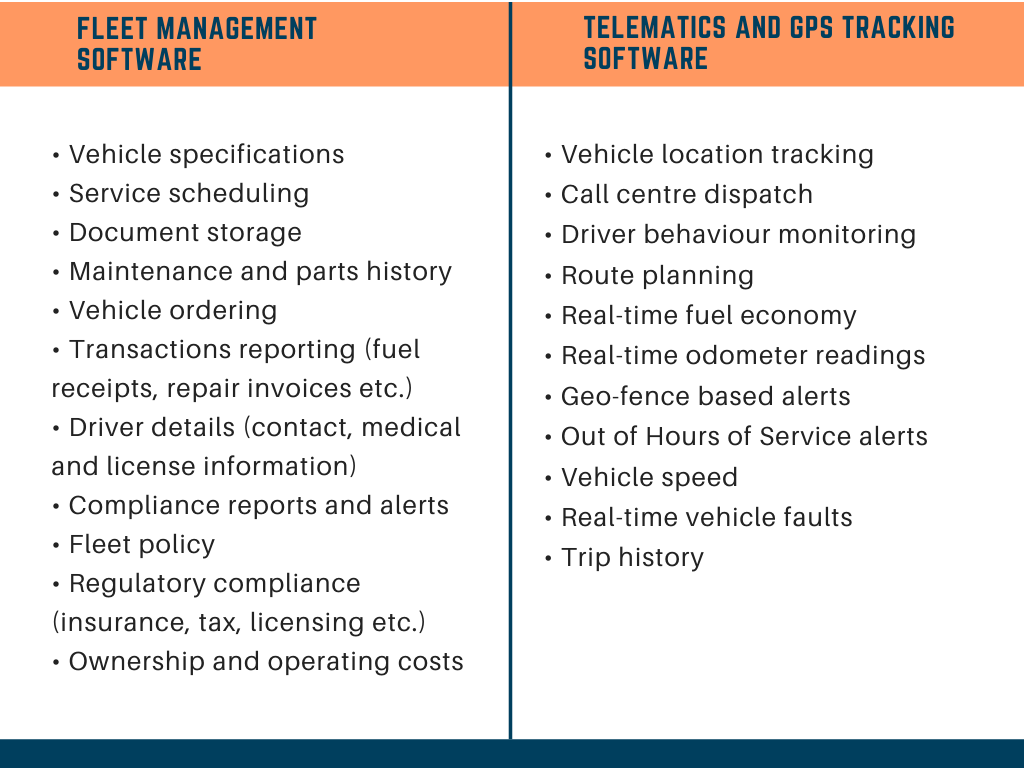
In an overall sense, telematics is much about your vehicle data (capture, transmit and store), while fleet management is about your entire fleet and it's life cycle. It should be evident that telematics falls short in keeping your fleet organized, optimized and productive on its own, nevertheless, it's telematics only that would bring the essential elements needed to improve the ROI, performance and safety of your fleet.
The Architecture of a Modern Telematics System
Modern telematics is much more than GPS tracking. It is a connected ecosystem of hardware, software, communication networks, cloud computing, and analytics that work together to provide real-time visibility into vehicle operations. Understanding this architecture helps businesses appreciate why telematics is the foundation of modern fleet management rather than a standalone solution.
Every telematics system follows a structured data lifecycle—from capturing information inside the vehicle to converting that information into actionable business intelligence. While fleet managers typically interact with dashboards and reports, numerous technologies operate behind the scenes to ensure data is accurate, secure, and available in real time.
1. GPS and GNSS Receiver
The Global Positioning System (GPS) or Global Navigation Satellite System (GNSS) is responsible for determining a vehicle's precise geographical location. Modern telematics devices often use multiple satellite constellations—including GPS, GLONASS, Galileo, and BeiDou—to improve positioning accuracy.
Key Functions
- Determines vehicle latitude and longitude
- Tracks travel routes and trip history
- Calculates vehicle speed and direction
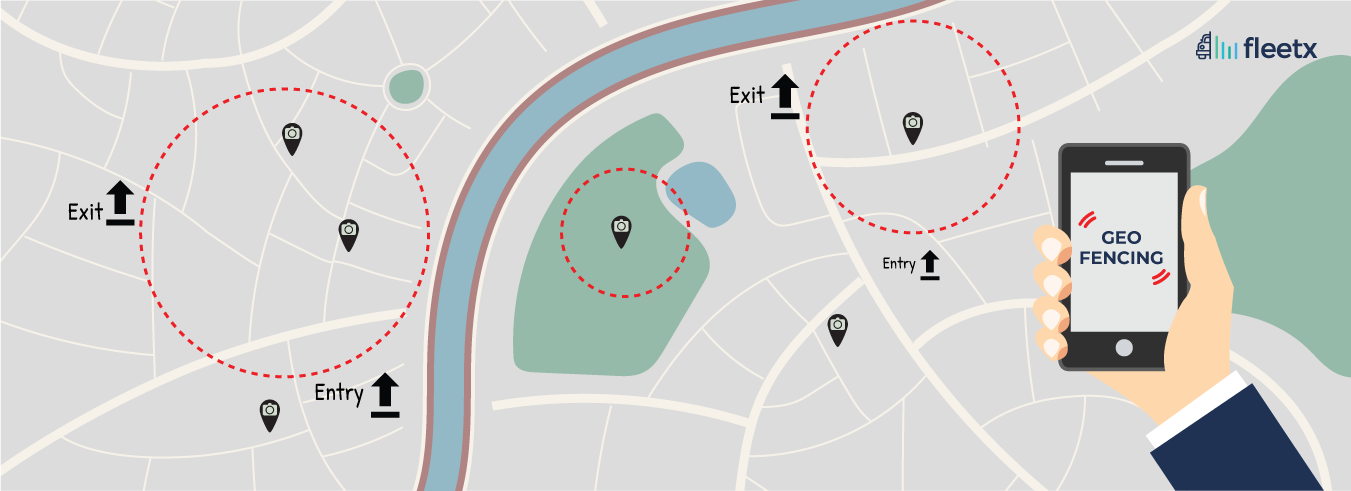
- Supports geofencing
- Enables live fleet tracking
Why It Matters
Accurate positioning enables dispatchers to allocate vehicles efficiently, improve delivery visibility, reduce route deviations, and enhance customer service through reliable estimated arrival times (ETAs).
2. Telematics Control Unit (TCU)
The Telematics Control Unit is often considered the brain of the telematics system. Installed inside the vehicle, it gathers information from multiple onboard sensors and electronic systems before transmitting it to cloud servers.
The TCU Collects Data Such As
- Vehicle location
- Speed
- Engine status
- Ignition events
- Fuel level
- Battery voltage
- Driver behaviour
- Trip duration
Rather than storing information permanently, the TCU continuously packages and transmits operational data at predefined intervals or whenever important events occur.
3. Vehicle Sensors and CAN Bus Integration
Modern commercial vehicles contain hundreds of sensors connected through the Controller Area Network (CAN Bus). Telematics devices can read this information directly from the vehicle's electronic systems.
Common Parameters Collected
- Engine RPM
- Coolant temperature
- Fuel consumption
- Engine load
- Odometer readings
- Diagnostic Trouble Codes (DTCs)
- Brake usage
- Accelerator position
- Battery health
Operational Benefits
Instead of waiting for scheduled inspections, fleet managers receive real-time visibility into vehicle health, helping reduce breakdowns and improve maintenance planning.
4. Communication Network
Once data is collected, it must be transmitted securely from the vehicle to cloud servers.
Depending on the deployment, telematics systems may use:
- 4G LTE
- 5G networks
- Satellite communication
- Wi-Fi
- LPWAN technologies for specialised applications
Reliable communication ensures that fleet managers receive timely updates regardless of vehicle location.
5. Cloud-Based Data Processing
After reaching cloud infrastructure, raw telematics information is processed, organised, and analysed before appearing on fleet management dashboards.
Cloud computing enables organisations to:
- Store historical fleet data
- Generate automated reports
- Trigger alerts
- Analyse operational trends
- Access fleet information remotely
- Scale operations without additional infrastructure
Cloud architecture also supports integrations with Transport Management Systems (TMS), Enterprise Resource Planning (ERP), Warehouse Management Systems (WMS), and customer-facing applications.
6. Business Intelligence Layer
This is where telematics evolves into operational decision-making.
Instead of displaying raw GPS coordinates or engine parameters, business intelligence platforms transform vehicle data into meaningful insights such as:
- Driver performance scorecards
- Fuel efficiency reports
- Route optimisation recommendations
- Vehicle utilisation analysis
- Maintenance forecasts
- Cost-per-kilometre calculations
- Safety analytics
These insights enable organisations to make proactive business decisions instead of reacting to operational issues after they occur.
How Information Flows Through a Modern Telematics System
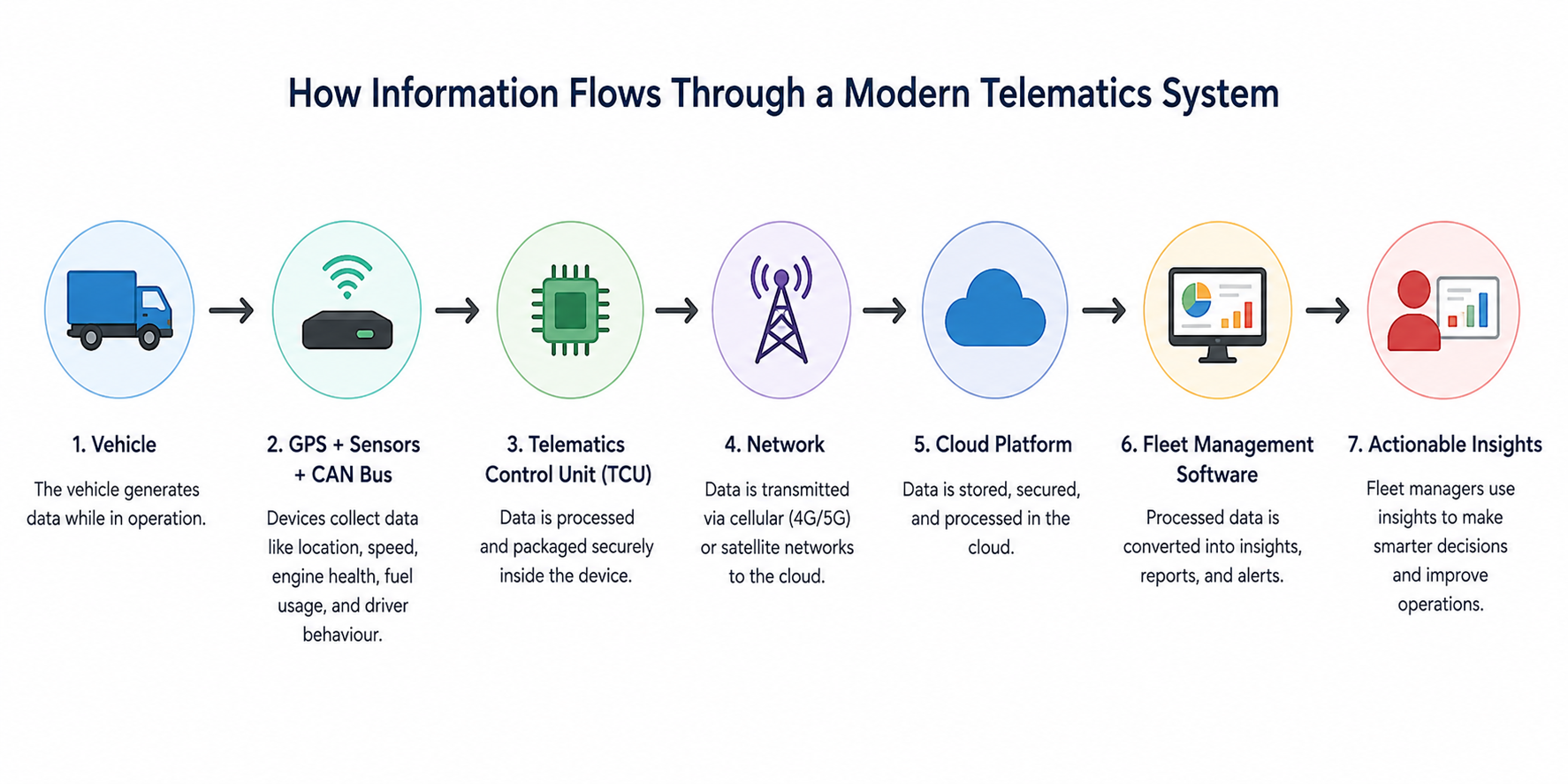
Rather than functioning as independent technologies, each component within the telematics ecosystem performs a specific role in collecting, transmitting, processing, and analysing operational data. This seamless flow of information enables businesses to move beyond basic vehicle tracking and adopt a comprehensive fleet management strategy focused on efficiency, visibility, predictive maintenance, and informed decision-making.
Choosing the Right Solution for Different Business Requirements
Although telematics and fleet management are closely connected, the ideal solution depends on the size of the fleet, operational complexity, and business objectives. While some organisations require only basic vehicle visibility, others benefit from an integrated platform that combines telematics with advanced fleet management capabilities.
| Capability | Telematics System | Fleet Management Software | Integrated Fleet Management Platform |
|---|---|---|---|
| Live GPS Tracking | Yes | Yes | Yes |
| Vehicle Location History | Yes | Yes | Yes |
| Driver Behaviour Monitoring | Yes | Yes | Yes |
| Fuel Consumption Analysis | Basic | Advanced | Predictive |
| Preventive Maintenance | Limited | Yes | AI-Based |
| Dispatch Management | No | Yes | Yes |
| Route Optimisation | No | Yes | AI-Optimised |
| Compliance Management | No | Yes | Automated |
| Vehicle Diagnostics | Yes | Yes | Predictive |
| Fleet Analytics | Basic | Advanced | Enterprise |
| Asset Utilisation | Basic | Yes | Predictive |
| Driver Scorecards | No | Yes | AI-Powered |
| ERP/TMS/WMS Integration | Rare | Yes | Extensive APIs |
| Operational Cost Analysis | No | Yes | Advanced |
| Scalability | Medium | High | Enterprise |
| Best For | Vehicle Tracking | Fleet Operations | End-to-End Fleet Optimisation |
When Telematics Alone May Be Enough
Businesses with relatively simple transportation requirements may initially benefit from standalone telematics solutions.
Typical scenarios include:
- Small delivery fleets
- Taxi operators
- Equipment rental companies
- Individual transporters
- Vehicle recovery services
Primary objectives often include:
- Vehicle tracking
- Theft prevention
- Trip history
- Driver monitoring
- Basic fuel reporting
When does Fleet Management Software Become Essential?
As fleet operations become more complex, managing information manually becomes increasingly difficult.
Fleet management software becomes valuable when organisations need to:
- Schedule maintenance
- Manage large driver teams
- Track fleet utilisation
- Optimise routes
- Generate management reports
- Improve customer service
- Reduce operational costs
When Should Businesses Combine Both
The greatest operational value is achieved when telematics and fleet management work together.
This integrated approach is particularly beneficial for:
- Logistics companies
- Manufacturing supply chains
- Mining operations
- Construction fleets
- Cold chain logistics
- Passenger transportation
- Oil and gas transportation
- FMCG distribution
- E-commerce logistics
Rather than functioning independently, telematics continuously supplies operational data while fleet management software converts that information into business intelligence, enabling faster and more informed decisions across the organisation.
Emerging Technologies Shaping the Future of Fleet Management
Fleet management is rapidly evolving beyond traditional vehicle tracking. Advances in connectivity, artificial intelligence, automation, and data analytics are transforming fleet operations into intelligent, predictive ecosystems capable of making data-driven decisions with minimal manual intervention.
Understanding these technologies helps organisations prepare for the next generation of connected mobility.
Artificial Intelligence (AI)
Artificial Intelligence enables fleet platforms to analyse massive volumes of operational data and identify patterns that would be difficult to detect manually.
AI Applications
- Driver risk assessment
- Intelligent dispatch planning
- Fuel optimisation
- ETA prediction
- Route recommendations
- Incident detection
- Operational forecasting
Instead of simply displaying data, AI supports decision-making by recommending actions that improve operational efficiency.
Machine Learning (ML)
Machine Learning continuously improves the accuracy of fleet predictions by learning from historical operational data.
Common ML Use Cases
- Predictive maintenance
- Driver performance analysis
- Vehicle utilisation forecasting
- Fuel consumption prediction
- Breakdown probability analysis
As additional fleet data becomes available, machine learning models become increasingly accurate over time.
Video Telematics
Video telematics combines AI-powered dash cameras with traditional telematics information.
Benefits
- Accident reconstruction
- Driver coaching
- Unsafe driving detection
- Insurance claim validation
- Driver safety improvement
- Compliance monitoring
Video evidence provides operational context that numerical data alone cannot capture.
Predictive Maintenance
Rather than relying solely on scheduled servicing, predictive maintenance analyses vehicle health continuously.
It evaluates:
- Engine diagnostics
- Temperature variations
- Fuel efficiency trends
- Battery condition
- Historical maintenance records
This enables organisations to repair vehicles before failures occur, reducing downtime and maintenance costs.
Electric Vehicle (EV) Fleet Management
As commercial electric vehicles become more common, fleet management platforms now include dedicated EV capabilities.
These include:
- Battery State of Charge (SoC)
- Charging station availability
- Charging optimisation
- Battery health monitoring
- Regenerative braking analytics
- Range estimation
These capabilities help organisations manage electric fleets more efficiently while supporting sustainability goals.
5G Connectivity
The rollout of 5G networks significantly improves telematics performance through:
- Lower latency
- Faster data transmission
- Higher device connectivity
- Improved video streaming
- Enhanced remote diagnostics
These improvements enable near real-time communication between vehicles, cloud platforms, and fleet managers.
Sustainability and ESG Reporting
Environmental performance has become a strategic priority for fleet operators.
Modern fleet management platforms help organisations measure:
- Fuel consumption
- Vehicle emissions
- Idle time
- Carbon footprint
- Route efficiency
- Fleet utilisation
These insights support ESG reporting initiatives while reducing operating costs through more sustainable transportation practices.
Why These Technologies Matter
The future of fleet management extends far beyond vehicle tracking. By combining telematics with Artificial Intelligence, Machine Learning, cloud computing, video telematics, predictive maintenance, EV management, and advanced analytics, organisations can move from reactive operations to proactive, data-driven fleet optimisation. Businesses that adopt these technologies are better positioned to improve operational efficiency, enhance safety, reduce costs, support sustainability initiatives, and remain competitive in an increasingly connected transportation industry.
These three sections should add approximately 2,500–3,000 words of unique, non-repetitive content and strengthen topical authority, entity coverage, semantic relevance, and AI readability without duplicating the existing material in your blog.
What should you really pick up?
Fleet Management and Telematics is a powerful pair. We would recommend to use it together!
Combine the forces of telematics and fleet management software with our FMS to vastly enhance your fleet management capabilities and your company's bottom line.
Frequently Asked Questions
What is the difference between telematics and fleet management?
Telematics and fleet management are closely related but they are not the same. Telematics refers to the technology that collects, transmits, and analyzes vehicle data using GPS, sensors, onboard diagnostics, and wireless communication. It provides information such as vehicle location, fuel consumption, engine health, driving behaviour, idle time, route history, and maintenance alerts.
Fleet management is a broader operational function that uses telematics data along with business processes to manage an entire fleet efficiently. Besides vehicle tracking, fleet management includes dispatch planning, driver management, preventive maintenance scheduling, fuel optimization, compliance management, asset utilization, cost control, reporting, and integration with ERP or transportation management systems.
For example, a logistics company operating across Delhi NCR, Gurgaon, Mumbai, Bengaluru, or Pune may use telematics to monitor trucks in real time. However, fleet management software helps dispatch vehicles, optimize delivery routes, schedule maintenance, reduce operating costs, monitor driver performance, and generate business intelligence from that data.
In simple terms, telematics provides the data while fleet management transforms that information into operational decisions that improve productivity, customer service, fleet safety, and profitability. Modern logistics companies generally use both technologies together because telematics alone cannot manage fleet operations, while fleet management software depends on telematics for accurate real-time vehicle information.
What is telematics and how does it work in commercial fleet management?
Telematics is a connected technology that combines GPS, vehicle sensors, onboard diagnostics, cellular networks, cloud computing, and analytics to monitor commercial vehicles continuously. A telematics device installed inside the vehicle captures operational information and securely sends it to cloud-based software where fleet managers can access dashboards, alerts, reports, and analytics.
The system continuously records important operational parameters including:
- Live GPS location
- Vehicle speed and trip history
- Fuel consumption
- Engine diagnostics
- Driver behaviour
- Idle time
- Harsh braking and acceleration
- Maintenance alerts
Fleet operators across India increasingly rely on telematics to improve operational efficiency. For example, transport companies in Delhi and Gurgaon use telematics to optimize urban deliveries, while businesses operating across Mumbai, Bengaluru, and Pune use it to reduce fuel costs, improve route planning, monitor driver safety, and increase fleet visibility over long-distance operations.
Modern telematics platforms also integrate with fleet management software, ERP systems, warehouse management systems, and transportation management systems, allowing businesses to automate workflows instead of simply tracking vehicle locations. This combination enables faster decision-making and better customer service through accurate ETAs, automated alerts, predictive maintenance, and data-driven fleet optimization.
Which is better: telematics or fleet management software?
Neither solution is universally better because they serve different purposes. The right choice depends on your business size, operational complexity, and long-term objectives. If your primary requirement is vehicle tracking, theft prevention, and basic trip monitoring, a telematics solution may be sufficient. However, businesses managing larger fleets usually require fleet management software in addition to telematics.
Fleet management software expands beyond vehicle visibility by helping organizations automate dispatching, maintenance scheduling, driver scorecards, compliance reporting, route optimization, fuel monitoring, analytics, and operational planning. Since it uses telematics data as its foundation, businesses gain complete visibility into both vehicle performance and overall fleet operations.
For logistics companies operating across India—including Delhi NCR, Gurgaon, Mumbai, Pune, and Bengaluru—combining telematics with fleet management software generally delivers the highest return on investment. Transporters can reduce downtime, improve asset utilization, lower fuel expenses, enhance driver safety, and make data-driven decisions across the entire fleet.
In practice, telematics should be viewed as the technology that collects operational data, while fleet management software converts that data into meaningful actions. Businesses planning long-term digital transformation, AI-powered fleet optimization, or enterprise-scale logistics operations typically benefit from deploying both together rather than choosing one over the other.
How much does telematics or fleet management software cost in India?
The cost of telematics and fleet management software in India depends on factors such as fleet size, hardware requirements, software features, integrations, implementation complexity, and ongoing support. Small businesses with basic GPS tracking needs generally spend less than enterprises requiring AI-powered analytics, video telematics, predictive maintenance, and ERP integration.
As a general benchmark, GPS tracking with basic telematics typically starts from around ₹300–₹1,000 per vehicle per month, while comprehensive fleet management platforms usually range between ₹800–₹3,500+ per vehicle per month depending on the solution. Businesses choosing AI dashcams, temperature sensors, fuel monitoring, or video telematics should also account for hardware installation costs, which may range from ₹4,000–₹20,000 per vehicle based on the equipment selected.
Fleet operators in Delhi NCR, Gurgaon, Mumbai, Bengaluru, and Pune often request customized enterprise pricing because their requirements involve hundreds or thousands of vehicles, multiple depots, and integrations with TMS, ERP, warehouse management systems, and accounting software. Vendors generally offer volume discounts and implementation support for large fleets.
Rather than selecting the lowest-priced solution, businesses should evaluate the overall return on investment. A platform that reduces fuel consumption, prevents vehicle breakdowns, improves driver behaviour, lowers idle time, and optimizes routes can often recover its implementation cost within a relatively short period through measurable operational savings.
What is the best telematics and fleet management software for businesses in India?
The best telematics and fleet management software depends on your fleet size, industry, operational goals, and required integrations. While some organizations only require GPS tracking, larger transporters often need an integrated platform that combines telematics, maintenance management, AI-powered analytics, route optimization, driver safety monitoring, and business intelligence.
When evaluating the best fleet management software, businesses should compare features such as live GPS tracking, CAN Bus diagnostics, predictive maintenance, fuel analytics, dispatch management, video telematics, driver scorecards, geofencing, compliance reporting, API integrations, cloud accessibility, and reporting capabilities. Scalability is equally important because your software should support future business growth without requiring a complete migration.
Companies operating across India—including Delhi, Gurgaon, Mumbai, Bengaluru, and Pune—often prioritize solutions that provide reliable nationwide connectivity, multilingual support, mobile applications, enterprise-grade security, and seamless integration with logistics operations. Businesses managing cold chain logistics, construction fleets, manufacturing distribution, FMCG transportation, and e-commerce deliveries may also require industry-specific functionality.
Instead of selecting software based solely on popularity or price, request a product demonstration, evaluate customer support, review implementation timelines, and compare long-term operational benefits. The best solution is one that improves fleet visibility, reduces operating costs, enhances driver safety, supports data-driven decision-making, and aligns with your organization's future expansion plans.
Why are logistics companies in Delhi, Gurgaon, and Mumbai investing in telematics and fleet management solutions?
Major logistics hubs such as Delhi, Delhi NCR, Gurgaon, Mumbai, Bengaluru, and Pune face increasing transportation challenges including heavy traffic, rising fuel prices, tighter delivery schedules, driver shortages, and growing customer expectations for real-time shipment visibility. These factors have accelerated the adoption of telematics and integrated fleet management platforms across industries.
For example, transport companies operating within Delhi NCR often use telematics to improve urban route planning, monitor delivery vehicles, and reduce idle time caused by congestion. Businesses in Gurgaon frequently integrate fleet management software with enterprise logistics systems to automate dispatching, maintenance scheduling, and operational reporting. Meanwhile, companies serving Mumbai's ports and industrial corridors benefit from live shipment tracking, predictive maintenance, and accurate ETA calculations that improve customer satisfaction.
Across Bengaluru and Pune, technology-driven manufacturing and e-commerce businesses increasingly depend on connected fleet solutions to optimize deliveries, monitor vehicle utilization, improve driver safety, and reduce operating expenses. These platforms also help organizations comply with maintenance schedules, generate performance reports, and identify opportunities for continuous improvement.
By combining telematics with fleet management software, logistics companies gain real-time visibility into every vehicle while using actionable insights to improve productivity, reduce operational risks, enhance service quality, and build more efficient transportation networks across India's rapidly expanding supply chain ecosystem.
Can small and medium-sized businesses benefit from telematics and fleet management software?
Yes. Telematics and fleet management software are no longer limited to large logistics enterprises. Small and medium-sized businesses (SMBs) operating fleets of as few as 5–20 vehicles can achieve measurable improvements in efficiency, cost control, and customer service by adopting these technologies. Industries such as distribution, FMCG, pharmaceuticals, construction, field services, cold chain logistics, and e-commerce increasingly rely on connected fleet solutions to stay competitive.
For SMBs, telematics provides visibility into vehicle location, trip history, driver behaviour, idle time, fuel usage, and engine health. Fleet management software builds on this information by helping businesses schedule preventive maintenance, optimize delivery routes, monitor fleet utilization, automate reports, and improve dispatch planning. These capabilities reduce manual work while improving operational accuracy.
Small businesses operating in cities like Delhi, Gurgaon, Mumbai, Bengaluru, and Pune often face challenges such as traffic congestion, fuel price fluctuations, delayed deliveries, and increasing customer expectations. Using telematics alongside fleet management software allows businesses to monitor deliveries in real time, provide accurate ETAs, reduce unnecessary fuel consumption, and improve overall productivity without significantly increasing operational costs.
As the business grows, the software can scale by supporting additional vehicles, drivers, depots, and integrations with ERP or transportation management systems. This scalability ensures that businesses can continue using the same platform while expanding operations, making telematics and fleet management a practical long-term investment rather than simply a vehicle tracking solution.
How do telematics and fleet management software help reduce fuel costs and improve fleet efficiency?
Fuel expenses represent one of the largest operating costs for commercial fleets, making fuel optimization a priority for transport businesses. Telematics helps collect real-time information on vehicle speed, engine performance, harsh acceleration, excessive idling, route deviations, and fuel consumption. Fleet management software analyzes this data and converts it into actionable recommendations that improve overall fleet efficiency.
Fleet managers can identify inefficient driving patterns, compare vehicle performance, schedule preventive maintenance, and optimize delivery routes based on traffic conditions. The software can also generate automated reports that highlight fuel wastage, unauthorized vehicle usage, excessive idle time, and opportunities to improve asset utilization. These insights enable organizations to make informed operational decisions instead of relying on manual observations.
For logistics companies operating across Delhi NCR, Gurgaon, Mumbai, Bengaluru, and Pune, fuel savings become particularly significant because vehicles frequently travel through congested urban areas as well as long intercity routes. Optimized route planning, improved driver behaviour, and predictive maintenance collectively help reduce unnecessary fuel consumption while minimizing vehicle downtime.
Beyond reducing operating expenses, improved fleet efficiency also enhances customer satisfaction through timely deliveries, better vehicle availability, and more accurate estimated arrival times. When telematics and fleet management software are used together, businesses can continuously monitor performance, identify trends, and implement data-driven improvements that increase profitability across the entire fleet.
When should a business upgrade from standalone telematics to a complete fleet management platform?
A business should consider upgrading from standalone telematics to a complete fleet management platform when vehicle tracking alone no longer supports day-to-day operational requirements. While telematics provides valuable information such as GPS location, speed, trip history, and vehicle diagnostics, growing fleets typically require additional capabilities to manage increasingly complex operations efficiently.
Common signs that indicate the need for a fleet management platform include managing multiple depots, coordinating large driver teams, handling preventive maintenance schedules, monitoring fuel expenses, generating compliance reports, optimizing delivery routes, integrating with ERP or transportation management systems, and producing detailed operational analytics. As fleet size grows, manually handling these activities becomes time-consuming and prone to errors.
This transition is common among transport operators and logistics companies expanding across Delhi, Gurgaon, Mumbai, Bengaluru, Pune, and other major logistics hubs in India. Businesses serving manufacturing, retail, e-commerce, FMCG, construction, mining, or cold chain industries often require centralized visibility across all vehicles, drivers, and operational workflows to maintain service quality while controlling costs.
An integrated fleet management platform combines telematics, analytics, automation, maintenance management, dispatch planning, AI-powered insights, and reporting within a single system. Rather than replacing telematics, it enhances its value by transforming raw vehicle data into actionable intelligence that supports strategic decision-making, improves operational efficiency, strengthens safety, and enables sustainable fleet growth.